Income and Welfare
Should we care about cross-country income differences? The answer is definitely yes. High income levels reflect high standards of living. Economic growth sometimes increases pollution or it may raise individual aspirations, so that the same bundle of consumption may no longer make an individual as happy.
But at the end of the day, when one compares an advanced, rich country with a less-developed one, there are striking differences in the quality of life, standards of living and health.Figures 1.5 and 1.6 give a glimpse of these differences and depict the relationship between income per capita in 2000 and consumption per capita and life expectancy at birth in the same year. Consumption data also come from the Penn World tables, while data on life expectancy at birth are available from the World Bank Development Indicators.
These figures document that income per capita differences are strongly associated with differences in consumption and differences in health as measured by life expectancy. Recall
6
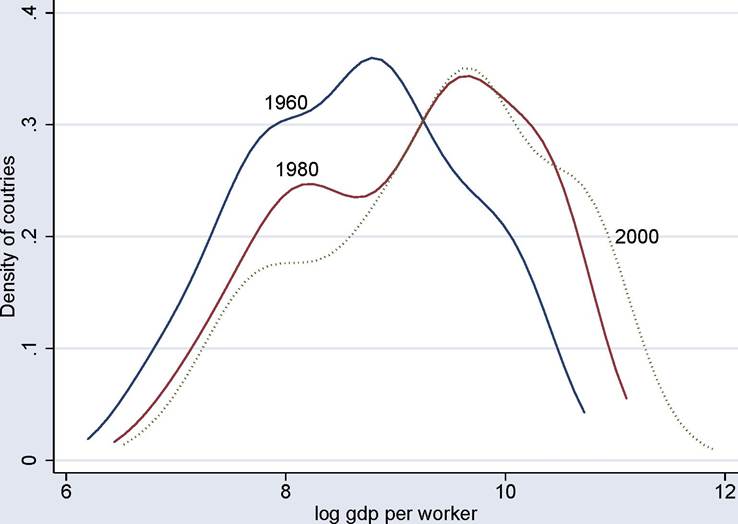
Figure 1.4. Estimates of the distribution of countries according to log GDP per worker (PPP-adjusted) in 1960, 1980 and 2000.
also that these numbers refer to PPP-adjusted quantities, thus differences in consumption do not (at least in principle) reflect the fact that the same bundle of consumption goods costs different amounts in different countries. The PPP adjustment corrects for these differences and attempts to measure the variation in real consumption. Therefore, the richest countries are not only producing more than thirty times as much as the poorest countries, but are also consuming thirty times as much. Similarly, cross-country differences in health are quite remarkable; while life expectancy at birth is as high as 80 in the richest countries, it is only between 40 and 50 in many sub-Saharan African nations.
These gaps represent huge welfare differences.Understanding how some countries can be so rich while some others are so poor is one of the most important, perhaps the most important, challenges facing social science. It is important both because these income differences have major welfare consequences and because a study of these striking differences will shed light on how the economies of different nations function and sometimes how they fail to function.
The emphasis on income differences across countries implies neither that income per capita can be used as a “sufficient statistic” for the welfare of the average citizen nor that it is the only feature that we should care about. As we will discuss in detail later, the efficiency properties of the market economy (such as the celebrated First Welfare Theorem or Adam
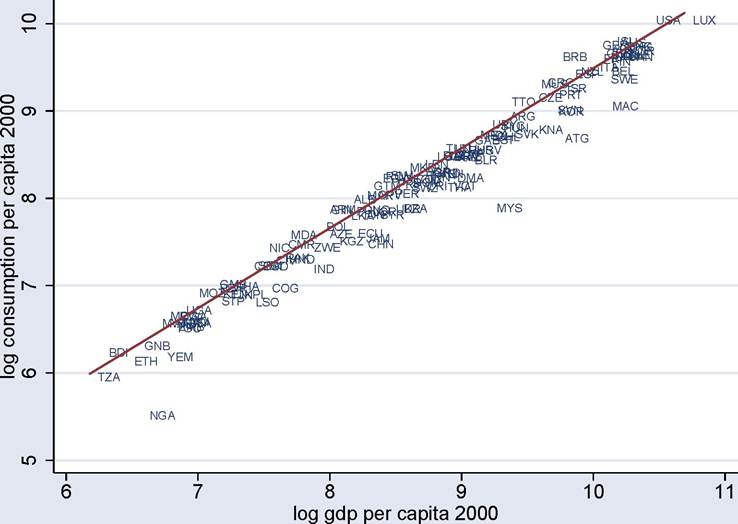
Figure 1.5. The association between income per capita and consumption per capita in 2000.
Smith’s invisible hand) do not imply that there is no conflict among individuals or groups in society. Economic growth is generally good for welfare but it often creates “winners” and “losers.” Joseph Schumpeter’s famous notion of creative destruction emphasizes precisely this aspect of economic growth; productive relationships, firms and sometimes individual livelihoods will often be destroyed by the process of economic growth because growth is brought about by the introduction of new technologies and creation of new firms, replacing existing firms and technologies. This process creates a natural social tension, even in a growing society. Another source of social tension related to growth (and development) is that, as emphasized by Simon Kuznets and discussed in detail in Part 7 below, growth and development are often accompanied by sweeping structural transformations, which can also destroy certain established relationships and create yet other winners and losers in the process.
One of the important questions of political economy, which will be discussed in the last part of the book, concerns how institutions and policies can be arranged so that those who lose out from the process of economic growth can be compensated or prevented from blocking economic progress via other means.A stark illustration of the fact that growth does not always mean an improvement in the living standards of all or even most citizens in a society comes from South Africa under Apartheid. Available data (from gold mining wages) illustrate that from the beginning of 8
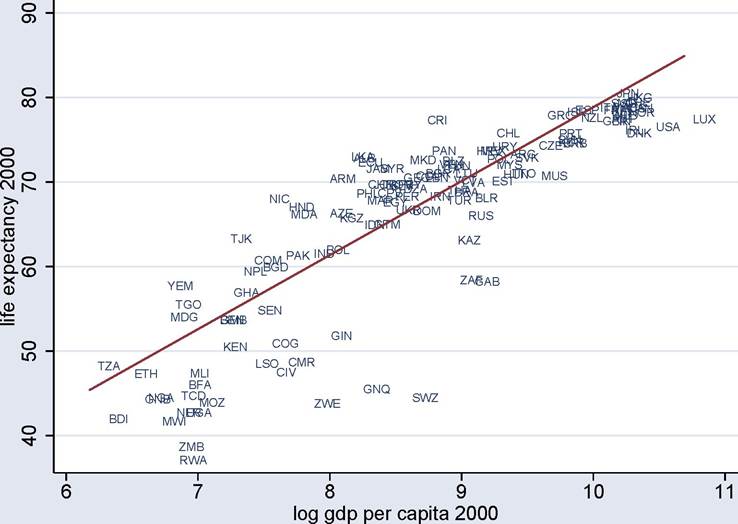
Figure 1.6. The association between income per capita and life expectancy at birth in 2000.
the 20th century until the fall of the Apartheid regime, GDP per capita grew considerably but the real wages of black South Africans, who make up the majority of the population, likely fell during this period. This of course does not imply that economic growth in South Africa was not beneficial. South Africa is still one of the richest countries in sub-Saharan Africa. Nevertheless, this observation alerts us to other aspects of the economy and also underlines the potential conflicts inherent in the growth process. Similarly, most existing evidence suggests that during the early phases of the British Industrial Revolution, which started the process of modern economic growth, the living standards of most workers may have fallen or at best remained stagnant. This pattern of potential divergence between GDP per capita and the economic fortunes of large numbers of individuals and society is not only interesting in and of itself, but it may also inform us about why certain segments of the society may be in favor of policies and institutions that do not encourage growth.
1.3.