KEY EQUATIONS

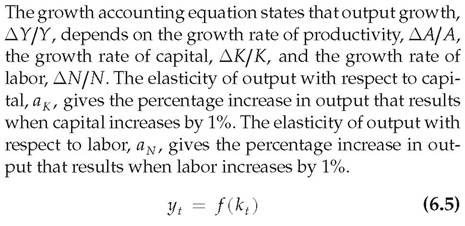
For any year, t, the per-worker production function relates output per worker, yt, to capital per worker (also called the capital-labor ratio), kt.
c = f (k) — (n + d) k (6.8)
Steady-state consumption per worker, c, equals steady-state output per worker, f (k), minus steady-state investment per worker, (n + d )k. Steady-state output per worker is determined by per-worker production, f (k), where k is the steadystate capital-labor ratio. Steady-state investment per worker has two parts: equipping new workers with the per-worker capital stock, nk, and replacing worn-out or depreciated capital, dk.
sf (k) = ( n + d) k (6.11)
The steady state is determined by the condition that saving per worker, sf (k), equals steady-state investment per worker, (n + d) k. Saving per worker equals the saving rate s times output per worker, f (k).
Y = AK (6.12)
Endogenous growth theory replaces the assumption of diminishing marginal productivity of capital with the assumption that the marginal productivity of capital is independent of the level of the capital stock. In the production function relating aggregate output Y to the aggregate capital stock K in Eq. (6.12), the marginal product of capital is constant and equal to the parameter A.

In an endogenous growth model, the growth rate of output, , is determined endogenously by the saving rate, s. An increase in the saving rate increases the growth rate of output.
►