Nelson-Phelps Model of Human Capital
The discussion in this chapter so far has focused on the productivity-enhancing role of human capital. This is arguably the most important role of human capital, emphasized by Becker and Mincer’s seminal analyses.
However, an alternative perspective on human capital is provided by Richard Nelson and Edmund Phelps in their short and influential paper, Nelson and Phelps (1966), and also by Ted Schultz (1965). According to this perspective, the major role of human capital is not to increase productivity in existing tasks, but to enable workers to cope with change, disruptions and especially new technologies. The Nelson-Phelps 408view of human capital has played an important role in a variety of different literatures and features in a number of growth models. Here we will provide a simple presentation of the main ideas along the lines of Nelson and Phelps’ original model and a discussion of how this new dimension of human capital will change our views of its role in economic growth and development. This model will also act as a steppingstone towards our study of technology adoption later in the book.
Consider the following continuous time model to illustrate the basic ideas. Suppose that output in the economy in question is given by

where L is the constant labor force, supplying its labor inelastically, and A (t) is the technology level of the economy. There is no capital (and thus no capital accumulation decision) and also no labor supply margin. The only variable that changes over time is technology A (t).
Suppose that the world technological frontier is given by Ap (t). This could correspond to the technology in some other country or perhaps to the technological know-how of scientists that has not yet been applied to production processes.
We assume that Ap (t) evolves exogenously according to the differential equation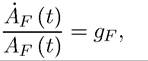
with initial condition Ap (0) > 0.
Let the human capital of the workforce be denoted by h. Notice that this human capital does not feature in the production function, (10.43). This is an extreme case in which human capital does not play any of the productivity enhancing role we have emphasized so far. Instead, the role of human capital in the current model will be to facilitate the implementation and use of frontier technology in the production process. In particular, the evolution of the technology in use, A (t), is governed by the differential equation

with initial condition A (0) ∈ (0,Ay (0)). The parameter g is strictly less than gp and measures the growth rate of technology A (t), resulting from learning by doing or other sources of productivity growth. But this is only one source of improvements in technology. The other one comes from the second term, and can be interpreted as improvements in technology because of implementation and adoption of frontier technologies. The extent of this second source of improvement is determined by the average human capital of the workforce, h. This captures the above-mentioned role of human capital, in facilitating coping with technological change. In particular, we assume that φ (∙) is increasing, with
where h > 0. This specification implies that the human capital of the workforce regulates the ability of the economy to cope with new developments embedded in the frontier technologies; if the workforce has no human capital, there will be no adoption or implementation of frontier technologies and A (t) will grow at the rate g. If, in contrast. there will be very quick
adaptation to the frontier technologies.
Since Ap (t) = exp (gpt) Ap (0), the differential equation for A (t) can be written as

Solving this differential equation, we obtain

which shows that the growth rate of A (t) is faster when φ (h) is higher. Moreover, it can be verified that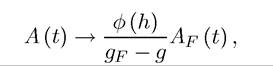
so that the ratio of the technology in use to the frontier technology is also determined by human capital.
The role of human capital emphasized by Nelson and Phelps is undoubtedly important in a number of situations. For example, a range of empirical evidence shows that more educated farmers are more likely to adopt new technologies and seeds (e.g., Foster and Rosenzweig, 1995). The Nelson and Phelps’ conception of human capital has also been emphasized in the growth literature in connection with the empirical evidence already discussed in Chapter 1, which shows that there is a stronger correlation between economic growth and levels of human capital than between economic growth and changes in human capital. A number of authors, for example, Benhabib and Spiegel (1994), suggest that this may be precisely because the most important role of human capital is not to increase the productive capacity with existing tasks, but to facilitate technology adoption. One might then conjecture that if the role of human capital emphasized by Nelson and Phelps is important in practice, human capital could be playing a more ma jor role in economic growth and development than the discussion so far has suggested. While this is an interesting hypothesis, it is not entirely convincing. If the role of human capital in facilitating technology adoption is taking place within the firm’s boundaries, then this will be reflected in the marginal product of more skilled workers.
Workers that contribute to faster and more effective technology adoption would be compensated in line with the increase in the net present value of the firm. Then the returns to schooling and human capital used in the calculations in Chapter 3 should have already taken into account the contribution of human capital to aggregate output (thus to economic growth). If, on the other hand, human capital facilitates technology adoption not at the level of the firm, but at the level of the labor market, this would be a form of local 410human capital externalities and it should have shown up in the estimates on local external effects of human capital. It therefore would appear that, unless this particular role of human capital is also external and these external effects work at a global level, the calibration-type exercises in Chapter 3 should not be seriously underestimating the contribution of human capital to cross-country differences in income per capita.
10.9.