NUMERICAL PROBLEMS
1. In the country of Kwaki, people produce canoes, fish for salmon, and grow corn. In one year, they produced 5000 canoes using only labor and natural materials but sold only 4000 as the economy had entered a recession.
The cost of producing each canoe was $1000, but the ones that sold were priced at $1250. They fished $30 million worth of salmon. They used $3 million worth of the salmon as fertilizer for corn. They grew and consumed $55 million worth of corn. What was Kwaki's GDP for the year?2. In one year in the country of Countem, workers earned $4150, the proprietor's income was $392, rental income was $20, corporate profits were $683, net interest was $228, taxes on production and imports were $329, business current transfer payments were $12, the current surplus of government enterprises was $3, statistical discrepancy was $28, consumption of fixed capital was $882, factor income received from the rest of the world was $331, and payments of factor income to the rest of the world was $623. Compute the national income, net national product, gross national product, and gross domestic product.
3. ABC Computer Company has a ?1.4 billion (Indian rupees) factory in Bangalore, India. During the current year, ABC builds ^140 million worth of computer components. ABC's costs for labor are ^70 million; interest on debt, ?7 million; and taxes, ^14 million.
ABC sells all its output to XYZ Supercomputer. Using ABC's components, XYZ builds four supercomputers at a cost of ^56 million each (components worth ^35 million, labor costs of ^14 million, and ?7 million in taxes per computer). XYZ has a ^2.1 billion factory.
XYZ sells three of the supercomputers for ^70 million each. At year's end, it had not sold the fourth. The unsold computer is carried on XYZ's books as a ^56 million increase in inventory.
a. Calculate the contributions to GDP of these transactions, showing that all three approaches give the same answer.
b. Repeat part (a), but now assume that, in addition to its other costs, ABC paid ^35 million for imported computer chips.
4. For each of the following transactions, determine the contribution to the current year 's GDP. Explain the effects on the product, income, and expenditure accounts.
a. On January 1, you purchase 10 liters of gasoline at €1.80 per liter. The gas station had purchased the gasoline the previous week at the wholesale price (transportation included) of €1.60 per liter.
b. Jorge Santiago purchases a Victorian mansion for $1,000,000. The broker's fee is 6%.
c. A homemaker enters the workforce in London, taking a job that will pay £40,000 over the course of the year. He incurs £16,000 during the same period for professional child care services.
d. A Japanese company builds an auto plant in Europe for €100,000,000 using only local labor and materials. (Hint: The auto plant is a capital good produced by the European workers and purchased by the Japanese company.)
e. You are informed that you have won R3,000,000 (South African rand) in a lottery, to be paid to you in total immediately.
/.The state government pays you a fee of $5000 to appear in a TV commercial publicizing the state lottery.
g. Rent-a-Car replaces its rental fleet by buying $100,000,000 worth of new cars from Toyota. It sells its old fleet to a consortium of used-car dealers for $40,000,000. The consortium resells the used cars to the public for a total of $60,000,000.
5. You are given the following information about an economy:
Gross private domestic investment = 40 Government purchases of goods and services = 30 Gross national product (GNP) = 200
Current account balance = — 20
Taxes = 60
Government transfer payments to the domestic private sector = 25
Interest payments from the government to the domestic private sector = 15 (Assume all interest payments by the government go to domestic households.)
Factor income received from rest of world = 7
Factor payments made to rest of world = 9
Find the following, assuming that government investment is zero:
a. Consumption
b.
Net exportsc. GDP
d. Net factor payments from abroad
e. Private saving
/.Government saving
g. National saving
6. Consider an economy that produces only three types of fruit: apples, oranges, and bananas. In the base
year (a few years ago), the production and price data were as follows:
| Fruit | Quantity | Price |
| Apples | 3000 bags | $2 per bag |
| Bananas | 6000 bunches | $3 per bunch |
| Oranges | 8000 bags | $4 per bag |
In the current year the production and price data are
| as follows: | ||
| Fruit | Quantity | Price |
| Apples | 4000 bags | $3 per bag |
| Bananas | 14,000 bunches | $2 per bunch |
| Oranges | 32,000 bags | $5 per bag |
a. Find nominal GDP in the current year and in the base year. What is the percentage increase since the base year?
b. Find real GDP in the current year and in the base year. By what percentage does real GDP increase from the base year to the current year?
c. Find the GDP deflator for the current year and the base year. By what percentage does the price level change from the base year to the current year?
d. Would you say that the percentage increase in nominal GDP in this economy since the base year is due more to increases in prices or increases in the physical volume of output?
7. Use the following FRED data for the consumer price index in the United Kingdom from 1929 to 1933 and calculate the rate of inflation for each year from 1930 to 1933. What is unusual about this period, relative to recent experience?

8. Loretta agrees to lend Ted $500,000 to buy computers for his consulting firm.
They agree to a nominal interest rate of 8%. Both expect the inflation rate to be 2%.a. Calculate the expected real interest rate.
b. If inflation turns out to be 3% over the life of the loan, what is the real interest rate? Who gains from unexpectedly high inflation, Loretta or Ted?
c. If inflation turns out to be 1% over the life of the loan, what is the real interest rate? Who gains from unexpectedly low inflation, Loretta or Ted?
9. The GDP deflator in Econoland is 200 on January 1, 2021. The deflator rises to 242 by January 1, 2023, and to 266.2 by January 1, 2024.
a. What is the annual rate of inflation over the two- year period between January 1, 2021, and January 1, 2023? In other words, what constant yearly rate of inflation would lead to the price rise observed over those two years?
b. What is the annual rate of inflation over the three- year period from January 1, 2021, to January 1, 2024?
c. In general, if P0 is the price level at the beginning of an и-year period, and Pn is the price level at the end of that period, show that the annual rate of inflation π over that period satisfies the equation 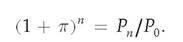
►