NUMERICAL PROBLEMS
1. Julia is making saving plans for this year and next. She knows her real income after taxes will be $50,000 in both years. Any part of her income saved this year will earn a real interest rate of 10% between this year and next year.
Currently, the consumer has no wealth (no money in the bank or other financial assets, and no debts). There is no uncertainty about the future.The consumer wants to save an amount this year that will allow her to (1) make college tuition payments next year equal to $16,800 in real terms; (2) enjoy exactly the same amount of consumption this year and next year, not counting tuition payments as part of next year's consumption; and (3) have neither assets nor debts at the end of next year.
a. How much should the consumer save this year? How much should she consume?
How are the amounts that the consumer should save and consume affected by each of the following changes (taken one at a time, with other variables held at their original values)?
b. Her current income rises from $50,000 to $54,200.
c. The income she expects to receive next year rises from $50,000 to $54,200.
d. During the current year she receives an inheritance of $1050 (an increase in wealth, not income).
e. The expected tuition payment for next year rises from $16,800 to $18,900 in real terms.
f. The real interest rate rises from 10% to 24%.
2. Hula hoop fabricators cost $100 each. Kai, the CFO of the Hi-Ho Hula Hoop Company is trying to decide how many of these machines to buy. HHHHC expects to produce the following number of hoops each year for each level of capital stock shown.
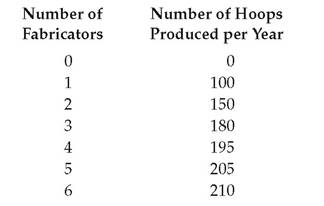
Hula hoops have a real value of $1 each. HHHHC has no other costs besides the cost of fabricators.
a. Find the expected future marginal product of capital (in terms of dollars) for each level of capital.
The MPKf for the third fabricator, for example, is the real value of the extra output obtained when the third fabricator is added.b. If the real interest rate is 12% per year and the depreciation rate of capital is 20% per year, find the user cost of capital (in dollars per fabricator per year). How many fabricators should Kai buy?
c. Repeat part (b) for a real interest rate of 8% per year.
d. Repeat part (b) for a 40% tax on HHHHC's sales revenues.
e. A technical innovation doubles the number of hoops a fabricator can produce. How many fabricators should Kai buy when the real interest rate is 12% per year? 8% per year? Assume that there are no taxes and that the depreciation rate is still 20% per year.
3. You have just taken a job that requires you to move to a new city. In relocating, you face the decision of whether to buy or rent a house. A suitable house costs $300,000 and you have saved enough for the down payment. The (nominal) mortgage interest rate is 10% per year, and you can also earn 10% per year on savings. Mortgage interest payments are tax deductible, interest earnings on savings are taxable, and you are in a 30% tax bracket. Interest is paid or received, and taxes are paid, on the last day of the year. The expected inflation rate is 5% per year.
The cost of maintaining the house (replacing worn-out roofing, painting, and so on) is 6% of the value of the house. Assume that these expenses also are paid entirely on the last day of the year. If the maintenance is done, the house retains its full real value. There are no other relevant costs or expenses.
a. What is the expected real after-tax interest rate on the home mortgage?
b. What is the user cost of the house?
c. If all you care about is minimizing your living expenses, at what (annual) rent level would you be just indifferent between buying a house and renting a house of comparable quality? Rent is also paid on the last day of the year.
4. Huxley, the owner of the Missing Link Chain-Link Fence Company is trying to determine how many chain-link fabricating machines to buy for its factory.
If we define a chain-link fence of some specified length to be equal to one unit of output, the price of a new fabricating machine is 60 units of output, and the price of a one-year-old machine is 51 units of output. These relative prices are expected to be the same in the future. The expected future marginal product of fabricating machines, measured in units of output, is 165 — 2K, where K is the number of machines in use. There are no taxes of any sort. The real interest rate is 10% per year.a. What is the user cost of capital? Specify the units in which your answer is measured.
b. Determine the number of machines that will allow Missing Link to maximize its profit.
c. Suppose that Missing Link must pay a tax equal to 40% of its gross revenue. What is the optimal number of machines for the company?
d. Suppose that in addition to the 40% tax on revenue described in part (c), the firm can take advantage of a 20% investment tax credit, which allows it to reduce its taxes paid by 20% of the cost of any new machines purchased. What is Missing Link's desired capital stock now? (Hint: An investment tax credit effectively reduces the price of capital to the firm.)
5. An economy has full-employment output of 9000, and government purchases are 2000. Desired consumption and desired investment are as follows:
| Real Interest | Desired | Desired |
| Rate (%) | Consumption | Investment |
| 2 | 6100 | 1500 |
| 3 | 6000 | 1400 |
| 4 | 5900 | 1300 |
| 5 | 5800 | 1200 |
| 6 | 5700 | 1100 |
a. Why do desired consumption and desired investment fall as the real interest rate rises?
b. Find desired national saving for each value of the real interest rate.
c. If the goods market is in equilibrium, what are the values of the real interest rate, desired national saving, and desired investment? Show that both forms of the goods market equilibrium condition, Eqs.
(4.7) and (4.8), are satisfied at the equilibrium. Assume that output is fixed at its full-employment level.d. Repeat part (c) for the case in which government purchases fall to 1600. Assume that the amount people desire to consume at each real interest rate is unchanged.
6. An economy has full-employment output of 6000. Government purchases, G, are 1200. Desired consumption and desired investment are
Cd = 3600 - 2000r + 0.10Y, and
Id = 1200 - 4000r,
where Y is output and r is the real interest rate.
a. Find an equation relating desired national saving, Sd, to r and Y.
b. Using both versions of the goods market equilibrium condition, Eqs. (4.7) and (4.8), find the real interest rate that clears the goods market. Assume that output equals full-employment output.
c. Government purchases rise to 1440. How does this increase change the equation describing desired national saving? Show the change graphically. What happens to the market-clearing real interest rate?
7. Suppose that the economywide expectedfuture marginal product of capital is
where K is the future capital stock. The depreciation rate of capital, d, is 20% per period. The current capital stock is 900 units of capital. The price of a unit of capital is 1 unit of output. Firms pay taxes equal to 15% of their output. The consumption function in the economy is C = 100 + 0.5Y — 200r, where C is consumption, Y is output, and r is the real interest rate. Government purchases equal 200, and full-employment output is 1000.
a. Suppose that the real interest rate is 10% per period. What are the values of the tax-adjusted user cost of capital, the desired future capital stock, and the desired level of investment?
b. Now consider the real interest rate determined by goods market equilibrium. This part of the problem will guide you to this interest rate.
i.
Write the tax-adjusted user cost of capital as a function of the real interest rate r. Also write the desired future capital stock and desired investment as functions of r.ii. Use the investment function derived in part (i) along with the consumption function and government purchases, to calculate the real interest rate that clears the goods market. What are the goods market-clearing values of consumption, saving, and investment? What are the tax- adjusted user cost of capital and the desired capital stock in this equilibrium?
8. (Appendix 4.A) A consumer has initial real wealth of 20, current real income of 90, and future real income of 110. The real interest rate is 10% per period.
a. Find the consumer's PVLR.
b. Write the equation for the consumer's budget constraint (using the given numerical values) and graph the budget line.
Suppose that the consumer's goal is to smooth consumption completely. That is, he wants to have the same level of consumption in both the current and the future period.
c. How much will he save and consume in the current period?
d. How will his current saving and consumption be affected by an increase of 11 in current income?
e. How will his current saving and consumption be affected by an increase of 11 in future income?
f. How will his current saving and consumption be affected by an increase of 11 in his initial wealth?
9. (Appendix 4.A) A consumer lives three periods, called the learning period, the working period, and the retirement period. Her income is 200 during the learning period, 800 during the working period, and 200 again during the retirement period. The consumer's initial assets are 300. The real interest rate is zero. The consumer desires perfectly smooth consumption over her lifetime.
a. What are consumption and saving in each period, assuming no borrowing constraints? What happens if the consumer faces a borrowing constraint that prevents her from borrowing?
b. Assume that the consumer 's initial wealth is zero instead of 300. Repeat part (a). Does being borrowing-constrained mean that consumption is lower in all three periods of the consumer's life than it would be if no borrowing constraints applied?
►