NUMERICAL PROBLEMS
1. Desired consumption and investment are
Cd = 4000 - 4000r + 0.20Y;
Id = 2400 - 4000r.
As usual, Y is output and r is the real interest rate. Government purchases, G, are 2000.
a. Find an equation relating desired national saving, Sd, to r and Y.
b. What value of the real interest rate clears the goods market when Y = 10,000? Use both forms of the goods market equilibrium condition. What value of the real interest rate clears the goods market when Y = 10,200? Graph the IS curve.
c. Government purchases rise to 2400. How does this increase change the equation for national saving in part (a)? What value of the real interest rate clears the goods market when Y = 10,000? Use both forms of the goods market equilibrium condition. How is the IS curve affected by the increase in G?
2. In a particular economy the real money demand function is

Assume that M = 6000, P = 2.0, and πe = 0.02.
a. What is the real interest rate, r, that clears the asset market when Y = 8000? When Y = 9000? Graph the LM curve.
b. Repeat part (a) for M = 6600. How does the LM curve in this case compare with the LM curve in part (a)?
c. Use M = 6000 again and repeat part (a) for π' = 0.03. Compare the LM curve in this case with the one in part (a).
3. An economy has full-employment output of 1000. Desired consumption and desired investment are
Cd = 200 + 0.8(Y - T) - 500r;
Id = 200 - 500r.
Government purchases are 196, and taxes are
T = 20 + 0.25Y.
Money demand is
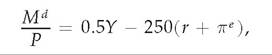
where the expected rate of inflation, πe, is 0.10. The nominal supply of money M = 9890.
a. What are the general equilibrium values of the real interest rate, price level, consumption, and investment?
b. Suppose that government purchases are increased to G = 216. What are the new general equilibrium values of the real interest rate, price level, consumption, and investment?
4. The production function in an economy is
Y = A(5N - 0.0025N2),
where A is productivity. With this production function, the marginal product of labor is
MPN = 5A - 0.005AN.
Suppose that A = 2. The labor supply curve is
NS = 55 + 10( 1 — t ')w,
where NS is the amount of labor supplied, w is the real wage, and t is the tax rate on wage income, which is 0.5.
Desired consumption and investment are
Cd = 300 + 0.8(Y - T) - 200r;
Id = 258.5 - 250r.
Taxes and government purchases are
T = 20 + 0.5Y;
G = 50.
Money demand is
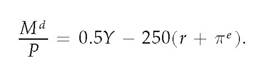
The expected rate of inflation, πe, is 0.02, and the nominal money supply M is 9150.
a. What are the general equilibrium levels of the real wage, employment, and output?
b. For any level of output, Y, find an equation that gives the real interest rate, r, that clears the goods market; this equation describes the IS curve. (Hint: Write the goods market equilibrium condition and solve for r in terms of Y and other variables.) What are the general equilibrium values of the real interest rate, consumption, and investment?
c. For any level of output, Y, find an equation that gives the real interest rate that clears the asset market; this equation describes the LM curve. [Hint: As in part (b), write the appropriate equilibrium condition and solve for r in terms of Y and other variables.] What is the general equilibrium value of the price level?
d. Suppose that government purchases increase to G = 72.5. Now what are the general equilibrium values of the real wage, employment, output, the real interest rate, consumption, investment, and price level?
5.
Consider the following economy:Desiredco∏s?ption Cd = 1275 + 0.5(Y - T) - 200r.
Desired investment Id = 900 - 200r.
Real money demand L = 0.5Y — 200i. Full-employment output γ = 4600.
Expected inflation π e = 0.
a. Suppose that T = G = 450 and that M = 9000. Find an equation describing the IS curve. (Hint: Set desired national saving and desired investment equal, and solve for the relationship between r and Y.) Find an equation describing the LM curve. (Hint: Set real money supply and real money demand equal, and again solve for the relationship between r and Y, given P.) Finally, find an equation for the aggregate demand curve. (Hint: Use the IS and LM equations to find a relationship between Y and P.) What are the general equilibrium values of output, consumption, investment, the real interest rate, and price level?
b. Suppose that T = G = 450 and that M = 4500. What is the equation for the aggregate demand curve now? What are the general equilibrium values of output, consumption, investment, the real interest rate, and price level? Assume that fullemployment output Y is fixed.
c.Repeat part (b) for T = G = 330 and M = 9000.
6. (Appendix 9.B) This question asks you to use the formulas in Appendix 9.B to find the general equilibrium values of variables for the economy described in Numerical Problem 4. Assume that G = 50.
a. Use the data from Numerical Problem 4 to find the numerical values of the parameters A, f1, f2, n0, nw, c0, cγ, cr, 10, t, i0, ir, L0, Ly, and Lr defined in Appendix 9.B.
b. Substitute the values of these behavioral parameters into the relevant equations in Appendix 9.B to compute the general equilibrium values of the real wage, employment, output, the real interest rate, and the price level.
c. Assume that government purchases, G, increase to 72.5, and repeat part (b).
►