NUMERICAL PROBLEMS
1. West Bubble makes ordinary soap bars that are sold for 5 guilders each. East Bubble makes deluxe soap bars that are sold for 100 florins each. The real exchange rate between West and East Bubble is two ordinary soap bars per deluxe soap bar.
a. What is the nominal exchange rate between the two countries?
b. During the following year West Bubble has 10% domestic inflation and East Bubble has 20% domestic inflation. Two ordinary soap bars are still traded for a deluxe soap bar. At the end of the year what has happened to the nominal exchange rate? Which country has had a nominal appreciation? Which has had a nominal depreciation?
2. Japan produces and exports only cameras, and Saudi Arabia produces and exports only barrels of oil. Initially, Japan exports 40 cameras to Saudi Arabia and imports 64 barrels of oil. The real exchange rate is 4 barrels of oil per camera. Neither country has any other trading partners.
a. Initially, what is the real value of Japan's net exports, measured in terms of its domestic good? (Hint: You have to use the real exchange rate to express Japan's oil imports in terms of an equivalent number of cameras. Then calculate Japan's net exports as the number of cameras exported minus the real value of its imports in terms of cameras.)
b. The real exchange rate falls to 3 barrels of oil per camera. Although the decline in the real exchange
rate makes oil more expensive in terms of cameras, in the short run there is relatively little change in the quantities of exports and imports, as Japan's exports rise to 42 cameras and its imports fall to 60 barrels of oil. What has happened to the real value of Japan's net exports?
c. In the longer run, quantities of exports and imports adjust more to the drop in the real exchange rate from 4 to 3, and Japan's exports rise to 45 cameras and its imports of oil fall to 54 barrels.
What are Japan's real net exports now?d. Relate your answers to parts (b) and (c) to the J-curve concept.
3. Consider the following classical economy:
Desired consumption Cd = 300 + 0.5Y — 200r.
Desired investment Id = 200 — 300r.
Government purchases G = 100.
Net exports NX = 150 — 0.1Y — 0.5e.
Real exchange rate e = 20 + 600r.
Full-employment output Y = 900.
a. What are the equilibrium values of the real interest rate, real exchange rate, consumption, investment, and net exports?
b. Now suppose that full-employment output increases to 940. What are the equilibrium values of the real interest rate, real exchange rate, consumption, investment, and net exports?
c. Suppose that full-employment output remains at 940 and that government purchases increase to 132. What are the equilibrium values of the real interest rate, real exchange rate, consumption, investment, and net exports?
4. Consider the following Keynesian economy:
It trades with a country that produces only cheese, and the currency of that country is crowns. The real exchange rate, e, equals 5 wedges of cheese per bottle of wine. The foreign price level is 20 crowns per wedge of cheese, and the domestic money supply is 48 francs.
a. What is the domestic price level? What is the fundamental value of the (nominal) exchange rate?
Desired consumption Cd = 200 + 0.6 (Y — T ) — 200r.
Desired investment Id = 300 — 300r.
Taxes T = 20 + 0.2Y.
Government purchases G = 152.
Net exports NX = 150 — 0.08Y — 500r.
Money demand L = 0.5Y — 200r.
Money supply M = 924.
Full-employment output Y = 1000.
a. What are the general equilibrium (that is, long-run) values of output, the real interest rate, consumption, investment, net exports, and the price level?
b. Starting from full employment, government purchases are increased by 62, to 214. What are the effects of this change on output, the real interest rate, consumption, investment, net exports, and the price level in the short run? In the long run?
c.
With government purchases at their initial value of 152, net exports increase by 62 at any income and real interest rate so that NX = 212 — 0.08Y — 500r. What are the effects of this change on output, the real interest rate, consumption, investment, net exports, and the price level in the short run? In the long run? Compare your answer to that for part (b).b. Suppose that the domestic country fixes its exchange rate at 50 crowns per franc. Is its currency overvalued, undervalued, or neither? What will happen to the domestic central bank's stock of official reserve assets if it maintains the exchange rate at 50 crowns per franc?
c. Suppose that the domestic country wants a money supply level that equalizes the fundamental value of the exchange rate and the fixed rate of 50 crowns per franc. What level of the domestic money supply achieves this goal? (Hint: For the given real exchange rate and foreign price level, what domestic price level is consistent with the official rate? What domestic money supply level will yield this price level?)
6. (Appendix 13.B)
a. For the economy described in Numerical Problem 4, find the values of all the parameters of Eqs. (13.B.1), (13.B.2), and (13.B.3). Use Eqs. (13.B.8) and (13.B.9) to derive the open-economy IS curve for this economy.
b. Derive the LM curve for this economy.
c. Find output, the real interest rate, and the price level when the economy is in general equilibrium.
d. Derive the AD curve for this economy. Suppose that net exports increase by 62 at any given level of domestic output and the domestic interest rate. How is the AD curve affected?
5. Consider the following classical economy:
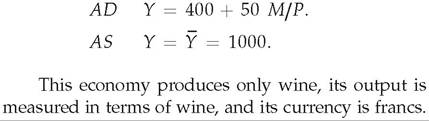
e. Find the effect of the increase in net exports on output in this economy, assuming that the price level is fixed at the general equilibrium value you found in part (c). (Hint: This assumption is equivalent to assuming that the SRAS curve is horizontal.)
►