Overlapping Generations with Impure Altruism
Section 5.3 in Chapter 5 demonstrated that altruism within families (for example of parents towards their offspring) can lead to a structure of preferences identical to those of the representative household in the neoclassical growth model.
In contrast, this section has so far ignored altruistic preferences in order to emphasize the effect of finite lives and the economic implications of the arrival of new agents in the economy. As briefly noted in Section 5.3, the exact form of altruism within a family matters for whether the representative household would provide a good approximation to the preference side of the economy. In particular, a potentially empirically relevant form of altruism is one in which parents care about certain dimensions of the consumption vector of their offspring instead of their total utility. These types of preferences are often referred to as “impure altruism” to distinguish it from the pure altruism discussed in Section 5.3. A particular type of impure altruism, commonly referred to as “warm glow preferences”, plays an important role in many growth models because of its 373tractability. Warm glow preferences assume that parents derive utility from (the warm glow of) their bequest, rather than the utility or the consumption of their offspring. This class of preferences turn out to constitute another very tractable alternative to the neoclassical growth and the baseline overlapping generations models. It has some clear parallels to the canonical overlapping generations model of last section, since it will also lead to equilibrium dynamics very similar to those of the Solow growth model. Given the importance of this class of preferences in many applied growth models, it is useful to review them briefly. These preferences will also be used in the next chapter and again in Chapter 21.
Suppose that the production side of the economy is given by the standard neoclassical production function, satisfying Assumptions 1 and 2.
Let us write this in per capita form as f (k).The economy is populated by a continuum of individuals of measure 1. Each individual lives for two periods, childhood and adulthood. In the second period of his life, each individual begets an offspring, works and then his life comes to an end. For simplicity, let us assume that there is no consumption in childhood (or that this is incorporated in the parent’s consumption). There are no new households, so population is constant at 1. Each individual supplies 1 unit of labor inelastically during his adulthood.
Let us assume that preferences of individual (i,t), who reaches adulthood at time t, are  where Ci (t) denotes the consumption of this individual and bi (t) is bequest to his offspring. Log preferences are assumed to simplify the analysis (see Exercise 9.19). The offspring starts the following period with the bequest, rents this out as capital to firms, supplies labor, begets his own offspring, and makes consumption and bequests decisions. I also assume that capital fully depreciates after use.
This formulation implies that the maximization problem of a typical individual can be written as
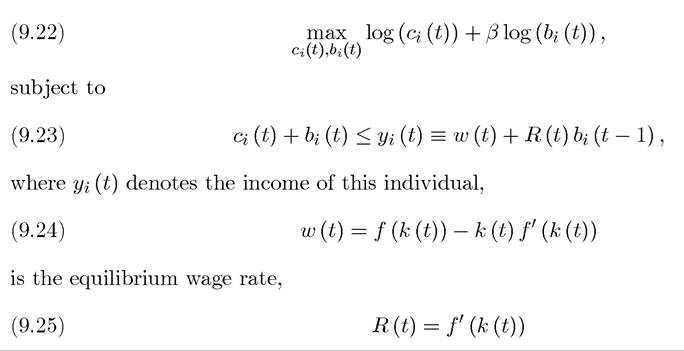
is the rate of return on capital and bi (t — 1) is the bequest received by this individual from his own parent.
The total capital-labor ratio at time t + 1 is given by aggregating the bequests of all adults at time t:

which exploits the fact that the total measure of workers is 1, so that the capital stock and capital-labor ratio are identical.
An equilibrium in this economy is a somewhat more complicated object than before, because we may want to keep track of the consumption and bequest levels of all individuals. Let us denote the distribution of consumption and bequests across households at time t by [ci (t)]i∈[o i] and [bi (t)]i∈[01], and let us assume that the economy starts with the distribution of wealth (bequests) at time t given by

The solution of (9.22) subject to (9.23) is straightforward because of the log preferences,
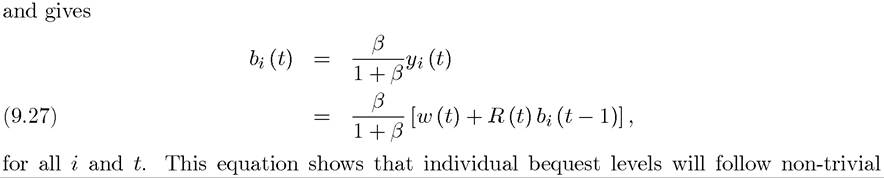
dynamics.
Since bi (t) determines the asset holdings of individual i of generation t, it can alternatively be interpreted as his “wealth” level. Consequently, this economy will feature a distribution of wealth that will evolve endogenously over time. This evolution will depend on factor prices. To obtain factor prices, let us aggregate bequests to obtain the capital-labor ratio of the economy via eq. (9.26). Integrating (9.27) across all individuals,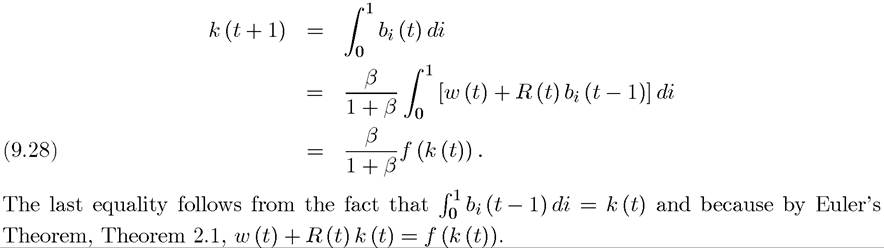
Consequently, aggregate equilibrium dynamics in this economy are straightforward and again closely resemble those in the baseline Solow growth model. Moreover, it is worth noting that these aggregate dynamics do not depend on the distribution of bequests or income across 375
households (we will see that this is no longer true when there are other imperfections in the economy as in Chapter 21).
Now, solving for the steady-state equilibrium capital-labor ratio from (9.28),  which is uniquely defined and strictly positive in view of Assumptions 1 and 2. Moreover, equilibrium dynamics are again given by Figure 9.2 and involve monotonic convergence to this unique steady state.
A complete characterization of the equilibrium can now be obtained by looking at the dynamics of bequests. It turns out that different types of bequests dynamics are possible along the transition path. More can be said regarding the limiting distribution of wealth and bequests. In particular, we know that k (t) → k*, so the ultimate bequest dynamics are given by steady-state factor prices. Let these be denoted by w* = f (k*) — k*f0 (k*) and R* = f' (k*). Then, once the economy is in the neighborhood of the steady-state capital-labor ratio, k*, individual bequest dynamics are given by

When R* < (1 + β) /β, starting from any level ⅛ (t) will converge to a unique bequest (wealth) level given by

Moreover, it can be verified that the steady-state equilibrium must involve R* < (1 + β) /β.
This follows from the fact that in steady state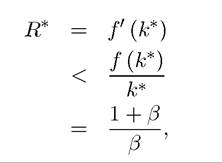
where the second line exploits the strict concavity of f (∙) and the last line uses the definition of the steady-state capital-labor ratio, k*, from (9.29). The following proposition summarizes this analysis:
PROPOSITION 9.9. Consider the overlapping generations economy with warm glow preferences described above. In this economy, there exists a unique competitive equilibrium. In this equilibrium the aggregate capital-labor ratio is given by (9.28) and monotonically converges to the unique steady-state capital-labor ratio k* given by (9.29). The distribution of bequests and wealth ultimately converges towards full equality, with each individual having a bequest (wealth) level of b* given by (9.30) with
9.7.