A Simple Separation Theorem
Let us start with the partial equilibrium schooling decisions and establish a simple general result, sometimes referred to as a “separation theorem” for human capital investments.
I set up the basic model in continuous time for simplicity.Consider the schooling decision of a single individual facing exogenously given prices for human capital. Throughout, I assume that there are perfect capital markets. The separation theorem referred to in the title of this section will show that, with perfect capital markets, schooling decisions will maximize the net present discounted value of the individual (I return to human capital investments with imperfect capital markets in Chapter 21). In particular, consider an individual with an instantaneous utility function u (c) that satisfies Assumption 3 above. Suppose that the individual has a planning horizon of T (where T = ∞ is allowed), discounts the future at the rate p > 0 and faces a constant flow rate of death equal to ν ≥ 0 (as in the perpetual youth model studied in the previous chapter). Standard arguments imply
that the objective function of this individual at time t = 0 is

Now suppose that this individual is born with some human capital h (0) ≥ 0. Suppose that his human capital evolves over time according to the differential equation

where s (t) ∈ [0,1] is the fraction of time that the individual spends for human capital investments (i.e., “schooling”) determines how human capital
evolves as a function of time, the individual’s stock of human capital and schooling decisions.
In addition, we may impose a further restriction on schooling decisions, for example,(10.3) s (t) ∈ S (t),
where S (t) C [0,1] and captures the fact that all schooling may have to be full-time, i.e., s (t) ∈ {0,1}, or that there may exist other restrictions on schooling decisions.
The individual is assumed to face an exogenous process of wage per unit of human capital given by [w (t)]f=0, so that his labor earnings at time t are
W (t) = w (t)[1 - s (t)] [h (t) + ω (t)],
where 1 — s (t) is the fraction of time spent supplying labor to the market and ω (t) is nonhuman capital labor that the individual may be supplying to the market at time t.The process of non-human capital labor that the individual can supply to the market,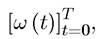 is exogenous. This formulation assumes that the only margin of choice is between market work and schooling (that is, there is no leisure).
Finally, let us assume that the individual faces a constant (flow) interest rate equal to r on his savings (potentially including annuity payments as discussed in the previous chapter). Using the equation for labor earnings, the lifetime budget constraint of the individual can be written as

The Separation Theorem, which is the subject of this section, can be stated as follows:
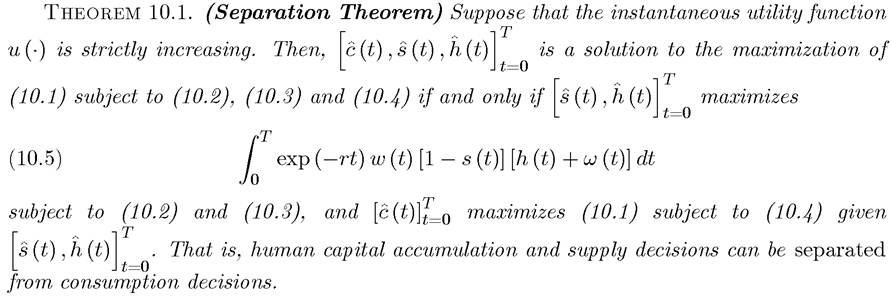
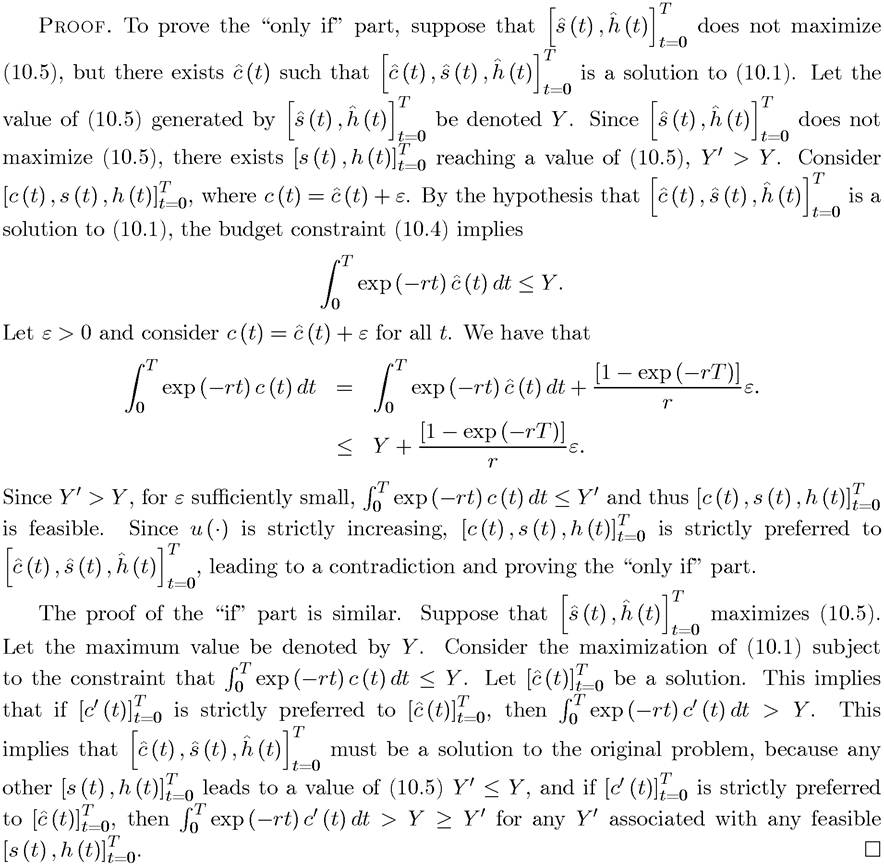
The intuition for this theorem is straightforward: in the presence of perfect capital markets, the best human capital accumulation decisions are those that maximize the lifetime budget set of the individual. Exercise 10.2 shows that this theorem does not hold when there are imperfect capital markets and also does not generalize to the case where leisure is also an argument of the utility function.
10.2.