The AK Model with Physical and Human Capital
As pointed out in the previous section, a major shortcoming of the baseline AK model is that the share of capital accruing to national income is equal to 1 (or limits to 1 as in the variant of the AK model studied in Exercises 11.3 and 11.4).
One way of enriching the AK model and avoiding these problems is to include both physical and human capital. I now briefly discuss this extension. Suppose the economy admits a representative household with preferences given by (11.1). The production side of the economy is represented by the aggregate production function
where H (t) denotes efficiency units of labor (or human capital), which will be accumulated in the same way as physical capital. The production function F (∙, ∙) now satisfies Assumptions 1 and 2. Suppose, to simplify the analysis, that there is no population growth, thus n = 0.
The budget constraint of the representative household is given by

where h (t) denotes the effective units of labor (human capital) of the representative household, w (t) is wage rate per unit of human capital, and ⅛ (t) is investment in human capital. The human capital of the representative household evolves according to the differential equation:

where δh is the depreciation rate of human capital. The evolution of the capital stock is again given from the observation that k (t) = a (t), and the depreciation rate of physical capital is now denoted by δ⅛ to avoid confusion with δ⅛. In this model, the representative household
431
maximizes its utility by choosing the paths of consumption, human capital investments and asset holdings.
Competitive factor markets imply that
where, now, the effective capital-labor ratio is given by dividing the capital stock by the stock

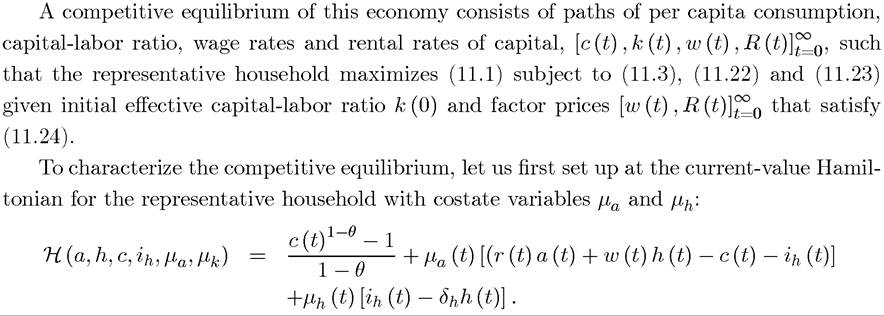
Now the necessary conditions of this optimization problem imply the following (see Exercise 11.8):
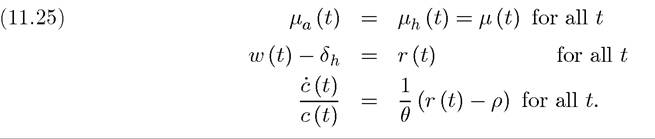
Intuitively, there are no constraints on human and physical capital investments, thus the shadow values of these two different types of investments have to be equal at all points in time as stated in the first condition in (11.25). This in turn yields the second condition in (11.25), equating the rates of return on human and physical capital. The third condition is the standard Euler equation. It can be verified that the current-value Hamiltonian is concave and and satisfies the sufficiency conditions in Theorem 7.14 in Chapter 7. Therefore, a solution to the conditions in (11.25) necessarily solves the representative household’s maximization problem.
Combining these with (11.24), 
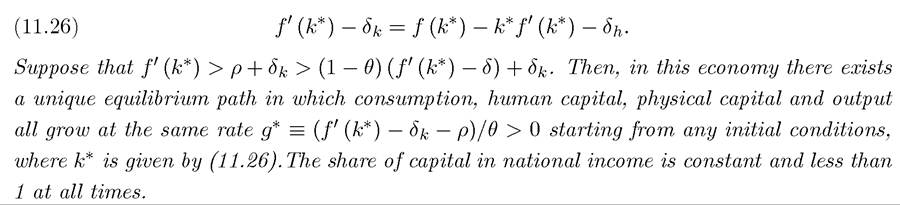
Since the left-hand side is decreasing in k (t), while the right-hand side is increasing, this implies that the effective capital-labor ratio must satisfy

This implies:
PROPOSITION 11.3. Consider the above-described AK economy with physical and human capital, with a representative household with preferences given by (11.1), and the production technology given by (11.21). Let k* be given by
Proof.
See Exercise 11.9 ?The advantage of the economy studied here, especially as compared to the baseline AK model is that, it generates a stable factor distribution of income, with a significant fraction of national income accruing to labor (as rewards to human capital). Consequently, the current model cannot be criticized on the basis of generating counter-factual results on the capital share of GDP. A similar analysis to that in the previous section also shows that the current model generates long-run growth rate differences from small policy differences. Therefore, it can account for arbitrarily large differences in income per capita across countries. Nevertheless, it would do so partly by generating large human capital differences across countries. As such, the empirical mechanism through which these large cross-country income differences are generated may again not fit with the empirical patterns discussed in Chapter 3. Moreover, given substantial differences in policies across economies in the postwar period, like the baseline AK economy, the current model would suggest significant changes in the world income distribution, whereas the evidence in Chapter 1 points to a relatively stable postwar world income distribution.
11.3.