The Representative Firm
The previous section discussed how the general equilibrium economy admits a representative household only under special circumstances. The other assumption commonly used in growth models, and already introduced in Chapter 2, is the “representative firm” assumption.
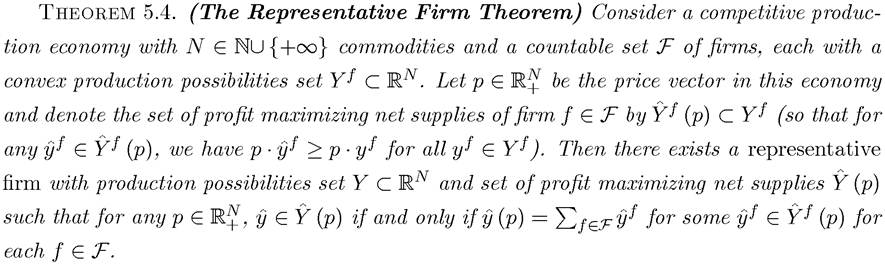
In particular, recall from Chapter 2 that the entire production side of the economy was represented by an aggregate production possibilities set, which can be thought of as the production facility set or the “production function” of a representative firm. One may think that this representation also requires quite stringent assumptions on the production structure of the economy. This is not the case, however. While not all economies would admit a representative household, the standard assumptions we adopt in general equilibrium theory or a dynamic general equilibrium analysis (in particular no production externalities and competitive markets) are sufficient to ensure that the formulation with a representative firm is without loss of any generality.This result is stated in the next theorem.
Proof. Let Y be defined as follows:
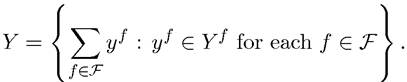

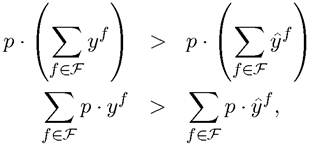
so that there exists at least one f' ∈ F such that
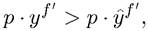
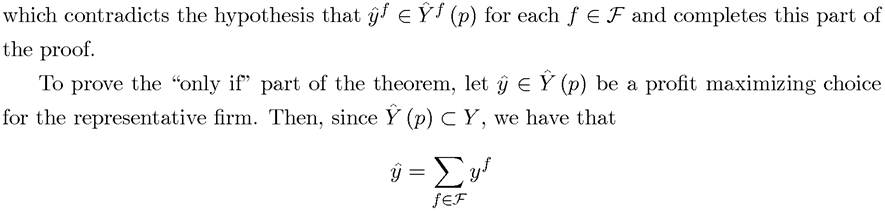
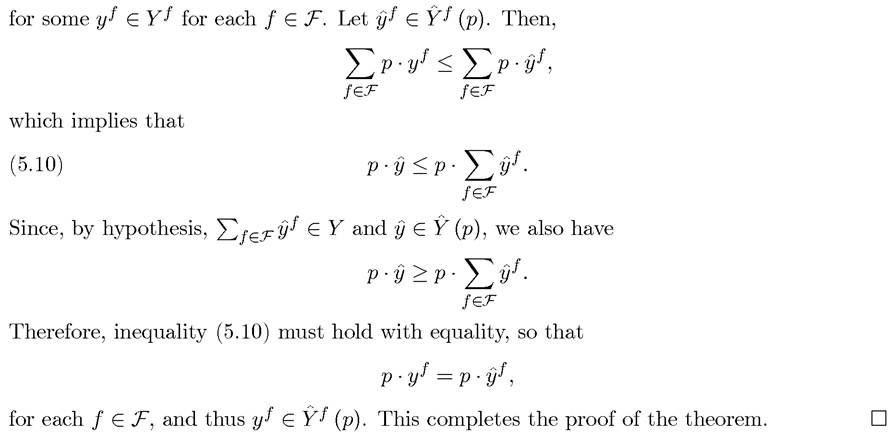
This theorem implies that, given the assumptions that there are “no externalities” and that all factors are priced competitively, our focus on the aggregate production possibilities set of the economy or on the representative firm is without loss of any generality. Why is there such a difference between the representative household and representative firm assumptions? The answer is related to income effects.
The reason why the representative household assumption is restrictive is that changes in prices create income effects, which affect different households differently. A representative household exists only when these income effects can be ignored, which is what the Gorman preferences guarantee. Since there are no income effects in producer theory, the representative firm assumption is without loss of any generality.Naturally, the fact that we can represent the production side of an economy by a representative firm does not mean that heterogeneity among firms is uninteresting or unimportant. On the contrary, many of the models of endogenous technology we will see below will feature productivity differences across firms as a crucial part of equilibrium process, and individual firms' attempts to increase their productivity relative to others will often be an engine of economic growth. Theorem 5.4 simply says that when we take the production possibilities sets of the firms in the economy as given, these can be equivalently represented by a single representative firm or an aggregate production possibilities set.
5.5.