Continuity, change, and transformative praxis (4D): fiqh and textual polities
‘Islamic law is not that found in the books of the jurists, but rather the outcome of a malleable and sensitive application of rules in a complex social setting.... To know what...
[the ‘aqd] was, therefore, is to know how actual Muslim societies of the past lived it’ (Hallaq, 2009, p. 167).The ‘aqd is not only a manifestation of God’s revelation, nor just a topic of the legal tradition; it is a ‘craft’ that belongs to a social reality, and as such, its ‘life’ has always depended on the specific space and time of its occurrence. As remarked from the very beginning of this book, there is no general and uniform archetype of the ‘aqd spanning all the history of the Muslim world; rather, both its theory(-ies) and practice(-s) have always been affected by a multiplicity of factors inserted in social reality. Of course, if the investigation of the specific space(s) and time(s) of the Islamic contract cannot be undertaken in this book (historical materials as well as anthropological and ethnographic research would be needed for this aim), the metaphor of the ‘aqd as a city and the reference made to Rome in the Introduction can help us to draw some general reflections on the matter.
On the one hand, a city is never an abstract place; on the contrary, its buildings exist for being employed by people, and their construction is functional to social life. While, in the previous chapter, much attention was given to the ‘rules’ that are necessary for the valid construction of the ‘aqd (as a building for which certain kinds of material and work are needed to guarantee its stability), we now have to examine how these rules of construction have evolved over time to meet the new needs of the city’s population.
On the other hand, if changes always imply a certain degree of separation from the past, aspects of continuity persist (the tradition offiqh, from medieval times, still maintains its cultural and religious echo, as we will see).
In a similar way, by visiting Rome, one can immediately feel the sense of continuity of a millennial enterprise, where the ancient ruins of the Roman Forum and the magnificence of the Colosseum continue to exist in a landscape that was subsequently affected by the architecture of the Church, the Baroque, modern and contemporary styles.This is precisely what the Introduction to this book described by referring to a persistent continuity in practice of the Islamic contract, despite the changeable and plural nature of its theories and practices in time. Looking back at the bridge of translation from West to East that we mentioned in Chapter 2, the traveller should now make an additional effort by putting the theories of the ‘aqd in a changeable domain of commercial and social practice that has been affected by a plurality of endogenous (e.g. the rise of the modern state in Muslim countries) and exogenous factors (e.g. legal transplants from other legal traditions). So, in the history of the ‘aqd, the surface of amplification of God’s Word in echoing divine revelation (see section 2.4.5) has changed over the centuries, with normative forces that have affected the nature of the contract in the Muslim world both by means of processes of law-making (e.g. the impact of codification in the colonial and post-colonial period: section 4.3) and adaptation to the globalisation of financial markets (section 4.4). In fact, the ‘aqd itself, at the very beginning of Islamic history, was not the result of the Islamic revelation alone but of local practices at the time of the Prophet (section 4.2).
More in general, the values of the contract in the Muslim world have always combined elements related to the performance of Islamic dm/bios (to which the elaboration offiqh was addressed) with a variety of contextual factors, from local customs to the political interests of modernisation, and later, the commercial concerns of contemporary capitalism. Not by chance, the recognition of this intrinsic plurality has constituted one of the methodological tenets of our research of the Islam-Muslim-world (section 1.3.2) by adhering to Shahab Ahmed’s invitation
to conceptualize Islam in terms that map onto the human and historical reality wherein Muslims have authored and lived with contradiction as Islam,...
[and...] to locate the logic of difference and contradiction as coherent with and internal to Islam - that is, to provide a coherent account of contradiction in and as Islam (ibidem)... [by drawing] attention to... the mutually constitutive relationship between Islam and Muslims: on how Islam makes Muslims as Muslims make Islam.(Ahmed, 2016, pp. 542-543)
In a publication dedicated to the variation of meaning of Islamic contract law from classical times to the present global economy (Cattelan, 2021), I stress how the social nature of norms go far beyond their letter in legal manuals and form part of the collective identity of the communities where they are applied, where their concrete life subsists. Their presence in-time embraces mutable contexts in the transformative praxis (and so agency) as fourth dimension (4D) of Bhaskar’s dialectics.3 Here, the focus on change that is distinctive in social sciences highlights the nature of negativity (2E) in terms of a process rather than a product, which allows the ‘shaped possibility of becoming’ (Bhaskar, 1993, p. 142), where ‘[t]he past shapes the present and therefore shapes, without determining, possible futures’ (Norrie, 2009, p. 34). Understanding of the Islamic contract, then, requires looking at a transformative praxis in which real people (merchants, Muslim believers, and non-Muslims) participate and by which they are transformed, too, as agents in a totality (3L) of internally related elements.
The implications of the passing of time radically challenge the possibility of dealing with any trans-historical archetype of contractual rules (see Introduction). Since the normative space of the ‘aqd cannot be properly understood without locating its nature in-time as a socio-anthropological construction,4 the ‘bridge’ of translation and comparison that we have crossed during our research must (metaphorically speaking) migrate from one age to another, in a conceptual exercise of continuity-through-change, where the ‘imag(in) ing power of...
[re-presenting the ‘aqd] is immersed in social reality and so subject to present (i.e., our presence in-time)' (Cattelan, 2021, p. 76). Moving the bridge of Babel (section 2.5) in-time requires, I believe, an additional power of imag(in)ing that can, fortunately, be inspired by one of the most famous poems of Nobel Laureate Wislawa Szymborska (1923-2012); namely, ‘The people on the bridge.’5 In her poem, Szymborska comments on our ‘odd planet,’ whose inhabitants, in her opinion, ‘are odd, too.’ They ‘are subject to time, but they won’t admit it;’ rather, they ‘have their own ways of expressing protest’ (Szymborska, 1996, p. 167). For instance, they make ‘little pictures,’ like the one printed by Japanese master Utagawa Hiroshige (1797-1858) (‘a rebel... who, by the way, died long ago and in due course,’ as Szymborska wittily remarks: ibidem, p. 168) under the title Sudden Shower over Shin-Ohashi Bridge and Atake (1857) (Figure 4.1).At first glance, nothing special.
What you see is water.
And one of its banks.
And a little boat sailing strenuously upstream.
And a bridge over the water, and people on the bridge.
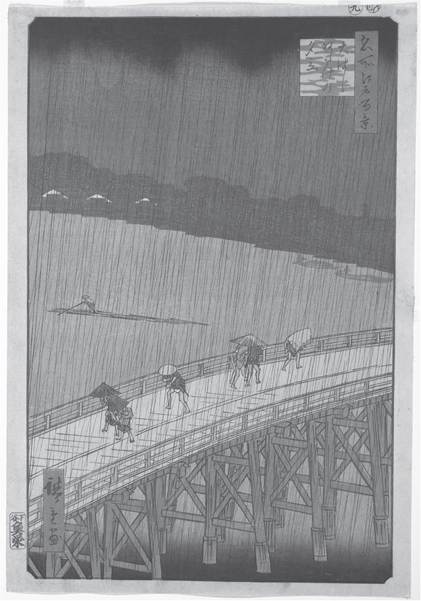
Figure 4.1 Sudden Shower over Shin-Ohashi Bridge and Atake (print artwork by Uta- gawa Hiroshige, 1857; Metropolitan Museum of Art, New York)
It appears that the people are picking up their pace because of the rain just beginning to lash down from a dark cloud.
The thing is, nothing else happens.
The cloud doesn't change its colour or its shape.
The rain doesn't increase or subside.
The boat sails on without moving.
The people on the bridge are running now exactly where they ran before.
It's difficult at this point to keep from commenting.
This picture is by no means innocent.
Time has been stopped here.
Its laws are no longer consulted.
It has been relieved of its influence over the course of events.
It has been ignored and insulted (Szymborska, 1996, pp. 167-168). Expressing our own protest against the conceptual fallacy of any trans-historical representation of the ‘aqd (as already criticised previously), the next pages will look at the variance of meanings that the Islamic contract has experienced over the centuries as a sort of ‘city in evolution,’ whose buildings have changed in relation to the social transformations. Recalling the bridge of translation/com- parison, we can use Hiroshige’s Bridge as a metaphor for a translation/com- parison subject-to-time that we are employing in the search for these meanings.
In particular, looking closer at the ‘aqd in the light of its transformative praxis, this chapter proposes to outline the story of its city through three main periods, which can indirectly reflect a diverse relation between law and religion in the textual tradition offiqh, and the related variation(-s) in the production of contractual rules as specific expressions of alternative ‘textual polities’ in the social reality (see the following). Keeping our reference to the metaphor of the city, the material construction of its buildings (the contracts negotiated in the reality of the Muslim world) has historically followed patterns that have changed over time. As a natural result, the rules that Muslim jurisprudence has forged in echoing God’s revealed Word have necessarily been adapted (hence, transformed) to different contexts. In fact, they have often been adopted in relation to purposes that have not been primarily the expression of Islamic din but sometimes more in line with commercial aims of practice, political/social preferences, and reasons of economic profit, in a constant interplay between theory and practice. Hence, the meaning of fiqh textual rules on the ‘aqd, which we examined in Chapter 3 as an expression of Islamic nomos, have continuously changed in the transformative praxis of the Muslim world.
The conception of texts as vehicles of legal meaning in the mutual interdependence between law makers, interpreters, and users belongs to the core of a well-known work of legal anthropology; namely, Brinkley Messick’s The Calligraphic State: Textual Domination and History in a Muslim Society (1993).6 With reference to the topic, Messick remarks how texts exist themselves in the ‘interlocking of a polity, a social order, and a discursive formation’ (Messick, 1993, p.
1), which arises through the bilateral conjunction ‘between the literary processes behind the constitution of authority in texts and the social and political processes involved in articulating the authority of texts’ (ibidem, p. 1; italics in the original text). Hence, within the textual polities of the Muslim world,[d]ocuments are mediations, their writers mediators, between the enduring text of shari ''a law and the particular events of the world. [It is in this frame that we can]... consider the problematic way documents fit the law to the world, and the world to law - rendering form historical and giving form to history.
(Messick, 1989, pp. 26-27)
Looking at fiqh rules as specific documents inserted in a certain social reality - hence, part of determined textual polities in-time where society affects the formulation of contractual rules - has a double advantage. On the one hand, it permits us to underline how contractual rules have been differently thought of in their practices in the Muslim world over the centuries. On the other hand, it makes it possible to broaden the non-identity of law and religion to a multiplicity of social, political, and economic factors that have always contributed to the ‘idea’ of the Islamic contract beyond the canons of Muslim bios and have also shifted its conceptualisation (as we will see) from an acoustic to a visual space in modern times, during the era of Western colonisation. In brief, the sub-totality of fiqh literature, when inserted in the flux of time, must be replaced by the broader totality of the ‘aqd in its transformative praxis (4D). Through the fourth dimension of Bhaskar’s dialectic, our understanding of the ‘aqd will be modified as well; we will listen to it no longer as the ‘product’ of Islamic law and religion, but rather, as a ‘process’ (rectius, ‘processes’) of legal, social, political, and economic interactions that are all constantly interconnected in the Muslim world.
Feeling the ‘rain’ of reality while crossing Hiroshige’s Bridge, three ages can be identified in the history of the Islamic contract: that of medieval times, which this book has labelled under the title of Verbal Trade (section 4.2); the period of codification under the influence of Western culture, under the semantics of the Codified Norm (section 4.3); and the contemporary world of the Typewritten Market (section 4.4), dominated by the forces of global capitalism. As we will see, each of these ages will show peculiar modalities of production and application of contractual rules that will also be interpreted as the expression (at a micro- and macro-level) of radical changes in the nature of Islamic law as a social construction.
4.2.