JIHAD IN EUROPE: PASTAS PROLOGUE?
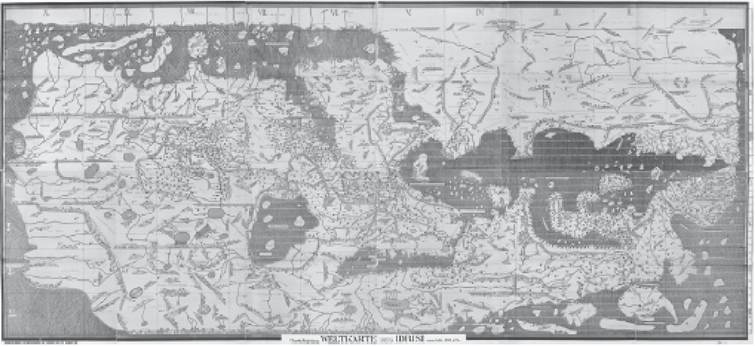
Figure 5.1. Weltkarte des Idrisi vom Jahr 1154 n. Ch., Charta Rogeriana/ wiederhergestellt und herausgegeben von Konrad Miller.
World map from 1154 drawn by Idrisi and restored and published (in 1927 and 1928, respectively) by Konrad Miller. Courtesy of Library of Congress, Geography and Map Division.Cover art for the Report by the High-Level Advisory Group established at the initiative of the President of the European Commission, “Dialogue between Peoples and Cultures in the Euro-Mediterranean Area,” Brussels, October 2003,
http://www.iemed.org/documents/lindhgroupen.pdf.
As the report noted, “The orientation of this map corresponds to the world view of the Arab cartographers of the Middle Ages”—that is, reinforcing Islamic jihad supremacism, and reversing the true geographical orientation of the Mediterranean Sea, with the North African Mediterranean littoral on top of the Southern European Mediterranean littoral.
In the fall of 2005, after three successive weeks of rioting in France by predominantly Muslim youths, the violence ebbed, albeit to an uneasy level in excess of the early October 2005 “baseline” before the riots. For example, about sixty cars per night continued to be burned as of December 8, 2005,1 and the number soared to 425 New Year's Eve 2006, in “troubled,” that is, Muslim neighborhoods.2 Then on New Year's Day, teenagers of Arab Muslim origin rampaged through a train between Nice and Lyon, intimidating and robbing passengers, and allegedly assaulting at least one young woman, sexually,3 prompting the creation of a special French police force to ensure security for railway passengers.4 During the fall 2005 intifada, the overwhelmingly Muslim rioters engaged in acts of wanton destruction, punctuated by claims of “territorial control” over sections of various French cities.
In the context of this havoc, one saw repeated references to the term Eurabia by journalists and other media and academic elites, who, almost without exception, had no idea about the concrete origins or significance of this term.5The use of the term Eurabia, as noted by Bat Ye'or, was first introduced, triumphantly, in the mid-1970s, as the title of a journal produced by the Association for Franco-Arab Solidarity, and published in Geneva, Paris, and London.6 The articles and editorials in this publication called for common Euro-Arab positions, at every level—social, economic, and commercial7—and were contingent upon the fundamental political condition of European support for the Arab (and nonArab) Muslim umma's jihad against Israel.8 These concrete proposals were not the musings of isolated theorists—they in fact represented policy decisions conceived in conjunction with, and actualized by,
European state leaders, their ministers of foreign affairs, and European Parliamentarians.9
Nearly two years ago [relative to 2006], Bat Ye'or summarized the bitter harvest western Europe was reaping from the sociopolitical and cultural changes it had sewn over the intervening three decades, the result
of a global movement that is transforming Europe into a new continent of dhimmitude within a worldwide strategy of jihad and da'wa, the latter being the pacific method of Islamization...this policy of dhimmitude for the EuroArabian continent...entitled “Dialogue between Peoples and Cultures in the Euro-Mediterranean Region”10 was accepted by the European Union in December 2003. Unfortunately, the policy of “Dialogue” with the Arab League nations, willfully pursued by Europe for the past three decades, has promoted European dhimmitude and rabid Judeophobia.11
And rabid Judeophobia is an apt characterization. During a November 14, 2005, presentation at the Center for Immigration Studies, in Washington, DC, Stephen Steinlight, former director of education at the US Holocaust Memorial Council, and subsequently director of national affairs at the American Jewish Committee, cited data demonstrating that Muslim youths, or more appropriately, youthful Muslim thugs, engaged in an average of twelve attacks per day on Parisian Jews, “putting the figures.close to [those] during the days of the Weimar Republic.”12 The twisted justification for such violent bigotry was evident in a Times of London poll whose results were published on February 7, 2006, revealing that 37 percent of British Muslims believe the Jewish community in Britain is a legitimate target “as part of the ongoing struggle for ‘justice’ in the Middle East.”13
It is within this harrowing context that one must view the apologetics regarding the French riots, or “intifada,” by pundits across the political spectrum, and on both sides of the Atlantic, who denied or trivialized the role of Islam.
For example, although twelve Christian churches were desecrated and/or burned by the overwhelmingly Muslim rioters in France,14 these bigoted acts were barely reported by investigative journalists or bloggers, and were ignored altogether by pontificating commentators. Apologetic assessments further ignored the existence of ominous and influential Islamic entities such as the Arab European League—a group which hideously equates the assimilation of Muslims within a European context to rape15—or the European Fatwa Council, headed by Muslim Brotherhood “spiritual” leader Yusuf al-Qaradawi, who sanctions homicide bombings against Israeli noncombatants and issued a public fatwa on December 2, 2002, calling on Muslims to conquer Europe, stating, “Islam will return to Europe as a conqueror and a victor after being expelled from it twice—once from the south, from Andalusia, and a second time, from the east, when it knocked several times on the doors of Athens.” Qaradawi’s fatwa ruled, in addition, that Muslims should reconquer, “former Islamic colonies to Andalus (Spain), southern Italy, Sicily, the Balkans and the Mediterranean islands.”16Also absent from the apologetic analyses of the French riots were the alarming statements made by European Muslim leaders at a conference titled, “Islam in Europe” that accompanied the July 10, 2003, opening of the new Granada Mosque.17 The keynote speaker at this erstwhile “ecumenical” conference, Umar Ibrahim Vadillo, a Spanish Muslim leader, implored Muslims to cause an economic collapse of Western economies (by switching to gold dinars, and ceasing to use Western currencies), while the German Muslim leader Abu Bakr Rieger told attendees not to adapt their Islamic religious practices to accommodate European (i.e., Western Enlightenment?) values.18
Rieger's pronouncements were in turn consistent with survey research conducted subsequently in 2004 indicating that 21 percent of his co-religionist German Muslims believed the German constitution was irreconcilable with their ultimate source of authority, the Koran.19 Finally, none of the apologetic narratives acknowledged, let alone addressed, the implications of disturbing survey results from British Muslims polled in January 2005, and again shortly after the July 7, 2005, London bombings.20 These data revealed that 60 percent of British Muslims surveyed prior to the bombings felt those who engaged in mere criticism of Islam should face criminal prosecution,21 while one- third were brazen enough to admit after July 7, 2005, “Western society is decadent and immoral and.
Muslims should seek to bring it to an end,”22 expressing ostensibly their desire to replace Britain's current liberal democracy with a sharia-based theocratic model —consistent with a worldview made plain in this statement published August 16, 2005, in the Guardian and signed by thirty-eight prominent British Muslim organizations and individuals:To equate “extremism” with the aspirations of Muslims for Sharia laws in the Muslim world or the desire to see unification towards a Caliphate in the Muslim lands, as seemed to be misrepresented by the prime minister, is inaccurate and disingenuous. It indicates ignorance of what the Sharia is and what a Caliphate is and will alienate and victimise the Muslim community unnecessarily.23
French philosopher Alain Finkielkraut noted, appositely, that it was a reductio ad absurdum to view the “social dimension” of the riots in France exclusively (and obsessively), as:
a revolt of youths from the suburbs against their situation, against the discrimination they suffer from, against the unemployment. The problem is that most of these youths are blacks or Arabs with a Muslim identity...in France there are also other immigrants whose situation is difficult—Chinese, Vietnamese, Portuguese—and they’re not taking part in the riots. Therefore, it is clear that this is a revolt with an ethno-religious character.24
Despite Finkielkraudt’s salient observations (which led to his public vilification), and others by the rare reporters Melanie Phillips aptly lauded for simply having “their heads screwed on the right way,” Phillips warned of the dominant mentality which sought to negate the truth through vilification, and replace reality with fantasy.25
Amir Taheri has cited perhaps the most disturbing example of this proclivity to indulge ahistorical and dangerous fantasy. The mythical invention of a purportedly “ecumenical” Islamic rule in Europe was revived—the “Andalusian paradise” of Muslim Spain.26 Taheri reported that Gilles Kepel, who (despite arguing prior to 9/11 that jihadism was a “spent force” within the global Muslim umma!—) continued to serve as an adviser on Islam to President Chirac, recommended the creation of a modern Andalusia, “in which Christians and Muslims would live side by side and cooperate to create a new cultural synthesis.”28 Taheri, but unfortunately, not Kepel, Chirac's adviser, possessed the wisdom to ponder the critical matter of sovereign political power, asking “who will rule this new Andalusia: Muslims or the largely secularist Frenchmen?”29 Other muddled thinkers were, according to Taheri, “even calling for the areas where Muslims form a majority of the population to be reorganized on the basis of the ‘millet' system of the Ottoman Empire: Each religious community (millet) would enjoy the right to organize its social, cultural and educational life in accordance with its religious beliefs.”30
To address Taheri's pressing concerns, one must understand the uniquely Islamic institution of jihad, which ultimately regulates the sociopolitical relations between Muslims and non-Muslims, to this day.
There is only one historically relevant meaning of jihad regardless of contemporary apologetics. The noted nineteenth-century Arabic lexicographer E. W. Lane, who studied the etymology of the term, observed, “Jihad came to be used by the Muslims to signify wag[ing] war, against unbelievers.”31 Jihad was pursued century after century because jihad embodied an ideology and a jurisdiction. Both were formally conceived by Muslim jurisconsults and theologians from the eighth to ninth centuries onward, based on their interpretation of Koranic verses and long chapters in the Traditions (i.e., hadith, acts and sayings of the Prophet Muhammad).32
Ibn Khaldun (d. 1406), jurist, renowned philosopher, historian, and sociologist, summarized the consensus opinions from five centuries of prior Muslim jurisprudence with regard to the uniquely Islamic institution of jihad:
In the Muslim community, the holy war is a religious duty, because of the universalism of the [Muslim] mission and [the obligation to] convert everybody to Islam either by persuasion or by force.. The other religious groups did not have a universal mission, and the holy war was not a religious duty for them, save only for purposes of defense.. Islam is under obligation to gain power over other nations.33
Confirming Ibn Khaldun's assessment, the late Muslim scholar Majid Khadduri wrote the following in his authoritative 1955 treatise on jihad, War and Peace in the Law of Islam:
Thus the jihad may be regarded as Islam's instrument for carrying out its ultimate objective by turning all people into believers, if not in the prophethood of Muhammad (as in the case of the dhimmis), at least in the belief of God. The Prophet Muhammad is reported to have declared ‘some of my people will continue to fight victoriously for the sake of the truth until the last one of them will combat the anti-Christ.' Until that moment is reached the jihad, in one form or another will remain as a permanent obligation upon the entire Muslim community.
It follows that the existence of a dar al-harb is ultimately outlawed under the Islamic jural order; that the dar al- Islam is permanently under jihad obligation until the dar al-harb is reduced to non-existence; and that any community accepting certain disabilities must submit to Islamic rule and reside in the dar al-Islam or be bound as clients to the Muslim community. The universality of Islam, in its all-embracing creed, is imposed on the believers as a continuous process of warfare, psychological and political if not strictly military.34By the early tenth century (923), jihad wars had expanded the Muslim empire from Portugal to the Indian subcontinent. Subsequent Muslim conquests continued in Asia, as well as eastern Europe. The Christian kingdoms of Armenia, Byzantium, Bulgaria, Serbia, Bosnia, Herzegovina, Croatia, and Albania, in addition to parts of Poland and Hungary, were also conquered and Islamized. When the Muslim armies were stopped at the gates of Vienna in 1683, over a millennium of jihad had transpired. These tremendous military successes spawned a triumphalist jihad literature. Muslim historians recorded in detail the number of infidels slaughtered or enslaved and deported, the cities and villages which were pillaged, and the lands, treasure, and movable goods seized. Christian (Coptic, Armenian, Jacobite, Greek, Slav, etc.), as well as Hebrew sources, and even the scant Hindu and Buddhist writings which survived the ravages of the Muslim conquests independently validate this narrative and complement the Muslim perspective by providing testimonies of the suffering of the non-Muslim victims of jihad wars.35
In The Laws of Islamic Governance, al-Mawardi (d. 1058), a renowned jurist of Baghdad, examined the regulations pertaining to the lands and infidel (i.e., nonMuslim) populations subjugated by jihad. This is the origin of the system of dhimmitude.— The native infidel population had to recognize Islamic ownership of their land, submit to Islamic law, and accept payment of the poll tax (jizya). Reconciliation and security last as long as the payment is made. If the payment ceases, then the jihad resumes. A treaty of reconciliation may be renewable, but must not exceed ten years.37 The “contract of the jizya" or dhimma encompassed other obligatory and recommended obligations for the conquered non-Muslim dhimmi peoples. Collectively, these “obligations” formed the discriminatory system of dhimmitude imposed upon non-Muslims—Jews, Christians, Zoroastrians, Hindus, and Buddhists— subjugated by jihad.38