MCCHRYSTAL, TOCQUEVILLE, AND THE KORAN
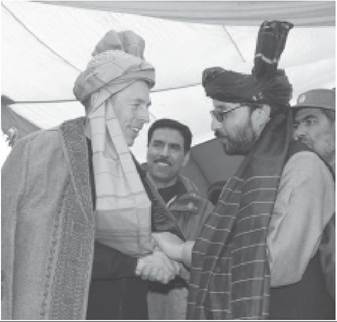
Figure 26.1. COMISAF visits Laghman Province. US Army Gen. David H. Petraeus, NATO International Security Assistance Force commander, in traditional Afghan attire, thanks Iqbal Azizi, governor of Laghman province, for his hospitality throughout the day.
Petraeus visited Azizi to talk about development within the province February 7, 2011. Photo by US Air Force 2nd Lt. Chase P. McFarland, Laghman Provincial Reconstruction Team.Just over nine months ago, on September 20, 2009, the Department of Defense released a declassified version of General Stanley A. McChrystal’s assessment of the war in Afghanistan. The Washington Post published a version of this report with minor deletions of material that officials maintained could compromise future operations, rather than a copy of the document marked “confidential.”1 Although General McChrystal’s counterinsurgency (COIN)-based analysis, “updated” for the Afghanistan theater,2 at least mentioned the Koran3 (a word omitted entirely from the December 2006 COIN manual coauthored by General David Petraeus4), the Koran’s motivational relevance— consistent with over a millennium of jihadism within Afghanistan (or “Ghazni”)5—was completely misrepresented. Negating doctrinal and historical
realities, past and present, McChrystal’s uninformed, Panglossian Koranic gloss rationalized an ostensibly “more forceful” strategy
whereby INS [insurgents] are exposed continually for their cultural and religious violations, anti-Islamic and indiscriminate use of violence and terror, and by concentrating on their vulnerabilities. These include their causing of the majority of civilian casualties, attacks on education, development projects, and government institutions, and flagrant contravention of the principles of the Koran.
These vulnerabilities must be expressed in a manner that exploits the cultural and ideological separation of the INS from the vast majority of the Afghan population. 6McChrystal’s superficial, bowdlerized pieties on the Koran, and Petraeus’s complete neglect of this foundational Islamic text, contrast starkly with the contemplative, firsthand observations on the Koran (and Islam) made by Alexis de Tocqueville.7 Shortly after his return from America, Tocqueville studied North African Islamic culture and history—which included an analysis of the Koran (“Notes on the Koran,” March 1838)—and made two visits to Algeria (in 1841 and 1846), becoming one of the foremost experts on these matters, while serving as a French parliamentarian.8
Before visiting Algeria, Tocqueville studied the Koran, writing an analysis of the first eighteen suras (chapters) in careful, if succinct, notes, and elaborating his summary conclusions during additional private observations and correspondence recorded through his voyage to North Africa in 1841.9 Tocqueville’s opening comments from his March 1838 “Notes on the Koran” include these astute and uncompromising remarks:
Encouragement, commandments for holy war.
Necessity of obeying the Prophet, of obeying him as one does God.
Abomination of apostasy
Entirely physical portrayal of paradise
The violence of Muhammad’s language principally directed against idolators and Jews
Faith constantly above good works
He accurately documents the Koran’s repeated references to jihad warfare,10 noting (in his apt summary of suras 2 and 3,
Sanctity of holy war encouraged with both energy and violence....Utility of supporting holy war with one’s property....Immortality particularly promised to those who die for faith with arms in hand....Happiness of those who die while fighting for the faith is exalted in a thousand ways....Permission and commandment to kill infidels. Prohibition against killing believers....Cut off the hands and feet of those who fight God and his prophet.11
This discussion culminates, appropriately, in Tocqueville’s more extended assessment of suras 8 and 9, which are redolent with eternal proclamations justifying and describing the conduct of jihad war against the non-Muslim infidel:
Spoils taken from the enemy belong to God and to his envoy.
Fear the Lord. Whoever turns his back on the day of combat shall remain in hell. Fight infidels until the point when there is no more schism and when holy religion is universally triumphant. O believers! when you march on the enemy, be resolute, obey God and the prophet, fear the discord that extinguishes the fire of courage. Be firm. The incredulous who refuses to believe in Islam is more abject than a brute in the eyes of the Eternal. If the fortune of battle causes those who violate the pact they have made with you to fall into your hands, use torture to terrify their followers. God will ease your task: 20 brave believers will crush 200 infidels, 100 will put 1,000 to flight. No prophet has taken prisoners without spilling the blood of a great number of enemies. Feed on what you have taken from the enemy. You shall have no society with believers who have remained at home, until they have marched into combat. Believers who have left their country to fight under the standard of faith and those who have given aid to the prophet are the truly faithful ones. Paradise is their portion.Believers who tear themselves from the bosom of their family to follow [God's] standard, sacrificing their property and their lives, shall have the first places in the realm of the heavens. They shall be the object of God's kindness; they shall live in gardens of delights and taste eternal pleasures. Cease loving your fathers, your brothers, if they prefer incredulity to faith....Young and old, enter combat, sacrifice your wealth and your lives for the defense of the faith, [for] there is no more glorious advantage for you. Some believers have let the prophet go, they have said, “Let us not fight during the heat!” The fire of hell shall be much more terrible than that heat....O Believers! Fight your unfaithful neighbors. May they find implacable enemies.12
Tocqueville concludes his Koranic analysis in the March 1838 “Notes” with these additional
observations:
Everything that relates to war is precise; everything that relates to morals...is general and confused....As in practically all of the Alcoran [Koran], Muhammad concerns himself far more with making himself believed than with giving rules of morality.
And he employs terror much more than any other motive.13Prior to visiting Algeria, Tocqueville supplemented his initial reflections on the Koran with further meditations on both this defining Muslim text, and Islam:
Reading the latter [Koran] is one of the most...instructive things imaginable because the eye easily discovers there, by very closely observing, all the threads by which the prophet held and still holds the members of his sect.. [T]hat the first of all religious duties is to blindly obey the prophet, that holy war is the first of all good deeds.all these doctrines of which the practical outcome is obvious are found on every page and in almost every word of the Koran are so striking that I cannot understand how any man with good sense could miss them.
Jihad: Holy war, is an obligation for all believers.. The state of war is the natural state with regard to infidels. Only truces can be made [meaning...can only be interrupted by a truce, not ended]....After the victory, 4/5 of the booty—land, buildings, and other property—of the defeated I shared out. Two motives: fanaticism, cupidity.
Muhammadanism is the religion that most thoroughly conflated and intermixed the powers in such a way that the high priest is necessarily the prince, and the prince the high priest, and all acts of civil and political life are more or less governed by religious law..[T]his concentration and this conflation of power established by Muhammad between the two powers...was the primary cause of despotism and particularly of social immobility that has almost always characterized Muslim nations.14
And following his first sojourn in Algeria, Tocqueville compared Islam's lasting impact with that of Christianity (and the latter's possible disappearance), in an October 1843 letter to Arthur de Gobineau:
If Christianity should in fact disappear, as so many hasten to predict, it would befall us, as already happened to the ancients before its advent, a long moral decrepitude, a poisoned old age, that will end up bringing I know not where nor how a new renovation....I closely studied the Koran especially because of our position with regard to the Muslim populations in Algeria and throughout the Orient.
I admit that I came out of that study with the conviction that, all things considered, there had been few religions in the world so dreadful for men as that of Muhammad. It is, I believe, the major cause of the decadence today so visible in the Muslim world and though it is less absurd than ancient polytheism, its social and political tendencies, in my opinion [are] much more to be feared. I see it relative to paganism itself as a decadence rather than an advance.15Nearly 170 years later, it is a bitter, tragic irony that the harshest and most valid critiques of Stanley McChrystal—leveled by military officers in Michael Hastings's now- infamous Rolling Stone essay (“The Runaway General”16)—hinge upon the general's ignorant and willfully misconceived formulation of the same timeless Islamic doctrines so plainly elucidated by Tocqueville.
Retired colonel Douglas MacGregor,17 an accomplished military strategist who attended West Point with General McChrystal, remonstrated:
The entire COIN strategy is a fraud perpetuated on the American people. The idea that we are going to spend a trillion dollars to reshape the culture of the Islamic world is utter nonsense.18
MacGregor’s plaintive statement19 reiterated the essence of Marine Corps Sergeant Major (Ret.) James Sauer’s criticisms elaborated with meticulous detail— doctrinal, historical, and hands-on experiential—in an October 2009 essay.20 But perhaps even more revealing —and damning—was the impassioned comment about the prohibitively restrictive rules of engagement (ROE) McChrystal has imposed upon US combat forces in Afghanistan. A Special Forces soldier with years of experience in Iraq and Afghanistan opined:
Bottom line? I would love to kick McChrystal in the nuts. His rules of engagement put soldiers’ lives in even greater danger. Every real soldier will tell you the same thing.21
With a combined wisdom and intellectual honesty almost absent in journalism today, Diana West has been chronicling, tirelessly, the dangerous absurdities of our “See-No-Islam” COIN strategy, pitted against the menace of global Islamic jihadism.22 Following McChrystal’s resignation, West, in her singular clarity, further identified the Gordian knot intertwining COIN doctrine and our troops’ hideously self-destructive
ROEs—which she aptly termed “a post-modern form of human sacrifice”—in Afghanistan.
It is this COIN theory that is directly responsible for the unconscionably restrictive ROEs that have been attracting media attention, a postmodern form of human sacrifice staged to appease the endlessly demanding requirements of political correctness regarding Islam. There is no separating the two. If we have COIN, we have these same heinous ROEs.23
West also reminded those engaging in wishful speculation24 that General Petraeus, now reassigned to McChrystal’s former command in Afghanistan, would somehow alter the current ROEs:
And there is no sign of the COIN nightmare ending anytime soon. Alas, the new commander in Afghanistan, Gen. David Petraeus, is the man who literally wrote the COIN book.25
Subsequently, Pentagon analyst Anthony Cordesman concurred with West’s assessment, noting:
Gen. Petraeus has been in the loop during the formulation of these [ROEs], has been sitting in on weekly satellite conferences, has been part of most of the major monthly and quarterly reviews. So this is not somebody coming to this with a new set of attitudes.26
Moreover, while he commanded US troops in Iraq, Petraeus (re-)stated during a 2007 interview with National Public Radio the standard mantra of COIN enthusiasts: that this mode of warfare featured “protecting the Iraqi population,” ostensibly to avoid actions which “create more enemies than you take off the streets.”27
Not surprisingly then, during a briefing to NATO officials about the war in Afghanistan in Brussels on Thursday, July 1, 2010, as he assumed command of the 140,000 allied troops stationed there following McChrystal’s firing, Petraeus confirmed that no modification to the rules of engagement would occur.28
Past, both distant and recent, as prologue, Afghanistan’s present manifestations of Islamic irredentism—-jihadism— and dehumanizing,—often lethal— persecution of non-Muslims, especially “apostates”32 from Islam and Muslim women33—reflect a readily discernible continuum also ignored by the avatars of COIN. Indiana University professor Nick Cullather (noted by Diana West34), for example, described in a 2002 essay how during more than three decades, between 1946 and 1979, the United States engaged in precisely the kind of sustained, nonmilitary “hearts and minds-winning” utopian efforts advocated by today’s COIN doctrinaires, to no avail.35 This doomed “Helmand Valley Project”36—Helmand being a present-day37 Taliban stronghold38—even featured a massive dam designed by the builder of the Hoover Dam (in addition to Cape Canaveral, and the Golden Gate Bridge), Morris Knudsen.39 As Cullather observed, instructively, the Helmand Valley Project:
was lavishly funded by U.S. foreign aid, multilateral loans, and the Afghan government, and it was the opposite of piecemeal. It was an “integrated” development scheme, with education, industry, agriculture, medicine, and marketing under a single controlling authority. Nation-building did not fail in Afghanistan for want of money, time, or imagination. In the Helmand Valley, the engines and dreams of modernization had run their full course, spooling out across the desert until they hit limits of physics, culture, and history....Proponents of a fresh nation-building venture in Afghanistan, unaware of the results of the last one, have resurrected its imaginings.40
Some twenty-five years after the Helmand Valley Project terminated in 1979, between October 2005 and October 2006, Holly Barnes Higgins worked as a public information specialist for a US-funded aid project, also in Helmand, seeking to inspire local citizens to commit themselves to economic progress, including the “repudiation” of poppy cultivation.41 Higgins left embittered by the project's failure, which she attributed in large measure to the region's Islamic irredentism:
Aside from a lack of security arising from the informal local poppy alliance, the barriers to shifting the local economy toward licit crops also included the absence of the rule of law, widespread illiteracy, corruption and fiercely conservative interpretations of Islam that seemed to oppose all change, especially change introduced by foreigners.42
The sixteen-year experiences of Dr. Theodore Leighton Pennell (1867-1912), originally published in 1909, provide sobering, if disquieting, evidence that Islamic religious fanaticism has been a continuous phenomenon among a defining element of the Afghan Muslim population—its frontier tribal peoples spanning the present-day border with northwestern Pakistan— since at least the latter half of the nineteenth century.
Pennell was a noble physician and Christian missionary who founded the Bannu hospital and died (of septicemia, likely contracted from a patient) serving the region's indigenous Afghan Muslim population.43 Although devoted to his patients, and sympathetic to their culture, Pennell objectively documented the antiinfidel jihadism and brutal misogyny he witnessed firsthand more than a century ago. Pennell's references to the profound societal influence of Afghan mullahs, and the sway they held over their talibs, or students (and in contemporary parlance, Taliban), remain depressingly relevant in our era.
There is no section of the people of Afghanistan which has a greater influence on the life of the people than the Mullahs, yet it has been truly said that there is no priesthood in Islam. According to the tenets of Islam, there is no act of worship and no religious rite which may not, in the absence of a Mullah, be equally well performed by any pious layman; yet, on the other hand, circumstances have enabled the Mullahs of Afghanistan to wield a power over the populations which is sometimes, it appears, greater than the power of the throne itself. For one thing, knowledge has been almost limited to the priestly class, and in a village where the Mullahs are almost the only men who can lay claim to anything more than the most rudimentary learning it is only natural that they should have the people of the village entirely in their own control. Then, the Afghan is a Muhammadan to the backbone, and prides himself on his religious zeal, so that the Mullah becomes to him the embodiment of what is most national and sacred. The Mullahs are, too, the ultimate dispensers of justice, for there are only two legal appeals in Afghanistan—one to the theological law, as laid down by Muhammad and interpreted by the Mullahs; the other to the autocracy of the throne—and even the absolute Amir would hesitate to give an order at variance with Muhammadan law, as laid down by the leading Mullahs. His religion enters into the minutest detail of an Afghan’s everyday life, so that there is no affair, however trivial, in which it may not become necessary to make an appeal to the Mullah.44
Frequently the object of the mullah is to egg the people on to acts of open violence:
The more fanatical of these Mullahs do not hesitate to incite their pupil [talibs] to acts of religious fanaticism, or ghaza, [jihad operation] as it is called. The ghazi [jihadist] is a man who has taken an oath to kill some non-Muhammadan, preferably a European, as representing the ruling race; but, failing that, a Hindu or a Sikh is a lawful object of his fanaticism. The Mullah instills into him the idea that if in so doing he loses his own life, he goes at once to and enjoys the special delights of the houris and the gardens which are set apart for religious martyrs. When such a disciple has been worked up to the degree of religious excitement, he is usually further fortified by copious draughts of bhang, or Indian hemp, which produces a kind of intoxication in which one sees everything red, and the bullet and the bayonet have no longer any terror for him. Not a year passes on the frontier but some young officer falls a victim to one of these ghazi fanatics. Probably the ghazi has never seen him his life, and can have no grudge against him as a man; but he is a “dog and a heretic,” and his death a sure road to Paradise.45
And Pennell also recounted the repressive, even lethal misogyny of Afghan Muslim society:
The Afghan noblemen maintain the strictest parda, or seclusion, of their women, who pass their days monotonously behind the curtains and lattices of their palace prison-houses, with little to do except criticize their clothes and jewels and retail slander....The poorer classes cannot afford to seclude their women, so they try to safeguard their virtue by the most barbarous punishments, not only for actual immorality, but for any fancied breach of decorum. A certain trans-frontier chief that I know, on coming to his house unexpectedly one day, saw his wife speaking to a neighbour over the wall of his compound. Drawing his sword in a fit of jealousy, he struck off her head and threw it over the wall, and said to the man: “There! you are so enamoured of her, you can have her.” The man concerned discreetly moved house to a neighbouring village....The recognized punishment in such a case of undue familiarity would have been to have cut off the nose of the woman and, if possible, of the man too. This chief, in his anger, exceeded his right, and if he had been a lesser man and the woman had had powerful relations, he might have been brought to regret it. But as a rule a woman has no redress; she is the man’s property, and a man can do what he likes with his own. This is the general feeling, and no one would take the trouble or run the risk of interfering in another man’s domestic arrangements. A man practically buys his wife, bargaining with her father, or, if he is dead, with her brother; and so she becomes his property, and the father has little power of interfering for her protection afterwards, seeing he has received her price.
.The two greatest social evils from which the Afghan women suffer are the purchase of wives and the facility of divorce. I might add a third—namely, plurality of wives; but though admittedly an evil where it exists, it is not universally prevalent, like the other two—in fact, only men who are well-to-do can afford to have more than one wife.46
Consistent with Tocqueville’s learned approach to understanding Islam—based upon actually studying the creed's foundational texts, and living history of jihad— Major Stephen Coughlin, a trained lawyer and the Pentagon's only expert on Islamic law, wrote a magisterial thesis on the contemporary jihadist enemy's threat doctrine. Coughlin concluded his analysis, published in July 2007, with this warning—and challenge—to the advocates of COIN:
Islam is not just a religion but a way of life. As a way of life for all Muslims at both the individual and community level, [they] are bound by Islamic law. Islamic law understands jihad exclusively as warfare to establish the religion. In the doctrinal trenches of jihad, while Current Approach advocates and the national security community consistently message adoctrinal notions of Islam and jihad, the “extremists” will always be able to counter with the requirements of jihad that are grounded in Sacred Islamic law emanating directly from Allah and His Prophet.47
Finally, the juxtaposition of COIN-based Islamic negationism to Tocqueville's writings—both on Islam, and his renowned two-volume Democracy in America48 —also reveals the postmodern immoral equivalence between Islamic and uniquely Western values promoted by the avatars of COIN.
Postscript 1: A friend asked that I write a postscript to this essay, listing strategic aims for Afghanistan and Pakistan. The United States has these two main, legitimate strategic interests in so-called Af-Pak:
First and foremost, seizing and destroying or removing Pakistan's nukes.
Second, destroying Afghanistan’s—and the Taliban’s
—odious “cash crop”—opium.
If the United States is unwilling to pursue these two basic strategic aims, we should withdraw, lest our brave combat soldiers—subjected as they are to our heinous, COIN-based ROEs—become victim to the hopeless malaise characterized so aptly by Rudyard Kipling in his “The Young British Soldier.” Kipling wrote, “When you’re wounded and left on Afghanistan’s plains, And the women come out to cut up what remains, Just roll to your rifle and blow out your brains.”49
Postscript 2: As of November 2011, sixteen months after this essay was originally published, the willful blindness of COIN advocates to Major Coughlin’s warning not to continue promoting “adoctrinal notions of Islam and jihad,”50 has been accompanied by the complete, objective failure of COIN as a strategy in Afghanistan. Culminating in leaked contents from the CIA’s July 2011 “District Assessment of Afghanistan,” a comprehensive, district-by-district analysis of the actual “ground realities,”51 Afghan president Hamid Karzai’s October 22, 2011, pronouncement that his country would side with Pakistan in the event of a US- Pakistani conflagration,52 and the Taliban’s continued ability to mount high-profile attacks against American and Western targets across Kabul, including a particularly deadly homicide bombing on October 29, 2011, which killed thirteen American troops,53 enumerated below are a few depressingly representative examples from the past year which illustrate the ongoing, intensifying fecklessness and moral depravity of COIN:
• “Afghan imams wage political battle against U.S.,” published February 17, 2011, in the Washington Post,54 captured the Jew and broader non-Muslim infidel hatred that pervades irredentist Afghan Muslim society —the Jew-hatred persisting despite the complete absence of the former small, and brutally oppressed Afghan Jewish community, which was liquidated by 1950, shortly after the creation of Israel.55 According to a 1950 report, the Jews of Afghanistan were subjected to governmental anti-Jewish bias, and the religious zeal of local Muslim populations, right until their final exodus (typically escaping to India, and thence to Israel). This ongoing discrimination included their public humiliation during collection of the Koranic poll tax or jizya—the infidel tax paid in lieu of being slain:
[T]he Jews in Afghanistan are still subject to all the forms of discrimination which rigorous adherence to the Koran [9:29] requires. They have to pay the jizyah poll-tax imposed upon infidels, and the payment is accompanied by humiliating ceremonies.56
Below are extracts from the largely res ipsa loqitur Thursday, February 17, 2011, Washington Post story, which demonstrate how COIN's utter failure of imagination engenders the delusive—and dangerous— belief that US largesse will solve a millennium of Afghan Muslim Jew and broader infidel hatred, and the related historic use of mosques to foment and physically supply murderous jihadism.
Under the weathered blue dome of Kabul's largest mosque, a distinguished preacher, Enayatullah Balegh, pledged support for “any plan that can defeat” foreign military forces in Afghanistan, denouncing what he called “the political power of these children of Jews.”...Balegh, the preacher, who is also a professor of Islamic law at Kabul University, said in an interview. “I don’t think even a single Afghan is happy with the presence of the foreign military forces here.”...Enayatullah Karimi said to dozens gathered at the Ayub Khan Mina mosque. “The Jews and Christians are training some Islamic scholars. They have beards and wear turbans just like us.” “The Jews and Christians are our enemies,” Karimi told the crowd. “No doubt about it.”...Across town, a firebrand imam named Habibullah was even more blunt. “Let these jackals leave this country,” the preacher, who uses only one name, declared of foreign troops. “Let these brothers of monkeys, gorillas and pigs leave this country. The people of Afghanistan should determine their own fate.” It was a comment by Sen. Lindsey O. Graham (R-SC)— calling for permanent U.S. bases in Afghanistan—that set Habibullah, the firebrand imam, off. “There are some nut cases with pro-West and pro-infidel ideas who are urging President Karzai to accept the Americans’ offer,” he said last Friday. “But no matter how well protected these people are in the arms of foreigners, they should know that God will take revenge on them and turn their bones and flesh into dried spiderweb powder.” He grew increasingly agitated, at times shouting into the microphone. The Afghans who support the U.S. troops, he said, “don’t have the patriotism of street animals.” “We brothers are Muslims and worship one God,” he concluded. “Let us hug each other.” Two elderly men in the front row nodded in appreciation. “God bless you,” they told Habibullah. “God bless you.”...The United States has also sought to temper the mullahs’ rhetoric. The U.S. Embassy in Kabul has spent millions of dollars to fly mullahs to the United States and other countries to meet Muslims outside Afghanistan in the hope of encouraging a more moderate stance. The U.S. military funds mosque refurbishment projects and is partnering with the Afghan religious affairs ministry to facilitate building an electronic database of mosques. A senior U.S. military official said dozens of mosques in key Afghan districts are used as “command-and-control nodes” for the Taliban, places where fighters can take refuge and stash weapons. “The Taliban has used that network of mosques to extend their message,” said the official, who spoke on the condition of anonymity to freely discuss U.S. intelligence information. “Many, many mosques are directly linked back to the madrassas [in Pakistan] and teachings of the Taliban.”57
• April, 2011, Una Moore, self-described “international development professional based in Afghanistan,” despite a predilection for immoral equivalence, captured the sheer futility of even Western humanitarian endeavors in Afghanistan. The Afghan blasphemy murder mob which killed eight United Nations workers ostensibly in response to US Pastor Terry Jones's threat to burn a Koran (remotely, in southern Florida) was not comprised of “Taliban,” or other usual suspect “extremists”—just “enraged men,” local Muslims easily aroused to commit acts of lethal anti-infidel fanaticism against non-Muslims seeking to aid their society.58
Foreigners have been killed in Afghanistan before, and today's attack was not the first fatal attack on UN staff. But it was different than previous fatal attacks. Very different. The killers were ordinary residents of a city deemed peaceful enough to be one of the first places transferred to the control of Afghan security forces. The men who broke into the UN compound, set fires and killed eight people weren’t Taliban, or henchmen of a brutal warlord, or members of a criminal gang. They weren’t even armed when the protests began—they took weapons from the UN guards who were their first victims. Foreigners committed to assisting in the rebuilding of Afghanistan have long accepted the possibility that they might die at the hands of warring parties, but this degree of violence from ordinary citizens is not something most of us factored into our decision to work here. Tonight, the governor of Balkh province (of which Mazar-i-Sharif is the capital) is telling the international media that the men who sacked the UN compound were Taliban infiltrators. That’s rubbish. Local clerics drove around the city with megaphones yesterday, calling residents to protest the actions of a small group of attention-seeking, bigoted Americans. Then, during today’s protest, someone announced that not just one, but hundreds of Korans had been burned in America. A throng of enraged men rushed the gates of the UN compound, determined to draw blood. Had the attackers been gunmen, they would likely have been killed before they could breach the compound. I was sharing a meal with aid worker friends when I heard the news. Phones began buzzing. Security officers were demanding that my friends return to their compounds immediately. Cars had already been sent to retrieve them. Lockdown was in effect. This is not the beginning of the end for the international community in Afghanistan. This is the end. Terry Jones and others will continue to pull anti-Islam stunts and opportunistic extremists here will use those actions to incite attacks against foreigners. Unless we, the internationals, want our guards to fire on unarmed protesters from now on, the day has come for us to leave Afghanistan.
Tragically, the same immoral equivalence was evident in this statement by our own General Petraeus.
In view of the events of recent days, we feel it is important on behalf of ISAF and NATO members in Afghanistan to reiterate our condemnation of any disrespect to the Holy Quran and the Muslim faith. We condemn, in particular, the action of an individual in the United States who recently burned the Holy Quran. We also offer condolences to the families of all those injured and killed in violence which occurred in the wake of the burning of the Holy Quran. We further hope the Afghan people understand that the actions of a small number of individuals, who have been extremely disrespectful to the Holy Quran, are not representative of any of the countries of the international community who are in Afghanistan to help the Afghan people.59
Petraeus’s disgraceful pronouncement entirely ignored condemnation, first and foremost, of the fanatical Afghan Muslim murderers.
• Our “allies” in attendance at an Orwellian Counterterrorism Conference in Tehran (June 25-26, 2011) were Iraqi president Jalal Talabani, Afghan president Hamid Karzai, and Pakistani president Zardari. Not only did these “allies” apparently fail to object to the conference agitprop of their Iranian hosts—“defining” the United States and Israel as the primary sources of global terrorism—these specific anti-American views of Iranian Supreme Leader Ali Khamenei were endorsed by the Iraqi, Afghan, and Pakistani presidents:
During the two days of the conference, Iranian Supreme Leader Ali Khamenei met with the presidents of Afghanistan, Iraq and Pakistan. In his meeting with Afghan President Karzai, he said that U.S. President Obama’s statement regarding the withdrawal of U.S. troops from Afghanistan by 2014
was meant for domestic consumption, and that the U.S. planned to use Karzai's country as a permanent base for its forces. Karzai replied that he hoped Obama would keep his promise, and asked Iran to extend aid to Afghanistan. In his meeting with Iraqi president Jalal Talabani, Khamenei said that U.S. power in the Middle East had declined, and that this fact should be taken advantage of against the U.S. Talabani replied that the Iraqis were united in their opposition to the ongoing U.S. presence in their country, and likewise asked for Iranian assistance. In his meeting with Khamenei, Pakistani President Asif 'Ali Zardari told the Iranian leader that the U.S. was trying to sow division in Pakistan for its own ends, and promised that his country would work toward expanding its relations with Tehran.60
• Diana West blogged October 30, 2011, that on the preceding day, an Afghan National Army soldier opened fire, murdering three and wounding seven members of an Australian military training team in southern Afghanistan. As she observed, “The ANA soldier attacked his own Mentoring Task Force 3 just as they ended a regular weekly parade at a forward operating base at Shah Wali Kot in Kandahar province.” The lone investigative reporter assiduously monitoring and recording these attacks by our “Afghan allies,” West added, “To my best knowledge, that brings the grim toll of Afghan murders of their Western allies to 42 in the last 23 months.”61
As described in the Washington Post, the July 2011 CIA analysis “District Assessment on Afghanistan” concluded that the country was “stalemated” between the Taliban and the US/NATO troops.62 The Washington Post's David Ignatius quoted a US military official familiar with the CIA assessment who stated that the CIA analysis is “pretty harsh” in its characterization of the ground situation. Ignatius reported:
Even in areas where the United States has surged troops over the past 18 months to clear insurgents, the CIA analysts weren’t optimistic that the Taliban’s momentum had been reversed, as President Obama and his military commanders have argued....The [CIA] analysts’ skepticism about U.S. strategy in Afghanistan, which has been deepening over the past several years, presents challenges for [David] Petraeus and the White House.63
Subsequently, an October 3, 2011, analysis by Tufail Ahmad and Yigal Carmon of the Middle East Media Research Institute (MEMRI) confirmed the leaked summary of the July 2011, CIA assessment, noting both the stepped-up tempo of Taliban attacks and what the report characterized as examples of Pakistan’s de facto “military invasion” of Afghanistan.
Sensing that the withdrawal of U.S. troops could provide them an opportunity to capture power in Kabul, Pakistan’s Inter-Services Intelligence (ISI) and the ISI- backed Taliban militants have stepped up their military campaign inside Afghanistan, as reflected in growing attacks on strategic centers in Kabul and other cities. Over the past two years, the Taliban have regularly carried out successful operations and attacks in various parts of Afghanistan, including a January 18, 2010 attack aimed at a swearing-in ceremony of Afghan ministers at the Presidential Palace in Kabul; the escape of 480 Taliban prisoners from the Kandahar prison in April 2010; an attack in the Defense Ministry building in Kabul in April 2011; an attack on Intercontinental Hotel of Kabul in June 2011; and numerous attacks and bomb blasts in various districts of Afghanistan.
Separately from the Taliban, Pakistan too launched a series of military attacks on Afghanistan this year.. [Afghan] General Amarkhel noted that there have been 50 incidents of border violation by the Pakistani forces on the eastern borders of Afghanistan with Pakistan, and that Pakistan has established 16 security check posts inside Afghanistan’s territory; 31 Pakistani security checkposts on the border with eastern Afghanistan were also seen as a threat to Afghanistan. It also emerged that Pakistan has established control on some areas inside Afghanistan and offered citizenship to the local tribes. General Amarkhel made startling revelations that Pakistan has offered citizenship to the Afghan tribes, noting that there is proof that Pakistan provided Pakistani citizenship cards to Afghans in the eastern border towns, particularly in Kunar and Nuristan provinces.64
Thus even before the murderous attack on US troops in Kabul on October 29, 2011,65 the MEMRI report concluded:
[T]he military gains in southern Afghanistan are minor, and it is unclear whether the U.S. troops can secure such areas for long where some progress against the Taliban has been seen. On their part, the Taliban— supported by the Pakistani military’s Inter-Services Intelligence (ISI)— are escalating the war by mounting successful attacks in heavily secured areas of Kabul and other cities.66
Diana West brought to my attention a commentary published May 13, 2011, by Pakistani Rhodes Scholar at Magdalen College, University of Oxford, Dr. Mohammad Ali Rai. Dr. Rai recorded comments made by General Stanley McChrystal in May 2011 at Oxford's International Relations Society, during a discussion of US military intervention in “Af-Pak.”— Regarding the assassination of Osama bin Laden—the avowed jihadist mastermind of the mass killing of three thousand US noncombatants in New York, Washington, DC, and Pennsylvania, on September 11, 2001, as well as a litany of other murderous jihad terrorist actions,68 McChrystal opined:
To my [Dr. Rai's] surprise, the general [McChrystal] also brought up the issue of Pakistan's territorial sovereignty and how that had been violated in the Bin Laden mission. The general even went on to say that the news of Bin Laden's death was not something that should be celebrated, as there is no happiness and satisfaction in the loss of human life.69
The preening, pseudomoralistic voice of amoral, postmodern COIN defeatism, in its own words.
Even if the COIN strategy miraculously succeeded in sustaining the Karzai government, or its equivalent, that “achievement” would at best be a costly (in US blood treasure), Pyrrhic victory gauged by Afghanistan's complete lack of the genuine freedom and human dignity upheld by Western legal standards, as revealed in this self-explanatory news item from December 1, 2011:
Hamid Karzai on Thursday (December 1, 2011) pardoned an Afghan woman serving a 12-year prison sentence for having sex out of wedlock after she was raped by a relative. Karzai’s office said in a statement that the woman and her attacker have agreed to marry. That would reverse an earlier decision by the 19-year-old woman, who had previously refused a judge’s offer of freedom if she agreed to marry the rapist. Her plight was highlighted in a documentary that the European Union blocked because it feared the women featured in the film would be in danger if it were shown. More than 5,000 people recently signed a petition urging Karzai to release the woman. She had the man’s child while in prison and raised her daughter behind bars, which is common among women imprisoned in Afghanistan. A statement released by Karzai’s office says that after hearing from judicial officials, the decision was made to forgive the rest of the sentence she received for having sex out of wedlock, a crime in Afghanistan. The presidential statement did not say when the woman was to be released or how much prison time had been pardoned. [Emphasis added.]70
Finally, even post-surge Iraq—the paragon of COIN doctrine “success”—has deteriorated, predictably,71 into a hotbed of anti-Christian, Islamic irredentism.
• As reported December 5, 2011, in the Wall Street Journal, according to Archbishop Louis Sako of the Chaldean Catholic Church in the northern provinces of Kirkuk and Sulimaniya, at least fifty-four Iraqi churches have been bombed and at least 905 Christians killed in various acts of violence since the US invasion toppled Saddam Hussein in 2003. Noting that hundreds of thousands of Iraqi Christians have fled, the archbishop stated: “It’s a hemorrhage. Iraq could be emptied of Christians.”72
• Archbishop Louis Sako's assessment was confirmed by a Minority Rights Group International form released at the end of November 2011, which included these summary findings:
Since 2003, Iraq’s religious minority communities have been targeted for abduction, rape and murder and had their homes and businesses destroyed, specifically because of their faith. They have received threats and intimidations to pay a protection tax, convert to Islam, or leave their homes and country. The violations against religious minorities documented by MRG in its 2010 report continue. Major areas of ongoing concern are Baghdad, Nineveh Plains, Mosul and Kirkuk.. Christians are at particular risk for a number of reasons, including religious ties with the West, perceptions that Christians are better off than most Iraqis, and leadership positions in the pre-2003 government. The fact that Christians, along with Yezidis, continue to trade in alcohol in Iraq (both groups have traditionally sold alcohol in Iraq), has also made them a target in an increasingly strict Islamic environment. Waves of targeted violence, sometimes in response to the community’s lobbying for more inclusive policies (for example, reserved seats in elections) have forced the Christian community to disperse and seek refuge in neighboring countries and across the world. In 2003, they numbered between 800,000 and 1.4 million; by July 2011, that number had fallen to 500,000, according to USCIRF [the United States Commission on International Religious Freedom].73
Tl. NPR
All Things Considered...
Except Evidence—and Scholarship
On March 18, National Public Radio's (NPR's) All Things Considered (ATC) aired a segment1 regarding Philip Jenkins's claims—made in an unpublished book manuscript, “Dark Passages,” not yet even listed at Amazon.com2—that the Koran had a lower “brutality quotient” than the Bible, and Islam, regardless, had undergone a “holy amnesia” (at some unspecified time point) until very recently, neutralizing the creed's bellicosity and rendering it “contemplative.”
Despite being interviewed by NPR religion reporter Barbara Bradley for over thirty minutes, and providing her much additional written material countering Jenkins's flimsy speculations, precious little of my rebuttal was included in the broadcast (see transcript3).
Moreover, NPR's ATC subsequently ignored my request to have a written corrective of mine read aloud, as suggested by Ms. Bradley herself. The e-mail appeal to ATC’s producers and correspondents, and my brief statement debunking Jenkins, follow below.
---- Original Message-----
From: Andrew Bostom
To: Barbara Bradley; Melissa Block
Cc: Matt Martinez; Petra Mayer; Robert Siegel
Sent: Sunday, March 21, 2010 9:56 AM
Subject: Edifying statement re: my ATC appearance on 3/18/10
Matt Martinez, Supervising Senior Producer, Petra Mayer, Associate Producer, Robert Siegel and Melissa Block, correspondents, “All things considered” (ATC), (and Barbara Bradley, NPR Religion Reporter)
Dear Ms. Block, Mr. Siegel, Ms. Mayer, and Mr. Martinez,
As per a discussion with Barbara Bradley this past Friday, March 19th (2010), I am pursuing her recommendation to submit a statement to be read on air at ATC as a corrective to the 3/18/10 segment, which included a very truncated representation of my meticulously documented scholarship on the jihad.
As I explained to Barbara [Bradley], this severely limited presentation of my arguments is in the end disorienting to your own listening audience, when juxtaposed to the air time granted to Mr. Jenkins' apologetic views on Islam, reinforced by those of a second interlocutor, Mr. Ansary.
As one who has painstakingly researched these matters at considerable personal cost, I hope you share my belief that your vast, diverse audience deserves to be exposed to the factual data contained in my reply so they—and you —can place Jenkins' views in a sobering light.
Sincerely,
Andrew G. Bostom, MD, MS
I was not given a fair opportunity to counter Philip Jenkins's claims during my very brief appearance on ATC.4 What follows are just a few of my rebuttals that did not air.
As of March 20, 2010, there were at least 15,022 documented fatal terror attacks committed by Muslims since the cataclysmic acts of jihad terrorism on 9/11/2001. This is by nature a gross underestimate given the horrific level of jihad violence in Sudan, Thailand, and more recently, Nigeria, which has gone underreported.5
Dr. Tina Magaard—a Sorbonne-trained linguist specializing in textual analysis—published detailed research findings in 20056(summarized in 2007)7 comparing the foundational texts of ten major religions. Contra the mere opinions of Jenkins, put forth without any objective comparison methods, Magaard concluded from her hard data-driven analyses:
The texts in Islam distinguish themselves from the texts of other religions by encouraging violence and aggression against people with other religious beliefs to a larger degree [emphasis added]. There are also straightforward calls for terror. This has long been a taboo in the research into Islam, but it is a fact that we need to deal with.8
For example, in her 2007 essay “Fjendebilleder og voldsforestillinger i islamiske grundtekster” [“Images of enemies and conceptions of violence in Islamic core scriptures”], Magaard observed,
There are 36 references in the Koran to expressions derived from the root qa-ta-la, which indicates fighting, killing or being killed. The expressions derived from the root ja-ha-da, which the word jihad stems from, are more ambiguous since they mean “to struggle” or “to make an effort” rather than killing. Yet almost all of the references derived from this root are found in stories that leave no room for doubt regarding the violent nature of this struggle. Only a single ja-ha-da reference (29:6) explicitly presents the struggle as an inner, spiritual phenomenon, not as an outwardly (usually military) phenomenon. But this sole reference does not carry much weight against the more than 50 references to actual armed struggle in the Koran, and even more in the Hadith.9
My own copiously documented The Legacy of Jihad describes the doctrinal rationale for Islam's sacralized jihad violence, and its historical manifestations, across an uninterrupted continuum from the seventh-century advent of the Muslim creed through the present. Consistent with Magaard's textual analysis, I cite the independent study of Australian linguist and renowned Arabic to English translator Paul Stenhouse, who maintained the root of the word jihad appears forty times in the Koran. With four exceptions, all the other thirty-six usages in the Koran and in subsequent Islamic understanding to both Muslim luminaries—the greatest jurists and scholars of classical Islam—and to ordinary people meant and means, as described by the seminal Arabic lexicographer E. W. Lane: “He fought, warred or waged war against unbelievers and the like.”10
Muhammad himself waged a series of bloody, protojihad campaigns to subdue the Jews, Christians, and pagans of Arabia. Numerous modern-day pronouncements by leading Muslim theologians confirm (see for example, Yusuf Al-Qaradawi's “The Prophet Muhammad as a Jihad Model”11) that Muhammad has been the major inspiration for jihadism, past and present. Jihad was pursued century after century because it embodied an ideology and a jurisdiction. Both were formally conceived by Muslim jurisconsults and theologians from the eighth to ninth centuries onward, based on their interpretation of Koranic verses and long chapters in the canonical hadith, or acts and sayings of Muhammad. My own research also confirmed Magaard's observation that the canonical hadith, whose significance to both Islam's foundational jurists, and individual Muslims, as a permanent guide to pious behavior remains equivalent to the Koran,12 contains extensive, detailed discussions rationalizing jihad war, with a particular emphasis on jihad martyrdom.13
Within two centuries of Muhammad's death, jihad wars had expanded the Muslim empire from Portugal to the Indian subcontinent. Subsequent Muslim conquests continued in Asia, as well as in eastern Europe. Under the banner of jihad, the Christian kingdoms of Asia Minor and the Balkans, in addition to parts of Poland and Hungary, were also conquered and Islamized. Arab Muslim invaders engaged, additionally, in continuous jihad raids that ravaged and enslaved Sub-Saharan African animist populations, extending to the southern Sudan. When the Ottoman Muslim armies were stopped at the gates of Vienna in 1683, over a millennium of jihad had transpired. These tremendous military successes spawned a triumphant jihad literature. Muslim historians recorded in detail the number of infidels slaughtered, or enslaved and deported; the cities, villages, and infidel religious sites which were sacked and pillaged; and the lands, treasure, and movable goods seized.14 This celebratory literature is entirely consistent with the concepts of Dar al Islam and Dar al Harb (Arabic for “the House of Islam” and “the House of War”), also formulated by classical
Islamic jurists.15 As described by the great twentiethcentury scholar of Islamic law, Joseph Schacht:
A non-Muslim who is not protected by a treaty is called harbi, “in a state of war,” “enemy alien”; his life and property are completely unprotected by law.16
And these innocent noncombatants can be killed, and have always been killed, with impunity simply by virtue of being harbis during endless razzias (raids) and or full-scale jihad campaigns that have occurred continuously since the time of Muhammad through the present.17
This is the crux of the specific institutionalized religio-political ideology, that is, jihad, which makes Islamdom's borders (and the further reaches of today's jihadists) bloody, to paraphrase Samuel Huntington, across the globe.18 And unlike Christianity, which has issued formal mea culpas for its past imperial warfare,19 authoritative Islam has never renounced the living, genocidal legacy of jihad.20
Thus today, jihad war remains the central pillar of Hamas's foundational ideology, as featured in its 1988 covenant,21 which highlights unequivocal statements fomenting the annihilation of Israel's Jews via jihad.22 Despite repeated public appeals to the UN Human Rights Commission since 1989, this charter of jihad genocide has never been condemned by the fifty-seven- member nation Organization of the Islamic Conference (OIC)—which represents the entire global Muslim community.23 On the contrary, the OIC held a special meeting during 2004 to commemorate Sheikh Yassin, founder and spiritual leader of Hamas, who co-drafted this document sanctioning jihad genocide.24
28.
More on the topic MCCHRYSTAL, TOCQUEVILLE, AND THE KORAN:
- “It remains to be seen how soon the reformers will realize the account that must sooner or later be settled between real civil and religious liberty and Mohammedan sacred law or ‘Shariat’ [Sharia] (including the Koran, and the Traditions)....
- ALLAH'S APOSTATE CASSAN DRA—A REVIEW OF WAFA SULTAN'S A GOD WHO HATES
- AUTHOR'S UPDATE
- Bibliography
- Introduction
- ON ISLAM
- SEEING SHARIA THROUGH THE PRISM OF SERIOUS WESTERN SCHOLARSHIP
- Freeing of Slaves
- EDUCATING CHARLES KRAUTHAMMER ON ISLAM—AGAIN
- UNDERSTANDING THE JIHAD AGAINST ISRAEL AND AMERICA