PUBLIC PRACTICES AND EMBODIED KNOWLEDGE
The public behavior of Muslims across the states of peninsular Malaysia embody diverse forms of knowledge and often express shifting and merging senses of self. Attire is one important form of patterned body techniques.
Most Malaysian Muslim men wear pants and shirts. I have rarely seen a Muslim man in public wearing shorts cut above his knees; for men to cover the aurat (i.e., the parts of the body that are not to be exposed), slacks must fall below the knees. Although dressing indecently in public would bring censure, merely dressing modestly in this manner does not embody a sense of virtue. Some men add an Islamic headdress—kopiah or songkok (fez-like cap)—reflecting Malay and/or Muslim attire. The sharia court judges I interacted with usually wore dress slacks, shirts, or suits with pici hitam or black conical headdresses, which are Malay Muslim and nationalist symbols. One judge in the Federal Territories Shariah Court told me that many in PAS circles do not respect this form of dress and view them as lesser than traditional scholars wearing robes and serban (turbans). He expressed the feeling that this common form of attire for sharia court judges embodied their Islamic modernity. Malaysian Muslim men also wear baju melayu in the streets, at work, and in the masjids. These colorful two-piece outfits, often accompanied by a sarong and headdress, embed and perform both Malay and Muslim identities. In many masjids and suraus affiliated with PAS around Kuala Lumpur, Kota Bharu, and Alor Setar I have observed a large number of men wearing jubah (long robes) and serban. For men wearing these forms of clothing, they embody a stricter sense of piety, adherence to the Sunna, and Islamic identity. Moreover, for some in Islamic NGOs, PAS, and Sufi movements, baju melayu expresses a conflation of Malay and Muslim identities from which they want to distance themselves. They seek to dress themselves in a fashion that expresses and embeds their unambiguously Muslim identities and commitment to Islamic virtue.Similarly, Malaysian Muslim women often wear baju kurung that embody Malay and Muslim identities. Most women wear these two-piece outfits together with tudung, but some women wear them without head covering. Moreover, some of the fashionable new styles of baju kurung are shape-fitting and tight, and some tudung are short or sheer, which flout stricter notions of proper body covering. However, these stylish outfits embed modern Malay Muslim identities. Young Malay women on college campuses, at work, and in the streets often wear jeans, a long T-shirt, and a short headscarf, embodying a liberal Islamic identity. Several of my Malaysian Muslim contacts have informed me that some of their Malay friends that wear baju melayu or baju kurung and tudung are doing so as public performances of Malay identity but lack Islamic knowledge and do not practice their five daily prayers. Conversely, some of my close Malay friends often did not wear Islamic style clothing expressing their piety, but they did perform their daily prayers and other practices that embodied their religious convictions and commitment to virtue. As Lara Deeb (2006, 220–28) noted in her study of Shia Muslim women in Lebanon, personal piety is not always unambiguously expressed in public piety. Nadiah, a twenty-three-year-old college student, told me that transformations in her personal piety were not yet reflected in her choice of attire in public. On the occasion she shared this self-reflection with me, she was dressed in stylish black jeans and a tight, bright purple sweater with her long black hair uncovered. A few years later, she was regularly wearing longer garments and headscarves.1 In fact, I observed many other Malay women wearing more loose-fitting baju kurung with tudung, and some donned abaya (long robes) and long tudung, which covered the shoulders and breast and fell around the waist, and even added socks or stockings when wearing sandals.
This latter form of dress, similar to jubah and serban for men, embodies a strong sense of obedience, piety, and Islamic identity. Women in dakwah movements usually wore this form of attire, and some students on campuses also practiced this body technique in public. I have seen more Middle Eastern women visiting Malaysia as tourists wearing niqab (facial veil) than I have seen local women dressed in such a manner.
Devout Muslim women in Alor Setar, Kedah
On the other hand, some Malay youth appear to embody secular ethics and perform secular body techniques. I observed large groups of Malay teenagers and young men around malls and shopping centers wearing jeans, T-shirts with colorful designs, and occasionally jackets. Some of the young men in these groups even wore shorts. They did not appear to be doing much shopping, but rather congregating to socialize with their friends and fraternize with young women. I watched one group of young Malay men standing in a circle and performing break-dancing beside the entrance to a mall in Alor Setar, Kedah. Not far from the mall entrance, down one of the alleys, I saw some Malay teenagers selling and buying drugs. Malay juvenile delinquents, popularly known as mat rempit, are often depicted in mass media as a social problem and moral challenge for the Malay Muslim community. These groups of Malay youth tend to embody a racialized Malay identity and perform secular body techniques aimed at having fun and seeking worldly pleasures. As such, they are a base for chauvinistic campaigns and mobilizations led by Malay rights organizations and silat groups. There appears to have been a group of this sort that slung racial slurs at an African international student on his way home from morning prayers before killing him (Daniels 2014a, 864). Likewise, I have seen many young Malay women in Melaka and Kuala Lumpur wearing chic, tight-fitting jeans with short T-shirts or blouses, without headscarves.
During my visits to the large shopping centers in Kota Raya, Melaka, and Bukit Bintang, Kuala Lumpur, I observed many young Malay women dressed in similar clothing styles as many of the Chinese non-Muslim women, except that some of them would add a short headscarf as an accessory to otherwise immodest dress. In some of these cases, the headscarf may primarily be a conventional symbol of their racial identity as Malays, thereby distinguishing them from young women of other racial categories dressed in similar popular fashions. Many of the body styles they exhibit reflect the influence of popular culture images flowing in from the West and Asian countries such as Taiwan and South Korea. In particular, Korean popular culture is prevalent among Malay youth.2 Whereas some Malay youth wearing baju kurung or baju melayu embody both racial and religious identities, these Malay youth sporting some of the latest fads personify modern and secular body techniques occasionally alongside symbols of Malay-ness.Public comportment with members of the opposite sex is another area of practice that exemplifies normative and liberal Islamic, as well as secular, body techniques and cultivation of the self. Most of the Malaysian Muslims I observed on university campuses, restaurants, and other public places were alone or with a friend of the same gender when not accompanied by their families. There were often groups of two or more Malay youth of the same gender walking or sitting together in restaurants and cafeterias serving halal food. They sat separately from groups of the opposite gender and sometimes in different parts of the restaurant. Such practice embodies the pious ethics of normative Islamic authorities that advise against the mixing and interactions of unmarried men and women, even in public places. On the other hand, some observant Malaysian Muslims do date members of the opposite sex, going out together to dining and entertainment establishments. However, they avoid inappropriate touching and seclusion with their prospective partners.
Unlike more traditional youth, they want to fall in love with the person of interest before marriage. These young people generally strive to operate within the limits of sharia and embody a combination of liberal Islamic and modern secular ethics. They attempt to perform a sense of secular modernity, manifesting in their individual autonomy in choice of mate, while also adhering to the moral and legal norms of avoiding any prohibited and indecent sexual actions.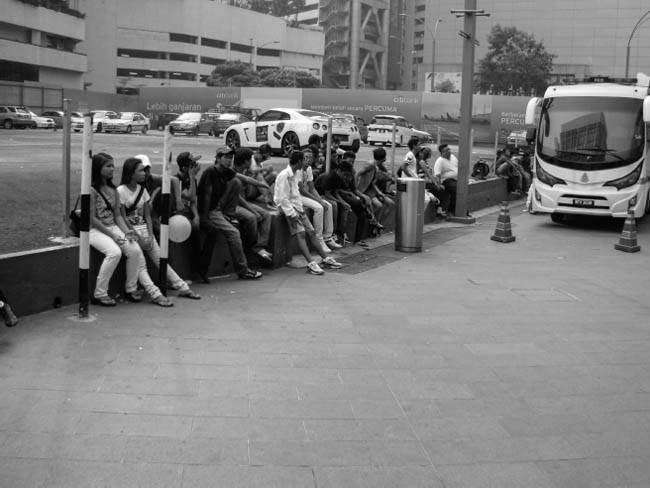
Secular Muslim youth in Bukit Bintang, Kuala Lumpur
On the other hand, some Malay youth transgress normative and liberal Islamic limits in their public conduct with members of the opposite sex. For instance, during June 2012, I saw two teenage Malays engaging in public displays of affection on a public train. The young girl seemed to be around sixteen years old and wore a short tudung that covered her head and came down just below her neck but far above her bosom. She wore tight jeans and a blouse. The boy seemed to be around seventeen, wore jeans and a T-shirt, and sported a punky hairstyle. They playfully tussled with each other. Then they stood close together, leaning against the side of the train, and the boy began to caress the girl’s face and hair. A Chinese family, several adult women, and children occasionally looked at them. Similarly, in June 2012, I observed a young Malay couple sitting together in an intimate fashion and engaging in body contact in a McDonald’s restaurant in Bukit Bintang. The girl wore a short, light blue tudung with jeans and a blouse, and the boy wore jeans and a casual shirt. She was sitting in her seat, facing straight ahead, and the boy was sitting facing her with his legs open, with one knee around her buttocks and the other in front of her knee. He rubbed and caressed her, stroking her head, face, and shoulders. One of the young Malay female employees, sweeping and mopping in that area, smiled and seemed to tell him to calm down.
But he continued to sit as he was, and the worker continued doing her job. Other Malays in the restaurant did not say anything to the couple. When I left, they were still sitting together in the same fashion and the boy was still caressing her. These practices, which I occasionally noticed around Melaka and Kuala Lumpur, explicitly violate sharia laws and ethics and embody secular senses of self, pleasure, and individual freedom.In addition to attire and public comportment, activities surrounding the performance of daily prayers and opening the fast during the month of Ramadan embody piety and cultivate humility, obedience, and remembrance of Allah. Masjids and prayer halls in neighborhoods establish the five daily prayers, but most local residents are in other areas of town during the morning and afternoon, working and performing household chores. However, there are prayer halls in government buildings, shopping centers, and transportation hubs. These suraus distributed throughout society are active centers for worship during the day, especially for the early afternoon and late afternoon prayers, Zohor and Asr, and sometimes for evening prayers (Maghrib) while people are in transit, returning home after work. In Malaysia, masjids and suraus generally have separate sections or rooms for men and women to perform their obligatory daily prayers. I often saw men and women scurrying into prayer halls in shopping centers and transportation hubs. At times they had to stand in long lines to perform their ritual ablution (wuduh) at faucets and pack into rows to perform prayers collectively or stand in the back and make prayers individually. Likewise, during the month of Ramadan, when Muslims are fasting from before sunrise to just after sunset, special Ramadan markets are erected across town that are popular with Muslims and non-Muslims. They begin selling food a few hours before the daily fast is set to end. Many Muslims will purchase their meals at these markets and take them home in order to open fasting (M. buka puasa) together with their families. In fact, I found that most middle-class Malaysian Muslims preferred to have their fast-opening meals (ifṭhār) at home. Masjids and prayer halls offer free meals during the month of Ramadan to all worshipers, but most of those in attendance tend to be lower-class and poor Muslims. I participated in ifṭhār at masjids and prayer halls on several occasions. Around thirty minutes prior to the time for the evening prayer, Muslim men and women, in separate sections, will form rows sitting on the floor, and attendants place small containers with dates, cakes, and fruit along with bottles of water in front of each worshiper. An ustaz (learned Muslim) can usually be heard reciting the Qur’an over loudspeakers, and worshipers engage in individual prayers as the time for the daily fast winds down. At the moment people hear the call to prayer (adhān) being recited, they can begin to eat and drink. Following this snack, evening prayers are performed, people reform rows on the floor, and larger meals are distributed to the congregation.
Many working- and middle-class people prefer to open their fasts with friends and relatives at restaurants if they are not having ifṭhār at home. On several occasions I opened my daily fast together with scores or hundreds of Muslims at restaurants. In these sites, Muslim stand in line to purchase their meals and drinks and then find seats at tables, where they set their food until the call of prayer, which can be heard from a nearby masjid or surau in the case of outdoor venues or over public communication systems or from someone’s telephone at indoor restaurants. For instance, in August 2011, I sat at a McDonald’s in Kuala Lumpur Sentral, a transportation hub, waiting to open my daily fast together with scores of Malays who filled most of the tables and counters. There were fewer Malays there on this occasion than earlier in the month because many had already returned home for Hari Raya Aidifitri, the celebration at the end of the fasting month. At some tables were young, seemingly unmarried Malay couples who appeared to be taking this special time to spend with their romantic partners. At one table sat a middle-aged woman with five young Malay women. At the counter sat several young Malay men. We heard adhān, perhaps from someone’s phone, and began to make our supplications (doa) to Allah and open fasting. These public performances of piety, enacted either in religious institutions or in restaurants, embody Islamic ethics and virtues.
These and other public practices illustrate that ethical notions are integral to broader processes of Islamic resurgence and increasing implantation of religious values and norms throughout society. The authoritative discourses of government ulama, Islamic NGOs, Muslim political parties, and global Islamic revitalization movements have clearly affected the daily practices of many Malaysian Muslims. On the other hand, the widespread cultivation of pious dispositions creates an upward pressure on authorities to formulate discourses and policies that are more sharia-compliant. Indeed, growing numbers of youth fostering and exemplifying virtuous selves cry out for a greater institutionalization of religion that would more closely reflect their inner feelings and experiences.