The revelation of Islam: the Wor(l)d and its understanding
2.4.1. Translating Sari‘ah in human life: the normative science of fiqh
The time has come to investigate how Sari‘ah is translated in the world by the human understanding of God’s revelation and the central role to this aim of fiqh as a normative science.
This is quite a different issue from what we have just examined in dealing with the translation of religio into bios, moving from the Western Temple of modernity to the Muslim way of life. As we approach the other side of the bridge, the space of Islam has now to be further disclosed by considering how the revelation is rendered in terms of Islamic nomos. In particular, how is law conceived within the Muslim world as part of Islamic din?With reference to the hadith of Gabriel, we have just seen how din comprises the contents of faith, imdn, the practice of isldm and ihsdn, the internalisation of the faith. None of these three components exactly matches the idea of ‘law’ in a Western perspective, while combining aspects of obligation, value, and virtue. If ‘Western scholarship... has rarely presented Islamic law in such a way as to demonstrate its values rather than the values of the observer’ (Calder, 1996, p. 979), it is by considering the translation of God’s Word into the human world as the quintessential purpose of the science (ilm) offiqh that our investigation can come closer to the ‘aqd as the vehicle of Islamic nomos (Chapter 3).
In a recent overview of the topic, Anver M. Emon (2016) writes that ‘f]iqh is a curious term of art, let alone genre of literature, in Islamic legal history,’ whose meaning is usually rendered, as it is in the entry by Ignaz Goldziher and Joseph Schacht (2012) in the Encyclopaedia of Islam, as ‘understanding, knowledge, intelligence;’ it is ‘the technical term for jurisprudence, the science of religious law in Islam. It is, like the iurisprudentia of the Romans, rerum divinarum atque humanarum notitia and in its widest sense covers all aspects of religious, political and civil life’ (ibidem).
Emon recalls here the Roman idea of iurisprudentia, rendering fiqh as a kind of ‘jurisprudence’ (a translation which is widespread in academic literature) that is specifically devoted to the religious law of Islam (what Schacht defined as ‘sacred Law’).However, the reference to ‘jurisprudence’ and ‘ iurisprudentia’ raises difficulties regarding the translation of fiqh when this is related to a principle of non-identity. On the one hand, if the English meaning of jurisprudence (covering legal theory and philosophy in common law systems) may cover the realm of usul al-fiqh (the ‘roots,’ ‘principles’ of understanding - i.e. fiqh legal methodology), it excludes the field of furu‘ al-fiqh (Islamic substantive law in the form of ‘branches’ of knowledge) as the main subject of investigation for fiqh scholars. Moreover, the extract from the Corpus Iuris Civilis to which Emon refers (both in Institutes 1.1.1 and Digest 1.1.10.2, ‘iurisprudentia est divinarum atque humarum rerum notitia, iusti atque iniusti sciential ‘jurisprudence is the knowledge of things divine and human, the science of the just and injust’) does not refer at all to religio (the word itself is not mentioned in the passage). The original text deals with ius as normative science, and prudentia, ‘care,’ ‘attention,’ ‘prudence’ in terms of ‘practical wisdom’ (see also later, section 2.4.3). If one can agree that prudentia is the virtue par excellence of the scholars offiqh (the fuqahd', sing. faqlh), how does their wisdom translate the divine Word in the human world? What is the role of religion in the normative process?
In a space whose boundaries are not conceived of in form of visual separation but of an acoustic continuity that brings together this world (dunyd) and the hereafter (al-dkhirah) as ‘simultaneously related with centers everywhere and boundaries nowhere’ (McLuhan, 1989, p. 71; see section 1.3.3), the sacrum intrinsically belongs to the real as God’s creation. The peculiar nature of this space has been meaningfully described by Clifford Geertz as being
in its essence imperative, a structure not of objects but of wills.
The moral and the ontological change places, at least from our [Western] point of view. It is the moral, where we see the “ought,” which is a thing of descriptions, the ontological, for us the home of the “is,” which is one of demands.... The “real” here is deeply moralized, active, demanding real, not a neutral, metaphysical “being,” merely sitting there awaiting observation and reflection; a real of prophets not philosophers.(Geertz, 1983, pp. 187-188)
In this ‘real of prophets not philosophers’ the translation of the divine Word into the world occurs by echoing the divine revelation into human reality in the form of a practical wisdom, where the Pathway of Sarl‘ah offers the ‘roots of knowledge,’ usul al-fiqh, the sources of the pre-scribed Law, as much as it nourishes the ‘branches of knowledge,’ furu‘ al-fiqh, which, in turn, de-scribe the law for human actions. As God is the only Wor(l)d-giver (Lawgiver and all-Omnipotent Creator), the meaning of fiqh cannot be solved by maintaining the rationales of Western law-religion, nor can it replicate a distance between the profane and the sacred (as implicitly assumed in Schacht’s definition of the ‘sacred Law of Islam’); rather, it must be replaced by an instance of the sacred into the real as a distinctive manifestation of Islamic bios (see later section 2.4.4). It is by linking ‘fact’ and ‘law’ that fiqh rationales can be disclosed in terms of a ‘conceptual replica of social life, not necessarily aspiring to be either complete or practical, but balanced between revelation, tradition and reality, all three of which feed the discussion and exemplify the concepts’ (Calder, 1996, p. 981). In this law-religion space ‘[t]he literature of usul identifies the divinely revealed sources of the law (Qur’an and Sunnah), auxiliary sources (like consensus - ijma‘) and the hermeneutic disciplines which permit the complex intellectual cross-reference between revelation, tradition and reality which is exemplified in a work offuru° (ibidem).
2.4.2. The dictum of the revelation as pre-scribed Law and the usul al-fiqh
The revelation of God as the only Wor(l)d-giver represents the core of fiqh normativity. God's Word is engraved in the world and makes it sacred in Muslim life (bios) as God's immediate creation. Accordingly, any person's right (haqq) derives from God's Word, which is the way through which Truth has been communicated to mankind and, in this sense, it is the (Real) World that precedes the world experienced by human beings. The ontological inscription of God's Word into the world can be seen engraved in the walls of any mosque (Figure 2.1). Above all, its deontological presence is persistently heard in the recitation of the Qur'an by Muslim believers (see section 2.4.5).
The act of recitation brings our discourse back to the comparison between God's Word in Islam and Christianity (see section 2.1), given that the textual character of the Qur'an, as highlighted by Brinkley Messick is ‘quite different from that of the Bible, or at least the Gospels, which are considered humanly authored and which constitute a “book” in a sense closer to the
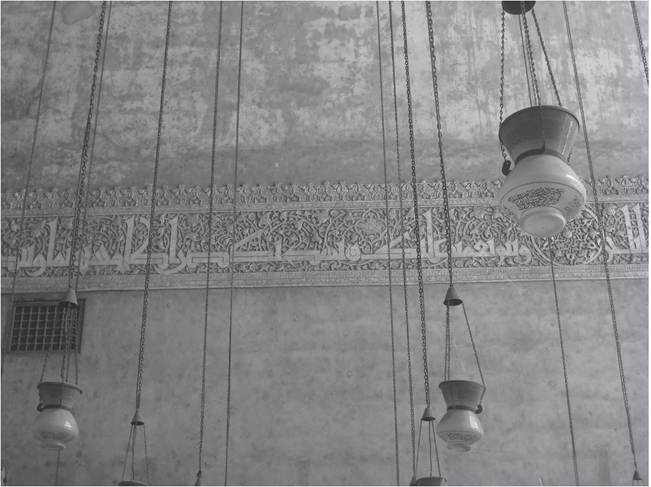
Figure 2.1 The Word engraved in the world (Kufic inscription of Qur'anic verses in the Mosque-Madrassa Sultan Hassan, Cairo; author's photograph, 2009)
contemporary Western meaning’ (Messick, 1993, p. 22). By contrast, the Qur’an,
[r]eceived orally by a Prophet who, according to doctrine, could neither read nor write,... is a recitation-text. The Prophet was instructed by the Archangel Gabriel to “recite,” and the Quran, an extented “recitation,” was received by him and then orally reconveyed in this way to his companions. As the Quran circulated in the world, recitations were repeated and memorized, the text was preserved in human hearts, and, in the event, a discursive style was set in place. The Quran’s written form, the physical text located “between the two covers,” would always be backgrounded in relation to its emphasised recitational identity.
A century ago, Snouck Hurgronje urged Western scholars “to give up the erroneous translations of Quran by ‘reading,’ and [the root verb] qara'a by ‘to read’ ” [in favour of the idea of ‘recitation’: qird'ah].(Messick, 1993, p. 22)
The very nature of the Qur’an as ‘recitation’ (and not as ‘book’ or ‘reading’) is, probably, the crucial aspect that must be considered to deal appropriately with the acoustic space of Islam (sections 1.3.3 and 2.4.5). To further elaborate this point, a preliminary disclosure is required with regard to the Wor(l) d of Islam in relation to what Ian Netton defines as the ‘Qur’anic Creator Paradigm,’ whose God ‘(1) creates ex nihil^o; (2) acts definitely in historical time; (3) guides His people in such time; and (4) can in some way be known indirectly by His creation’ (Netton, 1989, p. 22).
In Islam, the surrender of the believer (muslim) to God is complementary to God’s omnipotence. Allah is the Lord (rabb), the original Owner of all that He creates, and the believer is his/her ‘abd (‘slave,’ ‘servant,’ ‘agent’),18 with the root ‘-B-D carrying connotations of both worship and service that reappear in the notion of ‘ibdda (pl. ‘ibdddt), ‘act of worship.’ The absolute freedom of God’s will (irddah) is the direct manifestation of His omnipotence (Hourani, 1985; Gimaret, 1990; Burrell, 2008, pp. 144-145). ‘What He wills, is and what He does not will, is not,’ writes Al-Ghazali (d. 505/1111), in his doctrinal kaldm work al-Iqtisdd fi'lT‘tiqdd (quoted by Ormsby, 1984, p. 192). This extends to the least, seemingly insignificant, occurrence: ‘not even the casual glance of a spectator nor the stray thought in the mind come to be outside the sphere of His will’ (ibidem). Will is also expressed by the term masht'ah, ‘volition,’ and so it is that the word shay', ‘thing,’ deriving from the same root, is sometimes glossed as ‘what has been willed [by God] to exist’ (ibidem). ‘To Him is due the primal origin of the heavens and earth.
When He decreeth a matter, He saith only “Be,” and it is’ (Q. 2:117).19 God’s command (‘Be! and it is,’ kun fa-yakun) rules any event in time. In every instant, coherently with an atomic theory of time, God is creating the world anew: ‘[f]rom the “Be!” of a person’s creation to the time of death, human existence falls under the decree of God: Allah is the Lord of each instant; what He has determined happens’ (Lowering, 1997, p. 58).Accordingly, within the Islamic universe of sense, each instant is an act of God’s instance (a case for the believer to submit to His will). This is a core point to understanding the very nature of the Qur’an as a ‘text’ whose recitation happens in a reality where time ceases [to flow] and space vanishes.20 God creates by locating each event as single occurrences that are co-existent with no distance (hence, no space) between the divine Word and the world; correspondingly, the presence of human action in time determines an instance of moral action for the believer (a ‘request’ of adherence to din by submitting to God’s order in the ‘no time’ of the instant). Muslim jurisprudents understood time in moral terms, in their attempt to balance submission to the divine commands and practical choice in temporal life (Farahat, 2022). Within this moral conception, as God’s revelation interrupted the (ontological and deontologi- cal) silence of the desert by establishing an acoustic space of salvation, so the recitation of the Qur’an by the believer verbally re-affirms this acoustic space. This is the space that provides the Right Path for the traveller; it is the Way (Sari‘ah, lit. ‘the road leading to water’: Q. 45:18) that replaces the no-where of the desert (an absent visual space made of ‘distance’) with the now-here of running water (a present acoustic space made of ‘instance’ in human action). By surrendering to God, the human being becomes the recipient (mahall) of the Way pre-scribed by Law (what has been already established in the divine Wor(l)d of the Qur’an).
Given this background, the understanding (fiqh) of the Path (Sari‘ah) becomes the specific knowledge of divine and human things which relate to din, the Islamic way of living which is witnessed by the recitation of the Word. The knowledge (fiqh) of the dictum of the revelation provides guidance for salvation through the ‘roots, principles of understanding’ (usul al-fiqh) (Zysow, 2013). To make human beings responsible for their actions, God has given the Qur’an, ‘what is recited,’ and sent the Prophet as a reminder of the Message. If Sari‘ah is eternal and ever-lasting as pre-scribed Law, the worldly performance of the rule by the believer implies its move (its translation) from the transcendental to the empirical, where the human understanding (fiqh) of the rule (hukm) de-scribes the revelation. 'Ilm al-fiqh, lit. ‘science of comprehension,’ is the discipline aimed at understanding God’s Guidance, Sari‘ah, by deriving from the usul al-fiqh, the ‘roots,’ ‘principles’ of understanding (i.e. the divinely provided sources of Law: Qur’an and Sunnah, the Prophet’s way of life as transmitted through His ahadith; plus auxiliary sources, like consensus, ijmal, and analogy, qiyas) the ‘branches’ (fund) of rules for a proper Muslim life (religion as din, bios). Thus, in this sense, the meaning of Sari‘ah equals that of din: ‘for the Muslim the whole religion itself is in a very real sense a synonym of God’s guidance: Islam is “being rightly guided” ’ (Netton, 1989, pp. 24-25).
Alongside the nature of the Qur’an as recitation that has been mentioned previously, another fundamental element, often neglected in legal scholarship, confirms the acoustic nature of ‘being rightly guided’ in Islam. In fact, with regard to the Sunnah, the authority of reports about what the Prophet had said or done depends in Muslim fiqh ‘on the existence of an unbroken and unimpeachable series of reputable and reliable word-of-mouth transmitters’ (Messick, 1993, p. 24) of the contents of the ahadith. This ‘uninterrupted chain (isnad) of trustworthy persons’ (Schacht, 1964, p. 34) discloses ‘a kind of textuality in which writing, or the text in written form, was considered secondary and supplementary’ (Messick, 1993, p. 24). ‘The privileging of the recited word over the written text and an associated concern with the specific connections of oral-aural transmission’ (ibidem) further differentiate the Islamic and the Western legal traditions in a framework of non-identity.
Moreover, just as the Word becomes direction (Sari‘ah) and ordered life (bios) by means of the discovery of God’s commands (ahkam) and its chain (isnad) of transmission, the revelation (logos) of Islam does not only say but, in fact, performs God’s Mercy: it leads man to salvation. In Islamic normativity, the distant ideal of a divine Law separated from human affairs (Western legal tradition) is replaced by an ‘instance of action’ of the rule (hukm) into the right (haqq) that belongs to the reality of God’s creation (see section 2.4.4).
2.4.3. Furu‘ al-fiqh as de-scribed law in a iurisdictio of verdicts
‘Shari‘ah may be defined as the totality of guidance that Allah s.w.t. has revealed to the Prophet Muhammad pertaining the dogma of Islam, its moral values, and practical legal rules’ (Kamali, 1998, p. 42). ‘Fiqh... is defined as the knowledge of the practical rules [ahkam] of Shari‘ah which are deduced from their detailed evidence in the sources [i.e. from the usul\' (ibidem, p. 43).21 Pursuing our approximation to the city of the ‘aqd by locating its place in the space of Islam, two additional comments can be added to the previous paragraphs on the relation between Sari‘ah and fiqh jurisprudence.
(1) As noted previously, the meaning offiqh (the ‘science of religious law in Islam:’ Emon, 2016) is much broader than that of English jurisprudence to which may correspond - roughly - the domain of usul al-fiqh, the ‘roots,’ ‘principles,’ ‘methodology of understanding.’ In fact, the core of fiqh relates to the knowledge of practical rules, the ‘branches’ (furufi of understanding derived from Sari‘ah sources. It is in this respect that Reinhart can remark how ‘Islamic law is both practical and theoretical, concerned with human action in the world, and (strictly speaking) religious’ (1983, p. 186). At the same time, the original Roman notion of iurisprudentia (humanarum atque divinarum notitia, ‘the knowledge of things divine and human’) may better illuminate the ‘care, attention for legal things’ (prudentia iuris) which inherently belongs to the practice of Muslim jurisprudence. Dealing with the translation of the Roman idea of iurisprudentia a significant point is made by Neil MacCormick when he notes that
prudentia is the normal Latin translation of the Greek phronesis, perhaps best rendered in English as “practical wisdom”. This is the same as the English “prudence”... in the sense of the “reasonable man”... who has regard for the common good as well as particular goods in his actings.... [In this context] “[l]aw” is at best an imperfect rendering of ius, for there is as much of lex as of ius in “law”. Recht, droit, diritto work better as translations, precisely in being ambiguous between the English “right” in various of its senses and the English “law” (MacCormick, 2001, pp. 80-81).
Indeed, the German islamische Recht, the French droit musulman, as well as the Italian diritto musulmano, and the Spanish derecho musulman work better than the English ‘Islamic law’ in translating fiqh jurisprudence as a distinctive science between the law (the ‘rule,’ hukm, given by God) and the right (haqq, again, provided by God). Referring to the passage of the Corpus luris Civilis that we mentioned before, MacCormick advances a more precise translation in the sense of a ‘practical wisdom in matters of right... [through the] awareness of God’s and men’s affairs, knowledge of justice and injustice’ (2001, p. 81).
How far can this definition also be applied to fiqh?
For Norman Calder, as we have seen previously, Islamic law constitutes ‘a hermeneutic discipline which explores and interprets revelation through tradition’ (1996, p. 980). Calder underlines the radical difference of this discipline from the practice of law in a Western sense, and he is right in arguing that, in the Muslim juristic discourse, the search for practical rules is ‘certainly present, but strangely hard, sometimes, to find’ (ibidem, p. 979). At the same time, the commitment of Muslim jurists to discovering God’s will within the domain of fiuru‘al-fiqh has never been purely theoretical and speculative (something that explains its distance from the science of speculative theology, kaldm). Rather, fiqh, in connecting the divine and the human, has always maintained the essence of a practical wisdom in the search for rules that echo the revelation of the Truth. In this regard, paraphrasing MacCormick’s translation, a definition offiqh can be advanced as a ‘practical wisdom in legal questions whose rationale lies in echoing God’s revelation into person’s rights.’ Fiqh interpretive effort does not remain within the boundaries of hermeneutics in the understanding of the revelation; on the contrary, the divine rule (hukm) is always linked to human acts, so as to put God’s command in action into man’s rights (huqnq). In other terms, fiqh rules are located within the person’s rights for the hukm to be performed; it is this performative aim that nurtures the prudentia offiqh in dealing with the Word. Its practical wisdom operates by ‘saying the Law’ (in Latin, ius dicere) in de-scribing the rules revealed by God.
(2) It is precisely by focusing on the translation of the pre-scribed Law of SarTah into the de-scribed law of fiqh that the rationale of Muslim jurisprudence consists in a iurisdictio that echoes God’s revelation into man/woman’s rights. This leads our discussion to investigate more closely how the pre-scribed Law (the transcendental rule, hukm) is echoed into the right (haqq) through the empirical rule (again, hukm) discovered by Muslim jurists.
In this regard, al-Ghazali (d. 505/1111) observes in his Al-Mustasfa min Tlm al-Usul (The Quintessence of Legal Theory) that ‘a rule (hukm)... denotes the dictum of the revelation when it is linked to the acts of those made responsible [inna ‘l-hukm ‘indana ‘ibara ‘an khitab al-sar' idha ta‘allaqa bi af‘al al-mukallafin\' (quoted by Moosa, 1998, p. 9). Subsequently, he defines fiqh as the ‘knowledge of revealed judgments (al-ahkam al-sar‘iyyah) associated with the actions of legally capable subjects (al-thabita li-af‘al il-mukallafin) ’ We can note from both the passages how the link between God’s decree (hukm) and the action of the responsible human being (mukallaf) (the person legally capable, so under taklif, ‘legal charge or obligation to act’) lies at the heart of Islamic law. It is between the dual nature of the rule, hukm (first transcendental, as pre-scribed Law, and then empirical, as de-scribed law) that the right, haqq, can be related to the responsibility of the mukallaf. The haqq makes ‘real’ the divine Word in the world (see also section 2.4.4); the revealed rule (hukm, pl. ahkam) finds its ‘real’ meaning ‘when it is linked to the acts of those made responsible.’ This matches the moral nature of reality as God’s creation, where human beings are constituted in their ethical existence as ‘by way of word' (Stelzer, 2008, p. 169). Within this peculiar iurisprudentia, Islamic law de-scribes human rights (huquq, pl of haqq) in the world of social reality as direct manifestation of the Law pre-scribed by the revealed Word. More precisely, the practical wisdom of Muslim jurisprudence resides in ‘echoing the divine revelation’ by ‘stating the law’ (ius-dicere in Latin): a iuris-dictio that consists in making explicit, manifest the Wor(l)d of Sari‘ah, so that the discovery of the divine rule leads to the delivery of a verdict (from the Latin vere- dictum, ‘to say the truth’) for the particular case under consideration. This confirms a logic where, Allah being the only Ruler, the transcendental hukm of the Word, the pre-scribed Law, precedes any right (haqq), which is de-scribed in Islamic law.22 At the same time, the verdict is never an isolated assessment by the singular jurist; on the contrary, it is part of a collective construction of fiqh iurisdictio in a long-lasting tradition of knowledge that belongs to the madhahib (the schools of law as ‘ways of going’ along the Path of Sari‘ah: in the Sunni universe, the Hanafi, Maliki, Safi‘i, and Hanbali schools: see later in Chapter 3). The intersection law-fact makes the understanding of the rule, bound, on the one hand, to the revealed proofs of the transcendental rule (hukm)23 and, on the other hand, to the right (haqq) as direct effect of the empirical dimension of the hukm. Accordingly, if in the making of Islamic law it is the delivery of a verdict by the single Muslim jurist that nurtures the process of discernment, the discovery of the rule finds its epistemological unity through its transmission in each legal school (madhhab), within ‘a discipline that explores tradition, and uses tradition to discover (and limit) the meanings of the revelation’ (Calder, 1996, p. 980). In its centripetal fugue towards the Word (Cattelan, 2016, p. 383), fiqh tradition relates the transcendental hukm to its empirical manifestation by the ‘way of walking,’ ‘going’ (as per the literal meaning of madhhab) along the Path (Sart‘ah). While ‘Western legal theory locates the (specific, empirical) case within the (general, abstract) norm to deduce the judgment, the logic of fiqh sees law as an epistemological issue, fiqh-judgement being an atom of what constitutes fiqh-knowledge, deposited in the tradition (an echoing amplification, where the human word reflects the divine Word)’ (ibidem, p. 384).
Within the process of law-making that characterises Muslim iurisdictio as de-scribed law, the relationship between the ‘ideal’ and the ‘real’ also changes in comparison to the Western legal tradition, as we will see in the next section (section 2.4.4). This is an aspect that will finally lead us to summarise the qualities offiqhpractical wisdom in terms of a ‘law without corpus' (section 2.4.5).
2.4.4. From the rule (hukm) to the right (haqq): an instance of action in the wor(l)d
Fiqh practical wisdom locates legal questions between the divine and the human by echoing God’s Word in the believer’s life; by stating the law (ius- dicere), it tells the Truth (vere-dicere) of the revelation’s dictum. This iurisdictio (a ‘tradition of thought and of education’: Calder, 1996, p. 981) will be investigated with reference to the ‘aqd in Chapter 3. But, before moving in this direction, we still need to consider how the dictum of the revelation and fiqh tradition interact in Islamic legal reasoning. In other terms, how does the Muslim jurist move from the transcendental to the empirical rule (hukm) so as to identify what is right (haqq) according to Sari‘ah1
As previously noted (section 2.4.2), in Islam, God is the Creator of all the universe and the human being is the receiving subject (mahall) of God’s creation; God attributes acts to man by acquisition (kasb, iktisdb), for which the believer becomes responsible. Between the dogmas of divine creation and human responsibility, Ebrahim Moosa notes that, just as Sart‘ah ‘provides the interface between the eternal and the temporal,’ ‘[t]he crucial intersection of the divine will into history occurs by means of the hukm' (1998, p. 5). Hence, in Muslim jurisprudence ‘the term hukm is employed to describe two moves simultaneously: it involves an empirical judgement, as well as a transcendental judgement’ (ibidem, p. 7). Most importantly,
the authority of the empirical dimension is dependent on its relationship with the transcendental and metaphysical hukm. If we do show some awareness of these two dimensions, we will begin to understand the complexity of the human-divine interaction in the process of discovering “God’s rule” in Islamic law. The hukm proper is a transcendental norm, of which the empirical hukm is but a temporal manifestation. It is in such scenario that God is the real hakim (transcendent monothete or sovereign ruler) and the real shari‘ (Supreme Legislator).
(ibidem)
On the one hand, the sacred Law, ^re-scribed in the revelation, appears to the Muslim jurist as a ‘decision (hukm) of the Ruler (hakim), whose essential object (mahkum bihi) is the qualification of human actions according to God’s will and the determination of their effects, the rights and obligations of human beings; the decision is addressed to the person, who is subject to the rule (mahkum lahu, ‘alayhi)' (Milliot and Blanc, 2001, p. 171; my translation). On the other hand, the de-scribed law, in stating the truth of SarTah, qualifies the moral performance of the ethical being in the life (bios) of any Muslim believer. It is in this precise sense that ‘[h]umans can therefore not be adequately understood in their ethical dimension as already constituted beings “before the Law” who are then asked to find out by which means they will reply. Or rather, they can be understood in this way only because the law as a particular manifestation of the divine Word constitutes them by way of word' (Stelzer, 2008, p. 169).
In the understanding of SarTah, fiqh practical wisdom moves from the roots (usul) towards the branches (furu‘) of substantive law, whose rules are located in the real life of the individual Muslim believer - never in an abstract generalisation, as in Western legal tradition. Proofs of the revelation detached from the reality of the creation are like a voice without a medium of transmission; human reality without the revelation is like a moral desert deprived of salvation. The real provides the setting for God’s Guidance (SarTah) about how to sort, filter, and interpret the proofs of the revelation, turning them into operative norms of human conduct. With this purpose, Muslim jurisprudence refers to the notion of sabab (the ‘empirical circumstance’ to whose existence or appearance the rules of Law are linked). Sabab, as the underlying ‘reason’ for human action (directly dependant on its ‘divine cause,’ i'lla, in the revelation), relates in Islamic theology to the innate accessibility of human reason (‘aql) to moral knowledge, discerning through Qur’anic indicators (adillah) the status (hukm) of the action revealed by Sarffah.24
It is in the move from the transcendental to the empirical hukm that the materialisation of God’s Law implies its contextualisation within the specific social reality by the Muslim jurist in order to de-scribe man’s right (haqq) as human law. Thus, in this sense, ‘a rule (hukm)... denotes the dictum of the revelation when it is linked to the acts of those made responsible’ (al-Ghazali, see section 2.4.3, italics added). The point is remarked in contemporary scholarship also by Mohammad Hashim Kamali: ‘hukm is defined as a communication from the Lawgiver concerning the conduct of the mukallaf (legally competent person) and consisting of a demand (something obligatory [wajib] or prohibited [haram]), an option (takhylr), or an enactment (wad‘)' (1993, p. 347). The centrality of the rule in Muslim jurisprudence is confirmed by a normative ethics that derives from the concept of hukm the taxonomy of the ‘quintuple qualification’ (al-ahkdm al-khamsa, lit. ‘the five states,’ ahkdm, pl. of hukm). In the framework of the ethical status of the action created by God, Muslim jurisprudence collocates any human act into one of the five status already established by God: (1) obligatory, duty: wdjib, fard; (2) recommended: sunna, mandub, mustahabb; (3) neutral, indifferent: mubah; (4) reprehensible, disapproved: makruh; (5) forbidden: hardm (whose opposite is haldl, not forbidden) (Schacht, 1964, p. 121; in relation to the contract, see later section 3.3.2).25 Therefore, the task of the Muslim jurist is not to qualify the action (its status is already established by God); the effort, ijtihdd, of the jurist is to find out how the ‘right,’ haqq, belongs to the ‘real,’ again, haqq.
So, while the divine rule establishes the status of the human act, the rights, huquq, are the means thanks to which God realises (in the sense of ‘making real’) the rule, hukm, as empirically known by human agents. The term haqq stems from the Arabic root H-Q-Q, whose primitive meaning was ‘to carve’ (on wood, metal, or stone), and later, ‘to be real, true, legal, right, correct;’ notably, the idea of carving brings to mind the divine Word carved into reality (Figure 2.1). ‘[A]lthough the primary meaning of haqq is “established fact” or “reality” (al mawjud al thdbit), in the field of law its dominant meaning is “truth” or “that which corresponds to facts”. Both meanings are equally prominent’ (Kamali, 1993, p. 342).
The primitive sense of haqq is “established fact” (al-thdbit haqiqat™), from which “reality”, and the sense: “that corresponds to the facts”....................................
“Haqq... is one of the names of God... and it appears several times in the Qur’an with this meaning.... But the usage of haqq in the Qur’an, in the Islamic traditions... and in the Arabic literature in general is not limited to the divine name; it can designate all the “reality”, every “fact”, all the “truth”.... Another meaning of haqq (pl. huquq), deriving directly from the first sense, is “demand” or “right”, as legal obligation... this usage of the term is already utterly developed in the Qur’an.... To sum up, the meanings of the root H-Q-Q, from that of the “carved” statute, valid and permanent, have extended to the ethical concepts of legal and real and right and true, and developed till including the divine and spiritual reality.
(MacDonald and Calverley, 1975)
It is by merging the hukm and the haqq that fiqh practical wisdom translates the divine into the human. The legal question, which holds in itself a demand for action, determines a statement of the right (an iuris-dictio) by means of a verdict (vere-dictum) that echoes the dictum of the divine Word into the human wor(l)d. This interpretation of the couple hukm-haqq confirms Clifford Geertz’s translation of haqq as ‘right’ and hukm as ‘law, rule,’ ‘from a root relating to delivering a verdict, passing a sentence, inflicting a penalty, imposing a restraint, or issuing an order’ within ‘a vision of reality as being in its essence imperative, a structure not of objects but of wills’ (1983, p. 187).
An article by Andrey Smirnov (1996), dealing with the cosmological background of Muslim jurisprudence, can help to further elaborate on the distinctive connotations of fiqh in comparison to Western jurisprudence.26 Smirnov’s analysis moves from the conception of truth in Islam, underlining how Truth, as the core of Muslim jurisprudence, ‘though of supreme (divine) origin, is not at all unearthly... [as] it is presented to us’ (Smirnov, 1996, p. 338; italics in the original text). ‘The truth, established and secured by its certainty, makes no distinction between “momentary” and “eternal”. The truth is valid not because it has ascended above the nonlasting; the truth is valid because it stands firmly established amid the flow of things nonlasting’ (ibidem) as prescribed Law. There is no ‘ideal’ in such truth detached from the ‘real,’ as in the Western tradition of legal thought; the deontological is not remote from the ontological. On the contrary, coherently with the ‘atomic theory of time developed in classical Islamic thought’ (ibidem, p. 339; see also Lowering, 1997), the truth of Islam ‘preserves its identity in any of the possible temporal transformations. To be true does not mean to be un-associated with time; to be true means to stay one and the same in the flow of time’ (ibidem, p. 340). Far away from the distance between the ideal and the real of the Western philosophical tradition (with the logical implication that the ideal becomes a utopia, a no-where),27 the truth of Islam is real ‘not because it envelops time (and the temporal) but because it precedes... any given moment of time (and any given temporal thing)’ (ibidem). Accordingly, its pre-scribed Law implies for the believer an instance of action (hukm as a ‘demand’): something that is present to us now-here.
In brief, the distance of the (general) law from the (particular) fact which belongs to Western legal tradition is replaced by an instance of the (pre-scribed) Law, the Word into the world of human actions. Muslim jurisprudence echoes the former into the latter in a iurisdictio that does not aim at any ‘representation’ (with an inherent distance that separates the present from the absent: see Introduction) but, rather, at a ‘re-presentation’ of God’s Truth - in the sense of ‘presenting it again (here-and-now)’ in the flow of time, as in an echo of the revelation (section 2.4.5).
When true in this way, the truth by no means has to be a general case for all the particulars that would fall under it and thus presuppose its authority.... [In Islam] the law is not an abstract order (of things or ideas) that claims the validity of truth and has a general character... the law is a line drawn and fixed, a set of exact requirements, an exemplar. Such is the law as presented by the shari‘a and the sunna - a line of behavior, an everlasting established specimen.... The main feature of these laws, as formulated by medieval [Muslim] thinkers, appears to be their nonabstract character.
(Smirnov, 1996, pp. 340-341)
Empirical rules (ahkam) coexist one next to the other not because particulars of a general but because derived from the same transcendental rule (hukm). In Islamic normativity, it is the hukm as ‘rule in the instant/in the instance’ that makes the right (haqq) ‘real’ (again, haqq). While God creates by locating each event as single occurrences co-existent in space, human agency in time determines an instance of action (a ‘request’ of adherence to din by submitting to God’s hukm:, on the issue of the nature of moral action in relation to time, see Farahat, 2022) to which the justice of the haqq intrinsically belongs.
Three corollaries can be drawn from the previous remarks, with additional thoughts about the non-identity of fiqh in comparison with Western law-religion.
First, a fundamental coherence subsists within fiqh ‘incoherence’ when the Western pair of the general/particular is removed.28 In Muslim jurisprudence, ‘legal unity’ does not stand in an ‘ideal,’ but in the ‘preceding fixity’ that makes it possible to move from the usul to the furu‘. In the link between the secured truth and its interpretation, the ‘branch’ concept does not imply a necessity of non-contradiction with other ‘branches’ for an empirical rule to be valid.29 As a result, differences and contradictions belong to the very core of Islamic legal theory, grounded on the diversity of doctrines (ikhtildf). ‘A tree, whose network of branches and twigs stems from the same trunk and roots; a sea, formed by the merging waters of different rivers; a variety of threads woven into a single garment; even the interlaced holes of a fishing net: these are some the metaphors used by Muslim authors’ (Coulson, 1964, p. 86) to explain this phenomenon. ‘The various schools of law [madhdhib], in which such diversity of doctrine was crystallised, are seen as different but inseparable aspects of the same unity’ (ibidem).
The second corollary recalls the etymology of haqq as ‘right,’ ‘just,’ ‘real,’ and ‘true.’ The definition offiqh proposed earlier as a ‘practical wisdom in legal questions whose rationale lies in echoing God’s revelation into person’s rights’ assumes further clarity when the haqq is conceived as ‘expressing the unity of the concepts of truth, right and obligation' (Smirnov, 1996, p. 344) in
both the reality of a thing’s existence and the validity of its cognition. The true, the due, the really existent, and the really recognized serve as the foundation for each other and are mutually transformable: each presupposes the rest and brings with itself a part of the sense of others... [so that to provide the haqq in Islam] is not only and not just an act of moral righteousness; it is first and foremost done to secure the ontological stability of the thing in question, that is to say, its being truly established in the flow of change.
(ibidem, pp. 344-345)
Thirdly, all this can also shed further light on Calder’s definition of fiqh as ‘a conceptual replica of social life’ (1996, p. 981), from which our journey started. The nature of fiqh is not that of an ideal body of legal unity but of a ramified echo; a polyphony, where contradictions enjoy mutual legitimacy, since they are validly derived from the preceding unity of the divine Word (Cattelan, 2016). The Western distance ideal-real is replaced in Islamic lawreligion by an instance of action that presents again the Word in the world. ‘Justice is not to be reached as an ideal outcome of specific and exceptional efforts. Justice is a function of the ontological organization of the thing’ (Smirnov, 1996, p. 346) - a function that belongs, in the end, to a ‘real of prophet not philosophers’ (Geertz, 1983, p. 188).
2.4.5. Echoing the revelation in an acoustic space: a sacred law without
corpus
Fiqh has been defined in the previous pages in terms of a practical wisdom echoing God’s revelation within person’s rights. Our discussion has focused on the hukm as the dictum of the revelation when it is linked to the acts of those made responsible. Subsequently, it is by attributing the ‘right,’ ‘just,’ ‘true,’ ‘real’ (haqq) to persons that the science of fiqh fulfils its function as a normative discipline in the reality of social life. In this sense, Muslim normativity has never been purely speculative or theoretical; rather, by moving from the ‘roots’ to the ‘branches’ of God’s Will, it appears ‘factual’ by anchoring rules to a ‘real of prophets not philosophers’ (Geertz). It is for this specific reason that, adhering to the specificity and casuistry of real life, fiqh becomes ‘a conceptual replica of social life’ (Calder) which is deprived of any abstract idealism; in brief, the sacred Law, the Wor(l)d, is present now and here in each instant of Muslim life (bios).
At this point, recalling the metaphor of the desert to which I referred in Chapter 1 (see section 1.3.3) may help to reach some conclusive remarks. In Islam, as Louis Milliot has pointed out,
[t]he Shari‘a is the Path, the way to be followed, daily concern of the inhabitant of the desert, here symbol of the believer’s anxiety. The same idea can be found in the term Sunna, the way followed by the Prophet, that is to say, Imitation of God’s Envoy; and in the term madhhab that we imperfectly translate as “rite” or “school” and that is, in reality, the “direction” to take, indicated by the Masters. As far as fiqh is concerned, it is the discernment - understanding, explanation and interpretation - of the Shari’a, the revealed Law.
(1952, p. 670; my translation)
The SarTah is the Route that provides salvation to the traveller lost in the desert; a place where no visual references are available. It is in the moral vacuum symbolised by this ethical desert (a state of ignorance, jdhiliyya, of the ‘real’ good, where man is fated to ruin: see Izutsu, 1966) that God’s Mercy intervenes by interrupting the silence and locating the believer in the acoustic space of the Word. The revelation provides the Right Path for the traveller in search for salvation; it is the Way, SarTah, that replaces the no-where of the desert (the absence of a visual space made of ‘distance’) with the now-here of present running water (which then calls for an ‘instance’ of action). Thus, the Sari‘ah, the Way to the water, qualifies the actions of a Muslim life as Islamic bios (din), outside of which there is no possible salvation. As God’s omnipotence makes any instant complete in itself, fiqh locates human responsibility in the precise life-situation of Muslim reality as understanding, explanation, and interpretation of Sari‘ah. It translates God’s pre-scription into the real, true, and just of man/woman’s right (haqq), making the believer responsible for his/her actions by a process of de-scription of the revelation, within an iuridictio that states the truth, vere-dictum, of the Message (section 2.4.3). By conceiving the right as rule-in-the-real, ‘if on the one hand the pre-scription (hukm) of the Law is discovered through the revealed juridical proofs (usul), on the other the jurist has to justify the right (haqq) through a verdict describing the fact in the furu‘, for the... law to be validly stated (found) for the given situation’ (Cattelan, 2016, p. 368). In the process of justification of the rule-in-the-real as linked to the right, the contingency of the empirical rule is co-determined by the everlasting certainty of the transcendental rule ‘[u]nder a criterion on probability... [where] a plurality of norms co-exist as possible interpretations of God’s will, leading to the ramification of rules in the furu° (ibidem, p. 375). This explains why, as remarked by Wael Hallaq, ‘stating the law’ as a system of general and abstract norms, according to the Western model of codification (Chapter 4, Section 4.3), has no space in the Islamic legal tradition.
Shari‘a’s law was not an abstraction, nor did it apply equally to “all,” for individuals were not seen as indistinguishable members of a generic species, standing in perfect parity before a blind lady of justice. Each individual and circumstance was deemed unique, requiring ijtihad that was context-specific.... [T]he law was an ijtihadic process, a continuously renewed exercise of interpretating. It was an effort at mustering principles as located in specific life-situations, requiring the legists to do what was right at a particular moment of human existence... to resolve a situation in due consideration of the unique facts involved therein. As a fully realizable and realized worldly experience, Islamic law was not fully revealed unto society until the principles meshed with social reality and until the interaction of countless social, moral, material and other types of human relations involved in a particular case was made to come full circle To know what Islamic law was, therefore, is to know how
actual Muslim societies of the past lived it.
(Hallaq, 2009, pp. 166-167)
Calder’s description of Islamic law as ‘a conceptual replica of social life’ matches Hallaq’s view, which also ‘explains why Islamic law never accepted the notion of blind justice, for it allowed the rich and the powerful to stand on a par with the poor and the weak’ (ibidem, p. 166); correspondingly, as we noted in the Introduction, the Western allegory of Lady lustitia is absent in the Islamic legal tradition. At the same time, this sheds light over the particularistic approach of the fund, with a casuistry which ‘is part of doctrine, not an exterior element that explains it’ (Johansen, 1995, p. 156). In the same way in which this casuistry looks like an improper legal corpus from a Western perspective (the ‘body’ of the Arab Girl, metaphor of the Orientalistic bias of Western compa- ratists: Figure 0.1), a sense of confusion may be felt by the Western traveller with regard to the admissibility by Muslim jurists of disagreement (ikhtildf) and contradictions as constitutive elements of their elaboration. In fact, the divergence of verdicts (the de-scribed law of fund), as we have seen, does not undermine at all (rather, it nourishes in ‘branches’) their shared convergence to the Truth (the pre-scribed Law of usul). It is in this conceptual framework that fiqh practical wisdom echoes God’s revelation: as the echo can be heard differently from different amplifying surfaces, so, by listening carefully, all Islamic law derives from a unique original source, the Word of the revelation. Echoing
God’s will while amplifying it, a “centripetal fugue”, a “polyphony compressed”... describes the history of fiqh... if fiqh-judgement in the fact/law interplay implies a ramified casuistry, a polyphony (furu^) of legal opinions, it is the tradition of fiqh-literature that guarantees its epis- temic unity, the centripetal nature of fiqh-knowledge in the narrative function... resulting from the record of verdicts.... [Hence] the tradition defines the constant continuity, the echoing, of the explanatory function offiqh in “actualizing” (by amplification) God’s message in the everyday life of the Muslim community and by answering practical problems that emerge from social differentiation.
(Cattelan, 2016, p. 383)
Therefore, in Islam, not only is fiqh ‘a conceptual replica of social life’ (Calder), but its practical wisdom describes human nature as agency of the divine Word, where individuals as ethical beings can be ‘understood only because the law as a particular manifestation of the divine Word constitutes them by way of word' (Stelzer, 2008, p. 169). Correspondingly, the guidance offered by fiqh scholars is also the channel through which, in the ramification of fund,
the mundane, earth-hugging realities, including new factual developments, were formally noticed by and reflected upon by qualified scholarly minds, leading to analogical extensions of the body of legal knowledge. In a dialectical manner, locally generated questions were related to locally interpreted jurisprudence. Muftis [i.e., fiqh scholars] were the creative mediators of the ideal and the real of the shari‘a.
(Messick, 1993, p. 151)
Within the nature of fiqh as iurisprudentia by way of word, McLuhan’s paradigm of the acoustic space (section 1.3.3) can finally illuminate (a) why contradictions do not affect the epistemic unity offiqh-tradition; and (b) why this tradition (outside the visual space of Western law) has never enjoyed the quality of a corpus iuris.
(a) In section 1.3.2, we noticed how normative pluralism belongs to ‘the mutually constitutive relationship between Islam and Muslims:... how Islam makes Muslims as Muslims make Islam’ (Ahmed, 2016, p. 543). The unity of pluralities in Islamic law precisely characterises ‘a human and historical phenomenon... constituted, not merely by immense variety and diversity, but by the prodigious presence of outright contradiction’ (ibidem, p. 542). Casuistry and contradictions do not represent a limit; rather, they are an inherent part of a juristic rationality that necessarily grows ‘not by elimination of difference but by inclusion of difference,’ in a ‘logic of difference and contradiction [that is]... coherent with and internal to Islam’ (ibidem). The valid co-existence of contradictions in a ramified knowledge (fund) matches the pair contingency-certainty, within an epistemic unity grounded on a plural iurisdictio that de-scribes the pre-scribed Law by verdicts. It is the dictum of the revelation (God as the only Word-giver) that implies the epistemological unity (certainty) of fiqh, just as the different waves of sounds coming from the same source define an echo in human space; (human) contra-dicere does not alter the unity of the (divine) dictum. The coherence offiqh-knowledge belongs to an acoustic cognitive space that, as noted by McLuhan, grows without separations and boundaries (precisely as a route that cannot be traced with margins in the desert). As the Word provides orientation to the stranded traveller in the desert, so it shapes an acoustic space, a Wor(l)d of salvation, the Path of SarTah, whose ‘right’ human intellect is asked to discern. The co-existence of concordant and discordant rules, in the end, constitutes the distinctive nature of an acoustic iurisdictio that intrinsically belongs to the contingency of Islamic law as the outcome of the elaboration of Muslim jurisprudence.
(b) In section 1.3.3, this book has already remarked how ius-dicere, ‘to say the law,’ may well substitute the allegory of the corpus iuris of the Western legal tradition to describe the law of Islam. Both the nature of the Qur’an as ‘recitation’ as well as the oral-aural chain (isnad) of transmission of the ahadith in the Sunnah (section 2.4.2) converge in this allegorical shift. In this framework, not only is it true that ‘ “a valid and sensible corpus of laws” was not what Muslim jurists had in mind’ (Calder, 1996, p. 979) but sic et simpliciter a corpus iuris could not exist within the rationales of fiqh-tradition. Since the Islamic pair law-religion belongs to an acoustic rather than visual space, the non-identity of fiqh is grounded on echoing the revelation within a legal rationality that has nothing to do with the scopic regimes of Western modernity (Jay, 1988). If ‘[t]he rational man in our Western culture is a visual man’ (McLuhan and Fiore, 1967, p. 45) and the ‘visual space is uniform, continuous, and connected’ (ibidem), in the desert (a space with no centre and no margin), the believer is asked only to rely on the Word of the Revelation. The individual is asked to (choose to) hear (the only option for salvation) and then to listen to (hence, to discern carefully) the Word in a potentially indefinite echo through the transmission of the tradition. It is this echoing, with no boundaries and no centre, its own discontinuity, replication, and nonlinearity (McLuhan), that defines a unity made of differences and contradictions (Ahmed), where the rationale of fiqh is no longer grounded in framing a visual body of law (as in the Corpus luris Civilis) but in echoing the Word of the Law. Human intellect does not choose how to frame the law; it locates the Law in the status that is already established by God. Significantly, the geometrical visual space depending on the eye of the beholder (hence, on his/her choice of ‘looking at’ as an act of will) is replaced in this way by the ‘ear of the believer,’ who ‘listens to’ the revelation as an act of intellect, thanks to the innate accessibility of human reason (‘aql) to moral knowledge. Correspondingly, the utopia (no-where) of the ideal law (Lady Tustitia) of Western tradition is substituted by the now-here of God’s creation in the non-ideal, non-abstract, non-speculative nature offiqh as conceptual replica of social life. An instance (rather than a distance) of action nourishes Islamic law, whose right (haqq) is true and just to the extent to which it corresponds to a rule(hukm)-in-the- real. Above all, moving from the ‘eye of the beholder’ to the ‘ear of the listener’ implies a radical change in what law is in the context of fiqh: a surrender of the centrality of man’s freedom in favour of the dictum of the revelation - an element that, as we will see in Chapter 3, has fundamental implications for the nature of the Islamic contract.
In summary, far removed from Western law-religion, fiqh normativity arises from a practical wisdom regarding legal questions whose rationale is not to affirm the centrality of the human being. Rather, fiqh entails a surrender (Islam) to God, an absence of human centrality, where, by echoing the revelation in the reality of social life, no corpus iuris can delimit the sacred Law of Muslim bios.
2.5.