Automated Feeders
Task-specific devices exist for feeding—such as the Winsford feeder, sold through Sammons Preston for approximately $3,800 (Fig 6.8). This is a motorized device intended for people without available arm
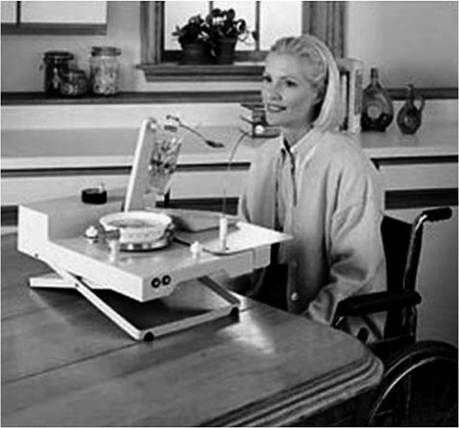
Figure 6.8 Winsford Feeder.
function. They activate a chin switch, which sends a signal to scoop up the food off a mechanized plate and present it to the user. The Handy 1 device is similar to the Winsford; however, it uses a commercially available robot that is controlled through switch operations (24). The movements are programmed to perform a selection of tasks, such as feeding, applying makeup, and shaving. The food is placed on a custom plate that has different compartments. A scanning system of lights designed into the tray section allows the user to select food from any part of the dish. For other tasks, the user selects similar programmed moves.
The Neater Eater (Neater Solutions, Buxton, UK) is a table-mounted feeding device that comes in two versions. The first is a motorized feeding arm that can be controlled by a user with little arm function, and retails for about $4,000 (Fig. 6.9). It is attached to a tabletop and can be controlled by a foot switch. A manual version is also attached to a tabletop and is for someone with some arm movement but that may be erratic or tremulous. The arm has a built-in damper that filters out unwanted movement.
Gravity-Eliminating Orthoses
A few new devices have become commercially available in this area. What makes this segment unique is that these devices are attached to an appendage (typically the arm) and provide assistance to accomplish activities of daily living. They utilize the remaining residual strength of the individual to allow voluntary movements. These devices act to amplify weak movements of the arm and negate the effect of gravity for the user so that he or she can perform tasks such as feeding easily.
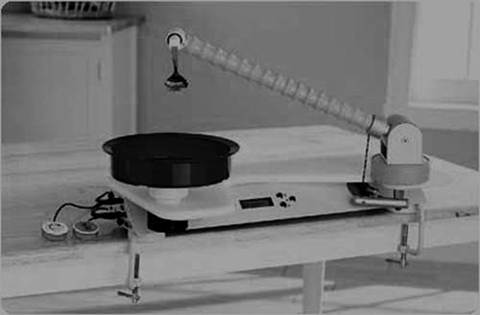
Figure 6.9 Neater Eater.
Among the earliest and most accepted devices is the balance forearm orthosis (BFO), also called the mobile arm support (Fig. 6.10). The BFO (JAECO Orthopedics, Hot Springs, AR), which is a passive (body-powered) device, was developed in 1965. It provides a person with weak musculature with the ability to move the arms in a horizontal plane through the use of two linkages that have joints along the vertical axes. One end of the BFO is attached to a wheelchair; the other end is connected to a trough into which a person places the forearm. The trough uses a fulcrum at the forearm that permits the hand to elevate if the shoulder is depressed. The BFO allows a person to move horizontally, for example, over a lap tray and to use compensatory movements to attain limited movement in the vertical direction. The BFO retails for approximately $350.
The Wilmington Robotic Exoskeleton (WREX) is a body-powered orthosis that is modular and mounted to a person's wheelchair or to a body jacket (Fig. 6.11). It is a two-segment, four-degrees-of-freedom exoskeletal arm, energized by elastic bands that aid in moving the arm in 3-D space. The WREX allows full passive range of motion of the arm and provides a sense of flotation that assists in voluntary movement (25). WREX can easily be adjusted to accommodate subjects of different weights and arm lengths by changing the number of bands or sliding the telescoping links. The device is typically mounted to a wheelchair and intended primarily for people with muscular weakness such as muscular dystrophy and spinal muscular atrophy. It is also being used for children with arthrogryposis who can walk independently by attaching the WREX to a body jacket (26). The WREX was conceived and developed at the Alfred I. duPont Hospital for Children and is now marketed by JAECO Orthopedics, Hot Springs, AR for $2,000.
Two other passive upper extremity orthoses have recently been commercialized, and both emanate from the Netherlands. The first is the Armon made by Micro Gravity Products, which is powered by springs. It is for
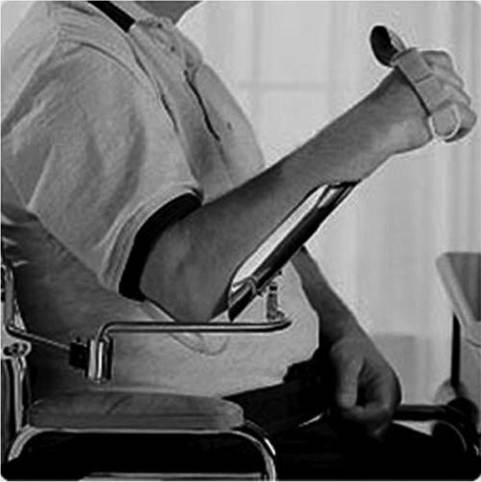
Figure 6.10 Balanced Forearm Orthosis (BFO).
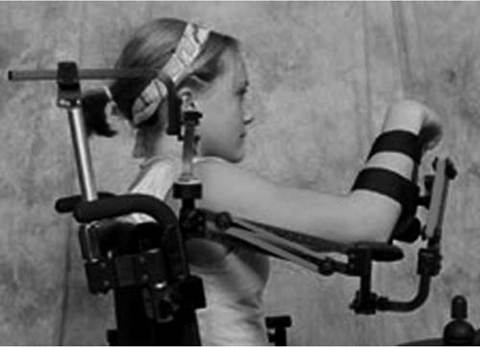
Figure 6.11 Wilmington Robotic Exoskeleton (WREX).
people with arm weakness. It attaches to the forearm of the user and provides gravity balancing. The device can be attached to the wheelchair or a tabletop. The Armon does not follow the contours of the arm. It can be adjusted by a motor to compensate for the weight of a person. The second device is called the Dynamic Arm Support (DAS) made by Exact Dynamics. It is similar to the Armon, but has a vertical movement that provides the elevation. It, too, can be adjusted for different-sized people with the aid of a motor and can be attached to a wheelchair.