BLOOD-PRODUCT TRANSFUSIONS
While blood product transfusions are life-saving, these infusions are not without risks and should be used judiciously with clear indications. It is preferable to use specifically desired blood components, rather than the whole blood in most cases.
Blood products: Whole blood is made up of plasma and cellular components, which can be separated by various centrifugation techniques. These separated blood products are further modified to meet appropriate storage requirements (e.g. frozen plasma) or reduce the risk of adverse reactions (salt-poor albumin, irradiated/ saline washed cells). In this way, single donor may be used repeatedly for various components. Some commonly used blood products in children are as follow: • Whole blood transfusion (15-20 ml/kg) should be strictly restricted to cases of—(a) massive blood loss during trauma or surgery, (b) severe anemia with shock, and (c) exchange transfusions.
TABLE 19.28: Indications for RBC transfusion1
*Preferably exchange transfusion. CP : Cardiopulmonary
Each bag of whole blood generally has a volume of 350 ml blood (with 49 ml anticoagulant), Hb content 12 gm/dl and shelf-life of ~35 days. Smaller bags of ~ 100-150 ml whole blood are also available for pediatric use.
Administration of a diuretic, e.g. furosemide (IV 2 mg/kg) during or immediately after whole blood transfusion, is preferred to avoid fluid overload. Cold blood, supplied by blood bank, should not be infused till it has reached the room temperature.
• Packed cells transfusions (10 ml/kg) with fresh or frozen and stored RBCs are preferred in—(a) severe anemia without shock, (b) transfusion therapy in thalassemia, and (c) preoperative correction of anemia (Table 19.28).
Each bag of Packed RBCs has a volume of 200 ml, Hb levels of 20 gm/dl and shelf-life of 35 days.
All complications and precautions of whole blood transfusions apply for packed cell infusions as well, except lesser risk of fluid overload. Pyrogenic reactions may be reduced by using saline-washed RBCs.• Platelet transfusions (5-10 ml/kg) are generally indicated in—(a) thrombocytopenia with internal bleeding, (b) asymptomatic thrombocytopenia of lt; 10000/mm3, or (c) when a surgical intervention is necessary in thrombocytopenic child. However, the critical level at which platelets need to be transfused depends more on the presence or expected risk of severe bleeding rather than absolute platelet counts (Table 19.29).
Each unit of platelets has a volume of ~ 50-70 ml and shelf-life of 3-5 days. These products are very prone for bacterial contamination and should be infused immediately, preferably within 30 minutes, after procurement. Do not store them in refrigerators (2-6°C) as it makes them non-functional.
Fresh or fresh frozen plasma, i.e. FFP (10-15 ml/kg) contain substantial amount of coagulation factors, albumin and globulins; and mainly used in severe multiple clotting factor deficiencies with active bleeding or before invasive procedures, e.g. liver
TABLE 19.29: Indications for platelet transfusions1
*e.g. Severe mucositis, DIC: Anticoagulant therapy, etc.
TABLE 19.30: Indications for plasma transfusions1
• Multiple clotting factor deficiencies with bleeding in -
- Massive transfusions (Dilutional coagulopathy)
- Severe liver disease, sp. with S. fibrinogen lt;1 gm/l
- Invasive procedures, e.g. liver biopsy with INR gt; 1.4
- DIC with INR gt;1.5
• Single-factor coagulopathies, if specific factor is not available
• Emergency reversal of warfarin effects
• Anticoagulant protein replacement
disease, massive transfusions, DIC or anticoagulant overdose (Table 19.30).
Each plasma bag has a volume of ~150 ml and shelf life is up to 1 year at-30°C.
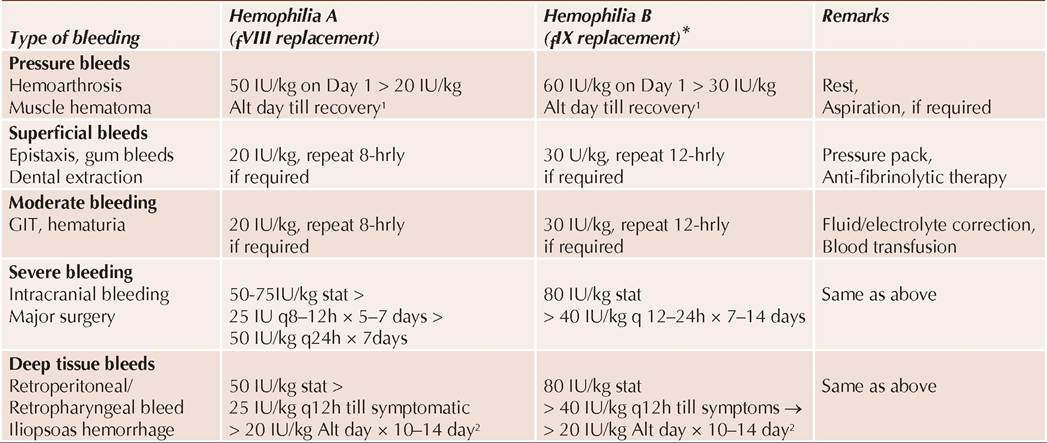
It should be used within 6 hours of thawing a room temperature.Cryoprecipitate, prepared from the precipitate formed by controlled thawing of FFP, is more concentrated with a volume of 15-20 ml and shelf-life of up to 1 year at-30°C. It is mainly used as an alternative to fVIII concentrates or as a source of fibrinogen in DIC
• Granulocyte infusion (1-5 ? 1010 neutrophils/kg), though used sparingly due to high-risk of transfusion reactions, are excellent adjuvant to antibiotic therapy for infections in granulocytopenic cases. However, the methodology to collect and produce proper granulocyte infusates is complex and not easily available at most blood banks.
Other commonly used blood products include immunoglobulins (Ch 9.9), etc. are discussed elsewhere. Adverse reactions to transfusion of blood products may develop due to errors at: (a) blood-bank levels, e.g. accidental supply of mismatched blood, underscreened blood, old blood, etc. or (b) transfusion level, e.g. accidental freezing/overheating of blood, delayed transfusions, rapid rate of infusion, etc. While various complications of blood-product transfusions are listed in Table 19.31, some important transfusion reactions and their management are as follows:
• Non-hemolytic transfusion reactions are commonest transfusion reactions due to presence of preformed pyrogens, e.g. leukocytes or bacteria (rare) in blood products. Clinically, these reactions present with fever with chills and rigors during or shortly after
TABLE 19.31: Complications of blood product transfusions
• Immediate complications
- Febrile non-hemolytic transfusion reactions
- Hemolytic reactions
#9830; Mismatched transfusions
#9830; Accidental infusion of hemolysed blood
- Allergic
#9830; Urticaria, anaphylaxis
#9830; Transfusion-related acute lung injury (TRALI)
- Fluid overload
#9830; Transfusion associated circulatory overload (TACO)
- Metabolic disturbances
#9830; Metabolic acidosis (with citrated blood)
#9830; Hyperkalemia (in vitro hemolysis)
#9830; Hyperphosphatemia (with CPD blood)
#9830; Hypocalcemia
#9830; Hyper/hypoglycemia
• Late complications
- Infections
#9830; Viral: HBV, HCV, HIV, CMV
#9830; Others: Malaria, syphilis
- Iron overload: Hemosiderosis
- Immunological:
#9830; Graft vs.
Host disease#9830; Late isoimmunization
transfusion, last only for few hours and can easily be controlled by discontinuation of transfusion and symptomatic therapy with antipyretics and/or antihistaminics. Use of saline-washed packed cells helps to prevent these reactions.
• Allergic reactions may develop during or after many hours of transfusions and present with wide clinical spectrum, ranging from mild urticaria to severe anaphylaxis. Treatment varies according to the severity, though most of them are mild and can be easily managed with simple antihistaminics. Incidence of allergic reactions can be minimized with the use of irradiated blood products. Late immunological reactions, e.g. Graft vs Host disease, are discussed later.
Transfusion-related acute lung injury (TRALI) is a rare but serious complication of transfusions, characterized by development of acute respiratory distress during or within 6 hours of transfusions. Although exact pathology is unclear, TRALI is presumed to be precipitated by the infusion of donor antibodies directed against recipient leukocytes, leading to immune-mediated endothelial damage and capillary leak. Most cases require ventilator support before spontaneous recovery within 3-5 days, with high mortality rate of 5-10%.
• Mismatched transfusion reactions, although uncommon, may be life-threatening and involve many medicolegal issues.
Clinically, these cases may present with acute hemolysis, hemoglobinuria, shock-like state and progressive renal failure.
Management includes: (a) immediate discontinuation of transfusion, (b) reporting back to blood bank for re-check the cross matching, (c) collection of blood samples for direct Coomb's test, blood counts, clotting profile, liver and renal function tests as well as serial urine examination for hemoglobinuria, (d) intensive clinical monitoring, and (e) supportive therapy with fluid/electrolyte correction and cardioventilatory support.
Re-transfusion with properly matched blood may be necessary for primary indication.
Many cases, transfused with mismatched blood for Rh factor (Rh+ve donor to Rh-ve recipient) or minor blood group incompatibility, may not manifest immediately with hemolysis but develop specific antibodies which can lead to severe hemolytic reactions during subsequent transfusions.• Transfusion associated circulatory overload (TACO) due to rapid or large volume blood product transfusions may develop within 12 hours of transfusion, specially in children with pre-existing liver, heart or renal disease. TACO presents with sudden onset of dyspnea, pedal edema and hypertension and must be treated as an emergency with immediate discontinuation of transfusion, supplemental oxygen if needed, and diuretics.
• Transfusion transmitted infections (TTI) continue to be an important risk of blood product transfusions despite stricter quality checks and donor screening strategies. Apart from bacterial contamination, many viruses, e.g. HIV, HBV, HCV, etc. and protozoal infections, e.g. malaria, may be transmitted via blood product transfusions.
19.15.2