IMMUNIZATION AGENTS
Immunological agents include products for both - active immunization, i.e. vaccines, and passive immunization, i.e. immunoglobulins (discussed later).
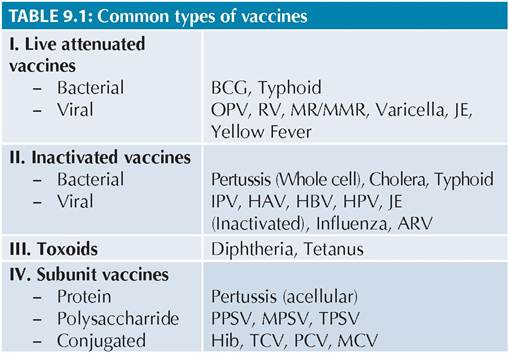
OPV: Oral polio vaccine; RV: Rotavirus vaccine; MR: Measles-Rubella; MMR: Measles, Mumps, Rubella vaccine; IPV: Inactivated polio vaccine; HBV: Hepatitis B vaccine; HAV: Hepatitis A vaccine; HPV: Human papilloma virus vaccine; JE: Japanese encephalitis vaccine; Hib: H.
influenzae B vaccine; PPSV: Pneumococcal polysaccharide vaccine; MPSV: Meningococcal polysaccharide vaccine; TPSV: Typhoid polysaccharide vaccine; TCV: Typhoid conjugate vaccine; PCV: Pnuemo- coccal conjugate vaccine; MCV: Meningococcal conjugate vaccineVaccines are biological formulations containing live or killed pathogens, their subunits or their toxins, minus their virulence. Currently available vaccines may be classified, based on the viability of organisms, contents and the methods of production (Table 9.1).
Some commonly used terms in vaccine technology are as follows:
Live vaccines contain viable organisms with attenuated virulence and hence: (a) are highly immunogenic, (b) require stringent storage conditions to maintain viability of organisms, and (c) cannot be used in severely immunocompromised persons due to risk of severe/ disseminated disease. These vaccines are usually supplied in lyophilized form to increase their stability and have to be reconstituted before use.
Killed or inactivated vaccines are prepared from organisms inactivated by heat or chemicals to remove the virulence. These vaccines are: (a) less immunogenic and usually need multiple doses for adequate immune response, (b) relatively heat-stable on storage, and (c) can be used in immunocompromised children.
Polysaccharide vaccines using a polysaccharide antigen from cell wall or capsule, are poorly immunogenic due to lack of development of IgG response and memory cells.
These vaccines are usually ineffective in younger children before 2 years of age and need re-vaccinations. Conjugated vaccines are modified polysaccharide vaccines in which component polysaccharides are conjugated with some other potent antigen, termed vehicle, (e.g. mutant diphtheria or tetanus toxoid), to increase the immunogenicity. Conjugated vaccines can be used in children lt; 2 years of age and provide long- lasting immunity.Polyvalent vaccines are the vaccines with two or more strains of the same organism, e.g. OPV, PCV HPV, etc. while monovalent vaccines are single antigen vaccines, e.g. varicella vaccine.
Combination vaccines are vaccines containing antigenic material from different organisms, e.g. DPT, MMR and others. These vaccines are useful to minimize the hospital visits, cost and number of pricks.
In addition to the basic antigenic material, vaccines may also contain other agents, collectively termed as excipients and include adjuvants, preservatives, stabilizers and diluents.
Adjuvants, e.g. aluminium hydroxide or phosphate, etc., are usually added in inactivated or sub-unit to augment the potency of vaccines to prolong the release of antigen and the attraction of immunocompetent cells around the injection site. Nearly all bacterial vaccines contain adjuvants while viral vaccines are usually adjuvant free, barring few exceptions.
Preservatives, e.g. mercurial compounds or antibiotics, e.g. neomycin, are added to prevent contamination of vaccines. These agents have been implicated in various adverse events of vaccines, earlier considered due to antigen component. Measles vaccine does not contain any preservative and hence, severe septic reactions, e.g. toxic-shock syndrome have been reported with its use beyond 3 hours of reconstitution.
Stabilizers, e.g. magnesium chloride, sorbitol, etc. are added to the vaccines to maintain the potency during storage of vaccine and during manufacturing process.
Diluents, e.g. distilled water, normal saline or others are used to reconstitute lyophilized vaccines before use. Only the diluents recommended or supplied by the manufacturers should be used. Some diluents are vaccine specific, e.g. calcium carbonate or citrated sodium bicarbonate for different RV vaccines.
9.2