IODINE DEFICIENCY DISORDERS
Iodine deficiency disorders (IDDs) is a common term used to describe various manifestations of dietary iodine deficiency, prevalent in certain geographical regions of India and developing world.
Epidemiology: Recommended dietary intake for iodine is ~100-150 #956;g#8725;kg#8725;day, which is adequately present in breast milk. In India, IDDs are mainly seen in sub- himalayan regions, e.g. Himachal Pradesh, northern Uttar Pradesh and Jammu and Kashmir, due to washout of iodine containing soil by large rivers. Reported incidence of IDDs in India varies from 10-40% in different endemic states. IDDs are relatively uncommon in coastal states due to consumption of iodine-rich sea foods.
Clinical spectrum: While endemic goiter and endemic cretinism are two well-defined manifestations of IDDs, Subtle features, e.g. short stature, mild mental retardation or learning disabilities are perhaps more common (Table 22.8).
a. Endemic goiter, more common in girls, represents mild/ moderate IDDs with compensatory enlargement of thyroid gland with variable size. In mild cases, goiter may appear only during periods of stress, e.g. puberty, pregnancy, etc. and disappear subsequently.
WHO (1994) classifies goiter into 3 stages or grades, i.e. Stage 0: No goiter, Stage 1A: Palpable but not visible even on extended neck, Stage 1B: Palpable but visible only on extended neck, Stage 2: Visible in normal neck position and Stage 3: Very large goiter, visible from a distance.
Most cases are clinically euthyroid, though biochemical abnormalities with raised TSH and T3 levels and low T4 levels are common. Combination of low T4/high T3 levels indicate preferential secretion or increased conversion to more bioactive T3 as a compensatory mechanism.
b. Endemic cretinism is the commonest cause of preventable mental retardation, seen mainly in populations with severe iodine deficiency.
Two overlapping 
*in increasing order of severity
TABLE 22.9: Neurological vs myxedematous cretinism
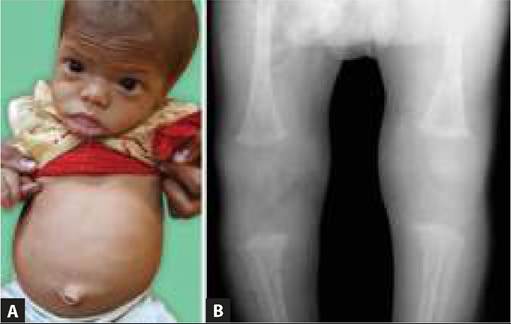
UMN: Upper motor neuron signs
clinical variants of endemic cretinism (Table 22.9) are well known:
- Neurological type, presenting with mental retardation, deaf-mutism and upper motor neuron signs, e.g. hypereflexia and Babinski sign. It is attributed to severe iodine deficiency in mother and intrauterine fetus.
- Myxedematous type is attributed to combined intrauterine as well as postnatal iodine deficiency, presenting with stunted growth, delayed puberty and myxedema along with signs of neurological type.
Treatment is mainly preventive. Administration of single IM injection of iodinated poppy seed oil is indicated in: (a) mothers, to prevent iodine deficiency during future pregnancies, and (b) in myxedematous children below 4 years to optimize stature, onset of puberty and cosmetic appearance. Neurological manifestations are irreversible. Surgery is needed only in cases with pressure symptoms or for cosmetic reasons.
National Iodine Deficiency Disorders
Control Programme (NIDDCP)
National Iodine Deficiency Disorders Control Programme (1992), in continuation of previous National Goiter Control Programme (1962), aims to prevent, control and monitor various IDDs and bring down the incidence lt;10%.
Major components of NIDDCP include:
• Continuous surveillance of IDDs, using goiter prevalence, urinary iodine excretion or neonatal screening (TSH gt;5 IU/L),
• Universal iodinization of common salt to ensure iodine content of gt;15 ppm at consumption level and gt;30 ppm at production level. Potassium iodate is commonly used for iodination of salt in India.
• Periodic monitoring of iodinization quality at production as well consumption level at national reference laboratories, and
• Information, education and communication activities.
WHO also recommends Iodine supplementation in areas of moderate and severe iodine deficiency with Goiter rate gt;20%, by a single yearly dose of iodized oil-400 mg to all reproductive age, pregnant/lactating women and 200 mg to infants below two years, if not on fortified complementary feeds.
22.3.2