Language Components
With regard to models of language, the prevailing school of thought follows Bloom and Lahey's philosophy, which proposes three main components of language: form, content, and use (Fig.
4.4). According to Bloom and Lahey, language can be defined as “a knowledge of a code for representing ideas about the world through a conventional system of arbitrary signals for communication (10).”These three components can be subdivided further into phonology, morphology, syntax, semantics, and pragmatics, as described in the following sections.
Form
Form with reference to language refers to the rulebased structure humans employ to formulate language, ranging from phonemes to sentences, and comprises phonology, morphology, and syntax.
Phonology refers to the rule-governed system by which sounds, or phonemes, are combined to create meaningful units, or words. The English language contains 44 recognized phonemes, which are classified as consonants or vowels. This distinction involves presence or absence of interruption of the air stream. Vowels are formed through modulation (without interruption) of the air stream via variation in position of the lips and tongue (Fig. 4.5) (11).
Variations in tongue position for production of different vowels are systematically characterized as high, mid, or low, as well as front, central, or back, and can further be described as tense or lax (Fig. 4.6) (12). For example, the vowel /i/, pronounced “ee,” is considered a high, front, tense vowel, as the front of the tongue is
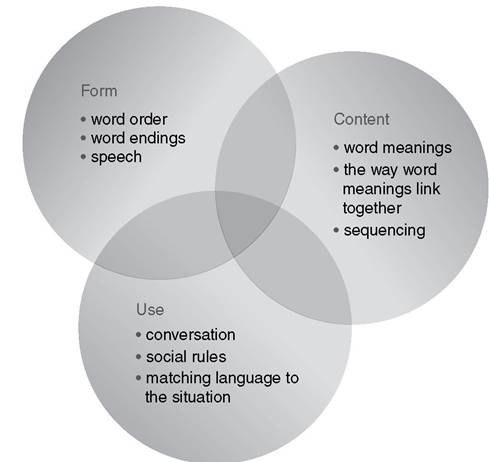
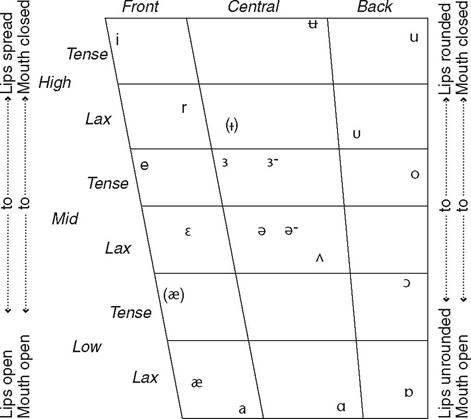
Figure 4.6 Tongue positions for vowel production. (Reprinted with permission from Bronstein AJ. The pronunciation of American English. New York: Appleton-Century-Crofts, Inc., 1960.)
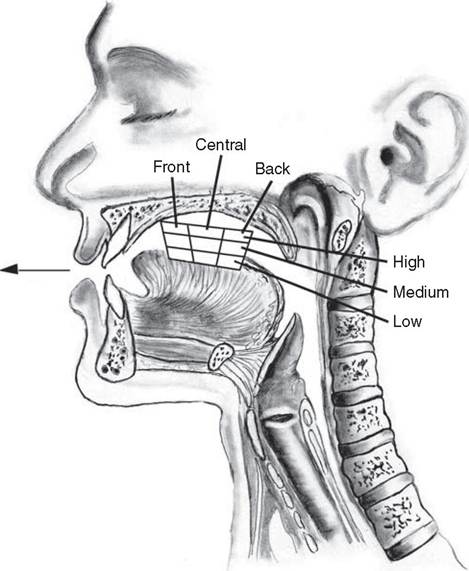
Figure 4.5 Vowel areas.
high and the tongue is tensed.
Diphthongs are combinations of vowels, and require movement of the tongue from one position to another during production.Consonants are formed through a combination of varying degrees of interruption of the airstream and variations in tongue and lip posture (see Fig. 4.3). Phonemic acquisition in children follows a systematic sequence, and it is believed that children acquire phonemes not in isolation, but rather in the context of their relationship to other sounds in a word (Table 4.5) (13).
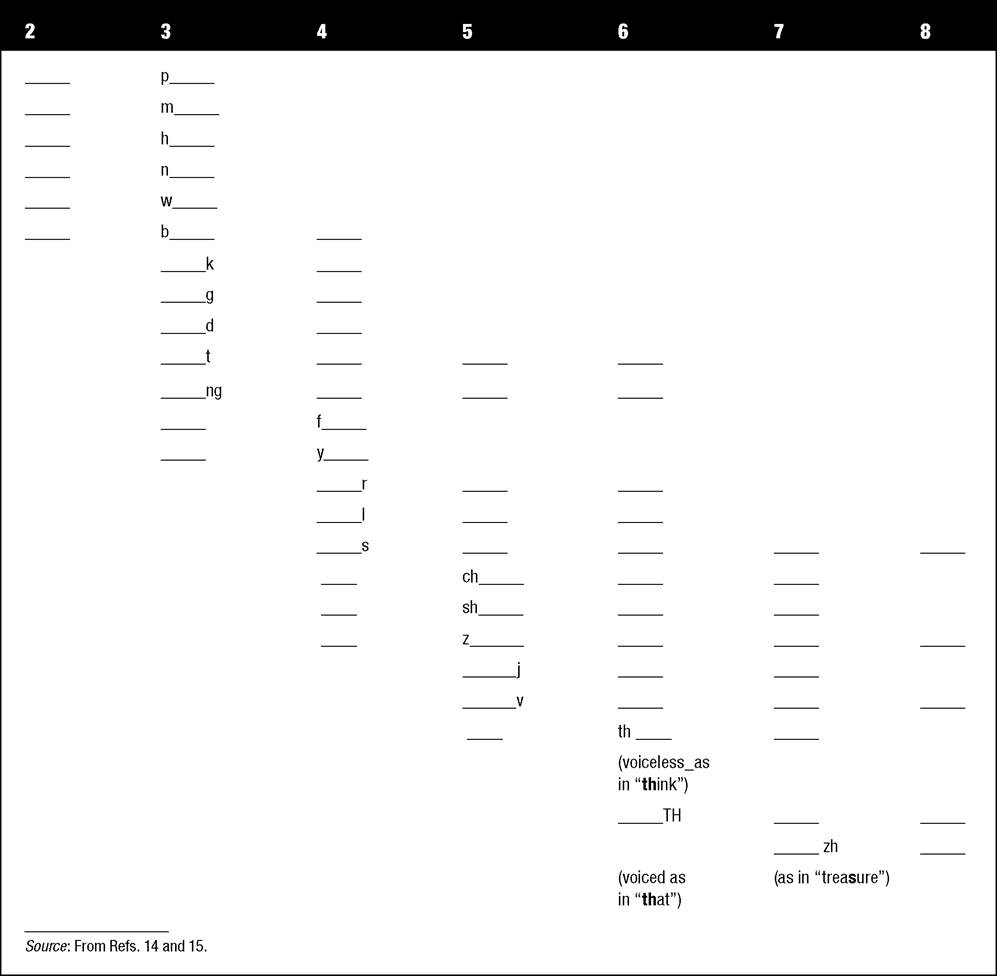
Table 4.6 provides a graphic representation of the typical age ranges during which most children acquire consonant sounds (14,15). This is useful in determining at what age a child is considered outside of the norm for acquisition of a specific sound and when intervention might be indicated.
With regard to how well one can expect to understand a child's speech over the course of phonemic acquisition, Lynch et al provide an estimate of speech intelligibility at different ages, summarized in Table 4.7 (16).
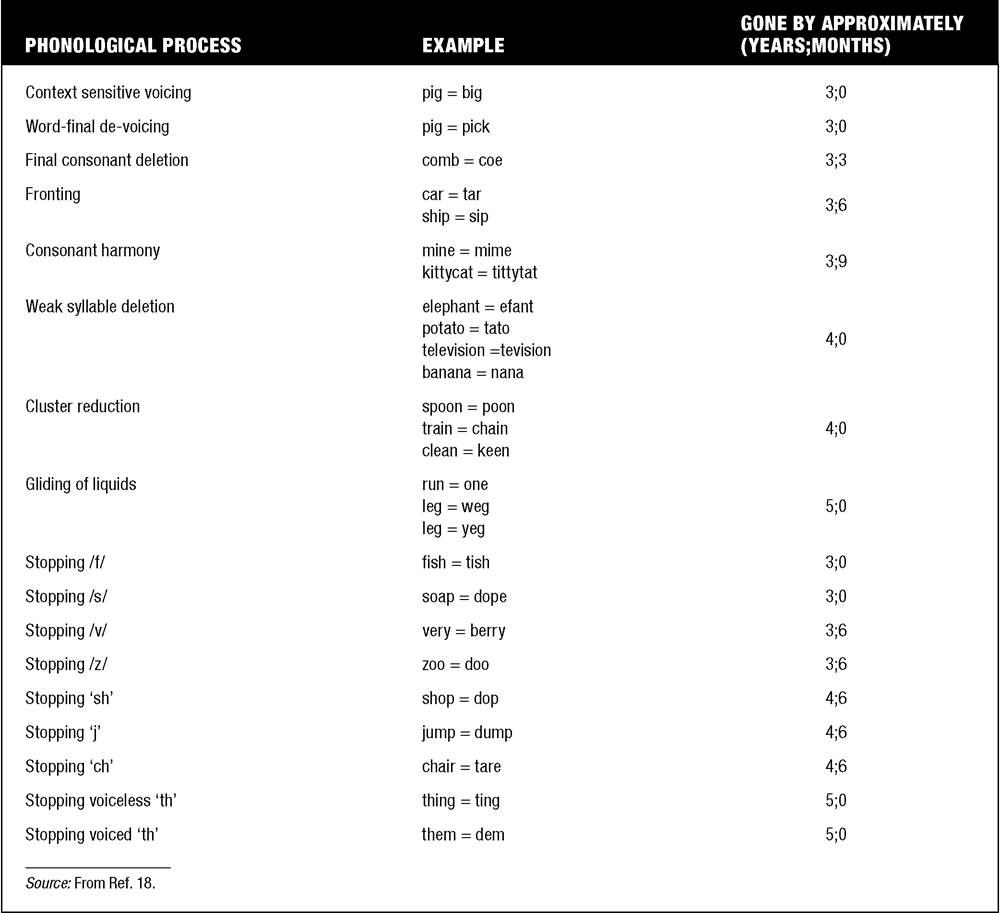
Phonological disorders are a subset of sound production disorders in which linguistic and cognitive factors, rather than motor planning or execution, are thought to be central to observed difficulties (common etiologic variables include otitis media with effusion, genetics, and psychosocial involvement) (17). Developmental phonological disorders result when children fail to progress in their acquisition of specific phonemes. Currently accepted theory regarding phonology in children proposes the existence of phonological processes that are present in the phonological systems of all children as they develop language, and are systematically eliminated at predictable ages in a standard developmental progression. Failure to eliminate, or resolve, these processes, results in a phonological processing disorder. An example of a developmental phonological process is “stopping of
4.5
Phonemic Acquisition: Age at Which 75% of Children Tested Correctly Articulated Consonant Sounds
| AGE (YEARS) | SOUNDS |
| 2 | m, n, h, p, η |
| 2.4 | f, j, k, d |
| 2.8 | w, b, t |
| 3 | g, s |
| 3.4 | r, l |
| 3.8 | s (she), ts (chin) |
| 4 | δ (father), Z (measure) |
| 4+ | dz (jar), θ (thin), v, z |
| Source: From Ref 13. |
fricatives,” in which a child systematically substitutes a stop sound (a sound that stops airflow, such as /p, t, k/) for a fricative sound (a sound that produces friction through partial interruption of airflow, such as [th, s, z, f, v]), producing words such as “dum” for “thumb,” “tun” for “sun,” or “dip” for “zip.” These sound substitutions are systematic and applied by the child in the same context each time that sound occurs.
Nondevelopmental phonological processes are indicative of disordered versus delayed phonological development, and are rarely seen in normal development. An example of a nondevelopmental phonological process is initial consonant deletion, in which a child deletes the initial sound in a word, such as “ee”/“key” or “ake”/“make.”Table 4.8 illustrates the typical developmental sequence for resolving phonological processes (18).
Morphology refers to the rule-based system by which words are constructed and altered, often through addition of prefixes and suffixes, to reflect concepts such as number, possession, and verb tenses. For example, addition of the phoneme “-s” to the end of a word makes it plural. The “-s” in this instance is considered a morphological marker signifying the notion of “plural.”
Disorders affecting morphology are most typically developmental and result when children have difficulty mastering the acquisition of rules for applying morphological markers. Difficulty with use of morphological markers can also be seen following certain types of focal brain injury, such as damage to Broca's area, when expressive language becomes telegraphic in nature, losing the nuances provided by morphological markers.
Syntax refers to the system of rules by which words are combined to create phrases, clauses, and sentences. The various parts of speech in English (eg, nouns, pronouns, verbs, adverbs, adjectives, etc.) serve different functions within these constructions, such as description, action, and attribute, and as such have specific rules for combination with each other. For example, the basic word order in English is subject-verb-object.
As with morphology, disorders affecting syntax are typically developmental and are the result of difficulty mastering the acquisition of rules for creating grammatically correct sentences.
Content
Content with reference to language refers to the semantics, or meaning, of words, as they relate to, or represent, objects, actions, and relationships.
Semantics, or meaning, is conveyed through the use of words or other symbols within a given context. Development of semantics in children reflects growing and changing concepts related to experiences, culture, and cognitive4.6
Acquisition of Consonant Sounds
4.7
Speech Intelligibility in Children
By 18 months, a child's speech is normally 25% intelligible.
By 24 months, a child's speech is normally 50% to 75% intelligible.
By 36 months, a child's speech is normally 75% to 100% intelligible.
Source: From Ref. 16. level. An example of a changing semantic notion is that of overgeneralization. Children first learn the meaning of a word based on one representation of that word and initially overgeneralize it to apply to all similar representations. Hence, “dog” may at some point be applied to denote all four-legged creatures.
Child language disorders affecting semantics may be developmental and related to general cognitive development, or they may be acquired. Examples of disorders that involve semantics include specific
4.8
Resolution of Phonological Processes: Ages by Which Phonological Processes Are Eliminated
language impairment (SLI), semantic-pragmatic language disorder, and Landau-Kleffner syndrome (19). In all these cases, children exhibit some degree of difficulty understanding the meaning of words and sentences. For children with semantic processing difficulties, the more abstract a concept is, the more difficult it is to understand. This holds true for things that require interpretation beyond the literal meaning, such as might be required in an idiom or slang expressions. Deficits related to semantics can also result in difficulty identifying the key points in a sentence or story, which in turn may lead to problems with topic maintenance.
Use
Use with reference to language describes the function language serves within a social context, and is governed by pragmatics. Pragmatics refers to how we use the language we have acquired to communicate in social situations. Within a social interaction, language may be used in many different ways, such as to make comments, to ask questions, to acknowledge comments, and to answer questions. In 1976, Elizabeth Bates described three critical components of pragmatics: the ability to use speech acts to express intentionality in order to accomplish a given purpose (function), the ability to use social understanding and perspective-taking ability to make presuppositional judgments, and the ability to apply rules of discourse (eg, quantity, quality, relevance, clarity) in order to engage in cooperative conversational exchanges (20).
Child language disorders affecting pragmatics are most typically those associated with disorders on the autism spectrum. Acquired injuries that may have an impact on pragmatics include traumatic brain injury affecting the frontal lobes. Frontal lobe injury often impairs executive functioning and increases impulsiv- ity, resulting in impaired judgment. This, in turn, may impair one's ability to understand perspective and to apply rules of discourse appropriately.
To summarize, language competence requires the successful intersection of form, content, and use. As simple as it may seem, having a successful conversation is a complex act requiring integration of many aspects of language and involving a blending of linguistic features with sociocultural understandings. “Conversation is not a chain of utterances, but rather a matrix of utterances and actions bound together by a web of understandings and reactions"(21).