VITAMIN C DEFICIENCY (SCURVY)
Scurvy is well-defined acute manifestation of vitamin C deficiency, though mild or subclinical deficiency states may present with impaired wound healing, bleeding gums, mild anemia and susceptibility for infections.
Physiology: Vitamin C or ascorbic acid (Table 6.16) is a water-soluble vitamin and hence not stored in the body and rapidly excreted in urine.
RDA of vitamin C is ~20-45 mg/day in children and 50-85 mg in adolescents, higher during infections and fever as it is not stored in body.
TABLE 6.16: Vitamin C at a glance
RDA: 20-85 mg/day
(Higher in infections e.g. fever, diarrhea)
Sources:
• Richest source: Amla (600 mg)
• Citrus Fruits: Guava (212 mg), orange, lemon, pineapple
• Vegetables: Cabbage (124 mg), tomato, green vegetables.
• Germinated pulses
• Non-veg foods, e.g. liver and kidneys (not in meat)
Functions:
• Essential for collagen formation
• Wound healing and epithelial integrity
• Facilitate iron absorption and folate metabolism
• Antioxidant effect
Deficiency states:
• Typical: Scurvy
• Others: Poor wound healing, anemia, recurrent infections
Dietary sources: Breastfeeding is an adequate source of vitamin C in early infancy. Citrus fruits, leafy vegetables and germinated seeds are rich sources of vitamin C. However, it is extremely heat-labile, rapidly inactivated on cooking and extrudes in cooking-water. Milk products and lean meat are poor sources of vitamin C.
Functions: Vitamin C essential for synthesis of: (a) normal collagen by incorporating proline and hydroxyproline, and (b) chondroitin sulphate - a component of intercellular matrix required for epithelial integrity and wound healing. It also facilitates, (c) iron absorption,
(d) folate metabolism (conversion of folic acid into folinic acid), and (e) elimination of toxic-free radicals (antioxidant).
Vitamin C Deficiency (Scurvy)
Etiology: Scurvy is usually precipitated by sudden increase in vitamin C requirements due to infections, acute febrile illnesses, diarrhea, etc. in children with subclinical dietary deficiency, e.g. in undernutrition or top feeding. Wrong cooking practices, e.g. overboiling of vegetables in excess water or throwing the excess cooking-water are important causes of dietary deficiency.
Clinical manifestations: Scurvy usually presents in late infancy or in toddlers, following an infective episode, e.g. diarrhea or viral infection in malnourished children. A typical case present with:
• Skeletal signs:
- Pseudoparalysis—severe tenderness and restricted limb movements with pithed-frog posture
- Scorbutic rosary—tender, sharp, nodular beading at costochondral junktions, due to subluxation rib epiphyses at sternal joints.
• Skin/mucosal signs:
- Swollen, purple, bleeding gums,
- Petechial/ecchymotic perifollicular hemorrhages over skin and mucus membranes. Severe gastrointestinal or intracranial bleeds are rare.
• Mental changes:
- Apprehensive facial appearance
- Extreme irritability or apathy
• Signs of subclinical deficiency:
- Poor wound healing
- Moderate dimorphic anemia
- Increased susceptibility for infections
Diagnosis of scurvy depends on:
• Suggestive clinical features with history of precipitating event, e.g. fever or diarrhea;
• Characteristic radiological finding, best seen at the end of long bones at knee joint (Fig. 6.8) and include:
- Ground-glass appearance of the shaft and epiphysis due to loss of trabecular pattern,
- Thinning or penciling of cortex with sharply outlined epiphyseal ends,
- Wimberger's ring sign-ground-glass appearance of epiphyseal centers, surrounded by a white ring of compressed collagen,
- White line of Frankel—a thick, irregular, transverse, white line at epiphyseal ends due to thickened provisional zones of calcification.
- Trummerfeld zone of rarefaction—a narrow zone of metaphyseal rarefaction proximal to Frankel's line, due to atrophy of subepiphyseal cortex.
- Angle sign—a triangular, rarefied, lateral defect proximal to Frankel's line, representing early stage of the zone of rarefaction.
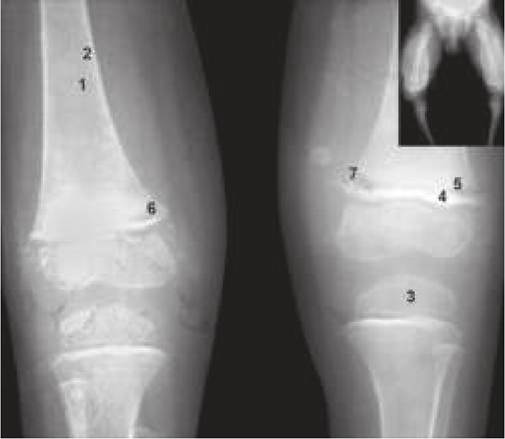
Fig. 6.8: Scurvy: X-ray
X-ray knee showing: 1. Ground glass matrix, 2. Pencil-thin cortex,
3. Ring sign, 4. Frankel's line, 5. Zone of rarefaction, 6. Angle sign,
7. Pelkan spar. Inset: Subperiosteal hematoma
- Corner sign or Pelkan spur—a lateral spur-like growth of Frankel's line, due to compression of soft shaft.
- Lifting or separa tion of periosteum from the cortex due to sub-periosteal hematoma. Actual hematomas are visible only after 1-2 weeks of illness as enveloping- shell appearance, due to calcification.
• Biochemical diagnosis is required only in sub-clinical cases, based on low ascorbic acid levels in a buffy coat (WBCs) sample of oxalate blood (Normal: 25-40 mg/ dl). A level of zero in this layer indicates scurvy, even without clinical signs. Plasma ascorbic acid levels are unreliable, though fasting levels gt;0.6 mg/dl exclude scurvy. Urinary excretion of gt;80% of dose after 3-5 hours of a loading dose of 100 mg/kg vitamin C, indicates no vitamin C deficiency.
D/D: Scorbutic bony lesions need to be differentiated from other cases of pseudoparalysis, e.g. (a) osteomyelitis/ septic arthritis, (b) transient synovitis, (c) trauma, (d) congenital syphilis, and (e) leukemic bone involvement.
Scorbutic rosary is different from rachitic rosary as it is: (a) tender, and (b) has sharper margins vs. rounded contour of the rachitic beading.
Treatment: Vitamin C therapy (PO 200-500 mg/day for a week) is highly effective with dramatic clinical recovery within 24-48 hours, though radiological improvement may take many weeks. Recurrence must be prevented by adequate diet and therapeutic supplementation (100 mg/day) for many weeks.
Prevention includes nutritional counseling, correct cooking practices and vitamin C supplementation in lactating mothers, top-fed infants and during acute infective illnesses.
Vitamin C excess: Being a water soluble vitamin with free urinary excretion, large doses of vitamin C are well tolerated though some studies have shown higher risk of renal stones and iron load after excess vitamin C intake for long periods.
6.4
More on the topic VITAMIN C DEFICIENCY (SCURVY):
- Agrawal M.. Textbook of Pediatrics. 3rd ed. — CBS Publishers,2025. — 973 p., 2025
- THE DESIRE FOR STABILITY MAKES US SEE MORE OF IT THAN THERE IS