Fallibilism, skepticism, and intellectual humility
Without qualification, fallibilism is the view that certainty is impossible, but we can also speak of fallibilism about a particular domain, i.e. the view that certainty in that domain is impossible.We mean not mere psychological certainty — i.e.
being completely sure or maximally confident — but rather justified or rational psychological certainty. Without qualification, skepticism is the view that knowledge is impossible, but we can also speak of skepticism about a particular domain, i.e. the view that knowledge in that domain is impossible.You might think that knowledge requires certainty; if so, fallibilism entails skepticism.But we can also think of “fallibilism” and “skepticism” as the names of two virtues, namely, excellence in attributing uncertainty — call that the virtue offallibilism — and excellence in attributing ignorance — call that the virtue of skepticism.13 These virtues overlap with, but are distinct from, the virtue of intellectual humility (Section 27.1).
First, that these virtues overlap with the virtue of intellectual humility: the latter includes, as a proper part, both excellence in self-attributing uncertainty, which is also a proper part of fallibilism, and excellence in self-attributing ignorance, which is also a proper part of skepticism. Given our definitions, fallibilism entails excellence in self-attributing uncertainty (which is one part of intellectual humility) and skepticism entails excellence in self-attributing ignorance (which is another part of intellectual humility).This vindicates the historical association of fallibilism and skepticism with intellectual humility. For example, in defense of his “mitigated” or “academic” skepticism, Hume, urges dogmatists to “become sensible of the strange infirmities of human understanding,” as “such a reflection would naturally inspire them with more modesty and reserve, and diminish their fond opinion of themselves, and their prejudice against antagonists.”14 For another, Pierce, articulating his fallibilism, denounces “overconfident assertion” as a “venomous error [that] assails our knowledge.”15
Second, that the virtues of fallibilism and skepticism are distinct from the virtue of intellectual humility.
For one thing, fallibilism and skepticism are concerned exclusively with uncertainty and ignorance, and not with other forms of intellectual weakness, such as epistemic vice, with which intellectual humility is concerned. For another, which is more important, the virtue of intellectual humility, given our account (Section 27.1), is concerned exclusively with selfattribution of intellectual weakness, and not with attribution of intellectual weakness to others, with which fallibilism and skepticism are concerned. This is confirmed by our image of the skeptic as a dogged interlocutor who ceaselessly challenges our assertions and claims to knowledge, which hardly manifests anything worthy of the name “humility.” By stressing the “strange infirmities of human understanding,” Hume not only implies his own intellectual weakness, but the intellectual weakness of human beings in general. It is the attribution of intellectual weakness to others that distinguishes skepticism, in the present sense, from mere humility. Were Hume merely intellectually humble, he might refrain from metaphysical speculation on account of the limited scope of his own intellectual powers. However, Hume the skeptic does more than that: he offers a blistering critique of other metaphysicians who attempt to go beyond the limited scope of their intellectual powers.Moreover, since attributing ignorance sometimes entails attributing uncertainty, fallibilism and skepticism overlap, in the same sense, with each other. Given all this, we can represent the relationship between our three virtues like this:
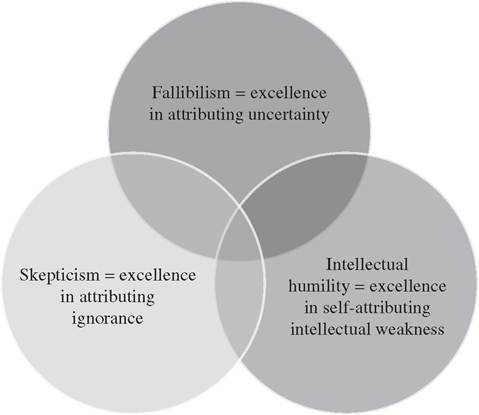
Someone who possesses the virtue of fallibilism, so defined, need not by definition accept fal- Iibilism the view, as defined above — either without qualification or about any particular domain. For the present account of the virtue of fallibilism leaves open the possibility that excellence in attributing uncertainty sometimes requires not attributing uncertainty.
In the same way, someone who possesses the virtue of skepticism need not by definition accept skepticism the view, either without qualification or about any particular domain, because the present account of the virtue of skepticism leaves open the possibility that excellence in attributing uncertainty sometimes requires not attributing ignorance. Nevertheless, it is clear why anyone attracted to fallibilism or skepticism, the views, either without qualification or about some particular domain, would be a fan of the virtue of fallibilism or the virtue of skepticism: skeptics and fallibilists are concerned about people's tendency to over-attribute certainty and knowledge — i.e. their tendency to attribute certainty and knowledge not at the right time — and thus will be keen to promote the virtues of fallibilism and skepticism as correctives (cf. Section 27.1).As above (Section 27.1), we can recognize both of these virtues as means between vicious extremes: the virtue of fallibilism is a mean between a vice characterized by excessive attribution of uncertainty (as well as insufficient attribution of certainty) and a vice characterized by insufficient attribution of uncertainty (as well as excessive attribution of certainty), while the virtue of skepticism is a mean between a vice characterized by excessive attribution of ignorance (as well as insufficient attribution of knowledge) and a vice characterized by insufficient attribution of ignorance (as well as excessive attribution of knowledge).“Quietism” seems an apt name for the first in each of these pairs of vices;“dogmatism” an apt name for the second.
Historical fallibilists and skeptics seem to disagree about what their stance implies about inquiry. Hume famously insists on the “limitation of our enquiries to such subjects as are best adapted to the narrow capacity of human understanding.”16 However, Pierce rejects as another “venomous error” any insistence that “this, that, and the other never can be known,” on the grounds that this necessarily “blocks the way of inquiry.”17 We could understand this as a disagreement between skepticism and fallibilism: if knowledge is impossible, then inquiry is pointless and should be closed; but if it is merely certainty that is impossible, then inquiry may sensibly remain open.
But we could also understand this as a disagreement about the scope of fallibilism and skepticism. For Pierce, the closure of inquiry about whether p on the grounds that we cannot know whether p is rash and dogmatic, since we cannot be certain of anything, including whether we cannot know whether p; inquiry must therefore be kept open. However, for Hume, the closure of inquiry on the grounds we cannot know whether p may well be sensible and modest, since the conclusion that we cannot know whether p may well be the justified conclusion of empirical reasoning about our cognitive powers. In any event, both of these stances seem to manifest a kind of intellectual humility.18Fallibilists and skeptics also associate their views with tolerance and open-mindedness. Karl Popper, articulating the “doctrine of essential human fallibility,” sympathetically quotes Voltaire on tolerance, which is said to be “a necessary consequence of our humanity. We are all fallible, and prone to error; let us then pardon each other's follies.”19 And we have already encountered Hume's idea that skepticism diminishes “prejudice against... antagonists”; the problem skepticism is meant so solve is that “affirmative and dogmatical” thinkers “have no idea of any counterpoising argument. nor have they any indulgence for those who entertain opposite sentiments.”20
A final theme from fallibilism and skepticism is a particular diagnosis of dogmatism.21 Here is Hume on the “affirmative and dogmatical” thinkers mentioned above:
To hesitate or balance perplexes their understanding, checks their passion, and suspends their action.They are, therefore, impatient till they escape from a state, which to them is so uneasy; and they think, that they can never remove themselves far enough from it, by the violence of their affirmations and obstinacy of their belief.22
And here is Pierce on those who employ the “method of tenacity” in forming beliefs:
[T]he instinctive dislike of an undecided state of mind, exaggerated into a vague dread of doubt, makes men cling spasmodically to the views they already take.
The man feels that, if he only holds to his belief without wavering, it will be entirely satisfactory.23Recall the idea that the virtues are corrective and correspond to spheres or domains of human life or experience. We can put Hume and Pierce's point like this: dogmatism, i.e. insufficient attribution of uncertainty and ignorance combined with excessive attribution of certainty and knowledge, at least in a certain class of cases, is a manifestation of an inability to cope well with uncertainty and ignorance, involving an intense and unmanageable discomfort with being unsure or not knowing — an especially strong desire for certainty, or “need for closure,” in the psychological jargon. Two conclusions at this point seem reasonable. First, the intellectually virtuous person will be able to handle uncertainty and ignorance, even when they would very much like to be certain or to know — they will not, for example, become foolishly overconfident as a way of dealing with the annoyance of not knowing or being sure. Second, the intellectually virtuous person's desires for certainty and knowledge will not entail an inability to feel comfortable or safe in their absence; the intellectual virtuous person will, in other words, can be quite happy in a state of doubt or suspension ofjudgment.
27.4