The realist argument: judges as the power people
In Holmes’s words, “in societies like ours the command of the public force is intrusted to the judges in certain cases, and the whole power of the state will be put forth, if necessary, to carry out their judgments and decrees.”[259] That is the reason “why people will pay lawyers to argue for them or advise them”: people “want to know under what circumstances and how far they will run the risk of coming against what is so much stronger than themselves.”[260] Judicial opinions determine where “the axe will fall.”[261]
This is the realist argument, and it obviously has a great deal to be said for it.
But, as both realists and their critics quickly realized, the argument has nothing exclusively to do with judges. As Lon Fuller asks, “Why should we stop with judges and exclude commissioners? And for that matter, what of officials whose duties are even further removed from those of a judge, like the sheriff and the sanitary inspector?”[262] It will matter greatly to people whether the prosecutor will proceed to an indictment or drop the charges against them, or whether the sheriff will enforce a judgment of a small claims court, or whether the IRS will audit them. And why stop with officials? The sheriff may balk at enforcing an eviction order that is so wildly unpopular that the friends and neighbors of the person against whom it is entered engage in passive or active resistance to protect their friend. For that matter, a disaffected populace may comply with law in such a grudging, up-to-the- edge manner that they nullify the law in fact - “work to rule” has long been one of labor unions’ most effective forms of job action. The passive resistance of Jim Crow Southerners to the courts’ desegregation decisions dramatically illustrates the point: these tactics delayed desegregation for two decades. So, following Fuller’s line of argument, “must we not extend our definition of law to include the behavior of laymen?” If so, “the realist view approaches perilously close the proposition that the law is the way everyone behaves.”[263]Another way to couch this response is that the power of judges rests on the power of the state more generally, and the power of the state ultimately rests on popular support, or at least popular acquiescence. Ultimately, it is a factual question how much the coercive power of judges matters. Tom Tyler’s study of influences on compliance with the law suggests that fear of sanctions matters very little - far less than personal morality or gender, and no more than peer opinion and the legitimacy of the legal authorities.[264]
I don’t mean to deny the obvious. A single Supreme Court decision can influence the behavior of thousands or even millions of people for decades to come. However, the Fullerian argument reminds us that Court decisions can have this effect only to the extent that those beneath the Court in the hierarchy of authority take up and support the decision rather than passively resisting it or maneuvering around it. From a genuinely realist point of view, the latter phenomena matter at least as much as what the Court does.[265] As I will suggest further on, judges may turn out to be far less important to the functioning of the legal system than practicing lawyers, who transmit the law from its sources to their clients, the law’s ultimate destination. If so, then the realist argument will turn out to be an argument for a lawyer-centric rather than a judge-centric conception of law.
As a second point against the realist argument for the primacy of judges, we must bear in mind how atypical and unrepresentative judicial decisions are as legal events. They represent disputes - and, as I shall suggest, that already makes them atypical legal events - and at that only a minute microcosm of the universe of disputes.
Here it is useful to recall the familiar sociologists’ image of the “pyramid of disputing” (depicted below).[266] Social life generates perpetual friction over vast numbers of issues, ranging from everyday trivialities to matters of life and death. Only a small subset of these social frictions can be addressed through law. Let this set of legally addressable issues form the base of the pyramid. Out of this incomprehensibly vast mass of legally addressable issues, some will be recognized as such (“named”) by the people they affect. The named issues form the smaller second level of the pyramid. But just because I name an issue, it by no means follows that I will raise it or argue about it with anyone else. I will not do so unless I not only name my problem but blame someone for it. At that point, my legally addressable issue turns into a dispute. Disputes, a smaller set than recognized legally addressable issues, form the third level of the pyramid.
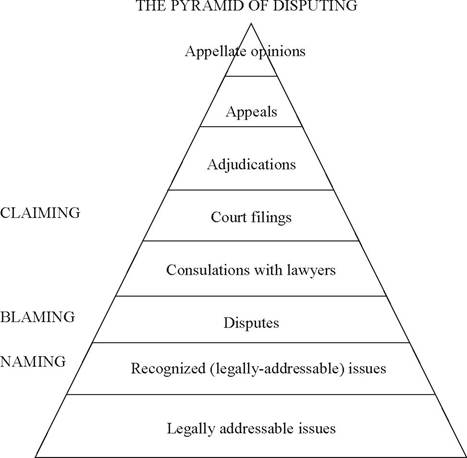
Disputes may proceed no further than a testy conversation, either because I receive redress (the cable company finally agrees to send out some service personnel) or because going further seems not worth the trouble and I decide to “lump it.” But people take some of their disputes to lawyers, and those consultations form the fourth level of the rapidly tapering pyramid of disputing. In many of those cases, the dispute ends there, because client or lawyer concludes that legal action wouldn’t be worth the trouble.
But sometimes the lawyer and client decide to take legal action, para- digmatically by filing a lawsuit. This takes us to the next level of the pyramid - the moment when the dispute breaks through from the informal into the formal legal system, and legal action commences. At this point, naming and blaming transform into claiming.[267]
Very few filed cases proceed to the next level of the pyramid, fullblown adjudication.
Only 3 percent of state-court tort cases, for example, and 3 percent of state criminal filings, are tried to a verdict.[268] Cases may be dropped, or settled, or pleaded out, or withdrawn after a partial adjudication such as an early adverse ruling on a motion, or dismissal by the judge. Even including partial adjudications, the adjudications layer of the pyramid is far smaller than the “filed claims” layer. And the appellate layer is smaller still.A few numbers help illustrate the shape of the pyramid in the United States. Obviously, determining the size of some layers of the pyramid raises insurmountable measurement problems - we cannot even conjecture, for example, how many informal disputes there are per unit of time. Others, however, can be given rough estimates. Thus, for example, a 1994 ABA study based on 3,000 interviews with moderate- and low-income Americans concluded that half of all households faced legal needs during the twelvemonth period of the survey.[269] Given our current population, that would amount to more than 50 million legally addressable issues annually (half of 112 million American households) at the base of the pyramid.[270] Of course, not all of these are actual or potential disputes: legal needs include such noncontentious activities as making a will, incorporating a small business, or obtaining public benefits. But that scarcely matters, because in fact the pyramid's base is much larger. The study excludes all of the legal needs of organizations other than households, and organizations are the most intensive consumers of legal services.[271] The average American household faces one
legal issue every two years, but government offices and large corporations face dozens or hundreds each week. Even the most cautious estimate, therefore, should number the legally addressable issues at the base of the pyramid in the hundreds of millions annually.
Although we have no reliable way of estimating across the board how many of these issues lead to naming and blaming, or how many legal consultations occur annually, data from several studies show that in one sector - physical injuries - very few result in formal claiming.
In the 1990s, large reviews of hospital records in California and New York showed that only 10 percent of patients injured through medical error ever filed malpractice claims.49 A 1989 Rand Corporation study of liability claiming for nonfatal injuries found that “overall, about one injury in ten led to an attempt to collect liability compensation,” including by informal means - that is, by asking for compensation without filing either an insurance claim or lawsuit.50 Most claiming for physical injuries arises from auto accidents and the workplace, while “in nonwork, non-motor vehicle accidents, only three injuries out of a hundred lead to liability claims.”51 Only 15 percent of the injured subjects contacted a lawyer, while only 8 percent hired a lawyer.52 The lawyers themselves turned away a fifth of those who contacted them, which implies that about a fourth of those who contacted a lawyer - themselves amounting to only three out of twenty injured persons - decided not to pursue matters legally.53 In short, the move from the “disputes” level of the pyramid to the “consultations with lawyers” level shrinks the pyramid dramatically, and the further move to “court filings” shrinks it more drastically still.The high rate of “lumping it” and the low rate of formal claiming still yielded 38 million civil and criminal cases filed in US state courts in 2003. (The state courts represent 98 percent of all court filings.54) At this point, the
industries and associations, while another 9 percent are in government. Ibid. at 6. (The US Census statistics cited in note 27, which are a bit more recent than Carson’s ABF study, place the number of government lawyers substantially higher than 9 percent.) A consulting firm reports that 140 major corporations average thirty attorneys in their law departments and spend over $1 million annually per attorney. Hildebrandt International 2005 US Law Department Survey, press release available at.
49 See Paul C. Weiler, Medical Malpractice on Trial 12-13 (1991).
50 Deborah R. Hensler et al., Compensation for Accidental Injuries in the United States: Executive Summary 19 (Rand Corp., 1991).
51 Ibid. 52 Ibid. at 24, Table 6.
53 Another study of 53,584 contacts between potential clients and contingency fee lawyers in Minnesota found that the lawyers rejected almost 70 percent of the cases. Herbert M. Kritzer, Contingency Fee Lawyers as Gatekeepers in the Civil Justice System, 81 Judicature 22, 24 (1997).
54 Federal court filings that year amounted to 350,000. See Table S-7,. For state filings, see National Center for State Courts, State Court pyramid of disputing once again narrows significantly, because only a handful of these are tried to a verdict - as we have seen, about 3 percent each of criminal and tort cases. At the next level of the pyramid, we find about 281,000 state-court appeals in 2003 - one appeal for every 135 cases filed.55 And of these, only 6,400 resulted in signed opinions by the highest court in the state.56 The ratio is one state supreme court opinion per 44 appeals, or one for every 6,000 cases filed. Federal appeal courts in 2004 terminated 27,000 cases on their merits, four-fifths of them with no opinion or an unpublished opinion.57 And the United States Supreme Court hears fewer than 100 cases a year.
It is easy to drown in numbers, but the basic point should be clear enough. The mainstay of casebooks consists of appellate opinions, and these represent perhaps 12,000 cases a year out of hundreds of millions of legally significant events - one out of tens of thousands. The litigants, moreover, are not a randomly selected or representative slice of humanity. They are all drawn from the unusual class of people with the money, nerves, and desire to maintain a dispute all the way through appeal. Appellate decisions thus represent only a minute proportion of atypical disputes, and a still smaller proportion of legally significant human interactions.
It might be objected that realists like Holmes were making a conceptual point about the power of judicial decisions, not an empirical one. They were not claiming that courts actually dominate the legal landscape, but that, as a matter of institutional definition and authority, they ought to dominate it. However, this objection robs realism of its interest, which lies in its claim to analyze abstract jurisprudential concepts as actual relationships of power and behavior. Holmes abhorred conceptual points, and aimed to bathe concepts like “legal duty” in cynical acid - to rinse away the moralistic verdigris and reveal the burnished sword that law wields. He certainly did not aim to spin out a peculiar utopian vision of a society in which judges rule.
It will also be objected that, rare or not, judicial decisions powerfully influence social behavior, which (in a familiar academic phrase) takes place “in the shadow of the law.” But, as I observed earlier, the extent to which the judicial shadow shapes social behavior depends on how a multitude of agents, intermediate between the judge and the ordinary citizen, take up a judicial
Caseload Statistics, 2004, Table 7, available at (page 12 ofPDF).
55 National Center for State Courts, State Court Caseload Statistics, 2004, Table 1, available at (page 3 ofPDF).
56 Computed from ibid., Table 6, available at.
57 Federal Judicial Caseload Statistics, Table B-5, available at. For the number of unpublished opinions, see ibid. at Table S-3, available at. decision. This observation suggests that the focus of attention should shift toward these intermediate agents - and, prominent among them, to practicing lawyers advising their clients.
Another point is crucial: a great deal of legal work has little or nothing to do with disputes. Most law practice concerns transactions and compliance work (such as doing taxes or fulfilling bureaucratic reporting requirements), not litigation. It is important to understand why.
One often overlooked point on which Hart and Fuller agree concerns the nature of legal rules. Hart points out that in addition to the “thou shalt nots” of prohibitory rules - most people’s dominant image of law - mature legal systems contain rules that empower rather than restrict human activity.[272] These include the procedures for getting married, forming a partnership, entering into a contract, creating a trust, and a host of other activities. Fuller took this point further, and insisted that the most fundamental and characteristic purpose of laws and legality consists in providing the architecture for social structures.[273] Private contracts form the paradigmatic examples of the architecture of social structure. Admittedly, the legal architect’s work requires careful consideration of what happens when the edifice collapses and the shouting and suing begin. But Fuller insists that only bad lawyers focus their energy on drafting long, complex sets of risk terms in contracts, neglecting the performance terms. Laws are basically blueprints for getting things done, not for picking up the pieces when things go sour.
Hart would likely agree with Fuller that the most characteristic legal events are the meeting and the handshake, not the court order. Deals outnumber trials, and although parties hammer out deals in the shadow of past litigation, the Ghost of Trials Past need not cast a particularly dark or haunting shadow.
Not only do deals outnumber trials, but legal consultations outnumber deals. Every meeting between lawyers, clients, and their transactional counterparts will be prefaced by meetings between lawyers and clients. Furthermore, a great deal of legal work within the business world consists of routine compliance with regulatory requirements - SEC filings, tax preparation, environmental compliance, the formulation of sexual harassment or affirmative action policies. This takes us, as I have suggested earlier, to the most basic activity in the legal system: the consultation between lawyer and client, in which the client sketches out a problem and a lawyer tenders advice. This activity dominates the work lives of lawyers, and it represents the basic intellectual transaction defining the law - a transaction whereby the lawyer matches up an intellectual understanding of the legal system with a particular human problem. Whenever the client follows the lawyer’s advice, or forms her own picture of the law based on that advice, lawyer and client together have laid down a tile in the social mosaic that makes up the law in action. The realist emphasis on the law in action, and the power relations that define it, should focus on the mosaic, not on the body of judicial opinions in the Westlaw data banks.