Acquiring Fruits
CASE 102
D 22.1.25.2 (lulianus libro septimo digestorum)
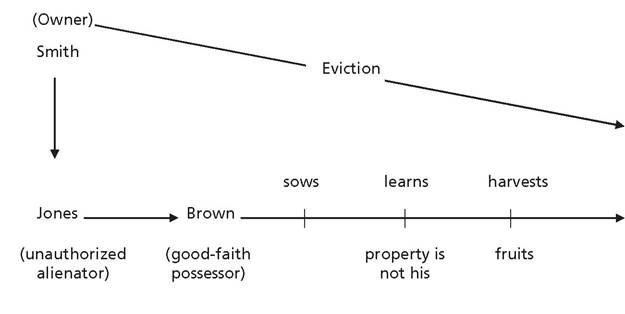
Antiqua">Bonae fidei emptor sevit et antequam fructus perciperet, cognovit fundum alienum esse: an perceptione fructus suos faciat, quaeritur.
Respondi: bonae fi dei emptor quod ad percipiendos fructus intellegi debet, quamdiu evictus fundus non fuerit: nam et servus alienus quem bona fide emero tamdiu mihi ex re mea vel ex operis suis adquiret, quamdiu a me evictus non fuerit.Translation: (Julian in the seventh book of his Digesta)[226]
A good faith buyer has sown seed. Before he harvested the fruit he learned that the land was the property of another. The question was posed whether he acquired ownership of the fruits by harvesting them. I replied: with regard to the harvesting of fruits, the buyer must be considered to be of good faith for as long as he has not been evicted from the farm. For even another's slave, if I have bought in good faith, will acquire for me, provided he does so with my money or his own labor, for as long as I have not been evicted from the possession of him.
Note on the Text:
On intellegi [“be understood”] see on Case 72.
Discussion Questions:
1) Can the buyer of the land usucapt it, although he has learned that it is owned by another?
2) At what point in time is bona fides required for acquiring the fruits? Cf.
also under Case 103.3) Who, in the above described case, will have acquired ownership, if the fruits of the field or tree are stolen?
4) What legal assistance is available to a tenant whose fruits of the tree or field are stolen?
5) Try to clarify the distinction between acquisition by severance and acquisition by collection.
Compare with this Case:
§ 330 Austrian Civil Code:
To the reasonable possessor belong all the fruits of the property, as soon as they have been severed from the property...83
§ 955 I German Civil Code:
He who holds property in proprietary possession acquires the ownership of the products and other objects pertaining to the fruits of the property... upon the separation.[227] [228]
D 41.1.48.1 (Paulus libro septimo ad Plautium)
In contrarium quaeritur, si eo tempore, quo mihi res traditur, putem vendentis esse, deinde cognovero alienam esse, quia perseverat per longum tempus capio, an fructus meos faciam. Pomponius verendum, ne non sit bonae fidei possessor, quamvis capiat: hoc enim ad ius, id est capionem, illud ad factum pertinere, ut quis bona aut mala fide possideat: nec contrarium est, quod longum tempus currit, nam e contrario is, qui non potest capere propter rei vitium, fructus suos facit.
Translation: (Paul in the seventh book of his Commentary on Plautius)[229]
Conversely it is asked whether I acquire ownership of the fruits—if I think the property belongs to the seller at the time it is turned over to me, but later learn it is another's—inasmuch as the possession continues for a long time [i.e., the requisite period of prescription]. Pomponius says one should beware that he is not a good faith possessor, even though he holds the property.
For one must distinguish between the question of law—i.e., the possession—and the question of fact—i.e., whether someone possesses in good or bad faith. And it makes no difference that a long time [i.e., the period of prescription] is running, because, to the contrary, he who cannot usucapt the property because of a defect nevertheless does acquire ownership of the fruits.Note on the Text:
In reference to prescription there was a principle of Roman law: mala fides superveniens non nocet (“supervening bad faith causes no harm”). The issue of good faith applies only at the time of acquiring possession.
Discussion Questions:
Analyze the positions, including those of Julian at D 22.2.25.2 (Case 102).
D 41.2.4.19 (Paulus libro quinquagensimo quarto ad edictum)
Lana ovium furtivarum si quidem apud furem detonsa est, usucapi non potest, si vero apud bonae fidei emptorem, contra: quoniam in fructu est, nec usucapi debet, sed statim emptoris fit...
Translation: (Paul in the 54th book of his Commentary on the Praetor’s Edict)[230]
If the wool of stolen sheep is shorn by the thief, it cannot be usucapted, but if it is shorn by a good faith buyer, the opposite is true: since it is among the fruits, it does not need to be usucapted, but it becomes the buyer's property immediately...
Discussion Questions:
1) Who is the owner of the wool that has been shorn by the thief?
2) Can the wool shorn by the thief be usucapted by the good faith buyer?
3) When must the buyer of the sheep be of good faith, in order to acquire ownership of the wool shorn by himself? Cf.
Cases 102 and 103.Literature:
Thielmann G. “Produktion als Grundlage des Fruchterwerbs.” ZRG 94 (1977) 76-100, at 87 ff.
Filip-Fröschl, Johanna. “Partus et fetus et fructus: Bemerkungen zur rechtlichen Behandlung der Tierjungen bei den Römern,” in Fest-Schr. W. Waldstein, Wolfgang Waldstein and Martin Josef Schermaier eds., Stuttgart: Steiner, 1993, 99-121, at 115 ff.
G.