Means of Acquisition: corpore et animo
Apart from the exceptions to be discussed in subsection B, possession in principle can be acquired only corpore et animo (these terms of art are best used in place of translations) Animus [the nominative form of animo] is the intention to possess; corpore [lit.
‘with body'] (the nominative form, corpus, is practically never used in this connection) means “by bringing about a physical relationship” to the thing that is to be possessed. The animus does not have to be expressly declared; often it is implicit in the act that brings about the physical relationship to the thing.The measure of physical proximity that satisfies the prerequisite of acquiring possession corpore is examined by Roman jurists in numerous cases. In this connection one must take account of whether the acquisition concerns a movable piece of property or an immovable (land), and whether the acquisition is with the previous possessor’s consent (derivative possession) or without it or against his will (original possession). The ability to exert control over the property is also at issue when there is the possibility of damage to the property by a third party (compare Cases 5 and 6 regarding the transfer of keys to a warehouse, and Cases 8 and 9 on acquiring possession of wild animals). We find both narrower and broader interpretations of this corporeal principle and, in the following discussion, we aim to analyze the most important of the pertinent case-distinctions. The animus possidendi [“intention of possessing”] is a topic that Cases 7 and 11 are particularly concerned with.
Literature:
Schulz, F. Einführung in das studium der Digesten. Tübingen: Mohr, 1916, 16 ff.
Gordon, W.
M. Studies in the Transfer of Property by traditio. Aberdeen: University of Aberdeen, 1970, 44 ff.D 41.2.3.1 (Paulus libro quinquagesimo quarto ad edictum)
Et apiscimur possessionem corpore et animo, neque per se animo aut per se corpore. quod autem diximus et corpore et animo adquirere nos debere possessionem, non utique ita accipendum est, ut qui fundum possidere velit, omnes glebas circumambulet: sed sufficiet quamlibet partem eius fundi introire, dum mente et cogitatione hac sit, uti totum fundum usque ad terminum velit possidere.
Translation: (Paul in book 54 of his Commentary on the Praetor’s Edict)[19]
And we acquire possession corpore et animo, not animo alone nor corpore alone. But that we have said we must take possession corpore et animo should not be understood in an absolute sense to mean that he who wishes to possess a farm must walk around the entire farm (literally “every clod of earth”): it suffices to enter any part of the farm, provided the entry is with the intention and thought that one wishes to possess the whole farm up to its boundary.
Notes on the Text:
The text begins with a broad explanation of the principle “apiscimur possessionem corpore et animo...” [“we acquire possession corpore et animo, not animo alone nor corpore alone”]. The abstract principle is then interpreted (ita accipiendum est) by means of an example. On the use of accipiendum est [“should be understood”], see under Case 72.
The word fundus can mean either a country estate or a piece of land. In what follows we usually translate the term as “piece of land.”
Discussion Questions [with model answers]:[20]
1) How does one get possession of a piece of land, according to Paul?
2) What practical considerations argue for walking around the land's boundaries? What ones argue against it?
3) Would you answer the previous question differently depending upon the location and nature of the land?
4) Is Paul thinking of original (i.e., first) possession (without derivation of possession from a predecessor), or derivative (subsequent) possession?
5) Would you require different degrees of physical relationship as between original versus derivative possession of a piece of land?
6) What measures would an acquirer have to take, if the jurists did not let even a “walk around the entire farm” (omnes glebas circumambulare) constitute sufficient physical relationship?
7) What measures might satisfy a less strict conception of physical relationship, one that would not require any entry at all onto the property?
8) How could the acquirer express most clearly his intent to take possession of the whole property “up to the boundaries” (usque ad terminum)?
— in the case of original possession?
— in the case of derived possession?
Answers:
1) By stepping onto any part of the piece of land in question with the purpose of taking possession of the whole piece.
2) Pro: Publicity (acquisition will sometimes be more clearly recognizable by
third parties); clear establishment of the boundaries avoids future disagreements with the neighbors.
(Fines demonstrare [“to point out the boundaries”] is a seller's obligation, the acquisition of possession is of course a separate and independent issue.)Con: Impracticality (property boundaries can be clarified in other ways); from the viewpoint of “control” of the property it makes no qualititative difference from mere entry.
3)size=1 face="Times New Roman"> A “walk around the fields” would scarcely be reasonable in the case of an especially large or impassable property. An argument can be made for or against different treatments using the considerations listed under “2” above.
4) Probably of derivative possession (the normal case). Original possession would be thinkable in the case of a long-abandoned property, also when possession is acquired through usucapio pro herede,[21] as much as in the case of occupation by force (in that connection, however, see under Case 54).
5) Stricter requirements are sometimes needed in the case of original possession, in view of possible acts of third parties who also wish to gain possession. (Smith enters in the morning upon an ownerless piece of property with a view to taking possession, then he leaves it again; in the afternoon Jones begins to plow or fence in the property with a view to taking possession of it.)
6) Fence it in; cultivate it.
7) Point it out (from a neighboring plot or possibly an even greater distance).
8) — In the case of original possession: walk around the boundaries, fence it
in, cultivate it, work the land in a manner that expresses a claim to the entire surface (not, say, just walking around or building on a part of the land without ever entering upon the remainder).
— In the case of derivative possession: manifesting directly to the preceding possessor (mostly by express declaration) the intention of taking possession of the whole property.
Compare with this Case:
§ 309 Austrian Civil Code:
Whoever has a piece of property in his control or custody is the holder of that property.
If the holder of a piece of property has the intention of keeping it as his own, he is the possessor of it.[22]§ 312 Austrian Civil Code:
Tangible, movable property is taken into possession by physically grasping it, removing it, or taking it into custody; immovable property is taken into possession by entering upon, marking the boundaries of, fencing, signposting, or working it. ..[23]
Literature:
Moehler, R. “Der Besitz am Grundstück, wenn der Besitzer es verlässt.” ZRG 77 (1960) 52-124, 54 ff.
D 41.2.18.2 (Celsus libro vicensimo tertio digestorum)
Si venditorem quod emerim deponere in mea domo iusserim, possidere me certum est, quamquam id nemo dum attigerit: aut si vicinum mihi fundum mercato venditor in mea turre demonstret vacuamque se possessionem tradere dicat, non minus possidere coepi, quam si pedem finibus intulissem.
Translation: (Celsus in book 23 of his Digesta)[24]
class=a6 style='text-indent:0cm'>If I have ordered the seller to place in my house that which I have bought, it is certain that I possess it, even if no one has yet touched it. Or if, after I have bought a neighboring piece of land, the seller in my tower points it out and says he is delivering vacua possessio [“unimpeded possession”], I begin to possess it no less than if I had set foot on the land.Notes on the Text and Discussion Questions [with model answers]:
On certum est (“it is certain”), see below on Case 27.
The text presents two factsituations that are connected with aut [“or”]. It cannot be known if the jurist is responding to an actual question or just dealing with theoretical considerations. A systematic division of the passage recommends itself:The first fact-situation:
1) The facts: buyer tells the seller to place the goods in the buyer's house. The seller complies with the instruction.
2) Legal question: has the buyer thereby acquired possession?
3) The jurist's decision: self-evidently (certum est) he has, even if no one in the house of the buyer has yet touched the goods.
4) Considerations: The buyer's intention to take possession is here unproblematic and will therefore not be discussed. The jurist instead considers how the physical relationship that affects the taking of possession should be established. In the normal case, delivery (traditio) of the goods is made into the hand of the buyer, who grasps the goods and takes them with him. Here, instead, an arrangement is made for subsequent delivery to the buyer's house.
a) Celsus states it as decided that with delivery of the property into the buyer's house it is not necessary for the buyer to have contact with it. Why is the jurist satisfied with the mere deposit of the goods absent any act of receiving them? Is he thinking only of the case where the seller comes with the goods into the house of the buyer, and the buyer is present and instructs him to put the thing down, or does the opinion also apply to the case of an agreement in the seller's shop with subsequent transfer to the buyer's house (in the buyer's absence)?
b) Does the buyer take possession if the seller leaves the thing in front of the house?
c) Does the buyer take possession of a thing left in front of his house if he has expressly agreed to that with the seller?
Answers:
a) The thing transferred into the house of even an absent buyer has clearly entered into his sphere of control.
b) If the buyer has instructed the seller to place the property in the house, possession does not count as passing before that point in time, in accordance with the instruction.
Although one might sometimes assume a sufficient physical relationship before then, there is no taking of possession, because the buyer did not wish to take possession until that point in time. The seller has the obligation of careful safekeeping (custodia) up to that point. He is therefore liable for loss or damage to the property, since he did not deposit the property in the house, according to the agreement, but in front of the house.c) lang=EN-US>The agreement of the parties cannot take the place of the required physical relationship. From the viewpoint of control, since there can be a considerable difference between whether the property is placed in or in front of the house, the Roman jurists reached different decisions according to the circumstances (the nature of the place, of the property, etc.).
The second fact-situation:
1) The facts: someone has purchased another piece of property that abuts onto his own. The seller points out the property to the buyer from a tower that is on the buyer's land and declares to the buyer that he, the seller, is delivering vacua possessio (i.e., turning over the vacated property).
2) Legal question: can one in this case speak of taking possession corpore?
3) The jurist's decision: yes, just as if the possessor had entered upon the property.
4) Considerations:
a) Is it an important detail that a neighboring piece of land is at issue?
b) Is it relevant to the decision that the piece of land is pointed out from the buyer’s tower?
c) How does this decision of Celsus relate to that of Paul D 41.2.3.1 (Case 1)?
d) To what degree is pointing out a piece of property from a tower comparable to placing a thing in the house of the buyer?
e) In spite of the collocation of the two fact-situations, could one make a distinction between their respective degrees of physical relationship?
Literature:
Gordon, W. M. Studies in the Transfer of Property by traditio. Aberdeen: University of Aberdeen, 1970, 50 ff.
D 46.3.79 (lavolenus libro decimo epistularum)
Pecuniam, quam mihi debes, aut aliam rem si in conspectu meo ponere te iubeam, efficitur, ut et tu statim libereris et mea esse incipiat: nam tum, quod a nullo corporaliter eius rei possessio detinetur, adquisita mihi et quodammodo manu longa tradita existimanda est.
Translation: (Javolenus in book 10 of his Letters)[25]
If I should ask you to put down where I can see it the money that you owe me or something else, the effect is that you are immediately free of the debt and the coin or other thing becomes my property; for at the point when physical possession of the thing is retained by no one, it counts as having been acquired by me and having been delivered, in a manner of speaking, “by a long hand.”
Antiqua">Notes on the Text:
The compilers have placed this text in Title 46.3 of the Digest, which is entitled “On Payments and Discharges of Debt.”[26] The words aut aliam rem [“or something else”] could be a later intrusion or perhaps only an imprecise manner of speaking. The following word, libereris [“you are free of”] shows that this statement must concern a thing that is owed.
Facts of the case. Someone has asked his debtor to lay down the money, or something else that is owed, in front of his eyes. The debtor complies with this command.
Legal question. Is the debtor released from the debt as a result of that action? Does the creditor acquire possession of the thing?
Discussion Questions:
1) Does the command itself serve to release the debtor and give possession to the creditor, or is it necessary to complete the action that is commanded?
2) What significance would you attach to the spatial distance of the creditor from the thing and the possibility of action by a third party?
3) Based on this text, try to develop a definition of traditio longa manu [“delivery by means of a long hand”] and then see if pointing out a piece of land from a tower (D 41.2.18.2 = Case 2) and leaving goods in the house of the buyer (same case) can be subsumed under your definition.
4) What is the meaning and importance of the provision: quod a nullo corporaliter eius rei possessio detinetur [“when physical possession of the thing is retained by no one”]?
Literature:
Eckardt, Bernd. lavoleni epistulae. Berlin: Duncker & Humblot, 1978, 231 ff.
D 41.2.1.21 (Paulus libro vicensimo tertio ad edictum)
Si iusserim venditorem procuratori rem tradere, cum ea in praesentia sit, videri mihi traditam Priscus ait, idemque esse, si nummos debitorem iusserim alii dare. non est enim corpore et tactu necesse adprehendere possessionem, sed etiam oculis et affectu argumento esse eas res, quae propter magnitudinem ponderis moveri non possunt, ut columnas, nam pro traditis eas haberi, si in re praesenti consenserint: et vina tradita videri, cum claves cellae vinariae emptori traditae fuerint.
Translation: (Paul in book 54 of his Commentary on the Praetor’s Edict)[27]
If I should order the seller in the presence of the thing to deliver it to my procurator[28] Priscus says that the thing is considered to have been delivered to me. [He says] the same is true if I order the debtor to give the money to another. For it is not necessary to take possession physically and with touching, but it can also be taken by means of the eyes and attitude. That is proved by those things which cannot be moved because of the greatness of their weight, like columns; for these are considered to have been delivered if the parties so agree in the presence of the property. Wine too counts as delivered, if the keys to the wine cellar have been delivered to the buyer.
size=1 color=black face="Book Antiqua">Note on the Text:
On videri (“is considered”), see below under Case 72.
Discussion Questions:
Four cases are joined together here:
1) Acquiring possession by command to the seller in the presence of the property to deliver it to the acquirer’s procurator [“agent”].
a) Does the buyer’s acquisition of possession occur at the instant of the command to the seller, or at the instant of the delivery to the procurator?
b) Is the presence of the procurator at the giving of the command necessary?
2) Acquiring possession of owed money by the creditor’s command to the debtor to deliver it to a third party.
a) In this case is an agreement in the presence of a visible and counted sum of money necessary?
3) Acquiring possession of especially heavy objects (e.g., columns) by agreement between the seller and the acquirer in the presence of the property.
a) What is the logical connection of this fact-situation with the first two factsituations?
4) Acquiring possession of wine by delivering to the buyer the keys to the wine cellar.
a) Is the jurist thinking of delivery of the keys in the cellar, in front of the cellar, or at any place?
b) Would all four cases count as traditio longa manu (D 446.3.79: Case 3)?
c) Under what conditions is the statement that one can take possession “by means of the eyes and attitude” valid?
Literature:
Gordon (Case 2 above) 47 ff.
Watson, A. “Acquisition of Ownership by traditio to an extraneus,” SDHI 33 (1967) 194 ff. (reprinted in Studies in Roman Private Law. Rio Grande, OH: Hambledon Press, 1991, 114 ff.
D 18.1.74 (Papinianus libro primo definitionum)
Clavibus traditis ita mercium in horreis conditarum possessio tradita videtur, si claves apud horrea traditae sint: quo facto confestim emptor dominium et possessionem adipiscitur, etsi non aperuerit horrea: quod si venditoris merces non fuerunt, usucapio confestim incohabitur.
Translation: (Papinian in the first book of his Definitions)[29]
Possession of goods stored in a warehouse counts as delivered with delivery of the keys to the warehouse, provided the keys have been delivered at the warehouse. With this act the buyer immediately takes both ownership and possession, even if he has still not opened the warehouse. But if the wares were not the property of the seller, usucapion will begin from that point.
Note on the Text:
On videtur (“counts as”), see below under Case 72.
Discussion Questions:
1) Is delivery of the keys understood as a “symbolic” transfer of the goods (cf. “through symbols” in § 427 of the Austrian Civil Code, quoted below), or as an “actual” one?
2) How does Papinian conceptualize the acquisition of possession, since he requires that the keys be delivered in front of the warehouse and not in some other place?
3) Is it relevant whether other copies of the delivered keys exist, and who has them in hand?
4) Does it make a difference if the goods of more than one owner are in the warehouse? How about if all the goods in the warehouse are being transferred? What if only a part of them?
5) Can someone deliver the goods in an unlocked warehouse merely by pointing out the warehouse without delivery of the keys?
Compare with this Case:
§ 426 Austrian Civil Code:
Movable property in general can only be transferred to another by physical delivery from hand to hand.[30]
§ 427 Austrian Civil Code:
However, in the case of goods that cannot be physically handed over because of their nature, like debts, cargoes, warehouse contents, or other collections, the law permits the transfer through symbols—by which the owner gives the transferee documents through which ownership is established, or transfers the means by which the transferee is placed in the position of taking exclusive possession of the goods, or by one's attaching a distinctive mark to the goods from which anyone can clearly recognize that the goods have been passed to another.[31]
Literature:
Gordon (Case 2 above) 57.
D 41.1.9.6 (Gaius libro secundo rerum cottidianarum sive aureorum)
Item si quis merces in horreo repositas vendiderit, simul atque claves horrei tradiderit emptori, transfert proprietatem mercium ad emptorem.
Translation: (Gaius in the second book of his lang=EN-US style='font-size:8.5pt; line-height:115%;font-style:italic'>Jurisprudence of Daily Life, also known as the Golden Rules)[32]
Likewise if someone sells goods that are stored in a warehouse, he transfers ownership of the goods to the buyer as soon as he delivers the keys to the warehouse to the buyer.
Discussion Questions:
Gaius speaks of acquiring ownership. Since acquiring possession is a condition of acquiring ownership, the opinion of Gaius implies an affirmation of this means of acquiring possession.
In contrast with Papinian (Case 5), the Gaius passage lacks an indication that the delivery of keys must take place in front of the warehouse. This could be the result of an unintended omission from the text, a conscious juristic controversy regarding the necessity of delivering the keys in the presence of the property, or a difference in the fact-situations of the storage, in which delivery of the keys in front of the warehouse is necessary or not, depending on the circumstances.
Try to reconcile the differences between Gaius and Papinian (Case 5) by proposing appropriately different fact-situations. Could arguments from Case 2 (D 41.2.18.2) and Case 9 (D 41.1.55) be found in support of Gaius' opinion?
Literature:
Gordon (Case 2 above) 57.
D 18.6.15[14].16 (Paulus libro tertio rerum epitomatorum Alfeni)
Materia empta si furto perisset, postquam tradita esset, emptoris esse periculo respondit, si minus venditoris: videri autem trabes traditas, quas emptor signasset.
Translation: (Paul in the third book of his Excerpts from Alfenus)[33]
If material that has been purchased is lost by theft after it has been delivered, he replied that the buyer bears the risk. If it has not yet been delivered, the seller bears it. Beams that the buyer has marked with his seal are understood to have been delivered.
Note on the Text:
On videri (“are understood as”), see under Case 72.
Discussion Questions [with model answers]:
1) What is meant by the statement: periculum est emptoris (“the buyer bears the risk”)?
2) What rule applies with regard to the seller's risk and liability?
3) What objection can be made against acquiring effective possession (corpore, animo) of beams by merely “marking them with one's seal” (signare)?
4) Is it important how the buyer marks the beams? Whether he provides an explanation or not? Would it be necessary to know the practice of Roman lumber-trading in order to answer this question?
class=a6 style='margin-left:0cm;text-indent:18.0pt'>5) Would acquisition of possession also be possible by merely pointing?Answers:
1) Periculum est emptoris means that the buyer bears the “price-risk”: the risk of loss of the property through the operation of force majeure (fire, flood, robbery, etc.) passes to the buyer as soon as the sale is concluded, not waiting until delivery of the goods to the buyer. The buyer must pay the purchase price even if he does not obtain the goods.
2) Up to the delivery, however, the seller is liable not only for intentional or negligent damage to or destruction of the property, but he has in addition a special duty of care, custodia, which places upon him the risk of theft in particular. In the case of theft after delivery, the buyer must pay the purchase price to the seller. In the case of theft before delivery, the seller must refund to the buyer any purchase price that has been received.
3) Just attaching one's seal (signare) to the beams may not indicate with sufficient clarity that the buyer wishes to take possession at that moment. He might only be intending to distinguish the marked beams from the whole stock and to take possession later (through collection or delivery).
4) By giving an explanation, it would certainly be clear whether the animus possidendi [“intention of possessing”] was present. A standard conforming practice in Roman lumber-trading would permit the marking (signare), or the manner in which the buyer does it, to serve as an implied expression of his intention one way or another.
5) Yes; the physical relationship would be entirely sufficient: cf. D 41.2.1.21 (columns etc.)—Case 4.
D 41.1.5.1 (Gaius libro secundo rerum cottidianarum sive aureorum)
Illud quaesitum est, an fera bestia, quae ita vulnerata sit, ut capi possit, statim nostra esse intellegatur. Trebatio placuit statim nostram esse et eo usque nostram videri, donec eam persequamur, quod si desierimus eam persequi, desinere nostram esse et rursus fieri occupantis: itaque si per hoc tempus, quo eam persequimur, alius eam ceperit eo animo, ut ipse lucrifaceret, furtum videri nobis eum commisisse. plerique non aliter putaverunt eam nostram esse, quam si eam ceperimus, quia multa accidere possunt, ut eam non capiamus: quod verius est.
Translation: (Gaius in the second book of his Jurisprudence of Daily Life, also known as the Golden Rules)[34]
The question was asked whether a wild beast that has been wounded sufficiently that it can be caught should be understood as immediately becoming our property (i.e., the property of the person who wounded it). Trebatius was of the opinion that it did and that it remained our property, as long as we continued to pursue the beast. But if we desisted from pursuing it, the beast ceased to be ours and became once again the property of whoever takes it first (occupatio). Therefore if, while we are pursuing the beast, another takes it with the intention of securing the profit of it, he is deemed to have committed a theft against us. Most jurists, however, hold that the beast does not become ours until we capture it, since many things can happen to prevent us from capturing it. This is the more correct opinion.
Notes on the Text:
The text stands in Title 41.1 of the Digest, which is entitled “On acquiring ownership of things” (de adquirendo rerum dominio). The compilers have used a large fragment from the res cottidianae of Gaius to introduce the subject. Gaius first discusses acquisition of original ownership according to the ius gentium [“law of (all) peoples”], beginning with the statement that one acquires ownership of wild beasts as res nullius (ownerless property) by means of occupatio (taking possession with the intent of owning): D 41.1.1 and 3 (Case 94). He then considers in the passage above the necessary physical relationship for acquiring possession.
Gaius refers to an old juristic controversy (quaesitum est [“it was asked”]) and then expresses his agreement (verius est [“is more correct”]) with the dominant opinion of most jurists (plerique) against Trebatius. On intellegatur (“should be understood”), see on Case 72.
The phrase verius est (“[this] is more correct”)—i.e., the better juristic opinion or solution to the problem—signals no more than a controversy. The jurist makes a choice between two positions that have been expounded by colleagues or predecessors (see Cases 118 and 125), or he contrasts a previous opinion with his own. Occasionally verius may just express a judgment after weighing two viewpoints that one and the same jurist has set forth.
Discussion Questions:
1) Express in your own words the fact-situation, legal question, and the two opposed juristic opinions.
2) Is the wounding essential to the view of Trebatius or could mere pursuit of a slow animal (one that is easily caught) be sufficient to acquire possession?
3) Does Gaius take a position contrary to the principle of acquiring possession longa manu [“with a long hand”] (Case 3)?
4) How would Gaius have viewed the killing of the animal before any immediate grasping of it?
5) Would Gaius have likely decided differently if the animal had been fatally wounded or his capture had been inevitable as a practical matter?
6) Should one under certain conditions recognize the claim of a pursuer who ought not to be interfered with by another (e.g., as a reward for his time and effort, or in order to avoid conflicts)?
n.b.: Regarding this case see the model case-analysis in the Appendix at p. 321.
Compare with this Case:
Pierson v. Post, 3 Cai. R. 175, 2 Am. Dec. 264 (Supreme Court of New York 1805)
Post, a hunter on horseback with a pack of hounds, was pursuing a fox and already near to killing him, when suddenly Pierson, a farmer, jumped in between, killed the fox, and carried him off. Post sued Pierson and won at trial. Pierson appealed the judgment.
The appellate court overturned the decision, saying: “The case now under consideration is one of mere pursuit, and presents no circumstances or acts which can bring it within the definition of occupancy...”
In dissent Judge Livingston wrote: “... [O]ur decision should have in view the greatest possible encouragement to the destruction of an animal so cunning and ruthless in his career. But who would keep a pack of hounds... and for hours... pursue the windings of this wily quadruped, if...a saucy intruder, who had not shared in the honors or labors of the chase, were permitted to come in at the death, and bear away in triumph the object of pursuit?... [A] pursuit like the present... which must inevitably and speedily have terminated in corporal possession, confers such a right to the object of it as to make anyone a wrongdoer who shall interfere and shoulder the spoil.”
On this American case and the Roman law foundations of its decision, see most recently Charles Donahue, Jr. “Animalia ferae naturae: Rome, Bologna, Leyden, Oxford, and Queen's County, NY, in Studies in Memory of A. Arthur Schiller, Roger S. Bagnall, A. Arthur Schiller, and William Vernon Harris eds., Leiden: Brill, 1986, 39-63.
Literature:
Knütel, Rolf. “Von schwimmende Inseln, wandernden Bäumen, flüchtenden Tieren und verborgenen Schätzen,” in Rechtsgeschichte Und Privatrechtsdogmatik, R. Zimmermann, R. Knütel, and J. Peter Meincke, eds. Heidelberg: C. F. Müller, 1999, 565 ff.
D 41.1.55 (Proculus libro secundo epistularum)
In laqueum, quem venandi causa posueras, aper incidit: cum eo haereret, exemptum eum asbstuli: num tibi videor tuum aprum abstulisse? et si tuum putas fuisse, si solutum eum in silvam dimisissem, eo casu tuus esse desisset an maneret? et quam actionem mecum haberes, si desisset tuus esse, num in factum dari oporteret, quaero. respondit: laqueum videamus ne intersit in publico an in privato posuerim et, si in privato posui, utrum in meo an in alieno, et, si in alieno, utrum permissu eius cuius fundus erat an non permissu eius posuerim: praeterea utrum in eo ita haeserit aper, ut expedire se non possit ipse, an diutius luctando expediturus se fuerit. summam tamen hance puto esse, ut, si in meam potestatem pervenit, meus factus sit. sin autem aprum meum ferum in suam naturalem laxitatem dimisisses et eo facto meus esse desisset, actionem mihi in factum dari oportere, veluti responsum est, cum quidam poculum alterius ex nave eiecisset.
Translation: (Proculus in the second book of his Epistles)[35]
A boar fell into a snare that you had placed there for the purpose of hunting. While he was held there I took him out and brought him away. Are you to understand that I have made off with your boar? If you think that he was your property, would he have ceased to be your property, or remained so, if I had released him into the forest? Further, I ask which action you could bring against me if he ceased to be your property, or whether you could bring an action in factum.[36] He answered: Let us see if it makes a difference whether the snare was placed on public or private ground; and if on private ground, whether on mine or someone else's; and if on someone else's, whether with or without the permission of the landowner. Additionally, was the boar so caught in the snare that he could not free himself, or would he have freed himself after more struggle? In my judgment, however, the essence of the case is that the boar has become my property if it has come into my control. If you release my wild boar into his natural state of freedom, and he therefore is my property no longer, an actio in factum must be given to me, just as it has been decided when someone threw another's cup off a boat into the sea.
Notes on the Text:
On videor (“are you to understand that I ..see on Case 72. Consider this passage only from the viewpoint of acquiring possession, in regard to which Proculus provides the following considerations:
1) The boar is caught in the snare, or he could have freed himself.
2) The snare lies on land that is:
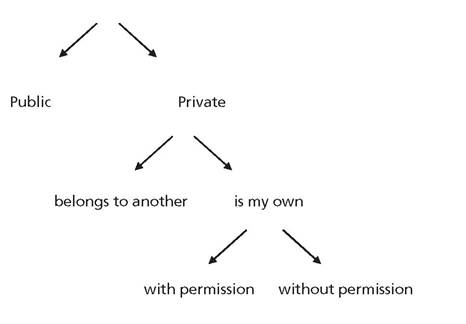
Discussion Questions:
1) Is hunting on another's land permissible in Rome? Cf. Case 94.
name=bookmark330>2) What effect does the landowner's prohibition have on the hunter's acquisition of possession and ownership?
3) Using the abstract viewpoints of Proculus, try to construct specific factsituations in which the person who places the snare would and would not acquire possession. Regarding these, compare Case 55.
4) Jones places a snare on Smith's land despite Smith's prohibition. A boar is caught in the snare. Jones sees the boar from a distance and goes to the boar with the intent of seizing him. Suddenly Smith comes up, cuts through the snare, and lets the boar free. Has Jones already acquired possession? Does the decision depend on whether the boar could have freed itself after a short while?
5) How do you decide the case in which someone takes fish out of a net that someone else has put in the sea?
Compare with this Case:
Young v. Hichens, 6 Q. B. 606 (1844)
Fisherman Young discovered a school of mackerel from his boat, laid his net around them in a half-circle, and drew it together leaving a small gap. His men beat the water with their rowing and thereby prevented the fish from escaping. Before they could close the net the boat of defendant Hichens sailed through the gap into the circle and completely fished it out. The court decided: “It does appear almost certain that the plaintiff would have had possession of the fish but for the act of the defendant; but it is quite certain that he had not possession.”
Literature:
Krampe, C. Proculi Epistulae. Eine frühklassische Juristenschrift. Karlsruhe: C. F. Müller, 1970 (Freiburger rechts- und staatswissenschaftliche Abhandlungen, 34), 65 ff.
D 41.2.51 (lavolenus libro quinto ex posterioribus Labeonis)
Quarundam rerum animo possessionem apisci nos ait Labeo: veluti si acervum lignorum emero et eum venditor tollere me iusserit, simul atque custodiam posuissem, traditus mihi videtur. idem iuris esse vino vendito, cum universae amphorae vini simul essent. sed videamus, inquit, ne haec ipsa corporis traditio sit, quia nihil interest, utrum mihi an et cuilibet iusserim custodia tradatur. in eo puto hance quaestionem consistere, an, etiamsi corpore acervus aut amphorae adprehensae non sunt, nihilo minus traditae videantur: nihil video interesse, utrum ipse acervum an mandato meo aliquis cutodiat: utrubique animi quodam genere erit aestimanda.
Translation: (Javolenus in the fifth book of his Excerpts from the Posthumously Published Writings of Labeo)[37]
Labeo says that one can acquire possession of certain things animo: for example, when I buy a pile of logs and the seller authorizes me to take them away, the pile is seen to have been transferred as soon as I have taken custody of them. The same rule [i.e., that one can take possession animo] applies to the sale of wine when all the wine-vessels are present at once. But let us consider, he says, whether this is a physical delivery, since it makes no difference whether the safe-keeping is transferred to me or to whomever I appoint. I believe the issue turns on this: whether the pile of logs or the wine is understood to have been delivered, even if they have not been physically touched. I see no difference whether I guard the woodpile myself or someone else does so at my command. In both cases it is to be accepted that possession has been acquired by a kind of mental act (animo).
Discussion Questions [with model answers]:
1)"Times New Roman"'> Is Labeo thinking of an agreement in the presence of the woodpile or in some other place?
2) Does Labeo require a guard to be placed in order to effect possession of wine vessels?
3) Consider to what degree the decisions in Cases 2, 3, 4, 5, 7, and 9 can be understood as applicable to woodpiles on the one hand and wine vessels on the other.
4) What do Labeo and Javolenus understand by the term animo? Are they thinking of a waiver of the requirement of physical relationship?
5) Does it matter what the personal status of the guard is?
Answers:
1) Earlier and in another place, because, as follows from the ensuing example of wine vessels, Labeo also recognizes that possession can be acquired by agreement in the presence of the thing. The buyer of the woodpile could therefore have taken immediate possession by agreement in the presence of the woodpile, without having to appoint a guard, unless he intended to take possession by means of appointing a guard.
2) No. Agreement in the presence of the thing is enough for taking possession.
3) Woodpile (the applicable principle is the coming into the possessor’s sphere of control): cf. placement of goods in the house, the boar in the snare. Wine vessels (the applicable principle is agreement in the presence of the thing): cf. pointing out land from a tower, setting something down in conspectu, delivery of keys in front of a warehouse.
4) Javolenus and Labeo do not waive the need for a physical relationship. The purchaser’s custodia [“custody,” i.e., taking responsibility for safekeeping] is still required. The waiver applies only to the requirement of physical contact (adprehensae non sunt [“they have not been grasped”]), which was called for by an older doctrine and was identified with the words corpore possidere [“to possess bodily”].
5) Yes. The later formulated rule that states that possession can be acquired animo nostro corpore alieno [“with our intent and another’s body”] restricts the physical element to the mediation of a person “in power.”
Literature:
Hausmaninger, H. “Besitzerwerb solo animo,” in Festgabe für Arnold Herdlitczka zu seinem 75. Geburtstag. Dargebracht von seinen Schülern und Freunden, R. Arnold, Franz Horak, and Wolfgang Waldstein, eds. München: W. Fink, 1972, 117 ff.
D 18.6.1.2 (Ulpianus libro vicesimo octavo ad Sabinum)
Si dolium signatum sit ab emptore, Trebatius ait traditum id videri: Labeo contra, quod et verum est: magis enim ne summutetur, signari solere quam ut traditum videatur.
Translation: (Ulpian in the 28th book of his Commentary on the Ius Civile of Sabinum)[38]
class=a6 style='text-indent:0cm'>Trebatius says that if the buyer has marked a wine vessel with his seal, it counts as delivered. Labeo says not, which is correct. For the seal is more often affixed in order to prevent substitution rather than to signify delivery.Note on the Text:
On videatur (“signify”) see on Case 72. Signare means “to seal” or “affix one's seal to”; summutare (“to substitute, exchange”) could refer to the vessel but also to the wine.
The facts: A wine vessel is marked with the buyer's seal. It remains in the seller's wine cellar.
The legal question: Has the buyer taken possession with his seal?
Discussion Questions:
Trebatius affirms that traditio [“delivery”] has taken place and therefore presupposes that the buyer has taken possession by agreement with the seller, who wishes to surrender possession. Labeo says traditio has not taken place.
1) Analysis of Trebatius' legal reasoning:
a) Does a seal suffice to establish the physical relationship?
b) Is the buyer's animus possidendi [“intention of possessing”] present?
c) Is this animus already expressed through the purchase itself?
d) Do you think that for Trebatius the issue of transfer of possession would also arise even without the sealing or other touching of the vessel (dolium) in question?
e) Can the decision of Trebatius be supported by Alfenus D 18.6.15 [14].1 (Case 7)?
2) Analysis of the contrary view of Labeo:
a) Does the degree of physical relationship not satisfy him?
b) How does he assess the factor of intent (both seller's and buyer's) and how does he explain his decision?
c) Following Labeo, how might someone take possession of a dolium?
d) What legal consequences are tied to the moment of traditio?
e) What considerations support Ulpian's apodictic approval of Labeo's opinion?
class=WordSection11>
B.