3. The Digest
Composition and Content
The Digest comprises 50 books. The arrangement of the material within it is based on the Codex Iustinianus and the praetorian edict (const.
Deo auct. § 5). The books - with the exception of D. 30-32 - are divided into titles with title headings (rubrics). Each excerpt is headed by a note or ‘inscription’ which states the name of the jurist, the work, and the number of the book from which the excerpt was taken. This method had also been used in earlier collections of excerpts (above, 122-3). Justinian divided the Digest into seven partes which bore some relation to the organization of the legal curriculum before his reform.46Within each title the excerpts are generally arranged in an order which was first discovered by Friedrich Bluhme in 1820.47 The Digest commission had divided the juristic writings into three large groups or masses: the edictal mass, the Sabinian mass, and the Papinian mass. The masses take their names from the works with which they begin. The edictal and Sabinian masses are roughly similar in extent (about 575 books or libri each); the Papinian mass comprises about half as many books as each of the other two masses (292 books).48 The division of the material into three masses implies a corresponding division of labour within the Digest commission.49 Generally, each of these masses appears within each individual title, although their order varies. On occasion the compilers removed an excerpt from its place in one mass and inserted it into another when this seemed more appropriate.50
The first book of the Digest contains titles on law and justice, legal history, the sources of law (D.
1.1-4), the law of status (D. 1.5-7), the division of things (D. 1.8), the law on senators (D. 1.9), and on the jurisdiction of officials of the state (D. 1.10-21). The great majority of the 50 books of the Digest is concerned with private law (D. 2—47); D. 48 contains public criminal law; D. 49 deals with appeals procedure (D. 49.1-13) and with the law of the imperial treasury, the fisc (D. 49.14). D. 50 has titles on the law concerning municipalities (D. 50.1—12) and on various specialized areas of law (D. 50.13—15). An extensive title at the end provides information on the legal meaning of certain expressions (D. 50.16). The last title (D. 50.17) contains a great number of juristic rules.Changes to the Original Texts: Interpolations
It is very important for our knowledge of classical Roman law to gain an understanding of how and to what extent Justinian’s compilers — in accordance with their mandate — altered the text of the excerpts they included in the Digest (interpolations).51 Occasionally constitutions of Justinian explicitly tell us about changes to the law.52 Furthermore, we know that in all instances where certain obsolete institutions occurred in the classical texts, the compilers replaced them with the institutions used in Justinian’s time. Examples can be found in the law of property (where the compilers inserted traditio for mancipatio), in family law (actio dotis for actio rei uxoriae), in the law of obligations (fideiussio for sponsio), and in inheritance law (legatum per damnationem for legatum per vindicationem). Incongruities in language or in substance within a passage may imply alterations to the text (especially omissions) by the compilers, but to suspect interpolations based purely on the use of certain expressions or on the assumption that the compilers held certain preconceptions of the law is no longer accepted.
Clarity about the alterations and omissions made by the compilers can be achieved only in those cases in which the same text has not only survived in the Digest but is also attested elsewhere — for example, in one of the collections of juristic writings produced before Justinian’s time (above, 122—3).
The following example is included in the Digest as well as in the Lex Dei (or Collatio). It is taken from Ulpian’s comment on the third chapter of the lex Aquilia, which deals with damage to property through urere, frangere, rumpere (burning, breaking, smashing). The case at hand is concerned with burning. Corresponding text is shown in italics; additionally, where the wording is identical the text is underlined.D. 9.2.27 (excerpts) Coll. 12.7 (excerpts)
Ulpianus libro octavo decimo ad edictum. Ulpianus libro XVIII ad edictum, sub titulo
“si fatebitur iniuria occisum esse, in simplum” et53 cum diceret:
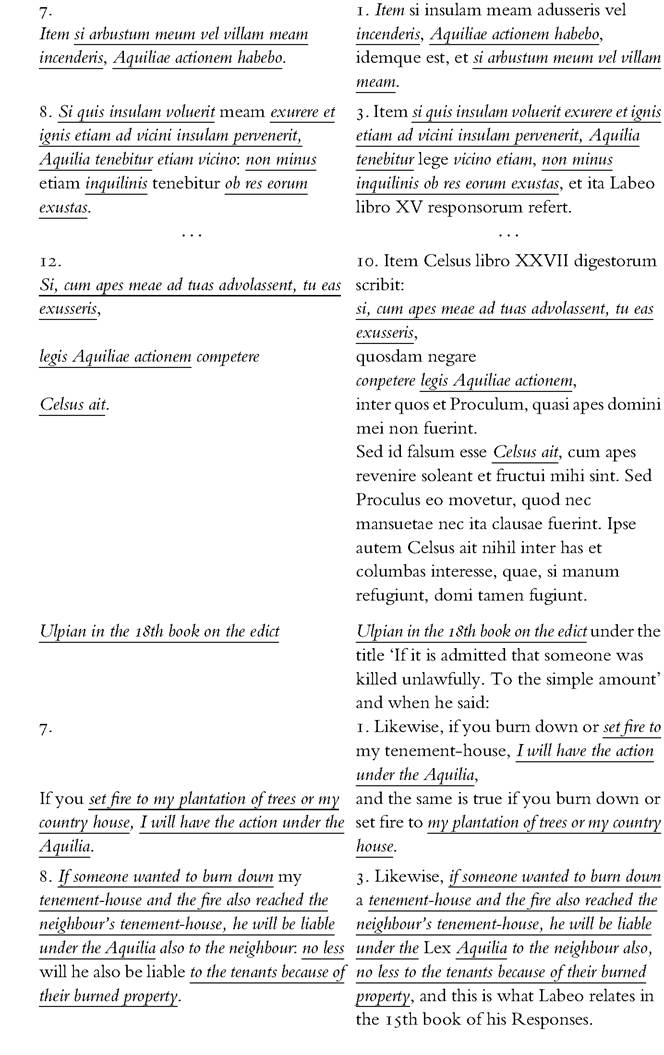
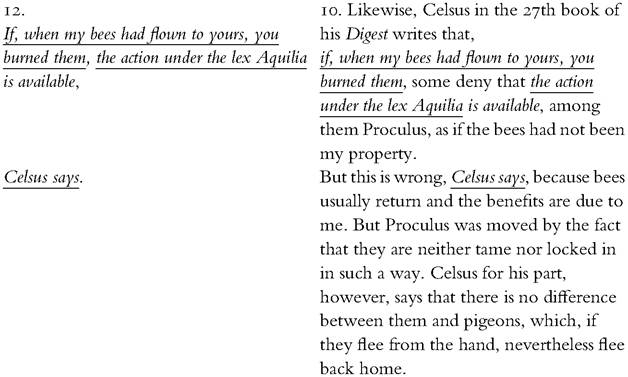
At the beginning of the example the compilers combined two cases into one (Item si insulam - meam was contracted to Item — habebo). They left out Ulpianface=Arial>’s references to other jurists (et ita Labeo - refert and Item Celsus - scribit). Furthermore, they settled differences of opinion among the jurists and omitted Ulpian’s account of the differing views (legis Aquiliae actionem competere Celsus ait instead of quosdam negare - tamen fugiunt). In this example no clauses or whole sentences were added by the compilers; it is, however, attested on some occasions that the compilers did this, too.
Editions, Transmission, and Textual Criticism
Today the authoritative edition of the Digest is that of Theodor Mommsen.54 It was published in the years 1868 to 1870 (editio maior).55 Only a few years later a simplified version of this edition, with a much shorter critical apparatus, was produced: the editio minor.
It was first published in 1872 and was frequently reprinted. Starting with the eleventh reprint (1908) the editio minor was revised by Paul Krüger. Krüger on occasion made improvements to the text, expanded the critical apparatus, and included the results of Otto Lenel’s palingenetic research. The result is that the editio maior and the editio minor no longer match exactly.The transmission of the Digest, which can be only sketched here, is marked by the survival of one almost complete manuscript from late antiquity, the Codex Florentinus Digestorum.56 The large manuscript comprises about 900 sheets (1800 pages), which today are divided into two volumes. It was probably produced in a scriptorium in the east, perhaps in Constantinople. Apart from the loss of some individual sheets and the fact that one double-sheet was already missing in the exemplar from which the Codex Florentinus was copied,57 the Codex Florentinus is complete; in particular, it includes the passages of text written in Greek. Apart from the Codex Florentinus, only fragments and relics of Digest manuscripts from late antiquity have survived.58
One fascicle of a manuscript that was created in Burgundy at the beginning of the ninth century is extant. It contains the end of the Institutes and the beginning of the Digest.59 The remainder of the manuscript is lost. The fascicle has only survived because it was accidentally bound into a manuscript of the Epitome Iuliani (below, 140). It seems that the Institutes and the Digest were copied directly from a late-antique manuscript.
So far as is known today, the medieval textual tradition of the Digest - the Digest vulgate - began around the middle of the eleventh century.60 The two oldest manuscripts known today are the ms. Vat. lat. 1406 (dating from the second half of the eleventh century) and ms.
Paris BN lat. 4450 (from the end of the eleventh century). The medieval manuscripts divide the text of the Digest into three parts (Digestum vetus, Infortiatum, Digestum novum), the exact delineation of which seems to have varied over time.61 lang=EN-US>In the medieval manuscripts the passages in Greek are either missing completely or are severely mutilated. All medieval manuscripts of the Digest go back to one mother manuscript, which cannot be further dated and is now lost.62 This mother manuscript is, in turn, dependent on the Codex Florentinus. This can be seen from the fact that many errors in the Codex Florentinus also appear in the medieval manuscripts. Occasionally, however, the vulgate manuscripts’ readings are superior to those in the Codex Florentinus, and they feature text which is missing in the Florentine manuscript. Yet the improvements to the text are by no means comprehensive; the medieval manuscripts correct far from all the known gaps and errors in the Codex Florentinus. The origin of these manuscripts’ superior readings is a question which has yet to be satisfactorily answered. The traditional model assumes that the copy of the Codex Florentinus (or the copy of the copy, etc.) which served as the mother manuscript for the medieval textual tradition was corrected by comparing it to a different manuscript of the Digest, which is lost today.63In addition to the Latin textual tradition we have the indirect Greek tradition, which goes back to the works used in legal education in Justinian’s time (above, 126). Depending on how faithful to the original texts the works of the antecessores were, they make it possible to draw conclusions about the original Latin text and expand the basis for textual criticism.64 In those instances where the Greek tradition confirmed the readings of the medieval manuscripts Mommsen used them to emend the text of the Codex Florentinus.
One example in which the text of the Codex Florentinus can be improved with the help of the other branches of tradition is the following.
At the end of D. 8.4.1 the Codex Florentinus (vol. i, f i4ova/i-5) reads:Ideo autem hae servitutes praediorum appellantur, quoniam sine praediis constitui non possunt: nemo enim potest servitutem adquirere vel urbani vel rustici praedii nisi qui habet praedium.
‘This is why these servitudes are called praedial because they cannot be created without there being estates [= praedia]. In fact, no one can acquire a servitude over either an urban or a rustic estate unless he has an estate.’
In the medieval manuscripts the text continues (see, e.g., the ms. Paris BN lat. 4450 f 8yr/34-39):
Ideo autem hae servitutes praediorum appellantur, quoniam sine praediis constitui non possunt: nemo enim potest servitutem adquirere vel urbani vel rustici praedii nisi qui habet praedium nec quisquam debere nisi qui habet praedium.
‘... unless he has an estate and no one can be bound [by a servitude] unless he has an estate.’
The indirect Greek tradition shows that the addition is, indeed, part of the original text of the Digest, as Basilica 58. 4.1 shows:
Ούδεις δουλείαν εχειν η χρεωστειν δύναται εΐ μNew Roman">η ό εχων άκίνητον.
‘No one can hold or be bound by a servitude unless he has an estate.’
Whereas Mommsen in his editio maior still considered the text of the Codex Florentinus to be accurate (editio maior, vol. 1, 264, 6-10), Krüger in the editio minor correctly features the expanded text which is attested by the medieval manuscripts and confirmed by the Greek tradition. The reason why the passage is missing in the Codex Florentinus is that the scribe - misled by the fact that the words nisi qui habet praedium occur twice - inadvertently skipped a line.