The Sources of the Code1
Boudetuijn Sirks
1. This chapter examines the way in which the Theodosian Code was compiled and the effect of this on its structure, particularly of the texts contained therein.
Here we inevitably encounter Seeck, whose theories still dominate the field. Far more than any other author before or since, Seeck was engaged in elucidating the dates of the constitutions of the Theodosian Code, beginning with his Die Zeitfolge der Gesetze Constantins (Zeitfolge) in 18992 and culminating in his Regesten der Kaiser und Päpste (Regesten) in 1919.3 Seeck set out to ascertain the dates and the locations mentioned in the texts of the Theodosian Code. In the course of his research he soon realised the need first to examine the way the Theodosian compilers had gathered and used their material.4 It is this preparatory work which is of interest for us: namely, Seeck’s theories concerning the sources and collection of the basic texts, and how the compilers dealt with them; his dating of the constitutions has received ample criticism, first by Mommsen and most recently by Voss.5 I shall first discuss Seeck’s methodology (which did not undergo any change between 1899 and 1919), then proceed to deal with the differences between the designs of 429 and 435 and the way the compilers may have worked, and conclude by looking at the Theodosian Code from another perspective.2. Seeck’s view of the legislative process of the Empire was that
11 wish to express my sincere gratitude to Prof. Dr Roger S. Bagnall, the Dean of Columbia Law School and Columbia University in New York for a Visiting Scholarship which enabled me to embark on the research for this contribution.
I further want to thank Dr K. Worp and Prof. N. van der Wal for their remarks on a draft of this, and Andrew Lewis for his correction of my English.2 Seeck, ‘Die Zeitfolge der Gesetze Constantins’, ZSS RA 10 (1889), 1-44, 177-251; reprinted in Materiali per una Palingenesia delle Costituzioni Tardo-Imperiali 2 (Milan, 1983).
3 Seeck, Regesten der Kaiser und Päpste (1919).
4 Zeitfolge; Regesten vii-viii.
5 Mommsen’s criticism was devastating (in ‘Das theodosische Gesetzbuch’, ZSS RA 21 (1900), 179-90). W.E. Voss, in his review of the re-edition of Zeitfolge, ZSS RA 106 (1989), 632-45, underlines Seeck’s imprudence. This lies, however, outside the scope of this chapter. imperial enactments were made in the form of a letter (leaving aside the far less numerous imperial edicts and the letters to the senate).6 The emperor had a letter containing a regulation written to a magistrate, including an order to promulgate it, and then signed the letter. The magistrate received the letter and promulgated its contents by means of an edict (if necessary he ordered a lower magistrate to promulgate; this alters nothing).7 It was only by the promulgation (propositio) that the rule became legally valid.8
From this procedure three dates emerge, and three locations: date (the day and month, DI, and consulate, Cl) and place (Pl) of the imperial signing, date (D2, C2) and place (P2) of the acceptance by the magistrate, and date (D3, C3) and place (P3) of the promulgation.
Since the consulate was put after the location, we will refer to these entries as D1-P1-C1, D2-P2-C2 and D3-P3-C3.9 These three dates were all registered on the imperial letter kept in the archives of the receiving magistrate: the first as part of the text after the entry of data or a similar entry, the second and third noted down in the margin after the entries of acc(epta) and p(ro)p(osita), or similar entries.10 Seeck refers to NVal 1.3 (of 450) as a splendid example of this.11Between DI and D2 or D3 several days, and often longer, might elapse.12 The annotated letter remained in the archive of the magistrate.
Thus the text the compilers found in the addressee’s archives had the following structure:
-data-(D-P-C)l-acc-(D-P-C)2-pp-(D-P-C)3
Seeck considered that the letters in the archives of the receiving magistrates were the primary source of texts used by the compilers. The archives furnished the majority (‘die grosse Masse’) of the texts, a proportion which became larger the older the texts were.13 The
6 Regesten 2.28-4.9. For the latter it sufficed to record it in the archives of the senate.
7 Regesten 10.19-26; in that case data may refer to the letter sent by the magistrate {Regesten 11.1-3).
8 Regesten 9.27-8.
9 (l)The emperor writes a letter: data : -data-Dl-Pl-Cl; The text includes the name of the addressee in the dative.
(2) The magistrate receives the letter and adds in the margin: acc(epta) : acc-D2-P2-C2;
(3)size=1 face="Times New Roman"> The text is promulgated by an edict, which is mentioned in the margin: p(ro)p(osita) : pp-D3-P3-C3.
10 Regesten 10.27ff.
11 Regesten 2.27, 4.12-15.
12 Regesten 10.27.
13 Regesten 2.12, 2.16-17, 2.24, 2.25.
In Zeitfolge 6-7 Seeck states that the proposita present reflect the state of the archives. Where the barbarians had roamed around, archives had been destroyed and indeed we find no proposita there. For the rest, unlike imperial archives in Constantinople were used for the texts of the laws issued in the West and sent to the East, and for those laws which had been sent to a collective body of magistrates.[60] [61] Geographically the West contributed more than the East; another argument for a provincial provenance.[62]Further, according to Seeck, the addressed magistrates kept an ‘Aktenbuch’, a record of, inter alia, the letters sent or received. (Seeck is not clear on this: beginning with a record of letters sent, he changes to a record of letters received; moreover, he does not make clear whether his ‘Aktenbucher’ were commentarii with excerpts or acta with integral copies, although he suggests the former.)[63] These have the following structure. At the beginning of every year the consulate was recorded (if the names were not yet known, a postconsulate was used). All the entries then were recorded with the name of the magistrate to whom it was addressed in the accusative, preceded by ad, then the day and month, and the place; after which the text of the letter was copied (including the D1-P1-C1 in the letter received).[64] In these cases the addressee would be identified in the accusative with a preceding ad, contrary to the dative of the letter. Where the compilers found the original letter, according to Seeck, they would always take over the dative.[65] In all cases they had to add the function of the addressee.[66]
The compilers used primarily the original letters in the archives of the high Constantinopolitan and provincial officials, but if these were not available, they had recourse to the commentarii (sent to Constantinople by order of the emperor - thus Seeck, but this order is unsubstantiated).[67] Although Seeck cannot prove this, according to him the proposita and postconsulates retained in the Code provide an argument in favour.[68] A copy from such an archive would have the structure:
aciuTn---[69]
This form is suggested by the postconsulates.[70]
Schoolbook">The Theodosian compilers had to incorporate valid laws and to arrange these in chronological order.
But since the moment of validity differed from province to province,[71] they realised that this was an impossible task. For that reason they took DI as the distinguishing date, because there is only one DI for the entire Empire, and left D2 and D3 out.[72] Consequently if we find a text with only a propositum, it is certainly taken from a local archive.[73] [74]Despite this, errors were still made (according to Seeck, who did not have a high opinion of the compilers). If there was no DI the compilers took D3 for the data-date; sometimes they mechanically copied both the dates of datum and acceptum or propositum',21 or merely the proposita-date since the data-date was missing.[75] With such an abundance of dates scribal errors were also made; and Seeck assumed that this happened often. The places were not essential and therefore often omitted. For that reason they are the more reliable when included.[76] Further, the commentarii gave occasion for wrong consulates: postconsulates were taken from the heading and placed with texts which had been received at a time when the new consuls were already known; a later correction would often produce a consulate one year too early or one year too late.[77] Then the fact that the same law was often found in several archives could (and would) cause confusion in the addressee, date and entry.[78]
After the constitutions had been collected and, if necessary, split up, the compilers corrected the consulates, using the consular fasti of Constantinople.[79] Then the names of the emperors were added with the use of the same fasti (in commentarii these were usually absent, the emperor being cited like this: Idem A). Divergences with the fasti appear more often in older laws.[80] Similarly postconsulates were corrected.[81]
3. This is how Seeck thought the collection of the basic texts took place.
His views correspond with those previously formulated by Mommsen.[82] Later authors conform, with some variations.[83] Only Van der Wai has stressed that the Theodosian compilers used none other than the integral texts of the imperial constitutions since they were not allowed to use anything less, and he has rejected the idea that excerpts from commentarii were used. The Imperial acta furnished these integral texts. They were kept next to commentarii, and both records were divided according to subject-matter or category.[84]4. It is indeed remarkable that Seeck in his Regesten almost completely leaves aside the question whether the emperors kept an archive or a copy book of letters sent, and whether, if extant, the compilers may have used these. In Zeitfolge he had, however, dealt extensively with this question.
In an article published in 1885 Bresslau had examined the origin of the papal recording books (‘Copialbucher’, ‘Registerbucher’, i.e. systematically arranged copy books of outgoing letters). He concluded that these had been modelled after the only existing records of that time: those of the Roman emperors and their officials. Bresslau next examined the form of the records: were these (a) (loose) copies of drafts, (b) (loose) copies of the final documents, or (c) books in which authentic copies of the final documents were entered (‘Registerbucher’)? Bresslau determined on the latter on the basis of several arguments - for example that books were more convenient to keep and were indeed used, and that loss of a book led to the loss of texts over a period, for instance one year (attested for the Gregorian Code). Further he found similar editing marks (‘Kanzleivermerke’, such as eodem exemplo) in both imperial and papal texts, and this in the fourth, fifth and sixth centuries. These Registerbücher’, which contained the full text with inscriptio and subscriptio in often abbreviated form, thus formed a uninterrupted source for the compilers of Theodosius’ and Justinian’s Code and were indeed their main source. Proposita noted down in the margin may have been drawn from the answers of the addressees (this is, however, not probable).[85] We will refer to these books as copy books, as distinct from the commentarii which contained mere excerpts.[86]
Seeck admitted that such copy books had existed, and conceded that, where such editing marks were found, the text had to derive from the imperial archive. However, he rejected Bresslau’s conclusion that these were copies of the final documents, maintaining that copies of drafts were involved.[87] According to him many copy books were lost once Diocletian started to travel around the Empire. By the time Arcadius and Honorius took up permanent residence again, the habit of copying had been lost.[88] Only in the provinces had the custom remained.[89] Had all these books not been lost, the compilers would certainly not have had to resort to the provincial archives, as it would of course have been easier to use the ‘Copialbücher’.[90]
Seeck’s argument is not convincing, since it is conditional upon the extent to which he can prove that the compilers used provincial archives. The only arguments he adduces for this are the proposita and similar entries (merely c. 200 out of more than 2,300). Yet Seeck, while admitting the existence of copy books, did not prove that the imperial chancelleries stopped keeping them. For instance the Novels of Theodosius, which the emperor sent in 447 to the West, are an argument that the habit had remained in existence. These Novels will have been copied from his own copy books (Bresslau mentioned two entries, in NTh 1A and 26, as proof for this).[91] We often find emperors referring to previous regulations. How could they do this, if they had no access to them in their own archives? Even the famous c.SirmA of AD 333, often cited as an example of the disorganisation of archives in the Empire, presupposes an organised imperial archive.
Seeck took NVal 1.3 as the model of the basic text the Theodosian compilers used. But how do we know that their sources had this structure and not, for example, that of the Novels of Theodosius?[92] Moreover, Seeck’s argument that the copies used must have come from provincial archives in view of their structure is not compelling. A copy in the imperial copy books will have carried the date D1-P1-C1, and no signature (the consulate being taken from the text itself and not from the heading; see §6 below). But such a copy would be identical to the copy of the letter in the provincial archive as usually rendered in the Theodosian Code: with the subscription D1-P1-C1 taken from the full subscription and the signature being left out. Consequently we may not assume that a text in the Code with the mark data necessarily came from the archive of the addressee. Since there are good reasons to assume the existence of such imperial copy books, we may only do so if we have evidence of a provincial provenance; for instance, an accompanying acceptum or proposition, or a date that fits better an acceptum or proposition. Conversely, if only data is present we may assume the obvious, namely an origin in those central archives.
Another argument against Seeck’s propositions is of a practical nature. If the letter actually sent was the primary source for the compilers, is it not likely that they would first have recorded all laws sent out, and then checked these in the provincial archives? Thus they would have been certain (at least to the extent that the imperial archives were complete) that they had collected all laws enacted. Yet if one proceeds in this way, and if one realises that the date of the signing of the law is the date to be used, then there is no further need to run a check in the other archives (except for filling lacunae).
The consequences of this are that data now refers to an origin in the archive of the sender and accepta and proposita to an extraction from the archive of the addressee, unless arguments for a different interpretation can be adduced. The statistical evidence corresponds much better with this. 85 per cent of the basic constitutions (i.e. the texts before the dividing process) carry merely data with one date. According to Seeck these basic constitutions with data (or a similar entry) were for the greater part or all copies from (provincial) archives where D2-P2-C2 and D3-P3-C3 had been left out; this notwithstanding the fact that in only 6 per cent of these 85 per cent could he demonstrate such an origin,[93] and that he states that in three-quarters or four-fifths of these laws with data the dates were correct.[94] Now, however, we may assume that these came from the imperial archives. In the end we may suspect for 9 per cent at most an origin other than the imperial copy books (in Constantinople, Rome or Ravenna), private collections (such as the Italian or African, as suggested by Mommsen), or law schools (such as those in Berytus or Constantinople).[95] This confirms Van der Wai’s postulate (see above section 3).
Besides, Seeck’s own attitude to the dates and places of the constitutions is revealed in the way he assumed that the compilers deviated from the basic pattern. Elsewhere he remarked with regard to the way the addressee is formulated that there are anomalies which indicate that the dative was also used in the commentarii; he explains this by referring to a difference between sources of recent and older date.[96] His methodological assumptions left him, one has to say, considerable scope for adaptation of the date or place.
5. We return for one moment to the difference in the mode of address. Seeck used this to support his theory of provincial provenance. Ad with the accusative would indicate an extraction from the commentarii, the dative a copy from the original letter. This would also explain why we find the former more frequently among the older constitutions. Lacking the originals in their sources, the compilers had recourse to the commentarii. It is certain, however, that we should not attach any significance to this difference: both forms were used in correspondence during the entire Empire (so Kühner, Gaudemet).[97]
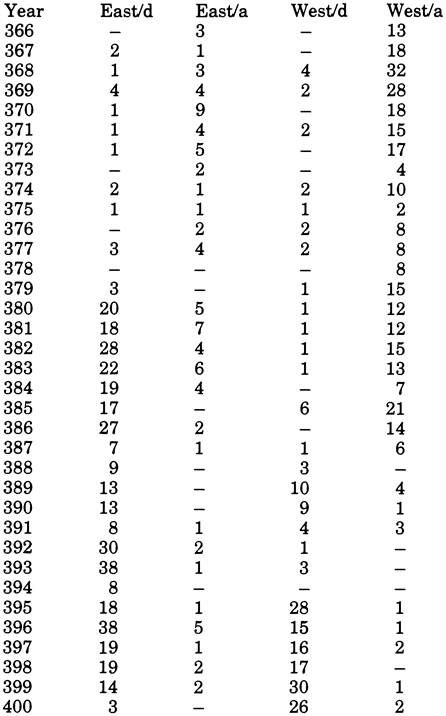
Moreover, the statistical evidence points to another conclusion.[98] Seeck linked the use of the dative with Theodosius I taking up permanent residence in Constantinople (while his predecessors used to travel permanently). As a result the laws enacted, including those sent over from the West, could now be collected at a permanent place. This archive enabled the compilers to use originals from that period onwards.[99] Yet closer examination of the data, distinguished according to eastern and western origin, shows that before 379 ad with the accusative dominated both in East and West.[100] With Theodosius’ accession in 379 the dative became preponderant in the East,[101] while in the West ad with the accusative continued to be generally used until Theodosius went to the West in 388. From then on, and certainly after his return to Constantinople in 394, both in East and West the dative became paramount (see Appendix 2). The obvious conclusion is that Theodosius or his aides had a preference for the dative which both of the chanceries followed after Theodosius took charge of them.[102]
6. Seeck assumed that the compilers corrected the dates by means of the eastern fasti consulares.[103] Did they in fact need to do this? They had to cite the dates (day, month and consulate) of the laws included, since the laws would otherwise lack force as a result of the prescript of CTh 1.1.1 (322). The reason for this requirement is unknown. It may have been introduced to make verification possible in proceedings. Yet it is not specified which date is intended and apparently Dl, D2 or D3 sufficed. Consequently copying the date found would have sufficed for the compilers (it is hardly conceivable that the compilers would invent dates).[104] There is indeed no order for the compilers to do what Seeck wanted them to do and in fact Seeck did not always find the eastern version of a consulate.
Seeck’s argument for his assumption is that the dates should be easily recognisable, viz. by making them identical to the official fasti. In this way the users of the Code could distinguish between the earlier and the later constitutions, whether these were in the same title or not.[105] Apart from the fact that this would not make sense in a code containing only valid laws (see §7 below),[106] if the compilers and the prospective users disposed of fasti it is still not certain that these were impeccable.[107] Certainly the compilers will have used a consular list, and occasionally they or the copyists may have ‘corrected’ a date; but this may also have been the source of text corruption.
The question becomes acute when dealing with the postconsulates. Seeck assumed that these were corrected, sometimes wrongly, while some were overlooked. In many cases Seeck thought he could discover such a correction. The authors of CLRE deny the use of postconsulates at the imperial court since the emperor would always know the consul he had designated himself and therefore preferred to use the et qui fuerit nuntiatus-formula in which the designated consul is mentioned.[108] They doubt Seeck’s reconstructions and try to explain the remaining postconsulates (not always convincingly).[109] Yet, like postconsulates, these e.q.f.n.-formulas then should have been corrected, but we find them often, and neither Seeck nor the authors of CLRE can explain this.[110]
The Novels of Theodosius furnish the answer. In these we see for the first months of the year merely the eastern consul mentioned, sometimes with the addition of e.q.f.n. In one case, where there were two western consuls to be appointed, we find a postconsulate.[111] Thus it would seem that only when both consuls were appointed by the emperor of the other half would a postconsulate be used until their names had been communicated, and that otherwise the name of one’s own consul would be used until the other’s name arrived; the addition of e.q.f.n. was not necessary. Since e.q.f.n. is sometimes missing, we may conclude that the consulates were entered at the end or beginning of the copies and re-copied with these and not from the heading of the copy book. Moreover, these dates were not corrected by either Theodosius’ or Valentinian’s clerks. There was indeed no reason to do so. The laws carried a day and identifiable consulate and this was enough. The same applies to the laws that the Theodosian compilers collected. Although we may be quite sure that, for example, for the year 435 they or their clerks will have known both consuls’ names, the e.q.f.n.-formula was retained.[112] Apparently there was no order to ‘correct’,[113] and since the consulate as dating system was less venerated than it used to be[114] they did not feel any obligation to do so.
Consequently the cases in which consulates are ‘corrected’ may have occurred by accident or where a consulate was unintelligible. It is true that the compilers will have needed fasti consulares in order to put the laws in chronological order.[115] Yet the laws they utilised had a date and consulate and this sufficed.[116]
7. If we may assume that the compilers used basically the imperial copy books in Constantinople and Rome (or Ravenna), and a few reliable private collections, and kept to the dates found with the texts, i.e. the dates as entered at the moment of copying, the picture of how the Code was assembled changes. The six years between 429 and 435 are often assumed to have been used mainly or entirely for gathering the constitutions in far-away provinces. Now we may assume that this was a relatively simple task, soon finished, and that the delay may have been due to other factors.
It lies outside the scope of this chapter to enter substantially into the purposes Theodosius had in the design of 429 or of 435, the relation between these and the reasons why the 429 plan was not completely executed. It suffices here to state briefly our understanding in order to support the rest of our argument.[117]
It seems as if the design of 435 concerning the editing of the constitutions is more detailed than that of 429, or even replaces it. Such a labour was perhaps not yet foreseen, but it was inevitable: although in 429 only the elimination of the inanis verborum copia is mentioned, this will have borne - vide Van der Wai - upon the phrasing of the main text. It must have posed a problem for the compilers, judging from the prescripts of the 435 design which imply questions arising from this work. So the second design may be regarded as a more detailed formulation of the first, changing the order of work and solving questions that had apparently arisen.[118] Such questions could have been thrown up during the first stages of the 429 plan. The design of 435 would have answered them, and therefore this design did not abrogate that of 429, but elaborated upon it.
As constitutions might be split up into fragments after 435, the initial concept (of 429) of reproducing the original constitutions completely (except for the preface and conclusion)[119] was abandoned: now the actual rules became central. This becomes more evident when we perceive that the compilers not only made a division when they attributed the rules of a constitution to different titles, but even when they were placed in the same title. Often we see fragments of the same constitution successively placed in one title. Fusco has observed that this is less harmless than it seems: stripped of its context a rule may gain a wider application.[120] [121] Yet this may have reflected an already existing interpretation. The systematisation of Justinian’s Code was to go a step further again. Here the compilers added fragments of one constitution to other constitutions (or fragments), thus creating a composite rule {sanctio}.14 Although in all three instances the validity of the rule depended upon its original promulgation, in the case of such a composite rule only one date was taken.
Did the compilers exclude from the compilation rules abrogated by later constitutions or no longer observed? The ad vim sanctionis non pertinentia were to be deleted. A rule, no longer in use, has no force any more. Therefore this prescription implies that obsolete rules have to be omitted. And what would the use of editing obsolete rules have been? In practice it appears indeed that the compilers, if not everywhere, at least for the greater part omitted rules no longer valid or applied, or which are restated by later laws.[122] Repetitions appear to be illusory, reducible to rules for different regions.76 CTh 1.1.5.pr. mentions such regional validity. This actually renders the chronology obsolete (as it is in Justinian’s Code). The principle of lex posterior derogat legi priori, once applied in a codification, leaves no traces and is no longer of use.77 This had been foreseen, perhaps, for the final code and consequently it would have been no real change of policy. The result is, however, that a title now represented the current state of the law, in as far as laid down in legislation from between 311 and 437 (every law still deriving its authority from the enacting emperor). Besides, the original plan to include obsolete laws was aimed at scholarly use. The present code was still usable for the law schools, but we find forensic and administrative practice expressly mentioned in NTh 1.3. We may suspect that this change in objective occurred between 429 and 435 and found its expression in the exclusion of obsolete rules.78
The design of 435 also changed the order of work. In 429 editing was foreseen in the second phase, after the insertion of the Gregorian and Hermogenian Codes and the legal writings. Now this was to be done at the end of the first stage. Theoretically the compilers could still have started, upon completion of this part, with the insertion of the constitutions of the Gregorian and Hermogenian Codes, and the
76 Such in any case is the outcome of our research into the law on the navicularii, pistores, suarii and some other corpora, published in Food for Rome (Amsterdam, 1991); a similar phenomenon is distinguishable with the decurions. On the other hand, a rule in the Theodosian Code did not have universal validity by the very fact of its inclusion. So there would be a difference in this respect between the ultimate goal of the 429 design and the 435 design. The ambiguity with regard to application within a certain territory is lifted, but the differences of territorial validity have been maintained. Limited validity can be deduced from the addressees and the place of enactment or promulgation.
77 If only valid law is to be included, then there has to be a concept of the law presently valid. On basis of this obsolete rules are omitted. The remainder may be ordered according to preference. In the Theodosian Code it is a combination of systematic order (headwords, tituli, quae sunt vocabula negotiorum), with some relation to the order of the Perpetual Edict, and chronology within the titles. The chronology was probably retained since this was prescribed in the first phase. See also A.J.B. Sirks, ‘Observations sur le Code Theodosien’, Subseciva Groningana 2 (1985), 30-1.
78 And thus useless for practice. A consequence of this is that we may not presuppose that the Code contains repetitions (except for some errors in the compilation). Secondly, if the Code would contain all legislation still valid of the period 311-437, this would amount to c. 2,700 constitutions, i.e. an average of 21 per annum. Exclusion of the obsolete laws raises this figure. It depends on one’s appreciation whether this output of legislation is to be considered high, low or normal. (On the basis of Seeck’s Regesten and without the missing constitutions: for 361-437 the average for the entire Empire is 24 per annum; in 364-389 for the West 17 per annum, for the East 11.5 per annum and for the entire Empire 28.4 per annum; for 395-437 for the entire Empire 17 per annum. There are considerable variations per year. Yet it is impossible to conclude anything from this. All our figures come from the Theodosian Code. Therefore any statement based on it is invalid. We cannot compare with a complete year, independent from the Code. There are constitutions known which are not included in the Code, but they may have been left out because they were not leges generales. The variations over the years can to a great extent be connected with certain emperors like Valentinian I and Theodosius I.) jurists’ writings. Since the collection of post-Constantinian constitutions was to acquire the name of Theodosius, this second phase was apparently discarded or not proceeded with further. But since the constitutions in the Code had been weeded out and edited with these texts in mind, their insertion was no longer necessary. Thus the code supplements these earlier collections with the law produced over the last 137 years. The goal, set in 429, was realised, albeit in a restricted sense in regard to the time-span covered. This would explain why in the Roman senate’s meeting of 438 the constitution of 429 was recited. The plan of 429, supplemented with details on the execution by the order of 435, had been successfully completed for its first stage: the constitutions of the (Christian) emperors.
Although a formal universalisation of the rules collected was lacking, despite Theodosius’ intentions,[123] legal practice apparently was to harmonise divergent rules on the same subject, if they clashed.[124] It will not have been too difficult in many cases. On the one hand, most of the law was common to both parts and remained unchanged or involved only slight differences. On the other hand, how much do we know of local customs already recognised in law? Part of the divergence may be ascribed to this.
8. Some of Seeck’s assumptions have been scrutinised and found wanting. This cannot diminish the greatness of a man who produced such a work as Untergang der antiken Welt. Yet, with all respect, did Seeck not expect too much from the compilers? His scathing remarks seem to suggest that in his view the compilation should have been a work of much higher precision as regards dates and places.[125] That was exactly what he needed, but it is not what the compilers set out to achieve. It is a clash of different goals and standards, a wrong methodology.
To elucidate this point let us look at the Code from a different point of view: not as a precursor of Justinian’s Code, but as the latest in a series of unofficial or official compilations of imperial constitutions. As such the Theodosian Code stands in an intellectual tradition maintained by lawyers. What intellectual standards do we see applied?
9. An early compilation such as Papirius Justus’ constitutiones libri XX (c. AD 170)82 merely mentions the emperors and gives an account of the rescript. Other authors sometimes mention the addressee and give quotations. The exact date apparently did not matter. Since these were not official collections, their reliability will have depended upon the author and the sources he used. Presumably collections gained authority in practice, which would suggest a check by the judges. The various additions might have facilitated such a check. But, as Volterra observed, as the imperial constitutions gained importance as a source of law, so did collections of them, and we see some uniformity emerge.83 The Gregorian Code usually mentions the emperor and the addressee, and sometimes a date (of the propositio), although dates may have been lost in the textual tradition.84 Likewise the Hermogenian Code.85 Conventions were thus established. In 322 Constantine decreed that all constitutions and edicts should bear a day and a consulate, viz. when cited in proceedings. Otherwise they would lack force. This may have been done in order to make checking easy; Constantine’s decision will have fitted into an existing convention.
The Fragmenta Vaticana is a collection made after 317. It consists not only of rescripts, but also of constitutions in the form of letters to officials and of excerpts from writings of jurists.86 Why the letters and not the edicts? Since the position of the emperor had become dominant in the second century, it was inconceivable that the senate would make amendments in an oratio delivered to the senate by the emperor or his representative. Consequently the text of the oratio became more important than the subsequent senatusconsult. The same occurred with the edicts of the provincial governors. They would receive a letter from the emperor (either directly or by way of a high official), with the order to promulgate the contents in an edict. Again it is inconceivable that they would alter the contents, and consequently the text of the original letter became the more important. This importance is acknowledged by its designation as lex edictalis, which put it on the same legislative level as an imperial edict.87 Publication remained
82 Liebs (n. 45) 134.
83 E. Volterra, ‘Il problema del testo delle costituzioni imperiali’, Atti II Congr. Intern, soc. ital. del diritto (Firenze, 1971), II, 948,1094-7.
84 On this Code: Liebs (n. 45) 134-7. Published probably in 291, divided in 15 or 16 books, each numbering 15-20 titles, containing rescripts over the period from Hadrian to Diocletian.
85 Liebs (n. 45) 137-43. Published in 295 and containing rescripts over the period 293-April 295, divided into c. 100 titles.
86 On this work Liebs (n. 45) 150-62. The inscriptions and subscriptions do not follow the patterns of the Gregorian and Hermogenian Code and seem to have been done casually.
87 See N. van der Wai, 'Edictum und lex edictalis. Form und Inhalt der Kaisergesetze important as regards the moment the edict took effect in province or Empire, but not as regards the authoritative text. The rescripts in the Fragmenta Vaticana always bear a date, sometimes the date of a datum. The same goes for the other constitutions. Since the Fragmenta Vaticana most probably date from after Constantine’s decree and will have complied with it, it follows that any plausible date sufficed. As far as the structure of the collections is concerned, the early ones were sometimes subdivided into books, the Gregorian Code into books and titles, the Hermogenian Code and the Fragmenta Vaticana into titles. In all cases the inscriptions are usually adapted by the authors.
We find variations, but what remains is the text which should be rendered faithfully. Textual corruption was public enemy number one, so to speak, in an era when texts were multiplied by manual copying and in a profession where much depended on their reliability. We see this care expressed several times: in the prohibition on using notae and the confirmation of the validity of all Paul’s writings (CTh 1.4.1 [321] and 2 [327]), in the so-called Law of Citations (CTh 1.4.3 [426, W]), which in reality gives criteria for establishing textual reliability,[126] [127] in the re-editing of the classical writers during the second half of the fourth century, in the wishes of the Roman senate in 438[128] and, lastly, in the plans for the Theodosian Code.[129]
How did the design of 429 for the Theodosian Code differ from this? In fact, the entire concept and structure does not differ from what we find in the Fragmenta Vaticana, except for the prescribed chronological order in the first version and the elimination in the final Code of diversity and repealed rules. Thus the Theodosian Code of 429 may be viewed as an improved collection within the tradition of legal collections. Nor is there any reason to suppose that the standard for the required date was suddenly set higher than before. After all, we can only surmise why Constantine required this. The compilers will have used the date probably as randomly - in our eyes - as the compiler of the Fragmenta Vaticana did. There was no need to check the publication date. There was no need to check the date in any case, as long as it was a plausible date. The important thing was the text itself: this should contain no false words, and of course it should not be a falsification. For this purpose they would have checked the text and as soon as that had been done (preferably by comparing with the official copy, if not already copied from it) and the text had been found correct, the date was unimportant. Since rules rendered obsolete by disuse should be left out in the final Code, and diversity should be removed, the Code was even modern in this respect.
Yet the compilers encountered some difficulties during their work. What about restricted validity? The administrative division of the Empire? What about the adaptation of texts? Since the Code was to be used in the courts, should rules which had been repealed or which had passed into disuse nevertheless be included? Perhaps some of these questions had already been posited before 429. Practitioners of law will not have been interested in abolished laws. Nor will a final Code as envisaged by Theodosius have figured high on their list of requirements. The Gregorian and Hermogenian Codes were reliable editions, the major legal writings existed in reliable editions. The only thing needed right away was a good edition of laws enacted since the two Codes and still valid. In 435 the emperor took several decisions (no invalid rules; both eastern and western laws, without a decision about precedence; splitting, editing and adapting of the texts)[130] and the result was a Code of lesser ambition, with a definite bias towards legal practice and its demands, but also a Code in which actual rules systematised according to subject-matter are central. In this respect the Code as realised represents a change in the concept of collections of constitutions.
10. It appears that Seeck attached too great a significance to the texts of Theodosius’ and Justinian’s Code as sources of historical knowledge. In his view these texts were basically the final laws as promulgated, which meant that they represented the exact wording of the law and their dates the exact moment of application. Corruption had, however, set in as soon as the compilers amassed the texts and edited them. Yet Seeck, as a true nineteenth-century historian, attached too much importance to the texts as objective source.[131] The problem that the Theodosian Code and other collections of legal texts were designed to remedy was a lack of convenient access to reliable editions of legal texts. For this the legal texts as established in an oratio or an imperial letter sufficed. The date was an addition, prescribed by law but not regarded as important. Seen in the light of this, the Theodosian compilers did a good job, since their textual work is generally considered favourably.
Postscript
Tn the light of Matthews’ comments on the propositions made above, I would suggest for the reader’s consideration the following questions. Any resolution of the problems raised will need to take account of these.
Matthews cites Gibbon, who used the Code rather as a work of history than of law, and of course historians have as much right to the Code as anyone else. However, the Code is and remains in the first place a lawbook and the compilers will have viewed it from a different perspective from modern historians. They were, as we are not, acquainted with the law in which the rules of the Code were embedded, and with its relation to the rules collected in the Gregorian and Hermogenian Codes. It is the same when legal historians use a literary source like Ammianus: no one can teach them the dangers inherent in too legal an approach to such a source better than Matthews.
It is as well to remember that legal historians such as Mommsen were so interested in the actual publication because of the rules: that would be the only valid text. For that reason Seeck proposed the idea that most of the constitutions had been stripped of proposita etc. Yet the collection of the novels of Theodosius II shows that the Romans themselves thought differently about this. For them the letter of the emperor was an adequate statement of the law, as was also the copy preserved in the file of the promulgators. Matthews doubts a systematic access to central archives. Otherwise there would have been more laws collected than there are now (the amount of basic laws not being impressive), there would be fewer discrepancies between different versions of the same laws, fewer indications of the circumstances in which the laws were received etc. (p. 41 above). How many more laws? How many discrepancies or indications otherwise? And on what basis may we assume that there would have been more of the earlier laws and fewer of the later? We do not even know any year’s output of laws. What about the fact that some 80 per cent of all basic constitutions of the Code do not pose any discrepancy at all and merely have the mark data? Indeed, there are many references in the Code to laws which are apparently not included (they cannot all have been in the missing parts). How many laws might not have been included? 25 per cent? 50 per cent? This is important. We may assume that the compilers had a good knowledge of the law existing at that moment. So laws still in force will certainly have been included. If not, they would have been abolished by NTh 1, and it is unlikely that the compilers would have resigned themselves to this. As for the rest, everything depends on the question how many general laws were issued in 311-437, to which there is as yet no answer. Yet the greater this number, is it not the more probable that those omitted were left out on purpose? The argument that the older constitutions were more difficult to trace so that fewer were recovered is not watertight: they may just as well have been supplanted by newer rules. The variations in the figures of laws over years can be connected with known periods of higher legislative activity.
True, private persons copied laws of publicly posted texts. Yet is not the success of the Gregorian and Hermogenian Codes due precisely to the fact that they were collections made by an official close to the emperor and thus near the imperial archives, and for that reason undoubtedly much more complete than collections made in the provinces?
It would be interesting to see statistical evidence pointing to a predominant use of local archives. Since the reverse is the case, should we not assume, so long as there is no good argument to the contrary, that most of the constitutions were taken from central archives (whether the emperor’s or the prefects’)? It would be interesting to know whether, and if so why, my arguments against Seeck’s methods and presumptions do not hold. Do we have reasons to assume that the provincial archives were in such a bad shape? How, for example, are the barbarian invasions in Gaul, Italy, Spain and Africa consistent with the so-called predominance of western constitutions? Would not the compilers have had knowledge of this?
Undeniably there are cases which are puzzling and Matthews is right to draw attention to them, but we should always keep in mind that contemporaries did not intend to use the Code to reconstruct imperial itineraries, Regesten or consulates, but to find the law.
Appendix 1. The fragments and basic constitutions of the Theodosian Code
The fragments of the Theodosian Code are found in three sources: manuscripts of the Code itself, the Breviarium Alaricianum, and Justinian’s Code. There are references in other sources. The first two sources supply fragments, in principle authentic, the last supplies fragments which in some 50 per cent of the cases were re-edited by the Justinian compilers.[132] But such re-edition does not have to affect the inscription and subscription, except when the fragment is inserted into another fragment.[133] The references in other sources should not be used for speculations on the form of the addressee etc.
The total of the fragments Mommsen took from the manuscripts and the Breviarium is 2,509, to which he added seven cases of references to fragments (one of which is probably confirmed by a CJust version). Of the 2,509 fragments two merely have a (partial) inscription or subscription.[134] In this way we possess books 7 to 16 almost complete, book 6 for the greater part and a lesser part of books 1 to 5.[135] This lack is partly made good by Justinian’s Code. In this 261 fragments, originating in the Theodosian Code, figure without their version in the first two sources.[136] The total of known fragments is then 2,777 (2,509 + 261 + 7). However, a number of these fragments derive from the same constitution, as divisions according to different subjects or as leges geminatae. It is doubtful whether there is a real difference between these. Gaudemet has examined the leges geminatae and concluded that in most or all cases it is probable that they imply slightly different rules.[137] We therefore treat the 39 fragments of the leges geminatae as pertaining to 19 constitutions. By subtracting those ‘extra’ fragments of combinations, we obtain a figure of 2,307 constitutions (since 750 fragments constitute 283 constitutions). This figure includes 10 fragments or constitutions of uncertain date which should be excluded when examining the textual variations. Of these 2,307 (or 2,297) constitutions, 283 (c. 12 per cent) covered more than one topic (since they were split up).
We see that the basic collection the compilers used consisted of 2,307 constitutions, plus [x] constitutions of which fragments were included in the Theodosian Code but not in Justinian’s Code (or are irretrievably inserted in other constitutions of the latter Code) and thus are lost to us (65 of these are indicated by PA or ETC in a fragment without a corresponding fragment), plus [y] constitutions of which no use at all was made since they were no longer in use (in total: 2307 + [x] + [y]).
After the splitting up the Code contained 2,777 fragments plus the [x] fragments. Mommsen estimated [x] at c. 480, on the basis of the word density in Vat. 886. If he is right, then the total number of fragments would amount to c. 3,250.[138] This would mean that we dispose of more than 80 per cent of the Theodosian Code, including the part supplied by Justinian’s Code; and of more than 75 per cent of the Theodosian Code in its original version.[139] And if we assume the missing part to have been fragmented in the same proportion as the rest, then the basic collection would have been c. 2,700, not taking [y] in account. Of that 2,700, some 350 (265 + 61: c.13 per cent) covered multiple topics. Of course it is not claimed that Mommsen’s total of fragments or his combination of fragments are final. Krüger suggested four additions and Maas mentioned other combinations; yet since these differences are marginal, it will not affect the outcome of the statistics as long as we adhere to a reasonable rounding up or down.[140]
Appendix 2. The distribution of the dative and ad with the accusative in the inscriptions of constitutions
On the basis of Mommsen’s Prolegomena, for the years 375-400 (‘East’ and ‘West’ refer to the part of the Empire the constitution was sent to, 7d’ refers to basic constitutions with the dative, 7a’ to basic constitutions with ad and the accusative):
On the basis of Seeck’s Regesten, for the years 375-400 for East and West, for the dative and ad with accusative respectively:
East - 375: 1-1, 376: 0-2, 377: 3-4, 378: 0-0, 379: 5-0, 380: 25-5, 381: 17-6, 382· 27-3, 383: 26-6, 384: 16-5, 385: 14-0, 386: 30-2, 387: 9-1, 388: 10-0, 389: i7_3, 390: 14-0, 391: 7-1, 392: 29-2, 393: 33-1, 394: 10-0, 395: 17-0, 396: 40-6, 397-19-1, 398:19-2, 399:11-3,400: 3-0.
West-375: 2-1,376: 2-9,377: 1-10,378: 1-10,379: 1-11,380: 1-11,381: 1-10, 382: 0-16, 383: 2-13, 384: 0-8, 385: 5-22, 386: 0-13, 387: 1-6, 388: 0-0, 389: 3-1, 390: 7-3, 391: 2-3, 392: 2-0, 393: 5-0, 394: 1-0, 395: 26-1, 396: 13-1, 397: 17-1, 398:19-0,399: 34-2,400: 22-2.
East and West-390: 2-0, 391: 2-1, 392: 0-1, 393:1-0, 394: 0-0.
3.