B Curiosity-Driven Science (Stuart Firestein)
Stuart Firestein puts forward the case for Curiosity-Driven Science5 in his books and a TED talk.6 He emphasizes that a scientist doesn't need a hypothesis to start a scientific inquiry and shouldn't wait for one to pop up.
He thinks the Scientific Method is a sham. This is strong stuff. However, as an eminent scientist (he is Professor of Neuroscience and former Chair of Biological Sciences at Columbia University), Firestein knows his way around the issues of scientific thinking. For him, scientific investigations are not motivated by hypotheses, but by curiosity: an interested but puzzled individual asks, “What if...?” and begins doing experiments to find out. The urge to try something, to turn over a rock to see what's under it, is universal among nonscientists and scientists alike and has always been a fundamental motivator of science, although Firestein pushes the idea beyond its usual boundaries.10. B.1 Ignorance
Ignorance is the core principle of Firestein's philosophy. He stresses that science is not a collection of well-established facts and that scientists are not people with fact-stuffed heads. Science is not about amassing information; it is about trying to shine light into dark places, to explore the unknown for the sake of exploring, with no guarantee that you'll find anything. Scientists are path-finders, discovering questions and inventing tools to answer them. The words of the two-time Nobel Prize winner Marie Curie express one of Firestein's main themes: “One never notices what has been done; one can only see what remains to be done.” Well-understood things are of great interest to society and technology, but, to a basic research scientist, established knowledge is merely raw material for new investigations. What is not known—ignorance—alone is truly important, and facts only lead basic science to new areas of ignorance.
From the insight that ignorance drives the curiosity that drives science, it follows that ignorance is the most important product of an investigation. “Creating ignorance” is Firestein's catchy phrase for the scientific enterprise.Firestein likens scientific progress to the widening ripples on a pond, with their increasing circumferences representing the expansion of the known into the unknown. We can imagine that the pond is the human grasp of nature. In prehistoric times, before anything that we could call knowledge existed, the pond was the “unknown unknown”; we were unaware, not only of what was in it, but that it existed. Knowledge acquisition began when somebody dropped a pebble into the water, and knowledge increased as the rings of ripples spread. Our knowledge is in the center, within the rings. As knowledge expands, we get a glimpse of what we don't know, the ripples of the “known unknowns,” and our ignorance focuses on them. The ripples form the border between the known and the unknown unknown; they are where science takes place. Ripples represent the productive ignorance that science seeks because it enables investigation to begin.
Still, the world is complicated and more than simple ignorance of facts is at stake. There is profound and impenetrable ignorance, “unknowable unknowns” (big rocks sticking up in the pond!)—Heisenberg's Uncertainty Principle in physics and Kurt Godel's Incompleteness Theorems in mathematical logic are two examples of facts that reveal absolute limitations on our knowledge and thus redirect science to productive avenues of inquiry. Thus, as science widens the breadth of knowledge, it increases productive ignorance.
Here's an example (not Firestein's) from neuroscience of how productive ignorance spreads from a small splash of new knowledge. For thousands of years, people have used cannabis plants for all sorts of purposes, for treating pain or depression, for religious rituals, or just for getting high. Nobody had any idea of how cannabis worked or what its active agent was until two biochemists, Raphael Mechoulam and Yechiel Gaoni, isolated A9-tetrahydrocannabinol (THC)7 from cannabis plants in 1964.
Before then scientists could not investigate how THC affected the body because they didn't know it existed; the problem was deep in the unknown unknown. The discovery of THC sent out ripples of productive ignorance. Because of THC's origin, it was called a “cannabinoid.” One ripple involved THC's chemical properties; what was it like? The investigation turned up a surprise and a wealth of productive ignorance. THC was an oily lipid, a fatty chemical, when many people had guessed it would be water soluble, like molecules that were already known to affect nerve cells. Attempts to find out how THC affected nerve cells led to new surprises—it clamped tightly and specifically onto a kind protein molecule, a receptor—and therefore new ripples of known unknowns to explore. The receptor seemed tailor-made for THC, so it was called the “cannabinoid receptor.” THC came from plants, which allowed researchers to investigate why animal brains have receptors for a chemical made by plants. And so it went, with every discovery expanding the area of knowledge into unguessed at areas of ignorance about the cannabinoid system. There were natural chemicals in the body that, because they also clamp onto cannabinoid receptors, were named “endogenous cannabinoids” (shortened to “endo cannabinoids”) and a growing list of things that endocannabinoids do (dull pain, control weight gain, regulate mood, and more).Firestein's imagery is in line with that of earlier writers:
It has been well said, that the more we enlarge the diameter or sphere of light, the more, too, do we enlarge the circumambient darkness—so that with a wider field of light on which to expatiate, we shall have a more extended border of unexplored territory than ever.8
(Or, in plain English, “As our circle of knowledge expands, so does the circumference of darkness surrounding it.”9)
10. B.2 Curiosity, the Hypothesis, and the Scientific Method
When I first read Ignorance, I found myself agreeing with most of what it had to say: the disorderly nature of research, its rewards and pleasures, the descriptions of life in the lab, were all familiar—until the topic of the hypothesis came up.
When my colleagues and I came across an unforeseen observation, we'd would dream up a rough-and-ready hypotheses, see what it predicted, and toy with schemes about how to test it, poking holes in the schemes as they came up, and, if we hit on a plausible one, take it into the lab and try it out. The process was inelegant and informal, but we found making up hypotheses and experiments to test them to be intellectually stimulating, useful, and fun. I assumed that Firestein felt the same way. Not so.In Firestein's view, the Curiosity-Driven and the hypothesis-based ways of doing science are unalterably opposed and as we've seen, he doesn't mince words: he hates hypotheses. Such passion is startling; he is not off-handedly dismissing a procedure that he has long since outgrown or expressing a lack of enthusiasm. “Hate” is committed antagonism.
Does Firestein perhaps have something else in mind than what others would call a hypothesis? No, his is a standard textbook definition: It is “a scientist's idea of how something works,” “falsifiable,” and “a statement of what is not known and a strategy for finding out.” But this is the rote answer; his real opinion is that a hypothesis is “imprisoning,” “biasing,” and “discriminatory.” Because it is our hypothesis, we become unreasonably attached to it—we want it to be right and defend it against all comers. He believes that if you have a hypothesis you cannot be open-minded, as you must be to follow your best instincts. Hypotheses are also “trendy” and “faddish” and attract entrenched cliques that support them.
These forces can destroy a true curiosity-driven investigation, which is nurtured by an accepting state of mind that is willing to consider any avenue of research and to welcome any outcome from it. Hypotheses filter and distort our perception of and appreciation for the data, which are the concrete products of an experimental investigation. Everything else is interpretation, which Firestein insists must be left up to the consumers of the published data, the scientific audience.
The worst part of hypothesis-based science is that, if you're devoted to a hypothesis, you overlook experimental results that don't support it; you may even fudge (fake, alter, misrepresent) data that threaten it. Firestein warns that the hypothesis is not merely useless and unnecessary; it is “a real danger.”What does Firestein say about the Scientific Method itself? It is a “calamity” a rigidly confining, simplistic recipe; an empty concept; a fake process that no one actually uses. A major shortcoming is that the Method does not tell you how to generate a hypothesis, and yet it supposedly requires hypotheses! An absurd situation, for Firestein. Science is about good explanations, and searching for an explanation is divorced from any Method. Creativity is the key. We have no real idea how creativity works, yet it and passionate curiosity, not sterile reasoning, are the most important attributes for a scientist. A scientific search begins with animated personal interest, not cold logic. Ideally, a scientist is like “a guileless, intent field biologist collecting bugs in a remote ecological niche” Science is trying things out, staying as unbiased as possible, and not having a definite plan; the main thing is to be looking. None of what's most important for science has anything to do with the Scientific Method, and therefore, in Firestein's vision, science could dispense with it without losing a beat.
10. B.3 The Importance of Failure
In Failure: Why Science Is So Successful, Firestein again flips common wisdom on its head by insisting that failure is a more significant stimulus for scientific research than is success. Both risk-taking and failure are vital to the advancement of knowledge. We should try to venture outside the safe confines of what we know to tackle bigger experimental challenges and ask more penetrating questions than we ordinarily would.
And failures are usually more informative than successes, says Firestein. A failure of an experiment shows that you've reached the limits of your knowledge and gotten to the edge of productive ignorance.
Failure breeds creativity. He calls on a classical example—it was the failure of Newton's theory of gravity that led to Einstein's dramatic reconceptualization of space and time. A scientist should always seek to push the envelope of knowledge to the point of failure. Indeed, good science is all about failure; the uncertainty of knowledge guarantees that we are continually immersed in failure and should therefore embrace it. The vast majority of all scientific theories in history, like the vast majority of species in evolution, have gone extinct; their apparent successes were transitory, the lessons of their failures lasting. We can increase our respect for failure by, for example, preferring research projects that have no better than, say, a 50-50 chance of succeeding. We need to know more about failure and should study and teach it at least as much as we study and teach success.10. B.4 Summary
At times, grasping Firestems message demands the mental agility and stamina of a Zen Buddhist acolyte wrestling with a koan: “Forget the answers, work on the questions”; “Trying to succeed... is driving science into a corner.... The alternative? Fail better.” His discussions are full of penetrating, often biting and witty insights, and the outrageousness works: it makes you think. The importance of ignorance and failure in science is frequently overlooked, and calling attention to them is unquestionably a good thing. Wholesale rejection of the scientific hypothesis is not a necessary consequence of his argument, but Firestein acknowledges that he is not after tight, logical coherence. Curiosity-Driven Science is less a defined program than a state of mind; it is best understood in motivational terms.
Firestein has a lot more to say, but this brief overview covers his fundamental messages. While there is much to admire about his maverick stances, you might wonder if he goes a bit too far to make his case. I'll look at a few outstanding issues in the next sections and focus on those parts of Curiosity-Driven Science that touch on the hypothesis.
10. B.5 Critique: Is Curiosity Enough?
Hearing that curiosity is a maj or instigator of scientific investigation might come as a surprise to hard- working, tax-paying nonscientists who think that science should be about formal procedures and rigorous control experiments, not about satisfying curiosity. However, Firestein is right; curiosity and ignorance are as influential as he says they are. Good scientific ideas come from aimless mental meandering, and curiosity is a great personal trait for a scientist. Still, is curiosity enough to guide scientific thinking? What happens after the curious thought has sprung up?
While Firesteins Curiosity-Driven scientists spend time “testing their ideas,” it is not clear what testing ideas means for them. When traditional researchers talk about testing their ideas, they are referring to their (explicit or implicit) hypotheses, their predictions, plus the experimental designs that could falsify them. Curiosity-Driven scientists want to their ideas to be correct, but, because they don't hypothesize anything, they can't use falsification as a tool to rule out the incorrect ones. What tests do they actually do, and why do they do them? Curiosity alone is not enough to sustain science, but they obviously can't look to the Scientific Method for guidance, and Firestein steadfastly declines to put forward a Method of Ignorance or a Method of Failure to take its place. This refusal is entirely in keeping with his philosophy; it may not be enough for students or others hoping to understand science.
The Curiosity-Driven program emphasizes the accumulation of observations unencumbered by interpretations and the baggage that goes with interpretations. After quoting Newton's proud, if flexible, reluctance to form a hypothesis (see Box 10.1, for a different take on Newton's position), Firestein remarks, “Just the data, please.” Give us the results and we'll make up our own minds about them, he seems to say. In this he anticipates the recent push to make scientific data widely available for checking and reanalysis (see Chapter 7), which is surely a good thing. But we can't act as if data interpretation doesn't take place, even in Curiosity-Driven Science.
Firestein suggests that data morphs naturally into facts; that observations, measurements, and so on “accumulate and at some point may gel into a fact.” On the contrary, nothing as free from human agency, as outerwordly, occurs. Perhaps he is alluding to the nebulous but real phenomenon of consensus; if enough scientists seem to accept an observation as true, then it is accepted as “fact,” keeping in mind that “a fact is where the investigation rests.” However it is that consensus emerges, accepted facts are nonetheless interpretations of data, and active human minds generate interpretations. Just because we don't understand how minds interpret data doesn't mean that they don't interpret them; cognitive science assures us that we are continually, reflexively engaged in trying to understand the world.
Stated plainly, we do not have the option of leaving evidence in a perpetually uninterpreted state. We can either try to suppress our innate urge to make sense of evidence—in effect denying our nature—or be aware of this urge and work with it. Most importantly, we mustn't forget that uncertainty guarantees that our interpretations are hypotheses, provisional truths that are subject to revision.
The Curiosity-Driven program officially declines to sanction summary statements, models, and interpretations along with hypotheses, which means that its inquiries leave us little beyond new questions and uninterpreted data. I say officially, because, of course, despite preferring to remain aloof from data interpretation, Firestein realizes that interpretation is necessary at some level; science, he acknowledges, does generate facts and facts can come in handy. Still, he tolerates facts as he tolerates success in discovering them: generating facts is “not a bad thing” and can even lead to accomplishments, “if by that you mean publishing papers and getting grants.” In effect, discovering facts is not exactly disreputable, but you get the distinct impression that the best people don't do it.
This probably sounds a little confusing, and it is because Firestein's overarching goal is to shake up hidebound, complacent thinking; paradox serves his purposes. Though he cares little for knowledge, he knows that we can't disregard it altogether because we can only appreciate ignorance, the driver and product of scientific investigation, against a backdrop of knowledge. Knowledge is more than a guide to ignorance; it defines ignorance. Just as darkness is defined
Box 10.1 Isaac Newton and Francis Bacon: Not Arch- Foes of the Hypothesis After All
In his magnum opus, The New Organon10, Bacon generally refers to hypotheses as axioms and distinguishes several kinds of them; how they’re used is their crucial characteristic. He condemns thinking that “flies from the senses and particulars to the most general axioms, and from these principles, the truth of which it takes for settled and immovable, proceeds to judgment and to the discovery of middle axioms.” It’s a mistake, in other words, to leap from simple observations to grand general principles and then use the general principles to justify intermediate-level explanations. Above all, you don’t start with the most general axioms and reason deductively about nature from them. That’s what made Aristotle’s natural philosophy “useless.” “The true way” says Bacon, “derives axioms from the senses and particulars, rising by a general and unbroken ascent, so that it arrives at the most general axioms last of all [emphasis added].” If you develop axioms from observations and use them gradually to discover larger, more general truths, they’re fine.
Bacon champions “induction” but disparages “simple enumeration”11 (i.e., enumerative induction. True induction “must analyze nature by proper rejections and exclusions,” and only after “a sufficient number of negatives, come to a conclusion.” Moreover, when evaluating axioms “the negative instance is the more forcible of the two”12. Searching for rejections, exclusions, and negatives is the essence of Popperian falsification 300 years before Popper. Bacon wants to guide science onto a course that begins with observations, proceeds through stages of understanding13 represented by formulating and testing intermediate hypotheses (axioms), until it achieves general principles of nature. Readers who focus only on isolated words—hypothesis, induction—and ignore their context miss his main argument.
What about Isaac Newton? Wasn’t he dead-set against hypotheses? Not really. In the Principia Mathematica, Newton’s “laws of motion” showed that a force, gravity, that decreased with distance between the sun and the earth could account for the earth’s elliptical orbit. Newton had no idea what gravity might be, and he declined to guess at this point, saying, “I form no hypotheses!”
His genuine feeling toward hypotheses was by no means clear-cut, however. In his notebooks, Newton first called his laws “Hypotheses” and even years after publication of the Principia, he still referred to his “hypothesis” of gravity14. During a dispute with Robert Hooke, Newton remarks to Edmond Halley15, who got the Principia published, that “there was an hypothesis of mine published in your books wherein I hinted a cause of gravity towards the earth.” He adds, “I hope I shall not be urged to declare, in print, that I understood not the obvious mathematical condition of my own hypothesis.” (Hooke! Back off! It was my hypothesis; I know what it says!)
And Newton was not finished with hypotheses; he later published a formal one. He had discovered that white light was not pure and unadulterated, and colored light complex, but the other way around. White light was what you got when you combined, using prisms, all of the colored rays into one beam. He described his experiments and his interpretation of them in An Hypothesis explaining the Properties of Light, discoursed of in my several Papers16. Since he had publicly despised hypotheses, Newton realized the title was a trifle awkward. He begins a letter to Oldenburg, the head of the Royal Society in 1695, well after the Principia: “Sir, I had formerly purposed never to write any hypothesis to engage me in vain disputes”; however, Newton now feels that “such an hypothesis would much illustrate the papers I promised to send you and having a little time this last week to spare, I have not scrupled to describe one” because it will make them “more intelligible,” presumably, to less-elevated minds.3 We should not, he implies, dream that he, Isaac Newton, would ordinarily stoop to a hypothesis, but he believed one would aid others in following his thoughts. So, having a little extra time on his hands, he dashed one off.
In fact, Newton had much more to do with the hypothesis. Nobel Prizewinning physicist Frank Wilczek remarks that “in [Newton's] vast notebooks one finds hypotheses galore about all sorts of things.”17 Though, often, says Wilczek, Newton used the “charming trick” of “putting a question mark at the end of statements. For then they are not assertions or Hypotheses, but only Queries.” He gives as example,“Do not Bodies act upon Light at a distance, and by their action bend its Rays; and is not the bending greatest at the least distance?”
Wilczek sees this as a “suggestion for research”; in other words, as a hypothesis (and not just any hypothesis, but the first hypothesis that gravity could actually cause the path of a light ray to bend; i.e., the one that Eddington famously tested in the context of Einstein's Theory of Special Relativity more than 150 years later).
Newton, like Bacon, thought intensely about the nature of science and scientific reasoning. Despite the bad reputation that the hypothesis had acquired prior to the Enlightenment, both men gave it a central place in their thinking.
by light and makes no sense without it, so is ignorance defined by knowledge. Science is more than peering out at the universe through innocent eyes and doing experiments. Scientists do try to figure out why things are the way they are and why they work the way they do.
Because his enthusiasm for acquiring knowledge is tepid, he doesn't delve deeply into the relationship between ignorance and knowledge. The metaphor of the pond, with its ripples of productive ignorance spreading out from a central circle of knowledge, is misleading. The image subtly suggests that, once established, facts are, pretty much, facts; they remain in the calm, settled waters, and Firestein warns against lingering there, bobbing around. He is well aware that this is not an accurate image, of course, but he doesn't explore the consequences of the notion that, because facts are indistinguishable from hypotheses, they are always susceptible to testing, modification, or rejection. Science is not always about pushing on into uncharted regions of ignorance for its discoveries.
Here's another picture of how science works. We live in a low, watery, boggy place, susceptible to intermittent flooding, say the Netherlands or the city of New Orleans. We need dry, stable land for houses, schools, roads, so we put up a levee, pump out the water behind it, secure the land (now called a “polder”), and build. Then we advance into more wet land, put up another levee, pump out the water, and repeat, moving steadily outward into newly dried areas. But the levees are never perfectly secure; they need constant tending or they leak; yearly storms weaken them, and they must be repaired; periodically they must be replaced. And every once in great while a major hurricane strikes, bursting levees and inundating swaths of formerly dry ground. After the disaster, the city regroups, builds new levees, and, maybe, abandons some territory in favor of higher ground. komas Kuhn called big intellectual storms scientific revolutions,25 and they require major reconstruction of the foundations as well. Like levees, scientific facts, no matter how solid they look, are never entirely secure. A group of them may seem very good, and we take them for granted while we move out into new areas. However, we need to monitor our facts even as we are on the lookout for novel productive ignorance because as our facts go, so goes our ignorance. We need to treat our facts as the tentative concepts that they are and always be willing to revisit and retest them.
Firestein's decision to focus on data rather than interpretations has additional consequences. Practically speaking, there is the genuine danger that, if a scientist does no more than collect and publish data, then she can be, and probably soon will be, replaced by a robot that will do the job faster and better. Curiosity will be replaced by a computer algorithm for detecting gaps in data, and programs will direct machines to collect and upload these data into colossal databases in the cloud. Human scientists will become technicians (see Chapter 15). At the moment, we hold the edge over computers in creative thinking, including data interpretation. Our lead is shrinking though, and we ought to work hard to maintain what we have.
Human science is communal, not solitary. Gathering data for personal satisfaction is not enough for us; we need to spread our information around. If the scientific community and society at large are going to benefit from an individual’s investigations (and why else pay for them?) that information must be available to all. Your fellow scientists want context and interpretation; while they want the numbers, the data, they also want to know what you think they mean. Hypotheses (and their alter egos, theories and models) are excellent vehicles for summarizing and communicating scientific thoughts and reasoning.
Finally, I believe there is a serious ethical issue at stake. Scientists have benefited from years of education and advanced training and have acquired a great deal of unique knowledge and mental skills. They understand the significance and limitations of data; they can think in novel and fruitful ways about problems. Their intellectual input adds value to their numbers. Thinking is therefore an integral part of scientists’ jobs, and sharing the benefits of their thinking is an ethical responsibility. Scientists who decline to contribute to communal data interpretation are shirking their responsibility.
10. B.6 Similarities and Differences Between Hypothesis Testing and Curiosity-Driven Science
Is curiosity freer, more authentic, less artificially constrained than hypothetical thinking? This seems dubious. We don’t know how the mind concocts a hypothesis any more than we know how it comes up with a curious thought. The enigmatic motivation to formulate a hypothesis resembles the ping of wonderment that signals curiosity: both are responses to mysteries. This reality creates a subtle problem for Firestein who rejects the Scientific Method partly because it doesn’t tell us how form a hypothesis; that despite the orderly connotation of a Method, “you just sort of passively make one up, sometimes out of thin air.” In contrast, he tells us that curiosity springs from “night science” our “intuitive, inspirational” side. Now of course night science does not take place only at night, but its name evokes the imaginative, romantic side of science. Good. The awkward truth for Firestein is that the answer to the question, “where do hypotheses come from?” is the same “night science.”
Hypothesis-based and the Curiosity-Driven modes of doing science are different—curiosity is an emotion; a hypothesis is a plan—but they are not in conflict. Driven by curiosity, a scientist may remain engaged with a problem, or she may go on to ponder about something else entirely. Curiosity does not offer guidelines about how to carry on, what questions to pursue, how to pursue them, or when to let an investigation rest; it does not summarize, interpret, account for observations, or suggest the next step. This is where a hypothesis comes in; it helps to make plans, draw conclusions, and organize and communicate thoughts.
Firestein says that real scientists that he knows don't follow the Scientific Method or use hypotheses. But other scientists do (Chapter 9), and sometimes quite explicitly. Here's an example from neuroscience. In the early 1900s, neuroscientists were investigating how brain cells communicated with each other at the synapses where they come close together. There were two camps: one camp (the “spark boys”) thought that electrical signaling in one cell directly caused electrical changes to occur in another, and a second camp (the “soup boys”) held that communication between neurons required a chemical messenger—a neurotransmitter—to carry the signals by diffusing from one cell to the other. Prior to the development of the electron microscope or the identification of chemical neurotransmitters in the brain, both hypotheses did about equally well in explaining the existing data. The soup boys based their arguments on the well-established finding that chemical transmission took place at synapses in the heart, and, hence, a parsimonious hypothesis was that all synapses operated on the same principles. The spark boys countered that the brain was not the heart and, besides, the speed of communication between nerve cells (~5/10000th of a second) was too fast for transmission by chemical diffusion.
Eventually, the spark boys, led by John Eccles, devised methods for measuring the electrical changes taking place inside a nerve cell during synaptic transmission to test their hypothesis. They had predicted that the intracellular electrical change would be in the “plus” direction and were surprised to find that it was actually in the “minus” direction. This observation was completely incompatible with their electrical hypothesis and could only be explained by the chemical messenger hypothesis. The authors concluded that “[their former] hypothesis is thereby falsified.”19 Eccles instantly switched sides, became an outspoken proponent of the soup theory, and eventually won a Nobel Prize (and a knighthood) for his efforts. The story shows not only that scientists truly do use hypotheses and hypothesis testing, but that there are benefits to changing your mind when facts fly in the face of your opinions.
Firestein's instincts about scientists and the hypothesis are certainly correct in at least one respect, however. Scientists nowadays, at least the neuroscientists whose papers I reviewed in Chapter 9, generally avoid saying that they have “falsified” anything. I did not find one occurrence of the term, even in those studies that tested hypotheses explicitly or implicitly, used models, or made predictions. Researchers seem to have a greater aversion to rejecting a hypothesis than to having one, a state of affairs that probably contributes to publication bias (Chapter 11). In any case, we should keep in mind that the apparent prejudice against “rejecting” hypotheses is a convention, not an indictment of the hypothesis.
10. B.7 Calling It “Curiosity”
“Curiosity-Driven Science” isn't precisely defined, which makes sense because curiosity itself isn't precisely defined. For Firestein, a scientist's curiosity is not an idle, casual thing; its essential element is passion, and a scientist has a burning desire to satisfy it. Curiosity is a drive to explore or to know without necessarily having a fixed objective. At the same time, calling it “curiosity” spotlights the human side of science and reinforces the perception that scientists are people with feelings like everyone else. Science done by regular, curious people seems less forbidding than science done by super-rational clones of Star Trek’s Mr. Spock. '1 his emphasis has the positive side effect of demystifying science and making it more approachable.
On the other hand, overdramatizing its emotional allure can misrepresent science. For example, one commentator describes the multibillion dollar Large Hadron Collider project in physics (and subject of the documentary film Particle Fever) as “Curiosity-Driven research.”20 A major objective of the collider project was to search for the Higgs boson, a hypothetical entity that the Standard Model of physics says is key to the mechanism that gives subatomic particles their mass.21 While individual physicists were definitely curious about its outcome, the project itself was as rigorously hypothesis-bound as anything you could imagine. Curiosity alone did not prompt thousands of physicists to spend decades collaborating in building, testing, and operating that immense machine. All the scientists involved wanted to know if the highly quantitative theoretical predictions were right or if the theory would be falsified and they would get a glimpse of a world of new physics. Calling the Large Hadron Collider project “Curiosity-Driven” obscures its theory-bound significance; outside of the context of the Standard Model, evidence for or against the Higgs boson might have been merely one more naked observation.
10. B.8 Curiosity Satisfying, Hypothesis Testing, or Both
Life in a Curiosity- Driven laboratory as portrayed by Firestein is engaging, lively, and deliberately unstructured. '1 he scientists spend lots of time “screwing around with things to see what will happen” and bouncing ideas off each other. I think that all labs are like this at times, and Firestein's books accurately capture the atmosphere, although his hostility toward the hypothesis evidently blinds him to the complementary functions that Curiosity-Driven and hypothesis testing research serve; scientists slip into and out of both modes all the time. An experiment will produce unexpected results that spark curiosity that leads to a hypothesis and an experiment to test it and more surprises, etc.
Any scientist can come up with dozens of examples of the blurred lines. Here is one of mine. While recording electrical responses from a nerve cell to test a rather boring hypothesis, a colleague and I noticed some small electrical signals coming from a nearby cell; technically they are called inhibitory postsynaptic currents (IPSCs). Remember that these cells are microscopic in size, and synapses are submicroscopic, so we couldn't tell immediately what was going on. The diagram in Figure 10.1 shows the set up; we were recording the activity of the P (for pyramidal) cell, while the small signals were coming from synapses made by the I (for inhibitory) cell. We had studied IPSCs in the past so they were familiar and, since our experiment at the moment was not focused on IPSCs,
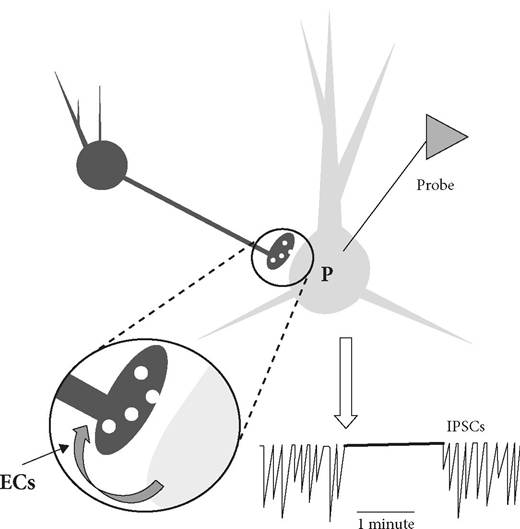
Figure 10.1 Schematic drawing of experimental set up (see text). A probe inserted into a pyramidal cell (P) recorded inhibitory postsynaptic currents (IPSCs; lower right) that originated from the inhibitory cell (I) and occurred spontaneously and continuously until the P cell was activated (open arrow). For about 1 minute after activation of the P cell the IPSCs disappeared and spontaneously reappeared. In the blow-up of the synaptic region (lower left) the gray arrow indicates that endocannabinoids (ECs) were released from the P cell when it was activated. The ECs' effect, which only lasted for a short time, caused the transient IPSC disappearance by preventing their release from the synaptic terminal of the I cell.
we ignored them; they were a bit like gentle static coming through on a radio. '1 hen we got a surprise: when we activated the P cell, the IPSCs disappeared and reappeared a minute or so later. And every time we activated the P cell, they vanished and then came back. Now, ordinarily, the IPSCs are monotonously predictable, and their sudden capriciousness was new. We mentally filed it away, and, after we finished the boring project, we thought about the odd behavior of the IPSCs again.
Our first hypothesis was that the P-cell properties temporarily changed and prevented us from detecting the IPSCs, even though they were still there. Yet we couldn’t find any evidence for such changes. 'lhe P-cell hypothesis was obviously false, and we were even more curious. We then hypothesized that something interfered with the IPSCs after they had been sent from the I cell to the P cell. This hypothesis, too, was wrong. In desperation, we hypothesized that activating the P cell itself prevented the IPSCs from being sent out from the I cell. It was a crazy idea; let me explain why. The P cell and the I cell are completely independent cells, and there was no physical connection between them. Thinking that activating the P cell could prevent the I cell from sending IPSCs would be like thinking that you could stop radio static by yelling at the radio. Strange though it was, we tested this hypothesis in many ways over the next several years and could never disprove it. It turned out that whenever we activated a P cell, it sent a new kind of “do not leave!” message to the I cell that kept IPSCs from leaving. Equally remarkably, as others eventually discovered,22 the new message going from the P cell was carried by the marijuana-like endocannabinoids in your brain that I mentioned a while back. When, driven at first by curiosity, we started our investigation, nobody knew that backward signaling with endocannabinoids could happen. Chance, curiosity, and hypothesis testing all were necessary. You can be a Curiosity-Driven hypothesis tester, or vice versa, going from one to the other and back. Nobody checks up on you, nobody cares.
10.B.9 Failure and the Hypothesis
Besides exalting ignorance, Firestein also promotes failure as a crucial ingredient for science. He quotes the physicist Enrico Fermi, “If your experiments succeed in proving the hypothesis, you have made a measurement; if they fail to prove the hypothesis, you have made a discovery.” While Firestein’s pronouncements are deliberately jarring, it is hard to argue with his main point, and yet something seems wrong. To “fail” means not to succeed, and to think about failure, you must know about success, in the same way that you have to know about “knowledge” to understand “ignorance.” We can’t even define failure without knowing what success is, so what counts as success for Firestein? Surprisingly, at this point, he balks. He won't go there. Not only does he not explain or explore “success,” but he inverts our intuitive understanding of it in his discussion of “failure.”
In a characteristic quip, Firestein tells us that Albert Michelson (of Michelson- Morely fame) won a Nobel Prize “for an experiment that didn't work.” '1 his seems odd; why would anyone get a Prize for that, we wonder? A bit of background: in the late 1880s, physicists thought that light was a wave in a mysterious stuff called the “luminiferous ether” (“ether”) that permeated all of space. 'lhe hypothesis was that ether was necessary for the propagation of light waves somewhat like water is necessary for the propagation of water waves.
Although there was no direct evidence for ether's existence, it was a reasonable hypothesis that led a physicist, Augustin-Jean Fresnel, to predict that, if the earth was constantly plowing through ether-filled space as it orbited the sun, the ether would exert a “drag” on a light beam generated on earth. If you stick your hand out of the window of a moving car on a windless day you can feel the drag of the otherwise stationary air because the car is traveling through it. Analogous drag caused by ether should slow the speed of a light beam as it traveled from one place on earth to another, depending on how the beam was oriented with respect to the direction of the earth's movement.
'lhe light beam should be slowed more if it was heading against the direction in which the earth was heading than when it was traveling at right angles to the earth's path. To change the metaphor, imagine you were swimming in a river, either going some way upstream or the same distance across it. It would take you longer to go upstream than across, and the same is true for the light. Remarkably, despite making unprecedentedly precise and sensitive measurements, Michelson and Morley observed no difference in the speed of light regardless of its direction of travel. Firestein classifies the experiment as a “failure” because the result predicted by the ether hypothesis was not obtained. And this, I think, is where he goes overboard.
Let's look again at what Michelson and Morley did. They rigorously tested a specific prediction of a dominant hypothesis and discovered that it was false. They found no evidence for ether, although light was undeniably propagated through space. Since its critical prediction was false, the hypothesis was rejected: light propagation occurs in the absence of ether. (Naturally, no one test is decisive, but numerous replications of the experiment have come to the same conclusion.) In falsifying a critical hypothesis, the experiment became one of the first major pieces of evidence for Einstein's theory of Special Relativity. (And, as a side note: Michelson got his Nobel Prize for inventing the interferometer, the device that he and Morely used, which is applied for making highly precise measurements in many branches of physics. His Nobel Prize Award citation23 does not mention the famous experiment.)
Michelson and Morley would have failed if their experiment had not tested the prediction that it set out to test. '1 he significance of the experiment was that it paved the way for a better explanation. '1 he Michelson-Morely experiment was a success under any ordinary definition of “success,” given any ordinary definition of “science”. It is a red flag that Firestein's dictionary is not the same as yours. You have to beware when decoding his messages.
10.B.10 Fishing Expeditions
Is Curiosity-Driven Science as unstructured as it seems to be? Sometimes Curiosity-Driven research is criticized as being a “fishing expedition,” and, in the arcane lingo of scientific criticism, this is always a pejorative. No real scientist, it is thought, wants to be caught dead on one of those, lackadaisically drifting along with the currents, free from the cares afflicting serious, no-nonsense types busily grinding away on their hypotheses. Advocates of Curiosity-Driven Science vigorously reject this criticism: philistines may not understand or appreciate fishing, but that's their problem; there is nothing wrong with fishing. Here again, Firestein is on target: if you don't know exactly what you'll find or where you'll find it, then fishing is what you do; it is the epitome of an open-minded unscripted search. And if you can't know in advance what shape the information will take, you can't very well have an explicit experimental hypothesis about it. There is no serious doubt that scientific fishing expeditions count as real science, even if convincing a grant review panel to give you money for them is hard to do.
We shouldn't forget though, that fishing is not an entirely random activity, and Curiosity- Driven searches are not utterly unguided. As Firestein points out, there are tricks to fishing successfully: you need to know “where to fish, and what's likely to be tasty and what not.” Indeed, you need to know more; if you want to catch fish, you have to know what gear to use and how go about fishing. To catch the tasty fish, you need to know what bait or lures they will go for. Background information, assumptions, lore, and so on come under the heading of implicit hypotheses (Chapter 2). Moreover, if fisher-folk take their gear to a likely spot and don't catch any fish, they might try again, vary their equipment, etc.; however, at some point, they'll give up and not go there again. Their implicit hypothesis about fishing will have been falsified.
A final thought: Firestein opens his book, Ignorance, with an old proverb that symbolizes the state that scientists are frequently in, “It is very difficult to find a black cat in a dark room.... Especially when there is no cat.” '1 his is “the best description of science” that he knows. 'lhe object of your search is often elusive, and worse, you might be wrong about its very existence. But let's think about it: if for some reason you really did have to find a black cat in a dark room, a random search would never do—cats are quick and clever and quiet; you'd better have a plan. You'll want to know a lot about cats, the equipment you might need to catch one, and a scheme for how to go about it. You'll need a hypothesis. Especially if there is no cat.
I'll save a few more general comments on Curiosity-Driven Science until we've considered an alternative approach that, while having similarities to the philosophy of Curiosity-Driven Science, differs from it in striking ways. The name says it all: Questioning and Model-Building. In contrast to the free-form nature of Curiosity-Driven Science, QMB is a tightly organized.
10.