Emergent Classicality
A factorization of Hilbert space into local micro-factors is not quite the entire story. To make contact with the classical world as part of an emergent description, we need to further factorize the degrees of freedom within some region into macroscopic “systems” and a surrounding “environment,” and define a preferred basis of “pointer states” for each system.
This procedure is crucial to the Everettian program, where the interaction of systems with their environment leads to decoherence and branching of the wave function. To describe quantum measurement, one typically considers a quantum object Hq, an apparatus Ha, and an environment He. Branching occurs when an initially unentangled state evolves first to entangle the object with the apparatus (measurement), and then the apparatus with orthogonal environment states (decoherence), for example: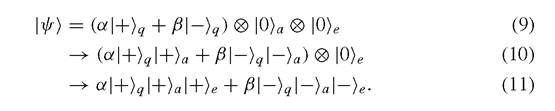
The Born Rule for probabilities, p(i) = |2, isn’t assumed as part of the theory; it
can be derived using techniques such as decision theory [12] or self-locating uncertainty [13].
Two things do get assumed: an initially unentangled state, and a particular factorization into object/apparatus/environment. The former condition is ultimately cosmological—the universe started in a low-entropy state, which we won’t discuss here. The factorization, on the other hand, should be based on local dynamics. While this factorization is usually done based on our quasi-classical intuition, there exists an infinite unitary freedom in the choice of our system and environment. We seek an algorithm for choosing this factorization that leads to approximately classical behavior on individual branches of the wave function.
This question remains murky at the present time, but substantial progress is being made.
The essential observation is that, if quantum behavior is distinguished from classical behavior by the presence of entanglement, classical behavior may be said to arise when entanglement is relatively unimportant. In the case of pointer states, this criterion is operationalized by the idea that such states are the ones that remain robust under being monitored by the environment [14]. For a planet orbiting the Sun in the solar system, for example, such states are highly localized around classical trajectories with definite positions and momenta.A similar criterion may be used to define the system/environment split in the first place [15, 16]. Consider a fixed Hamiltonian and some Hilbert-space factorization into subsystems A and B. Generically, if we start with an unentangled (tensorproduct) state in that factorization, the amount of entanglement will grow very rapidly. However, we can seek the factorization in which there exist low-entropy states for which entanglement grows at a minimum rate. That will be the factorization in which it is useful to define robust pointer states in one of the subsystems, while treating the other as the environment.
This kind of procedure for factorizing Hilbert space is, in large measure, the origin of our notion of preferred classical variables. Given a quantum system in a finitedimensional part of Hilbert space, in principle we are able to treat any Hermitian operator as representing an observable. But given the overall Hamiltonian, there will be certain specific interaction terms that define what is being measured when some other system interacts with our original system. We think of quantum systems as representing objects with positions and momenta because those are the operators that are most readily measured by real devices, given the actual Hamiltonian of the universe. We think of ourselves as living in position space, rather than in momentum space, because those are the variables in terms of which the Hamiltonian appears local.
7