B Find the Hypothesis
Scientific papers built around an implicit hypothesis are very common (Chapter 9). One problem with implicit hypotheses is that, if authors don't state their hypothesis directly, readers, especially students, can have difficulty extracting the message and, furthermore, may get the impression that most people don't rely on hypotheses.
Psychologists (and advertisers and politicians) are well aware that, in general, most of us like to do what others do. In The Structure of Scientific Revolutions, Thomas Kuhn2 argues that social or perceptual influences strongly shape scientists' behavior, including, we assume, how scientists communicate their work. Probably many scientists don't state their hypotheses because other scientists don't state theirs. Making implicit hypotheses explicit could help break this cycle.A good place to start is to become aware of the hidden hypotheses in papers. For instance, one method, find the hypothesis, is to practice identifying and bringing out the hypothesis in scientific reports. You can do this in the privacy of your own room, of course, but a typical venue is the weekly journal club or lab meeting. The presenter begins by laying out the hypothesis of the paper, whether it was implicit or explicit, and traces its logic throughout the presentation. If the hypothesis isn't explicitly stated and you're the presenter, then you have to find it, and you can begin by pinpointing the main theme of the paper; there are generally clues in its title and abstract. You may find that relatively few papers formally assert and follow a hypothesis3. More likely, you'll come across indirect statements or hints: the authors will say that a certain subject is “poorly understood,” imply that an existing model is “incomplete,” or note that some aspect of nature has not been “well-studied.” These are clues about where to find the hypothesis; they are not the hypothesis itself.
To find it, ask yourself what the authors are trying to explain; whether it is feature of the abstract or buried in the text, the explanation is probably the hypothesis.You also have to be aware that, because the current usages of “hypothesis” and “prediction” are inconsistent, even if a hypothesis or prediction is stated, you can't always be certain that the words mean the same thing in the paper as they do in this book. I often find “predictions” sprinkled almost whimsically throughout papers: a pleasant if isolated surprise when one pops up. Of course, some published work does genuinely lack a hypothesis (Chapter 4), but even in those cases, it is a good exercise to classify the kind of science involved. Frequently, a paper will start off sounding like a pure Discovery Science project: for example, the pattern of gene expression in a certain condition is not known and the authors want to “characterize” it, yet, as soon as the characterizing is done, they switch into hypothesis-testing mode with little fanfare.
After you've identified the probable hypothesis, look at the experiments and figures and try to work out how they relate to it and to each other. Do they follow a logical sequence ; are they arranged in a way that makes sense to you? Does each experiment test a bona fide prediction of a hypothesis? Could the test falsify a hypothesis? Finally, read the discussion and conclusion carefully. Not infrequently, you'll find that the implicit hypothesis of the paper only becomes evident when you see how the authors summarize the data and their significance. In the end, if you can see how all the pieces fit together, the odds are excellent that you'll have found the hypothesis.
Two things to watch out for are extraneous observations that, while interesting and important on their own, have little to do with the main theme of the paper, and experiments loosely connected to the theme that not test predictions. Ask yourself whether the main conclusion of the paper would have changed if an experiment had been left out.
If the answer is no, then it probably falls into one of these categories. (Incidentally, I'm a big fan of off-hand observations because they can enrich a report, and the fact that they're not an integral part of your line of reasoning is no reason not to mention them. Just call them what they are— intriguing side notes—and make sure they are not mixed up in the main flow of your argument or, I assure you, some referee will misunderstand and ding you in the review.)If you can find the hypothesis in the paper you're going to present and see how, even if unstated, it forms the scaffold for the work, you and your audience will get much more out of your presentation than you'd get by simply reciting the data. And you won't have to resort to that deadliest and emptiest of phrases to get you from one slide or idea to the next; “then they wanted to look at...,” (Whenever I hear that I think, “Why? Why did they want to look at it? Help us out here!”)
In the next section, I'll review an outstanding paper in neuroscience that tests an unstated hypothesis and use it to illustrate how to find and diagram an implicit hypothesis.
14. B.1 Diagram the Hypothesis
When you're trying to understand an abstract concept, it's often very helpful to make a sketch or diagram of its fundamental parts and their relationships, and there are many methods of diagramming.4 I've used a tree diagram in Figure 14.1A to show how a generic hypothesis-based paper might look. There is nothing unique about this scheme; you might identify different elements or a more elaborate tree in a paper that tested more than one hypothesis or that carried out extensive preliminary studies before getting down to the main job of testing the central hypothesis.
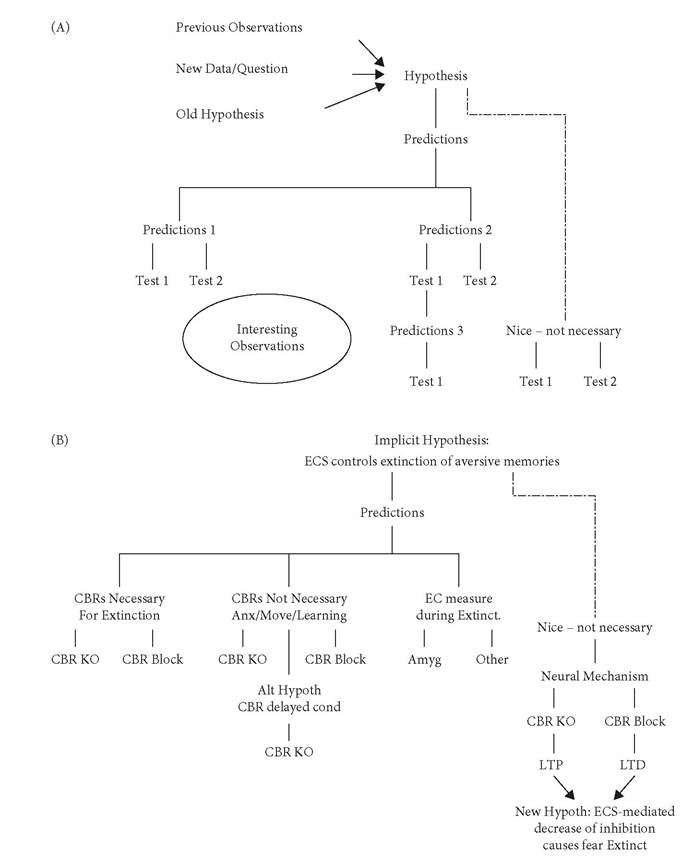
Figure 14.1 Diagraming hypotheses in scientific papers. (A) Diagram of a generic hypothesis-based paper. The hypothesis, which may be explicit or implicit, leads to two kinds of predictions: mandatory predictions that are logically deduced from the hypothesis, and optional—nice, but not necessary—predictions that are not logically demanded by the hypothesis but which may lead to complementary information.
Logically required predictions are connected to the hypothesis by solid lines, optional experiments by dashed lines. Each prediction is subjected to one or more tests. The paths of reasoning from the tests back to the hypothesis are illustrated in Figure 2.1. An average paper may also report on “interesting observations” that are only loosely coupled to the main theme of the paper. (B) Diagram of the report byIn their beautiful and widely cited Nature paper (>1,000 citations as of May 2018), Giovanni Marsicano and colleagues5 tested an implicit hypothesis about the role of the endogenous cannabinoid system, which involves the brain's own “marijuana” (Chapter 2). Figure 14.1B shows how you might diagram their paper. The authors do not state their hypothesis or spell out its predictions (they often call their predictions “assumptions”) in the body of the paper, and they say only that they want to study the involvement of the endocannabinoid system in memory formation. Nevertheless, their title strongly implies a hypothesis: “The Endogenous Cannabinoid System Controls Extinction of Aversive Memories.” They studied a part of the brain, the amygdala, that is a center for the control of fear. As the paper unfolds, they test three logically necessary predictions of this hypothesis and one that was “nice, but not necessary.”
Some background: neuroscientists are interested in fear (aversive) memories for two reasons. First, all animals, including humans, learn to fear danger in their environment (fear conditioning) and, whenever possible, learn to let go of their fear when danger no longer threatens (fear extinction). Hence, understanding how fear memories are formed and abolished would tell us about a fundamental neural process. Second, fear memory is obviously relevant to human maladies such as posttraumatic stress syndrome (PTSD). Unlike most people, PTSD patients can't “just get over,” or extinguish, the memory of their traumatic experience, and its persistence can make their lives miserable as they continue to respond emotionally to nonexistent threats.
If we understood the scientific basis of fear extinction, we might be able to help these patients.Figure 14.1 Continued
Marsicano and colleagues (see text). In this paper the authors tested the implicit hypothesis that the endocannabinoid system (ECS) in the amygdala (Amyg) controlled the extinction of aversive fear memories in mice. Their hypothesis predicted that cannabinoid receptors (CBRs) would have to be available so the endocannabinoids could bind to them. They tested this prediction by either deleting the CBRs (CBR KO) or blocking them pharmacologically (CBR Block). Their hypothesis also predicted that a number of behaviors that resemble fear responding should not be dependent on CBRs, which they tested with CBR KO and CBR Block. Finally, their hypothesis predicted that the level of ECs should increase in the amygdala but not other brain regions. The authors tested the optional prediction that synaptic connections between neurons in the amygdala could be strengthened by learning behavior, and they carried out several tests of this prediction. These tests led them to proposed a refined hypothesis based on a specific cellular mechanism for fear extinction mediated by the ECS.
The authors chose a conventional behavioral test in which a (male) mouse gets a short, mild electrical shock to its feet through the metal wire of its cage floor and responds by remaining motionless (“freezing”) for a few seconds. If a brief, audible tone regularly sounds immediately before the shock, mice soon learn to associate the tone with the shock and to freeze as soon as it comes on—a Pavlovian, or classical conditioning, task. When the animal has learned the tone-shock association, he has become conditioned to fear the tone. Now if you give him trials on which the tone sounds but no shock follows, he gradually realizes that the tone no longer announces that a shock is coming and stops getting into his freezing position. This phase of the experiment is called extinction, which is not the forgetting of an old fact, but the learning of a new one: the tone is now harmless.
The (implicit) hypothesis that amygdalar endocannabinoids (ECs in Figure 14.1B) control fear extinction makes three major predictions: (1) cannabinoid receptors (CBRs) must be activated for extinction to occur; (2) activation of cannabinoid receptors affects the fear responses specifically and not associated behaviors (such as the auditory response to the tone, ability to move, to sense the environment, or to feel anxiety) that could be mistaken for fear; and (3) that, when the tone sounds, endocannabinoids will be produced in the amygdala but not in other brain areas. Marsicano and colleagues tested these predictions by either genetically deleting the CBR, “knocking it out” (CBR KO) or blocking it with a drug, and by directly measuring endocannabinoid production (EC measure) in the amygdala. Figure 14.1B diagrams their paper. Solid lines indicate that the three main predictions are logically required by the implicit hypothesis, meaning that, if they are false, the hypothesis is false. (Note that, although the authors don't state their central hypothesis about extinction, they do state and test one alternative hypothesis for memory consolidation.)
Figure 14.1B makes another important point. The authors also report the results of several electrophysiological studies in a brain slice model of possible cellular mechanisms (the phenomenon of long- term potentiation [LTP] and a related phenomenon, long-term depression [LTD], that I mentioned in Chapter 7) whereby endocannabinoids might affect fear conditioning and fear extinction. Notice that, because the cellular details of this extinction process have not been fully worked out, the outcomes of these experiments were not truly predicted by the hypothesis. At best the results would be “nice, not necessary” for the conclusions of the study. And, no matter how they turned out, they could not falsify the main hypothesis. I've indicated this nonobligatory connection by a dashed line. Although I'd read the paper before, I hadn't realized this aspect of it until drawing the diagram. As it happened, the extra electrophysiological results were largely consistent with their main hypothesis and illustrate how such results can enrich and extend a report, in this case by suggesting a new hypothesis for a cellular mechanism of endocannabinoid-mediated fear extinction.
Incidentally, “nice, but not necessary” experiments are the sorts of things that I had in mind when discussing the Reproducibility Crisis (Chapter 7). You remember that the Reproducibility Project teams tried to replicate the last experiment in a paper and, if they couldn't replicate it, they put a check-mark in the “irreproducible” column of their ledger. The entire paper was graded as irreproducible. However, if the last electrophysiological experiments in the Marsicano et al. paper failed a replication trial, their major conclusion would be unaffected.
Finding a hypothesis “in the wild” and diagramming it gets you caught up in the reasoning of the paper and can give you valuable insight into what conclusions it truly allows, as well as an appreciation of its logical architecture. In the next section, I'll go over some suggestions for training yourself how to think in ways that can make the diagrams of your own papers more elegant.
14. B.2 Finding and Diagramming Your Own Hypothesis
If you are like the student I mentioned in the Introduction, you may be wondering about your own hypothesis. Your mentor may have dusted off a stack of old data and said “there's a PhD, thesis in there somewhere.” you may have started doing a few follow-up experiments, yet you feel that what comes next is not blatantly obvious. A good way to begin sorting things out is by asking yourself a series of questions:
• What are you “looking at” in the lab?
• Why? What's interesting about it?
• Do you see a problem that you can solve? Something you don't understand?
• What do you think might going on? Can you think of another explanation?
• Can you test your idea?
If the answer to that last question is yes, that is probably your hypothesis. Try diagramming your thoughts to get a sense of what the parts are and how they may fit together.
Always ask yourself: What is the best conceivable outcome of my experimental tests, and will they tell me anything, really? The purpose of doing this is not to bias your outcomes: it is to keep you from wasting time and help you design better experiments. If the best imaginable scenario is uninformative, you might want to rethink why you'd be doing those tests.
Now let's step back and look at a few more general ways of improving your ability to organize your thoughts and communications effectively.
14.