From Mind to Matter...
In Ref. [14] (see [15] for a summary), I have constructed a “proof of principle” theory that “reverses the arrow” in the sense explained above: it starts with the “self”, and shows that an emergent notion of “world” follows.
This is not the place to go into all the details, so let me simply give a very brief overview.The starting point is to formalize an information-theoretic notion of “your state” at a given moment (as mentioned in Fig. 1c, we do not intend to talk about “consciousness” or “qualia” here but aim for a technical notion). Think of everything that you, as an observer, perceive and remember at some given moment—something like a raw dump of all the data in your brain. We will denote this raw data by a finite string of bits, something like x = 011010 (just typically much longer). When we write down such a string, we assume that it makes sense to talk about “being in that state”, in the sense that there is a corresponding first-person perspective, i.e. a notion of “experiencing to be in that state and not another one”. In other words, we assume that there is some “mental oomph” that is described by any given string of bits, in a similar way as we typically ascribe some corresponding “material oomph” to whatever is described by giving the location of the positions and velocities of particles (or properties of a quantum field) in physics.
We assume that “being an observer” means to be in some state x at any given moment, and then to be in another state y in the subsequent moment.[14] We typically think that y is determined by physics, that is, by the external world. For example, if x describes that I see a tile fall from the roof of my house, then y will typically encode that I see the tile fall further down (or hit the ground) because that is what happens in the world, and my brain is part of that world. But if we do not presuppose the existence of a “world”, then we cannot resort to that argumentation.
Instead, we need a “law” that acts directly on the observer states, telling us what state to expect next, without assuming that it derives from some physical universe.This is done by the following postulate[15]:
Postulate 1. Being an observer means to be in some state x1 first, then in some state x2, and so on. The probability (chance) of being in state y next, after having been instates x1,..., xn, is given by conditional algorithmic probability P(y|x1,..., xn), i.e. P(x1, xn, y)/P(x1, xn ).
What is algorithmic probability? In a nutshell,[16] it is a probability distribution that favors compressibility. The probability P(x1,..., xn) is roughly 2-L, where L is the length of the shortest computer program (formalized by a version of universal monotone Turing machines) that produces first the output x1, then the output x2, and so on, until xn (and then possibly more). Consequently, if P(y|x1,..., xn) is large, then this means that short programs tend to output y after having output x1,..., xn— in other words, that it is somehow (algorithmically) “natural to guess” that y comes next.
In [14], I give three different conceptual and structural-mathematical reasons for postulating this distribution and not another one. Without going into this argumentation, the most obvious indication of the relevance of algorithmic probability P comes from “Solomonoff induction” [16]: in computer science and artificial intelligence [17], P is shown to be an efficient tool for predicting future observations, under some computability assumptions that are satisfied in physics according to some version of the Church-Turing thesis. Postulate 1 then claims that P does not only predict the future, but in fact determines it.
What are the consequences of Postulate 1? At this point, the mathematical tools of algorithmic information theory become relevant, leading us to some quite surprising predictions.
One such predictions is what I call the “principle of persistent regularities”: if there has been a computable regularity in all previous observations (say, by mere chance), then there is a high probability that this regularity will be present also in future observations. In more detail, define a “computable test”[17] as a computable function that assigns to any bit string x some f (x) which is either “yes” (1) or “no” (0). Then one can prove the following:Theorem 1 Consider the conditional probability that f will yield “no” next, if it has given the answer “yes” on all previous observer states; i.e. P(0|1n) := P( f (y) = 0| f (x1) =... = f (xn) = 1). Then limn P(0|1n) = 0, and the convergence is rapid, since P(0|1n) converges. That is, if n is large, then the answer will
probably be “yes” next, too.
As a simple example, think of a computer program f that checks whether x corresponds to a “brain dump” that is typical for an observer in a planet-like environment. If that check gave the answer “yes” to all previous observer states (and there were enough of those), then it would give “yes” with high probability also to future observer states. But this resolves the Boltzmann brain problem, regardless of any assumptions on cosmology (for pages of painstaking details, see [14]). Another way to see this is that Solomonoff induction would never make an observer assign significant probability to a shocking Boltzmann brain experience as described in Sect.3, and according to Postulate 1, Solomonoff induction is correct by definition.
It is this tendency to “stabilize regularities” that ultimately leads to an emergent notion of external world, as mentioned in thebeginning of this section. To understand
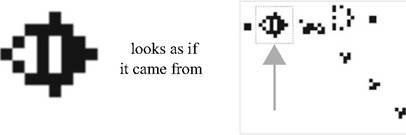
Fig. 2 The left-hand side symbolizes a bit string x, representing the state of an observer, and the right-hand side represents a probabilistic computable process (here actually deterministic: an instance of Conway’s Game of Life [18]), together with a rule to “pick out” some random variable from the process (playing the role of an “output”; instead of a distinguished tape as for a Turing machine, it is here some computable “locator function” that defines the output).
Postulate 1 acts directly on the left-hand side: it says that algorithmic probability determines how the observer’s state changes over time. But Theorem 2 shows that, as a consequence, after having run through many states xi,..., xn, the observer’s state will “look as if” the observer was actually the output part of some such computational process, in the sense that the probabilities P of observer state changes on the left will be equal to the marginal probabilities of some part of the process (the output) on the right. For example, if one glider in Gosper’s glider gun is going to hit the observer in the process in the next step, then this is reflected on the left by a corresponding change of state of the observer. In this sense, the (rest of) that computational process is something like an “external world”: it is not directly accessible to the observer, but correlated with the observer’s future states. It is a “convenient fiction” to predict the future—namely, an emergent notion of a physical universe that admits mechanistic causal explanationsthe significance of the following theorem, it makes sense to first read its illustration and interpretation in Fig. 2 below.
Theorem 2 Consider any computable probabilistic process which has description length L on a universal computer; we say that this process is simple if L is small. Suppose that this process generates a sequence of bit strings x1, x2,.as outputs, with probability p(x1,..., xn). Then, with P-probability of at least 2-L, we haveP(y|x1,..., xn) —> p(y|x1,..., xn)forn, i.e.this(simple)computable
probabilistic process will asymptotically yield a perfect probabilistic description of the observer’s state transitions.
Therefore, we obtain a prediction that seems consistent with the facts: observers will, with high probability, asymptotically be in states that look as if they were part of a larger computable, probabilistic process—an “external world”. The simpler the world (i.e. the smaller the L) the more probable that it emerges.
There would be much more to say about the consequences of Postulate 1: namely, that we also get an emergent notion of objective reality among several observers, that the emergent world doesn’t have to look like a typical computation on our desktop computers, that we expect to find some features (but not necessarily all properties of) quantum theory, and that there are surprising novel predictions like “probabilistic zombies”. But for these and other aspects, I refer the reader to [14]. Instead, let us discuss what a theory of the kind described above would imply for the question of fundamentality and causality.
5