C How Do Scientists Use the Hypothesis? Analysis of Neuroscience Literature
The survey tells us what scientists say about the hypothesis. What they say isn't necessarily what they do, however. Part of what scientists do with the hypothesis is reflected in their research papers.
A research paper is not like a diary or a stream of consciousness, but it is also not a robotic printout of data. In style, it is somewhere between a literary short story and a medical diagnosis. The factual content of a journal article is often woven into a narrative in which the author is trying to make her story interesting enough to keep you reading and yet not so colorful that she'll turn off the traditionalists in her audience or come across as an intellectual lightweight. In their journal articles scientists describe the experiments that they did and what they found. They also report why they did the experiments and what they believe that the results mean. Above all, a scientific author wants to come across as being a good scientist: observant, insightful, clever, well-read, and logical.By examining how scientists integrate the hypothesis into their research reports, I wanted to get a sense of how it figures in their reasoning or, at least, what they want us to think about their reasoning. Because scientists, like any professionals, are prone to breaking out their most arcane jargon when they're addressing other experts in their narrow areas, I avoided highly specialized technical journals in favor of the high-profile, generalized science journals, Science and Nature, plus two broad-based, top-notch journals within neuroscience, Neuron and Nature Neuroscience.8
I searched each article for key words related to hypothesis testing and the other scientific modes and tallied the numbers of times that they appeared, initially hoping to use the search function in Adobe DC exclusively, I nevertheless frequently had to read and score the text by hand to sort out ambiguities.
For instance, in published reports the word “hypothesis” overwhelmingly refers to a statistical hypothesis, and, since I was interested in scientific hypotheses, I had to weed the statistical ones out of the results manually. Figure 9.11 shows the literature survey results.I found that scientists rarely state their scientific hypothesis directly (“Our hypothesis is that...”): Only 16% of the papers were so overt. Then, assuming (see Chapter 2) that a scientific “model” (i.e., a conceptual model, not a “model system” or “animal model”—I weeded them out as well) is effectively the same as a “hypothesis,” I counted another 12% of the papers, which explicitly tested “models,” as being “hypothesis-based.” When authors used “hypothesis” as a synonym for “prediction” (17%), I didn't count them as explicitly hypothesisbased. Even allowing for the possibility of alternative judgments in a few cases (we can be surprisingly creative, or opaque, in presenting our ideas), I estimate that less than approximately 33% of the papers stated their hypothesis in so many words, which is not what you'd expect given that roughly 75% of the scientists responding to my survey (Figure 9.7) said that they always or usually stated the hypothesis of their papers. This suggests that a gap exists between what they say and what they do (assuming, of course, that survey respondents and authors do not represent independent groups). How could we explain such a gap? The
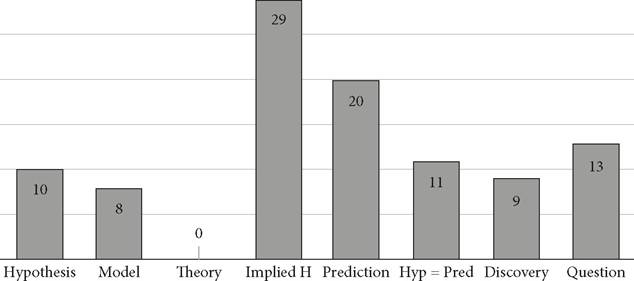
Figure 9.11 What do scientific papers reveal about how (neuro)scientists think about the hypothesis? A pdf search of the articles counted the times that “hypothesis,” “model,” “theory,” and “prediction” appeared in neuroscience articles in Nature, Science, Neuron, and Nature Neuroscience during 2015. To make decisions about whether the papers were based on “implied hypotheses,” “discovery science,” or “open-ended questioning,” or when the word “hypothesis” really meant “prediction,” I read and evaluated the article's text.
(See Note 8 for details.)answer may be that authors do not distinguish between their own “implicit hypotheses” and explicitly stated ones.
I found that, while roughly 45% of the papers did not state a hypothesis, they are plainly based on hypothesis testing procedures, and they do attempt to explain a particular phenomenon. That is, these are not “discovery” projects and are not asking “open-ended,” “what-if” kinds of questions. Moreover, though they lack an explicit hypothesis, the experiments laid out in the papers follow a logical sequence. The papers are also often sprinkled liberally with free-floating “predictions” which, though unmoored to a clearly stated hypothesis, let the reader in on why the authors went from one experiment to the next. The papers carried through a theme and reached concrete conclusions, usually proposing a conceptual model to give the reader a physical picture of what the authors have in mind.
I did classify some papers as Discovery Science (9%) or open-ended questioning (13%), so it wasn't as if these kinds work weren't represented in the sample. Rather, the main reason that an explicit hypothesis is missing from most research papers is that the authors prefer to avoid directly saying that they had one. It seems that scientific authors expect readers to sense its presence in the way that an art connoisseur senses the harmony of a painting or a chess master senses a dangerous position on the board. Why we adopt this round-about way of presenting out work is not self-evident.
You might object that, “If the only things missing are stated hypotheses and predictions, then there is no big deal; we, at least the experts, can figure them out.” Indeed, you can frequently ferret out what's going on in a paper but then, with effort, you can figure out what “sntncs mssng vwls mn, bt ts nt lwys sy r bvs”; “bvs” is not obviously “obvious,” for example. The mere fact that readers can often decode such writing doesn't mean that writers should write that way. Especially if the goal is to facilitate communication. What if it isn't? What other goals are there?
Why not speak plainly? If you have a hypothesis, why not come right out and say what it is? My survey participants who didn't always state their hypothesis said that they felt it was too “obvious” to need stating or that it seemed “artificial” to state it. Socially sensitive factors such as these are undoubtedly important, but there may be others. We'll come back to this topic in later chapters, where we'll cover a number of reasons for problems in communication, together with a few suggestions for solving or at least alleviating them.
9.