Let us compare histories of science to a series of portraits.
You have throughout the history of art beautified portraits, whether painted or photographed and then retouched. The wrinkles are ironed out and the person’s expression in the portrait is friendlier than in real life.
The person has in common with his portrait only the outline, the general contour, and even that not very accurately. Some people like portraits of their idols beautified in this way. I am not one of them. I like to see the wrinkles as signs of the hardships of life; of the sweat and the sleepless nights. This is my personal predilection. I therefore dislike much history of science that is being written today because it is a beautified portrait. Indeed, it is worse: it is, to shift the metaphor, a success story. Its theme is: Mr. So- and-So had this bright discovery and Mr. So-and-So this brilliant idea; and this is how we have arrived at the peak of this wonderful mountain called contemporary science. This is not to my liking. I like to see the wrinkles in a portrait; the setbacks or the road to success; in the history of science I want to see the discrepancies, I want to see the quarrels, personal quarrels as well as, and even more so, intellectual quarrels. I want to know, for instance, why Volta and Galvani quarrelled so that Galvan lost his job, but I want more particularly to know about their disagreement about animal electricity, and to understand it. I need not tell you that most histories of science are entirely reticent about this matter. On the other hand, I also love the general or broad outline of the history of science, or what E. A. Burtt calls the metaphysical foundations of science. In my view science is to be valued not because it gives us utility, but because it helps us to develop our metaphysical theories of the universe. So I am in a quandary. I want to see the contour alone and I want not to lose sight of the wrinkles, of the detailed discrepancies and difficulties, of the hardship.To put this in a more intellectual form, I will now discuss an historical example: the views of Faraday, whom his friend Dumas called a great philosopher and a metaphysician.
Faraday thought that forces do not act at a distance for reasons that I shall soon explain. He therefore had to declare Newton’s theory false (though a good approximation, of course). His paper on the conservation of force, which is one of his latest and most philosophical works, boldly presents a very unorthodox view. He begins with the admission, even with the stress on the fact, that Newton’s theory was empirically verified better than any other theory, and as strongly as anybody could ever expect, by the discoveries of the new planets. Yet Faraday rejected that theory. He declared that forces can not vary with the variation of distances according to the inverse square law or any other way because forces cannot vary. If forces conserve then Newton’s theory, taken literally, is false. The root of the error was Newton’s theory of action at a distance which, Faraday reminds us, Newton himself rejected. There is no such thing as action at a distance, Faraday claims, because force, contrary to Newton’s theory of force, is not a property of (or a relation between) material particles; force, rather than matter, is the primary entity of which the world is constructed.
This is Faraday’s position. It is reminiscent, as Dumas has pointed out already, of ancient Greek metaphysics. Thales says, “all is water”, and Faraday says “all is force”. Faraday comes as a great philosopher, as a metaphysician, and overrules the best and the most well-verified theory of his time because it conflicts with his metaphysics. It seems quite possible that this is the kind of situation which causes hostility towards, and impatience with, metaphysicians and metaphysics. If so, then those who try to dismiss metaphysics in the name of science are merely retaliating, and they have a point. If historians of science speak against metaphysics as a result of all this, then they also have a point.
The metaphysician arrogantly presents his speculations, and then comes forward and overrules, if need be, the best scientific theory, instead of humbly accepting the situation as an indication that he should withdraw his metaphysical speculations.I have now translated my problem from the metaphor to the theory of science. I want to see the details of science, and hence I do not want to see the metaphysics overruling it; but I do not want to see metaphysics deprecated. This conflict is my problem. And this is why my metaphor is inadequate. In a portrait you may see the contour as well as the wrinkles, and the painter may have, at most, a problem of balancing the two. But the existence of a conflict between the metaphysical contour and scientific details raises a more difficult problem. If E. A. Burtt has given us only the metaphysical contour but not the scientific details, we may feel that the details may be added to his picture. But this is not always possible, as I have shown in my example. We may, of course, centre our attention on the scientific details which do fit in well with Faraday’s metaphysics, and ignore those which do not. This, however, will not help us to solve the problem. It is not only an ostrich policy, it also makes Faraday look like a prophet. Faraday, it is often said, prophesied, or divined, Maxwell’s electromagnetic theory of light and Einstein’s general theory of relativity. Now divination is, again, a success story and since most historians of science love success stories they often indulge in the history of divination. They ask who was first to divine that light was electromagnetic; was it Faraday, was it Ampere, before him, or was it even Father Beccaria still earlier? I find the study of the history of the divination of the future developments of science distasteful and even embarrassing. To me it seems clear that Faraday was not interested in divining the future development of science when he developed a crude idea of gravitational fields; he was simply concerned with an immediate problem.
His prescription or suggestion was to overcome his problem by devising such a gravitational theory which agrees with his metaphysics, and explains the known facts at least as well as Newton’s gravitational theory.This provides my solution, for what it is worth, to my problem of how to see the contour and the details at the same time. The standard approach is both to denounce the metaphysics of scientists and to commend parts of it as divination of future scientific developments. Burtt’s alternative is to view metaphysics as the foundation of science. My alternative is to view some metaphysics as the possible foundation of future science; to view it as often conflicting with existing scientific theories and as incentives to alterations which would remove the conflict. In my view, then, the interaction between physics and metaphysics is by way of metaphysics prescribing programmes for future scientific development.
As you know, programmes are neither true nor false but commendable or condemnable. Now, if the metaphysics is true, the programme it prescribes is obviously commendable. The converse, it seems, is not universally true: Faraday’s metaphysics is false, yet the programme based on it was fruitful. The greatness of contemporary physics, in my personal
opinion, is that it gave rise to a better metaphysics than Faraday’s. And yet Faraday’s metaphysics, being better than Newtonian metaphysics, could give rise to better scientific theories. Faraday’s theory was not a system of scientific divination, nor was it a detailed scientific theory; it was a programme for possible future scientific theories. Metaphysics often is, so to speak, the contour being filled up later on with details - sometimes more successfully, sometimes less successfully (where success is, of course, not material but intellectual), but usually with great effort and along with controversy and trial and error.
The confusion between physics and metaphysics in the standard history of science is objectionable not only because it turns some metaphysics into the divination of future scientific developments while leading to the dismissal of other, less successful, metaphysics.
It is also objectionable on the ground that the metaphysics thus considered is trivial and uninteresting. It is my opinion that although the standard historians of science rightly caution us against metaphysics they usually report the history of metaphysics rather than the history of physics, and indeed, only that part of the history of metaphysics which is a dull success story, not the one which is an exciting story of conflict and immense efforts to render a metaphysics scientific. I will give an example from Poincare. I want to give an example from Poincare to avoid giving the impression that I criticise the standard history of science because it is not Popperian. As a follower of Popper, I look for the wrinkles on the understanding that the significant history of science is mostly wrinkles, mostly refutations, mostly criticisms; but here I am criticizing people not for ignoring Popper but for ignoring Poincare.The example from PoincarS is so obvious, and prima facie so strong, that those who reject it have to explain why they do so. Of course, ‘obvious’ does not mean true, but anybody who dissents from an obvious contention should answer it. To my knowledge Poincare’s contention was never answered, never in fact taken up, although it is in one of the most well-known classics, his Science and Hypothesis, and in one of its most crucial chapters. Poincare discusses the possible formulations of the law of conservation of energy and its status in each formulation. The most common formulation is: energy equals kinetic energy plus potential energy, and the energy of a closed system is constant. Now, do we exactly know what kinetic energy is? Let us assume we do. But do we know what potential energy is? Poincare says, no; we are vague about it and for a good reason. If you look closely at the formula you see that by ‘potential’ we quite often mean gravitational potential, the Laplacian potential. But then, we should have to say that this formula is false the sum of kinetic and gravitational potential energy in the system is not constant, since part of it may be converted into heat energy.
We have missed a factor there; we forgot the existence of heat energy. We therefore amend the formula: energy is now the sum of three factors. Do we know what heat energy is? Let us suppose that we do. We then find out that we have forgotten yet another factor; electromagnetic energy. We add this as well, and so our formula will contain more and more factors.Now, says Poincare, you have your choice between two alternatives. The one alternative is this: you lay down each item of the possible forms of energy, and describe them in sufficient clarity and detail, so that you have a refutable hypothesis. The hypothesis is refutable with the discovery of a new form of energy which has not been listed so far. I hardly need tell you, says Poincare, that the moment the refutable hypothesis is refuted you should discard it. The other alternative is not to lay down the list of all possible forms of energy: either you present the list as incomplete or unfinished, or else you leave the formula in its original version, with only two forms of energy - kinetic and potential, and confess that the meaning of the word ‘potential energy’ is ambiguous. In this case, says Poincar6, no fact can invalidate the law. For my part, I would say ‘refute’ rather than ‘invalidate’ because I believe in truth rather than in validity as the aim of science; but I shall not discuss this point here. To return to PoincarS, then, he said, the law of conservation of energy in its ambiguous version is irrefutable by experience; hence it is a tautology. To be more precise, Poincare doesn’t say ‘tautology’; he says ‘a kind of tautology’; which is kind of choice. The phrase ‘a kind of tautology’ may mean ‘a quasi-tautology’ and may mean ‘a tautology of a certain characteristic’. According to Poincare’s theory, the second alternative should be the correct one, but according to his discussion the first alternative should be the correct one. Indeed, here there is a very interesting split in Poincare’s philosophy, but I shall not discuss it here, because whether the law is a tautology or a near-tautology surely is trivial. The chief point is this: the law of conservation of energy in its vague version - with the potential energies unspecified - the irrefutable version, is indeed trivial. To this Poincare would agree whether he would ultimately decide that the irrefutable version is a tautology or a near-tautology.
The confusion in the standard histories of science of the trivial version of the law with its more substantial versions, is consequent on the attempt to beautify the picture of the history of science, because the substantial versions include conjectures and refutations; correction of the law of energy in each stage. The historian of science who does not like the discrepancies and criticisms resorts to generalities and speaks of conservation of energy in the ambiguous formulation just because he tries to forget that the history of science is full of refutations. I will give you one example.
Poincare originated a hypothesis according to which in uranium, or uranium salts, electromagnetic rays are captured and then emitted after a while. Becquerel refuted this hypothesis. As a result of this very famous refutation of Poincare’s hypothesis, we all know, it was found necessary to add nuclear energy to the list of forms of energy. I ask you, what history of physics mentions this refuted hypothesis of PoincarS, or similar cases of important refuted hypotheses? I have found very few which do, and it is those books which I admire; the rest I think do a disservice, because they present that version of the law of conservation of energy which is trivial, useless, and valueless.
But I do not wish to imply that the scientific and the trivialized ways of looking at the law of conservation of energy discussed by Poincare are the only important ones. I agree with him that the trivial metaphysical version and the more informative, specific, and scientific, versions are distinct. But there is a third distinct case, where the law may play a crucial role in an interesting metaphysical dispute. To make this case distinct we must select a metaphysical system which clashes with another metaphysical system, or with existing scientific theories, over the interpretation of this law. In Poincard’s example the contour and the details are in perfect agreement with each other, so that the contour is of little or no value in comparison with the detail. So I shall now discuss my example of a metaphysical conflict between Newtonianism and Faradayism and see what function the law of energy conservation plays there. But I have to warn you again against confusing metaphysics with clairvoyance. There was a game, invented by Tyndall, I think, of discussing who was the clairvoyant who foresaw the law of conservation of energy for the first time.
First he said it was Mayer and then he said it was SSguin and then he or others went back and back and back. As you know, the law of conservation of energy is ancient. All of a sudden somebody discovers that it is ancient, and, perhaps because this spoils the game, they dismiss him saying “but the ancient law is speculative; we ask about its verified version”, thus forgetting that they are speaking about divination. Verified, indeed! The law was never verified, and as Poincare knew, it could not be verified. Rather, 1 have argued, in its many scientific versions it was repeatedly refuted. But the sad fact is not that this kind of confused talk about the history of the law of conservation of energy still goes on - nobody really minds whether Seguin or Mayer divined it - but that this kind of confused talk stands in the way of discussions which can lead to really interesting results, as I want to show now, by briefly discussing the role, or rather the different roles, which the same law plays in Newtonian metaphysics, and in Faraday’s mataphysics.
First, within Newtonian metaphysics each potential energy, as is well known, can turn into kinetic energy and vice versa, so that possibly one potential energy can first become kinetic energy and then another potential energy. But, a potential energy cannot turn directly into another potential energy. This is so for the following reason. When gravitational potential turns directly into, say, electric potential then, to Newtonians, this can occur only as a consequence of gross matter, or heavy matter, turning into electric matter. But as within Newtonianism the law of conservation of each kind of matter is accepted, the process is impossible. When we speak of heavy matter in the Newtonian sense, we already have in mind the idea that heavy matter conserves, that the quantity of heavy matter in any closed system remains constant. Thus, in Newtonianism a potential cannot change directly into another potential.
Comment from the floor: I’m sorry I don’t agree with you. If you take two massive bodies which are attached together by a spring and move them apart, as a result of the attraction of gravity they will come close together, and therefore originally you had no motion and if the spring were under no tension, no potential energy.
Agassi: I am grateful for this interruption, because it deals with the example which Kant and Boscovitch have discussed and which led them to invent a new metaphysics. Newtonian metaphysics rules out this example as the following corollary to Newton’s theory of gravitation shows. If without motion some gravitational potential disappears, or turns into something else, than some heavy matter has also disappeared, or turned into something else, which is impossible. But then, ask Kant and Boscovitch, how can ordinary heavy matter be elastic? If you assume that two heavy atoms possess both gravitational energy and elastic energy you already admit that they interact not strictly according to Newton’s law of gravity simply on account of Newton’s law of addition of forces. Since the billiard balls are elastic, we must assume that their atoms are both elastic and heavy. To exclude the possibility of elastic and gravitational forces acting simultaneously Kant and Boscovitch suggested that the gravitational force acts when particles are placed at a great distance from each other and the elastic force acts when the same particles are placed at a small distance. If so, then Newton’s law of gravity does not hold in the small-range. This is the first modification of Newtonianism designed to allow one and the same particle to possess many forces. Without this modification Newtonian metaphysics allots one kind of matter to one kind of force (because of the law of addition of forces), thus leading to the invention of a multitude of matters - gross, electric, magnetic, caloric, etc. Newton himself, incidentally, was not a Newtonian, but a Cartesian, a point which Faraday emphasized in his debates with the Newtonians.
It is a strange fact that in spite of the criticism launched by Kant and Boscovitch, unmodified Newtonianism remained popular. It remained popular even after the criticism was levelled from a different angle in a stronger fashion in the early 19th century. If gross matter interacts only with gross matter and electric matter only with electric matter, then the two kinds of matter are two universes apart. If so, why does an electric charge remain on the Coulomb test body? Why does it not jump? More precisely, why does it jump only under some specific conditions in the form of a spark? If, on the other hand, we assume that there is a small factor of interaction between gross matter and electric matter, then every gross particle will have both electric force and gravitational force and by the law of addition of forces these two should unite, with the consequence that two gross particles do not interact precisely according to the inverse square law, at least in the presence of an electric particle. Thus, the second alternative leads to the modification of Newton’s theory of gravity, of his inverse square law. The only way out of this dilemma is to invent a new metaphysics. And the new metaphysics of Kant and Boscovitch may provide a way out of the difficulty because it disallows this unification of forces: it says that there is one force acting at one distance-range and another force acting at another distance-range, as the Boscovitch diagram makes clear. But this solution is not satisfactory because we know empirically that gravitational and electrical forces have the same distancerange.
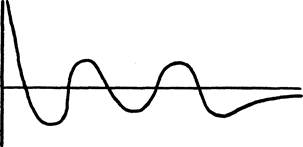
Fig. 1. Boscovitch*s diagram presenting the force of interaction between two material particles as a function of the distance between them. On the extreme right the function coincides with the inverse square function.
Oersted wrote his doctorate on the Kant-Boscovitch model, just before the discovery of electrochemistry; he tried to explain this phenomenon as soon as he learned about it. He said to himself, I suppose, the Kant- Boscovich model is not satisfactory because the distance does not play any important role in electrochemistry. But, he presumably said, what is important to electrochemistry is a certain chemican setting, and the contact between the various parts of the pile. So, instead of saying different forces act in different distance-ranges, he said that different forces act in different set-ups. Now this theory has a far-reaching consequence, because, according to it if a set-up is changed then the force acting within it is changed. In other words, what we call force is just a manifestation of something deeper, of an underlying reality, which does not change. The same force appears in different manifestations when in different settings; but it is always the same force, the primordial force. This is the law of conversion or conservation of force.
Holding this view Oersted tried to make electric force convert into magnetic force and it was no accident that for about twenty years he was working almost alone on the topic, and he was entirely alone in his persistence, because nobody else believed his metaphysics. He introduced the most violent electric discharge as a part of his setting because he knew that it causes other transmutations, of the electric force into heat and light forces, and he tought, by extrapolation, that if the current is very strong a part of the electric force converts into magnetic force as well. This is why he worked with bigger and bigger batteries although his experiment can be successfully conducted even with the weakest battery he could construct. But he got no result for a long time because following Newton and Kant he thought that the force he was looking for was central. When he ultimately made the discovery of electromagnetism, he corrected his errors of detail, but considered the discovery to be a strong support of his metaphysics, especially since he thought that non-central froces may fit his own metaphysics but not Newton’s or Kant’s.
Faraday accepted Oersted’s metaphysics from the start, and he later accepted as a matter of unshakeable faith Oersted’s law of conversion of forces; every two forces convert into each other at fixed ratios. Hence, he concluded, electricity can convert directly not only into magnetism, but also into gravity. We all know that gravity and electricity interchange via kinetic energy; this did not constitute any problem. What Faraday wanted was to discover a case of a change of gravitational forces directly into electric. And this, as I have said before, means to a Newtonian that Faraday wanted to change gross matter into electric matter. Hence, the Law of Conservation of Matter within Newtonianism conflicts with Faraday’s progam. It is for this reason that Faraday gave up matter altogether. He realized that the Law of Conservation of Force and the Law of Conservation of Matter contradict each other.
The Law of Conservation of Energy occurs both in the Newtonian and in the Faradayan metaphysical systems. But the two systems clash even with respect to this law, and it is this clash which I wanted to tell you about. I think that it is this clash which makes the trivial Law of Conservation of Energy so very interesting, because the clash is not trivial and the two clashing attitudes are interesting and deviate interestingly in the way energy is viewed.
I have contrasted first the scientific and the metaphysical versions of the Law of Conservation of Energy. Secondly, I have contrasted the status of the metaphysical law in isolation, and its status within a metaphysical conflict. I shall now briefly mention the law in its unscientific commonsense version, and in isolation. I should like to quote the story which Benjamin Franklin relates in his autobiography. When he worked in a London printing house his co-workers were surprised that he was the strongest in spite of the fact that he was a teetotaler and they drank strong beer; they were so ignorant that he had to explain to them that there can be no more strength in the beer than in the rye from which the beer was produced. This is the Law of Conservation of Energy in isolation, and it is, indeed, trivial: everybody knows it one way or another: if you don’t put fuel into the machine, including the human body, it will not work. This, I contend, is the triviality which is sold to us by many historians under the cover of history of science, along with scholarly and heavily documented discussion about how much of this triviality was known to SSguin or to Mayer. In order to understand why the conservation of energy was to important in the last century, I contend, we must consider the metaphysical systems, metaphysical conflicts, metaphysical difficulties, of the time, which were deeply connected with the scientific problems of that time.
appendix: reply to commentators
The critical comments on the foregoing are very interesting and valuable. I regret that for lack of time it is practically impossible to do them justice. I wish to discuss only one point concerning which I strongly dissent from my commentators. It seems that a change of attitude is taking place amongst some historians of science: the antimetaphysical attitude is becoming less and less universal. Now by ‘metaphysics’ we mean various things, but at least one thing we did always mean, and that is the doctrine of the substance of universe. This is what Aristotle understood metaphysics (or first philosophy) to be concerned with, as well as Bacon, Descartes, and Boyle, and Meyerson. There exist paradigm cases of metaphysics: “all is water”, “all is matter and form”; and, to take a less paradigm cases, “all is force”, which is Faraday’s metaphysics. It is, perhaps, congenial to some people to forget the mistake of antimetaphysics and to reintroduce metaphysics either via the back door or via a new name, as Gerald Holton has suggested. There is nothing in a name. But we made a mistake when we tried to overthrow metaphysics, though the mistake was made for a good reason. We should remember and record our mistakes, especially those made for good reasons, so as not to repeat them. It is not the name that I am concerned about, but the statements of metaphysics and what is done with them in science. Kuhn and Hanson have raised the question of the scientific status of such metaphysical theories as those I have discussed. Are they empirically refutable? Are they within the framework of science or are they separate? Are they separable? I do not really quite know. But one thing I do know is that metaphysics does present a great danger of overruling and overriding all empirical science. This we have seen in the example of Faraday’s attitude towards Newton’s theory: it is the best scientific theory, but it does not tally with my metaphysics so I prefer to reject it all the same. This is very dangerous, and we should remember the risk because it is this that made us antimetaphysical to begin with. If we are going to become pro-metaphysical again, as I am advocating now and as my commentators are advocating as well, we should not forget the risk. It is easy to adopt metaphysics and throw science overboard, as Hegel said true philosophy should. It is easy to advocate science and be hostile towards metaphysics. It is less easy, or less obviously possible, to advocate both simultaneously. Injustice to the anti-metaphysical attitude we should remember that it has this rationale. If we reintroduce metaphysics by another name we may easily confuse all this, and forget the rationale for the antimetaphysical attitude as well as the fact that it was an error nonetheless.