The Orthodox View...
Many of us are skeptics, and so am I. We reject ideas like astrology, omnipotent gods, or the afterlife simply because there is no convincing evidence for any of those things. We know how easily we can deceive ourselves and how often we err, which is why science is our method of choice.
What is it that makes science trustworthy? Philosophers have long been arguing about how to best define the scientific method and how to delineate it from pseudoscience (see e.g. [1, Sect. 4] for an overview), but there seems to be widespread consensus that features of self-correction play an important role. We try to adapt our views to new evidence, we reproduce our experiments many times, and we test our findings against those of others. The results of this approach, refined via mathematics and statistics, technological craftsmanship, and philosophical reflection, represent the closest to objective knowledge that we have.
Cherishing reliable objectivity, we can easily understand why the scientific community at large promotes what I call here the orthodox view, and we should in fact be glad that it does. According to the orthodox view, there is a single, material universe that evolves in time according to physical laws, and this is fundamentally all there is to say. In particular, “observers” or “agents” play no foundational role whatsoever. The question of consciousness is deliberately ignored, and the lessons of the Copernican Revolution [2] are extrapolated and promoted to a paradigm: the earth is not the center of the universe, humans are not central to physics, hence the “self” should not play any distinguished role in science.
We should be more than happy that the orthodox view dominates: banishing subjectivity, religious authority, and unverifiable spiritual claims was arguably a crucial prerequisite for progress and enlightenment. Without its development, we would not be able to give our children vaccination or antibiotics, and, more importantly, we would not have any good reason to tell them that they need not be afraid of ghosts.
Moreover, most contemporary attempts to go beyond this view are pseudo-scientific or at least highly controversial, such as the idea that “consciousness collapses the wave function” or the proliferation of the anthropic principle in the absence of predictive power of a theory.Yet, there are indications that the orthodox view is incomplete. One such indication is the hard problem of consciousness. As Chalmers puts it [3], “It is widely agreed that experience arises from a physical basis, but we have no good explanation of why and how it so arises. Why should physical processing give rise to a rich inner life at all? It seems objectively unreasonable that it should, and yet it does.” There are arguably good reasons to conjecture that the orthodox view might be unable in principle to provide a basis for solving this problem. But the focus of this essay is not on consciousness: as I will argue below, there are several problems in and around physics that point to a systematic deficiency of the orthodox view. These problems can guide our attempts in exploring alternatives to the orthodox perspective.
Given the benefits of the orthodox view, I am certainly not suggesting to drop it. Instead, I propose to modify it in a way that is consistent with the fundamental
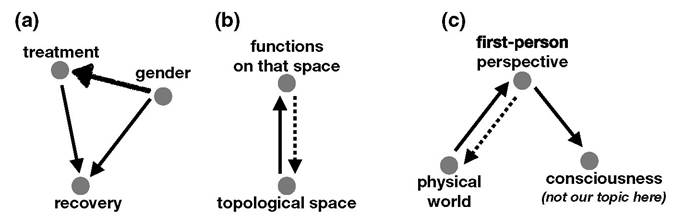
Fig. 1a In the theory of causality, directed acyclic graphs (DAGs) are used to represent the causal structure of a set of random variables. In this example, we would have a medical treatment that influences patients’ recovery, but also gender impacting recovery. If the hand-drawn arrow is present, then we have an additional influence of gender on the willingness of receiving treatment, which leads to counterintuitive effects like Simpson’s paradox; see e.g. the book by Pearl [5]. We are here borrowing this graphical notation for representing fundamentality or supervenience—in a nutshell, we draw an arrow from A to B if A “comes before” B in some well-defined sense, i.e. if A is more fundamental than B.
b If we are given a topological space, then we can define the (real) functions on that space. In this mathematical context, we would therefore intuitively say that the functions supervene on the space, and that we should draw an arrow from the (more fundamental) topological space to the (derived) algebra of functions on it, which would lead to the solid arrow. But, as explained in the main text, noncommutative geometry reverses this, leading to the dotted arrow instead (erasing the solid arrow), and does so with benefits. c In what I call the “orthodox view”, one would draw the two solid arrows: the physical world is the fundamental basis on which everything else supervenes. Let us introduce an abstract notion of “first-person perspective” as, roughly speaking, the information-theoretic content of an observer’s brain. Then, clearly, the orthodox perspective says that this is a property of the material world, and then consciousness is somehow supervening on that abstract first-person perspective (on the other hand, dualists would probably erase at least one of the arrows). The hard problem of consciousness is then to understand how these arrows come about, i.e. what sort of “causation”, logical implication, or supervenience they are supposed to represent. But instead of asking this question, my proposal here is to do something similar as in b: reverse the arrow of fundamentalitytenets of science, while keeping it fully intact in the familiar regime of physics. In a nutshell, my suggestion will be to “reverse the arrow of fundamentality”: it is not the external world that is ultimately fundamental and the self that supervenes on it, but rather the other way around in a specific sense (see Fig. 1 for an illustration of the “arrow” terminology).
Reversing the arrow in this sense is not unprecedented in science. Quite on the contrary: for example, noncommutative geometry [4] can be seen as such a reversal, and it will be instructive for what follows to examine this example in a bit more detail.
Consider a topological space,[13] called X. Once we have this space, we can look at the continuous real functions on it, denoted C (X). This set of functions has an important property called commutativity: the order of multiplication doesn’t matter, i.e. we have fg = gf for any two such functions. It seems completely obvious that X is more fundamental than C (X), in the sense that it “comes first” in the logical architecture of mathematical objects (see also the solid arrow in Fig. 1b). However, it turns out that this logical path can be reversed in some sense: if we know the set of functions C (X) and their algebraic properties, we can in principle reconstruct the underlying topological space X.Noncommutative geometry takes this observation seriously, and uses it to generalize the notion of a “space”. Namely, instead of considering a set of functions, it instead starts with an “algebra” A of objects which need not be commutative, i.e. it is allowed that fg = gf. It then uses the mathematical methods that led from C (X) back to the space X, and leads us from A to “something”. Is that “something” an underlying space for A? Well, not quite—it is a noncommutative space. It is similar to ordinary spaces in some respects, but different in others. In particular, one hopes that it can represent the sort of “quantum spacetime” that one expects to find in physics in the realm of quantum gravity. If successful, the mathematical strategy of noncommutative geometry would then attain an attractive physical interpretation: it would mean that quantum theory (and its algebra of operators) is more fundamental, and (some generalized notion of) spacetime supervenes on it. This is a reversal of the “usual” arrow of fundamentality.
Reversing the arrow may work in the context of noncommutative geometry, but why should we adopt this strategy for the “self” versus the “physical world”? How could this even work? Let us look at some problems of physics for guidance and motivation.
3
More on the topic The Orthodox View...:
- The Greek Orthodox Tradition8
- MUTAZ1LITE FANTASIES
- Conclusions
- The Views of Prince Kostiantyn Ostroz'kyi
- What Was It? What Was It Called?
- CONSTITUTIONAL END-GAMES
- Aguirre A., Foster B., Merali Z. (Eds.). What is Fundamental? Springer,2019. — 189 p., 2019
- The Iconoclastic Controversy
- Vagueness-Related Uncertainty as a Special Sort ofPsychological Attitude
- DEFECTS OF BOTH RATIONALISM AND RELIGION