The Politics of Fundamentality
Alyssa Ney
The claim that physics is fundamental is a claim with political implications. Though still taken as a starting assumption in much of analytic philosophy, where it forms the core of the widely held doctrine of physicalism, this claim has been contested in many other parts of the academy, including (most famously, during the fight over the doomed Superconducting Supercollider) within physics itself.
Theorists wanting to realign science with our democratic and ethical ideals often challenge the view that physics has some unique or privileged status among the sciences, rejecting any kind of fundamentalist doctrine. One provocative challenge has been offered by the philosopher of science Nancy Cartwright who, in her 1999 book The Dappled World, tried to undermine the claim that physics is fundamental precisely because she viewed such claims as motivating overspending on physics. These resources, Cartwright argued, could be used for more worthy projects, such as finding cures for diseases or improving social welfare. As she put it:
... theories that purport to be fundamental - to be able in principle to explain everything of a certain kind - often gain additional credibility just for that reason itself. They get an extra dollop of support beyond anything they have earned...
Cartwright argued that we should move beyond viewing some theories or branches of science as fundamental and instead recognize that the reliability of any theory, including those offered as “theories of everything,” have only limited applicability within a circumscribed domain.
A. Ney (B)
Department of Philosophy, UC Davis, Davis, CA 95762, USA e-mail: alyssaney@gmail.com
© Springer Nature Switzerland AG 2019 27
A. Aguirre et al. (eds.), What is Fundamental?, The Frontiers Collection, https://doi.org/10.1007/978- 3- 030-11301- 8_4
In my view, we should answer this call to ensure our view of science and science policy lines up with our values.[2] And this involves recognizing that our views on the question of whether one theory or another is fundamental may be used to motivate policies concerning the allocation of resources.
The claim that a certain theory or branch of science is fundamental has a kind of power. But properly construed, the claim that physics, or some part of physics, occupies a privileged status, thus earning the honorific ‘fundamental’ is both theoretically reasonable and ethically defensible, or so I will argue here. So we shouldn’t shy away from making the claim that at least certain parts of physics do constitute a fundamental science and use this to guide our democratic vision for twenty-first century science.But what is the sense in which physics or some part of physics is fundamental, and how could this underwrite a case for the continued support of physics, particularly support for those extremely expensive projects lying at the present frontiers of the field?
Let me begin by being clear (because this is frequently misunderstood) that the claim that physics is fundamental is not the claim that physics is more important than any of the other sciences, nor that it gives what ought to be regarded as better explanations than those explanations provided by other sciences, nor is it the claim that the other sciences could or should ultimately one day be dispensed with in favor of physics. I find all of these views indefensible - and one claiming that physics is fundamental need not hold any of them.
Rather, the claim that physics is fundamental, that it has some special status not shared by the other sciences, is most commonly interpreted as a claim about physics’s having a form of explanatory completeness. Again, this is not to say that physics provides explanations that are better than others that may be given using other sciences or modes of inquiry, so that other explanations should not be sought out or accepted. In a sense, it is a claim about quantity of explanations, rather than about their quality: for any phenomenon one might want to explain, physics has the resources to provide a certain kind of explanation for it.
As the metaphysician Ted Sider wrote, in his Writing the Book of the World :
Completeness seems definitive of fundamentally...
All fundamental matters “boil down to” or “derive from” or “hold in virtue of’ fundamental matters.And this general model, that the distinctiveness of physics rests in its ability to provide a far-reaching class of explanations, is not only advocated by philosophers. The physicist Steven Weinberg, in his 1992 Dreams of a Final Theory, similarly defended the special character of fundamental physics partly on the basis of what such theories could allow us to achieve in explanatory power. Starting with any fact we might wish to explain, we may ask a series of questions about it, asking in virtue of what that fact obtains and receive an answer, an explanation. Weinberg thought we should strive to discover such theories lying at the terminus of all arrows of explanation, declaring:
By tracing these arrows of explanation back toward their source, we have discovered a striking convergent pattern - perhaps the deepest thing we have yet learned about the universe.
But when we talk about a convergence of explanatory arrows, what kind of explanations do we have in mind? There are two broad kinds of explanatory completeness for physics that are typically defended.
First, physics is often taken to be fundamental or special in the sense that it is capable (in principle) of providing a complete class of constitutive explanations, explanations of the sort of entities that make up everything else. The idea has been developed in a number of ways, but the model proposed by Paul Oppenheim and Hilary Putnam in their 1958 paper “The Unity of Science as a Working Hypothesis” has been especially influential. Oppenheim and Putnam viewed the sciences as arranged into a hierarchy of levels ordered by relations of decomposition. Each science in the hierarchy comes with a proprietary domain (cells, molecules, atoms, etc.) with the entities of each science entirely decomposable into entities within the domains of each of the sciences below. Physics provides the fundamental science at the base of the hierarchy in virtue of the fact that it is out of the entities of physics that the entities of all of the other sciences are composed.
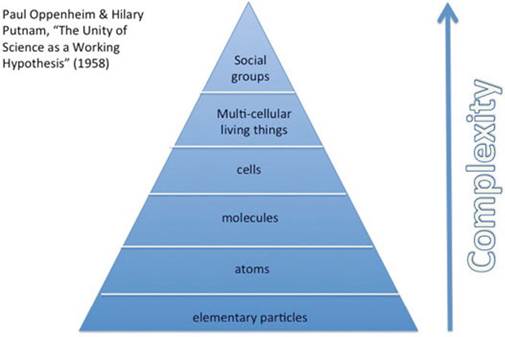
Physics thus enjoys a form of constitutive explanatory completeness: all entities are either physical or have a complete constitutive explanation in terms of the entities of physics.
Today’s philosophers of science are aware of many reasons to be skeptical of the specific details of Oppenheim and Putnam’s proposal. More contemporary models of the constitutive completeness of physics generally eschew the assumption that the sciences carve out a neat partition of entities into levels. Neuroscience in particular provides an immediate counterexample: explanations of a single phenomenon
will routinely appeal to brain areas, cells, chemicals, and individual ions. And few any longer subscribe to the building block model of constitutive completeness: that the ultimate constitutive basis for everything must be a class of little things out of which all else is built like a house is built out of bricks. The way in which the nonfundamental, derivative entities may be constituted out of the more fundamental or basic entities may take a variety of forms depending on the details of the case.[3] Metaphysicians of science have developed a variety of conceptual tools to facilitate constitutive explanations of macroscopic objects as derived from more fundamental physical images cast in terms of fields, wave functions, even group structures.[4]
Another form of explanatory completeness thesis one encounters in attempts to distinguish physics as fundamental focuses on its seeming ability to provide a complete class not of constitutive explanations, but rather of causal or dynamical explanations. If we ask what brought a given event about, the formation of a galaxy, or the splitting of a cell, we may ultimately find an explanation in terms of physics.
In his 2001 paper “The Rise of Physicalism,” David Papineau showed that the causal completeness of physics is made plausible by an inductive argument.
The large and diverse range of phenomena, including those involving living organisms, that have received explanations in terms of physical causes, especially since the development of quantum mechanics and molecular biology, make it reasonable to believe that all phenomena will receive explanation in terms of physical causes. Again, properly construed, this point about causal completeness doesn’t rule out the fact that other sciences will also often provide causal explanations of these events, nor does it entail a claim about the superiority of physical explanations over others. It only makes a claim about the range of causal explanations that our current physical theories make available in principle.Jaegwon Kim has argued that physics distinguishes itself in this respect from the other sciences.[5] Although a complete causal explanation of physical effects does not ever require the postulation of nonphysical causes, it is always the case that a complete causal explanation of chemical or biological or social effects requires an appeal to physical causes. Fires, heart attacks, and mass rallies all require the influx of oxygen. And all effects, when the demand for explanation is traced out far enough into the past, find nothing other than explanation in terms of early physical features of the universe. So we may see the causal completeness of physics as another characterization of what makes physics special, what makes it fundamental.
These interpretations of the fundamentality of physics expressed in terms of its exhibiting one or another form of explanatory completeness are, I concede, on the right track. They are a good first pass at explicating a useful notion of fundamentality. And I believe they would do a good job of capturing what it might mean for some idealized scientific theory to be fundamental. But I want to argue that we need to move beyond them, for it is simply too easy to raise doubts whether any actual physical theories are (constitutively or causally) complete.
And yet, this doesn’t challenge the fact that physics has a distinctively rich form of explanatory power that warrants the characterization of its theories as fundamental.But before articulating what I have in mind, let me first be clear. Why shouldn’t we take our actual physical theories to be explanatorily complete?
Consider first the conception of fundamentality as causal or dynamical explanatory completeness. One might try to point to Einstein’s field equations for general relativity or the quantum field theories making up the Standard Model in an attempt to cite theories that may appear to provide in principle causal or dynamical explanations of all phenomena. Yet, the equations making up these theories, and any others we might cite, are each known to hold only in a limited regime for special kinds of systems. The Einstein field equations hold for classical, i.e. non-quantum systems, the Klein-Gordon equation for free, i.e. non-interacting quantum fields, and there is neither a general equation holding for all relativistic quantum systems nor for all types of free particles, let alone particles that interact; nor is there a patchwork of principles we might stitch together to cover all regimes. Moreover, even in cases where we do have principles available, knowing how to model a system in order to generate solutions is an art, not something for which there is a general recipe.
This is hardly a revelation. Indeed, Paul Teller begins his An Interpretative Introduction to Quantum Field Theory with the remark:
An older view of theories took them to be composed of laws of unlimited generality and (for correct theories) unqualified truth... There have never been, are not now, and most likely never will be interesting scientific theories fitting this description.[6]
One might complain: what about string theories? String theories have been raised as candidate theories of everything that may apply to all domains and unify quantum theories with general relativity. But although the development of string theory has provided the physics community with a range of useful mathematical tools and significant insights, at least today, string theories do not provide a unique set of laws we may use to explain all basic processes in our universe.
In short, although we may grant that there are many cases in which physical principles and ingenuity allow physicists to predict how some systems will behave from one time to the next, to take the inductive leap from the existence of causal or dynamical explanations in some physical contexts to the existence of explanations in all is simply not justified. This isn’t to say that physicists don’t have the ability to explain and predict a lot. Of course they do, and the extraordinary power of physics is revealed repeatedly, for example in the stunning confirmations of the existence of the Higgs boson and more recently, gravitational waves. But it is certainly a leap to go from such successes to the conclusion that physics has anything like the tools to provide a complete causal/dynamical account of the behavior of all physical systems.
When it comes to constitutive explanatory completeness, again, we must concede that although physics has the ability to constitutively explain a lot, it certainly does not explain the constitution of everything. Dark matter is one phenomenon for which, although there are several excellent reasons to believe it exists, physics has no accepted account. Until recently it was common to think that supersymmetry provided the resources to explain the makeup of dark matter, but experiments have failed to find evidence for supersymmetric particles.
In addition, because some of the proposals for a theory of quantum gravity have consequences for the nature of the basic constituents of the matter in our universe, questions of constitution are very much bound up with questions of the right approach to quantum gravity. Yet there are several mutually incompatible proposals for the basic principles that should be used to guide the development of such a theory, all pointing toward very different fundamental entities: strings on the one hand, but also loops, spin foams, and causal sets. At least right now, physics fails to have a complete account of the makeup of the matter content of our universe. And so even if our present physical theories are fundamental theories, this cannot be in the sense of their being constitutively complete theories.
A natural response to these points about the current explanatory incompleteness of physics is that when it is claimed that physics is complete, it is not being claimed that any current physical theory is able to explain everything, but rather only that some future physical theory we can expect to reach one day will have the resources to provide a complete class of both causal and constitutive explanations.
There are several reasons to be dissatisfied with this response, of which I will note two. First, if we are interested in claims of fundamentality not as bare metaphysical claims, but as claims that can play a role in conversations that may have some practical importance regarding the future direction of science, then we should be interested in a notion of fundamentality that can apply to real physical theories of the kind we have or can be expected to have in the near future. For the arguments that can be made for the enthusiastic support of physics and development of its research programs in virtue of its being a fundamental science would seem to be undercut if the truly fundamental theories are merely idealized or several millennia away. If we must wait for completeness to have a theory that qualifies as ‘fundamental,’ we will likely wait a long time. The open problems in our current physical theories are not small and likely will require one or more scientific revolutions to address.
Additionally, there fails to be a good argument for the claim that physics ever will reach a complete theory in the future.[7] There is certainly no deductive argument that could establish this claim. And so at best, one could try to run an inductive argument with something like the following form: physics has already been successful at providing explanations for so many phenomena, it is therefore likely a future theory will achieve explanations for all.
But the trouble with trying to run an inductive argument for the conclusion that all phenomena will receive a physical explanation is that we have not delineated a class of phenomena that are similar in any respect or of a common kind from which we may generate the basis for an induction. Prototypical examples of inductive arguments narrow in on a class of phenomena (ravens, swans) that are all of a common kind, for this provides a basis for inferring that the feature they have all so far been observed to have is a feature common to all members of their kind. From the fact that all ravens so far observed have been black, we inductively conclude that all ravens are black.[8] But the class of phenomena that have so far been explained by physics is diverse. And when we discover new phenomena that a future physics might be expected to explain, they tend to be of novel kinds with unexpected features; i.e., we don’t simply find more ravens. And so there is no basis for an inference from what has been true of the kinds of physical phenomena for which we already have an understanding to those for which we do not.
So let’s move beyond completeness as a criterion for a theory’s fundamentality. After all, there is a significant kind of explanatory power we can claim even for our current physical theories, and this suffices to provide a sense in which they are fundamental that can play the important roles a notion of fundamentality ought to play. My suggestion is to reinterpret the concept of fundamentality in terms of a notion of explanatory maximality rather than explanatory completeness. For a theory to possess a maximal set of explanations is, I claim, for it to be a common source of (causal and constitutive) explanations that possess the greatest degree of scope, accuracy, and precision of all theories that have so far been formulated. And so physics is fundamental to the extent that it has the resources to provide a maximal class of explanations.
I say that a fundamental theory should be a common source of explanations to ensure that fundamental theories possess a certain degree of internal unification or systematicity, that they be more than a mere list of explanations. This unification and systematicity is, I believe, what Weinberg had in mind when he described physics as the place where all explanatory arrows converge. It is not simply that the explanatory arrows trace down to physical principles, but that they trace down to a unified class of physical explanations. Although Weinberg talked of a “final” theory, I don’t find this to be an essential part of the overall model. We may allow that explanations may converge on physical principles and also allow that there are open problems in current physics. We may then be optimistic that further developments may lead us to a deeper place of even greater convergence in the future.
Note that this notion of maximality rather than completeness is precisely the sense of fundamentally in play when theories are spoken of as fundamental in ordinary scientific contexts. In most scientific settings, the issue of fundamentally is relativized to a more narrow, target class of phenomena. For example, the Bardeen- Cooper-Schrieffer (BCS)-theory is the fundamental theory of superconductivity. The theory of evolution by natural selection provides the fundamental theory of heredity. These theories are fundamental theories of their targets, though, not because they are causally or constitutively complete—arguably, they do not even provide complete explanations within their target domains. Rather these theories are considered fundamental in virtue of the fact that the explanations they provide of their targets are both unified, and outrun the scope, accuracy, and precision of all competitor models. My proposal is then that a fundamental theory tout court is a unified theory that outruns the explanatory scope, accuracy, and precision of all competitor theories for the class of all target phenomena.
We can now ask how the claim that physics is fundamental in the sense of being explanatorily maximal may underwrite a case for its support and the development of future physical projects.
Physics organizations generally appeal to two primary justifications for funding projects in physics. First, they cite the value of research in physics in providing the knowledge needed to develop new and useful technologies. Sometimes this is cast in terms of a laundry list of cool and exciting technologies that would not have been possible without developments in the most basic areas of physics, technologies like GPS, lasers, and cellphones. But a stronger technology-based case for funding physics comes not from a mere listing of examples, but rather from the premise that for an extremely wide range of applications in which one is interested, physics may provide essential knowledge relevant to technological development. Indeed, basic research in physics has repeatedly demonstrated its use for the development of superior medical technologies, the most obvious examples being tools for medical imaging such as positron emission tomography (PET scans) and magnetic resonance imaging (MRI). An MIT report, “The Future Postponed,” similarly illustrates the many ways in which basic research, including research in physics, has been and should continue to be essential to the development of many new technologies that improve civilization.[9]
Second, an appeal is often made to the significant cultural value of possessing an understanding into the deep natures of the things that make up our universe. It would be difficult to overstate the cultural impacts of the revolutions brought by Copernican astronomy or Newtonian physics. The physicist Victor Weiskopf affirmed this point, noting:
Fundamental research creates the intellectual climate in which our modern civilization flourishes. It pumps the lifeblood of ideas and inventiveness not only into the technological laboratories and factories, but into every cultural activity of our time. The case for generous support for pure and fundamental science is as simple as that.[10]
Although the intellectual impact of some of the most important developments in twentieth century physics, quantum theories in particular, may presently be stymied by lack of a clear interpretation of those theories, one may expect future historians to note a similarly significant cultural shift in our time.
Thus we see the twin pillars of the case for the funding of physics: first, that it has the potential to facilitate the development of an especially wide range of important technologies, and second, that insight into the deep natures of things has wide-sweeping (presumably positive) cultural impacts on civilization.[11] [12] Both are underwritten by the claim that physics is a maximal theory. A maximal set of causal explanations tells us more, with more precision and accuracy than any other theory, about what tools we may develop in order to produce desired effects. A maximal set of constitutive explanations tells us more, with more precision and accuracy than any other theory, about the deep natures of all things, which will then affect how a civilization conceptualizes the world around it. In conclusion, I should acknowledge that some may find the claim that we should be worried about the loss of support for physics, so that there is cause to defend its claim to fundamentality, absurd. In response, it is easy to point to trends in allocation of research funding away from basic research in the sciences.11 But perhaps the following story can help us see the motives behind these trends that make me concerned. Each year I teach a course called “Understanding Scientific Change,” and in this course, I run an activity to help students see how human values may impact decisions about which scientific projects get funded. The class breaks up into small groups. Each is told they now run a funding agency. Their agency has a budget of $2 million to fund whichever scientific projects they choose. They receive a packet of twenty abridged research proposals, all real scientific proposals that were submitted to and eventually funded by the National Science Foundation on topics ranging from tests for supersymmetry to climate change to a cure for Alzheimer’s to dark energy to building a better cell phone. In this activity, not a single proposal on physics or cosmology has been funded. When pressed to explain this pattern, students claim the proposals they fund all have a chance of changing the world for the better by curing diseases or fighting poverty. What good could knowledge of dark energy or supersymmetry bring? What connects such research to real world problems? These questions my students ask are completely reasonable and if we are to defend the use of government funds to large research projects in any field, we must have a satisfactory way of answering them. I believe we do, but also that we can do a better job of communicating the importance of research at the cutting edge of physics to those outside of the field. In part, this requires communicating the content of our best physical theories to nonspecialists. But additionally this means clarifying and promoting the sense of what makes physics as a discipline special, what makes it fundamental. References 1. Barnes, E.: Emergence and fundamentality. Mind 121(484), 873-901 (2012) 2. French, S.: The Structure of the World: Metaphysics and Representation. Oxford University Press (2014) 3. Kim, J.: Why There are no laws in the special sciences. In: Essays in the Metaphysics of Mind. Oxford University Press (2010) 4. Kitcher, P: Science, Truth, and Democracy. Oxford University Press (2001) 5. Longino, H.: Science as Social Knowledge. Princeton University Press (1990) 6. McLaughlin, B.: The rise and fall of british emergentism. In: Beckermann, A., Flohr, H., Kim, J. (eds.) Emergence or Reduction? Prospects for Nonreductive Physicalism. De Gruyter (1992) 7. Ney, A., David, Z.A.: The Wave Function: Essays in the Metaphysics of Quantum Mechanics. Oxford University Press (2013) 8. Riordan, M.: The demise of the superconducting super collider. Phys. Perspect. 2(4), 411-425 (2000) 9. Teller, P.: An Interpretative Introduction to Quantum Field Theory. Princeton University Press (1995)