The Watcher Revisited
We have come to the end of our journey. In trying to understand how the human mind converts things into laws, we are led to conclude that the mathematical world and the physical world are one and the same.
The search for this union is what we would like to call fundamental. Everything springs from this union (Fig. 1).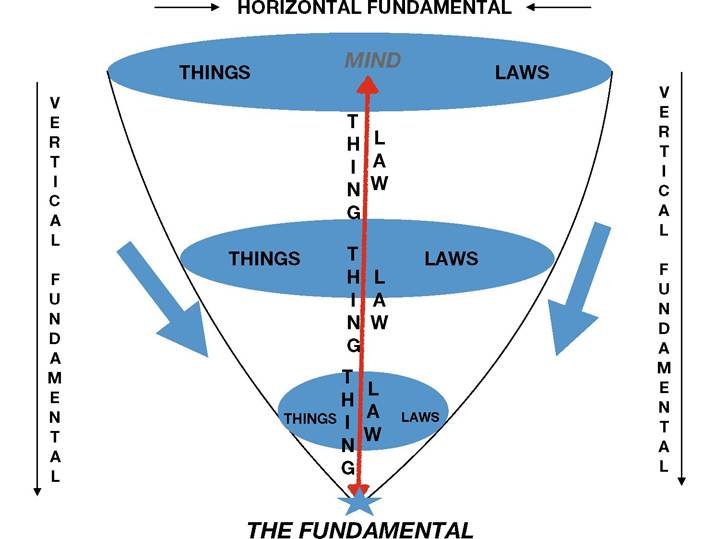
Fig. 1 Things, Laws, and the Human Mind. Horizontal Fundamental: the conversion of things into laws by the mind. Vertical Fundamental: the reductionist layers of reality. The Fundamental: as one digs into successive reductionist layers of reality, laws and things become more and more like each other, until deepest down they become the same. The central vertical line represents the mind, i.e. the thing-law
I am sitting on a chair, in front of my laptop, thinking how to end this essay. In so doing, I become aware of myself. I am defined by my consciousness. Could it be that consciousness itself is the law aspect of a thing-law? The thing being the physical connectome, or the body of the entire organism, and the law being consciousness? After all, consciousness is intangible, it is not material. It is felt, but cannot be defined. It is timeless—I am the same I at all ages; the I is timeless. Only the mind knows time; consciousness does not know time. And although consciousness seems confined to the spatially localised body, we have all felt at some time or the other that itchy desire to escape the body, to let the consciousness wander. Could it be that when we will have understood consciousness, its mathematical description will become one and the same as its physical description?