A Theory of Knowledge
To begin, I want to recall my own answer to the question of whether science tells us anything about the real world, that I gave in my undergraduate assignment. It already contains the seeds of the more sophisticated account I want to develop here.
Clearly, I reasoned, it is impossible that scientific theories have nothing to do with the observed empirical world. If a theory implied that airplanes must necessarily always fall out of the sky, then we would rightly reject such a theory as incorrect. At any given time, there is a large space of possible theories that are not in bald conflict with the available empirical evidence. When new evidence is acquired, the size of that space is reduced. It is still very large, so sociological factors can play a strong role in determining which of the theories in that space is “true”, but the chosen theory still tells us something about the objective physical world because we cannot choose just any theory we like. There is a constrained surface of theories that are compatible with the evidence, and that constraint is reflective of reality.
Whilst I think this is a reasonable response to the assignment question, it is far from giving an accurate account of the nature of knowledge. This is because the set of theories that are compatible with the evidence is still truly vast, and contains many things that we would not want to call science. For example, the theory that is identical to current physics, but also posits that there are green aliens hiding on the dark side of the moon that are completely undetectable because they do not interact in any way with ordinary matter, is compatible with current evidence, but we would not want to call it scientific. In the philosophical literature, this problem is known as the underdetermination of theory by evidence. This problem does not seem to arise all that much in practice, so there are clearly other constraints that determine what counts as knowledge.
Some of these may come from social factors, and some from more objective norms. To resolve this, we have to look at the actual structure of human knowledge.Note that here I am diverging from what epistemologists (philosophers who study the nature of knowledge) usually mean by a theory of knowledge. An epistemologist would usually define knowledge as something like “justified, true belief” and study the way in which knowledge is discovered as a separate question from whether it is justified. For example, if I have an intuition in the shower that leads to a new theory of physics then I do not need to think about why I came up with that intuition (the context of discovery) to understand whether we should believe the theory (the context of justification). I reject the distinction between the contexts of discovery and justification because I think that key aspects of the process by which we uncover new knowledge determine its relationship to other knowledge and to the empirical world.
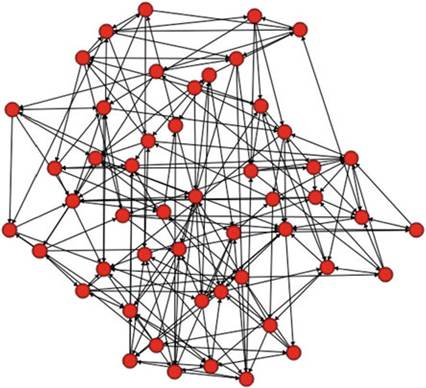
To understand the structure of knowledge, consider a network of nodes connected by links (see Fig. 1). The nodes are supposed to represent items of knowledge. These can include basic facts of experience, e.g. “that car looks red”, more abstract physical facts, e.g. “the charge of the electron is 1.602 x 10⁻¹⁹ C.”, or even whole theories, e.g. “Electrodynamics”. Clearly, the more abstract nodes can be broken down into smaller constituents, e.g. we can break electrodynamics down into its individual equations and explanations, so we can look at the network at a higher or lower degree of abstraction or coarse-graining. The links represent a connection between items of knowledge. I do not want to be too specific about the nature of this connection. It could mean, “can be derived from”, “is a special case of”, or even “there is a strong analogy between”. Depending on the nature of the allowed connections, we would obtain slightly different networks, but that is fine so long as we allow sufficient types of connections to capture what we want to think of as the structure of knowledge.
There is evidence that the knowledge network, so constructed, would have the structure of a scale free network [13]. Without getting into the formal definition of such networks, the distribution of nodes and links in such networks has two important
Fig. 1 Example of a network of nodes and links
properties. Firstly, there are some nodes, called hubs, which have significantly more connections to other nodes than a typical node. Secondly, the shortest path you can take between two nodes by following links is much shorter than you would think, given the total number of nodes. This second phenomenon is called “six degrees of separation” after the idea that any two people on Earth can be connected by friend- of-a-friend relationships in about six steps, despite the fact that there are billions of people on Earth.
Now, obviously, I do not literally have the knowledge network to hand, but there are real world networks that ought to approximate its structure. We could, for example, look at the structure of the world wide web, where web pages are the nodes and hyperlinks are the links, or do the same thing for Wikipedia articles. We could take the nodes to be scientific papers and draw a link when one paper cites another. All of these examples have been found to approximate the structure of a scale-free network [13]. Now, obviously, such networks include things that we would not ordinarily want to call “knowledge”, such as the name of Kanye West and Kim Kardashian’s latest baby, or authors citing their own papers for no other reason than to increase their citation count. However, whenever a society of intelligent agents form a network of connections organically by a large number of individual actions, they seem to do so in a scale-free way. Since the knowledge network is generated in this way, it seems likely that it would be scale-free too.
In my 2015 FQXi essay, I gave a mechanism for the generation of knowledge by abstraction from analogies that could plausibly lead to a scale-free knowledge network.
This process starts with nodes that represent the blooming, buzzing confusion of raw experience, which will end up being the nodes at the edges of the networks. We then draw analogies between nodes that are similar and, at some point, develop a higher level abstraction to capture the commonalities of those nodes. The links between every analogous node are then replaced with links to the higher level node, which reduces the number of links and complexity of the network. This process continues at higher and higher levels of abstraction, drawing analogies between higher level nodes and then replacing those by further abstractions. For further details, I refer to my 2015 essay.Here, I want to make a few points about the structure of the network so generated. Firstly, the “real world” imposes itself on the network by the edge nodes that represent raw experience. The commonalities of those nodes impose the set of analogies it is possible to draw, and hence the abstractions it is meaningful to define. In this way, the empirical world imposes itself on even very high level abstractions, such as the fundamental physical theories, so those theories do reflect the structure of the physical world. However, there are also many ways in which societal contingencies affect the structure of the network, e.g. the interests of the participating agents affect the order in which analogies and abstractions are drawn, which can affect the global structure of the network. So we can have a strong role for both the physical world and sociological factors in determining what we regard as the “true” structure of knowledge.
It is important to note that any large set of interacting agents attempting to make sense of the world could use this process to generate a scale-free knowledge network. Intelligent aliens or artificial intelligences would work just as well as humans. What is important is that there are independent entities interacting via social connections. The structure of the network is partly reflective of the structure of the world, and partly reflective of the fact that a social network of agents is generating the knowledge.
I do not really think that it makes sense to speak of “knowledge” outside this context. For me, knowledge is necessarily a shared understanding.At this point, one might ask why a scale-free network is a good way of organizing knowledge, i.e. why would nature endow us with the capability to organize knowledge in this way? Any given agent can only learn a small part of the knowledge network. The hub nodes encode a lot of information at a high level of abstraction, such that it is possible to get to any other node in a relatively short number of steps. Our fundamental theories of physics, as well as general theories of sociology, are examples of such hub nodes. In our undergraduate studies, we tend to learn a lot about a single hub node, and work outwards from that as we increase our specialization. The existence of hubs ensures that the six degrees of separation property holds, so that it is possible to get from any two specialized disciplines to a common ground of knowledge in a relatively short number of steps. If, for example, we encounter a problem that requires both a physicist and a biologist to solve, they can work back to a hub that both of them understand and use that as their starting point. This enables efficient collaboration between disciplines. In general, scale-free networks are a very efficient way of encoding information.
The scale-free structure also explains why smart physicists can think that physics is fundamental, while similarly smart sociologists can think sociology is fundamental. If you only learn a limited number of nodes hanging off a single hub node, then the structure of your knowledge is hierarchical, with everything seeming to hang off the hub. If you are a physicist, with fundamental physics as your hub, you will see physics as fundamental to everything, whereas if you have a sociological hub you will see sociology everywhere. The reality is that there are several hubs, all with equal importance, that abstract different aspects of human experience. Both physicalism and sociologism assume a hierarchical structure of knowledge, with a different discipline at the top. If, in fact, the structure of knowledge is not a hierarchy, then the question of which discipline is the most fundamental simply evaporates. Now, of course, hub nodes are more important than other nodes because they encode a larger portion of human knowledge, so it does make sense to think of them as more fundamental than the other nodes, but there is no sense in which everything boils down to a single most fundamental node.
4