C What Is a Hypothesis?
Given that there is a rough consensus about what the Scientific Method is and that the hypothesis is part of it, you would think that scientists must have agreed on what a hypothesis is.
Not so; there has been a wide range of interpretations of “hypothesis” (from the Greek, a “base, basis of an argument, supposition,” literally “a placing under,” from hypo- “under” + thesis “a placing, proposition”) and a brief list would include the following: (1) a scientific axiom5 intended to provide a foundation for deductive reasoning about nature, though not itself subject to being tested; (2) a necessary motivating force behind an investigation, a mandatory starting point for one6; (3) a postulate about fictional entities that is useful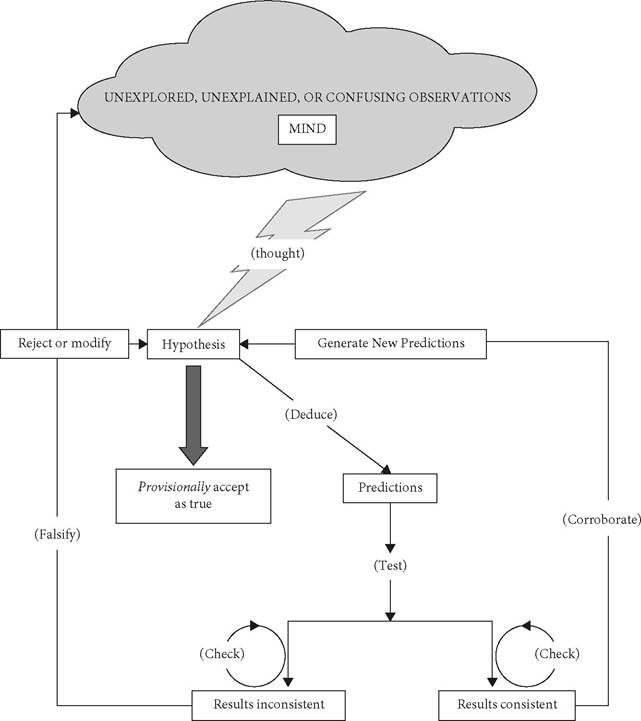
Figure 2.1 Schematic diagram of the recursive hypothesis testing cycle according to the Scientific Method and Karl Popper's standard of falsification. The boxes represent decisions or intentions, arrows represent processes and relationships between states, and the parenthetical labels identify the processes. The cycle begins with a thought, perhaps in response to an observation that you don't understand. You think of a testable explanation for your observation: this is your hypothesis. You deduce predictions from the hypothesis and test them. The test results are either consistent or inconsistent with the predictions. If they are consistent with the predictions, your hypothesis is provisionally “corroborated.” If they are inconsistent, your hypothesis is provisionally falsified. If your hypothesis is falsified, you must reject it in its present form, meaning either reject it entirely or modify it. If your hypothesis is corroborated, you can go back and derive new predictions, etc. At some point you decide to accept the hypothesis.
The cycle is recursive in toto or in part. For example, you should always check tests of predictions that either agree or disagree with the hypothesis.for facilitating calculations about natural phenomena but is otherwise disconnected from physical reality7; (4) a synonym for a prediction of how a given experiment will turn out8; (5) a conjecture that explains observable and unobservable details about a phenomenon9; (6) a conjectural explanation that can be verified by experiment10; (7) a conjectural explanation that makes predictions that can be falsified—found to be untrue—although not verified11; (8) a working plan12, a blueprint that outlines the relationships among ideas and implies the logical steps in an investigation; and, finally, (9) a model that summarizes the results of an investigation.
Definitions 1, 2, and 3 characterize the hypothesis, respectively, as a data-free postulate, a rigid requirement, or an imaginary construct never intended to depict reality. You might wonder if anyone ever thought that you could understand the world without observing it or having other kinds of evidence. Indeed, such ideas have been proposed, but few working scientists have taken them seriously for at least 100 years. Modern scientist are overwhelmingly empiricists.18 This is important because, as we'll see (Chapter 10), there are critics of the hypothesis who use definitions 1-3 and attack the hypothesis for being old-fashioned and inadequate. They get the argument backward; we should reject the old-fashioned definitions, not the hypothesis. Definition 4 says that predictions are the same as hypotheses, whereas, in fact, hypotheses and predictions are not the same, as we'll soon see, so we can ignore definition 4 as well.
At its core, the modern scientific hypothesis is a proposed explanation of a phenomenon. That is, it attempts to explain the cause of the phenomenon, where a cause is something that had to happen in order for the phenomenon to occur.
The cause of the road being wet is that rain fell from the sky, for example. And, of course, the rain itself has a cause, that cause has a cause, etc., ultimately all the way back to the Big Bang that started the universe. We don't have to go that far though; the immediate, intuitively obvious meaning of cause will do. As your investigation proceeds, your search for “the” cause may change or broaden as you learn more.Definitions 5-7 agree that hypotheses are explanations—we call them “conjectures” (“guesses”) to express our ignorance of the mental activity that produces them. In one way or another, they “happen” in our minds, and we don't know how. Although hypotheses are guesses in this sense, they are not random, purposeless stabs in dark, and, conversely, all guesses are not hypotheses. Hypotheses can be tested to see whether they're likely to be correct or not, and they have other properties we'll talk about. Definitions 6 and 7 disagree on the issue of whether hypotheses can be proved to be true, verified, which is a crucial distinction and the source of an enormous and often acrimonious struggle. We'll devote a lot of attention to the principle that we can't verify our hypotheses but only find out if they're incorrect; that is, we can falsify them. Finally, there seems to be good agreement that hypotheses are useful as working plans and models that guide and summarize investigations—definitions 8 and 9.
This may all seem confusing, so to anticipate the conclusion of this chapter: a modern hypothesis is a conjectural explanation for some aspect of nature that can be tested and potentially falsified and that serves as both a blueprint and a summary of an investigation. The hypothesis captures what is known about a phenomenon and frequently goes beyond appearances to identify unobservable causes for the phenomenon.
2.