Chapter 9 The Open Organization
To make things a new way, you need to make companies a new way, too.
In the mid-193OS, Ronald Coase, then a recent London School of Economics graduate, was musing over what to many people might have seemed a silly question: Why do companies exist? Why do we pledge our allegiance to an institution and gather in the same building to get things done? His eventual answer, which he published in his landmark 1937 article “The Nature of the Firm,”32 was this: companies exist to minimize “transaction costs”—time, hassle, confusion, mistakes.
When people share a purpose and have established roles, responsibilities, and modes of communication, it’s easy to make things happen. You simply turn to the person in the next cubicle and ask them to do their job.
But in a passing comment in a 1990 interview, Bill Joy, one of the cofounders of Sun Microsystems, revealed a flaw in Coases model. “No matter who you are, most of the smartest people work for someone else,” he observed, stating what has now become to be known as “Joy’s Law.” His implication: for the sake of minimizing transaction costs, we don’t work with the best people. Instead, we work with whomever our company was able to hire. Even for the best companies, that’s a woefully inefficient process.
In a sense, Joy’s quip was simply a modern reflection of the work of a Coase contemporary, Friedrich Hayek. While Coase was explaining why centralized organizations exist, Hayek was arguing that they shouldn’t. In his own landmark paper in 1945, “The Use of Information in Society,”33 Hayek observed that knowledge is unevenly distributed among people and that centralized planned and coordinated organizations would be unable to tap distributed knowledge (his point: only free markets could).
A half century later, when Joy made his similar observation, Sun Microsystems was one of the hottest tech companies in the world.
His remark was a warning not to become complacent about that. Even though Sun thought it had the best engineers and the best technologies, there were more good people outside the company than within. Regardless of what Sun did, the competition from outside the company would always have the potential to be greater; open innovation would beat even the strongest individual companies. And indeed, Sun was eventually eclipsed and is no longer an independent company (it’s now a division of Oracle, and Joy has left to become a venture capitalist.)The same is true today. Take even the best company you can think of, say Apple, and consider how it hires. First, it’s based in the United States, and most of its employees are in Cupertino, California. So there’s a bias toward those who are already in the U.S., or can legally work in the country, as well as toward those who live in the San Francisco Bay Area or are willing to move there. (It’s lovely in Cupertino, but if your spouse doesn’t want to leave her family in Rome or Chang Mai, that may matter more.)
Like all companies, Apple favors people with experience in the industry it’s hiring for, and it likes to see degrees from good universities as an indication Ofintelligence and work ethic. Even though Steve Jobs was a genius teenage dropout, there aren’t many others like him at Apple. The company may “think different,” but these days it hires pretty much like every other good company: based on professional qualifications.
It also can only hire people who want to be hired. So that eliminates all those elsewhere who love the jobs they’re already in and don’t want to leave. It tends not to hire children, the elderly, and felons, regardless of how smart they maybe. Nobodywho can’t keep a secret and doesn’t want to be bound by the terms of an employment contract, and so on.
Yet there are smart, even brilliant, people who fall into all those categories. By being a company, rather than an open-ended community, even Apple is subject to Joy’s Law.
Communities tend to be more egalitarian, in part because they typically don’t have the same legal obligations and risk as a company. They don’t have to check references and get people to sign contracts before they participate, the way a company typically must. They can afford to take more chances with participants, because the consequences of things not working out are so much smaller when you’re not promising people a wage (not to say they can’t get paid for work done, but any rewards tend to come after the fact, not as a salary).
To be sure, communities can’t do everything and the world’s economy can’t run entirely on volunteerism. But Joy’s point was that labor markets are changing. With the Internet, you don’t have to settle for whomever is sitting in the next cubicle. You find and tap the best person out there, even if you’re in Detroit and they’re in Dakar. Or, more to the point, they can find you. In open-innovation communities, participants self-select. They are drawn to cool projects and smart people, and when work is done in the open, they can find it. I learned this firsthand in my own robotics community.
A most unlikely CEO
A few months after Γd launched DIY Drones and had a few hundred members, a guy named Jordi Munoz signed up and posted a link to a cool hack he’d done with a new open-source microprocessor board called Arduino: he’d figured out how to use it to fly a toy helicopter with a Nintendo game controller.
His first forum post began this way: “English is not my first language, sorry if I made mistakes trying to describe this project. I made an autopilot for my RC helicopter with accelerometers extracted from the NunChuck of Nintendo Wii.” He included some pictures of the helicopter, now augmented with circuit boards and a tangle of wires, and, shortly thereafter, a video of it actually in the air.
People quickly took notice. Another poster responded with encouragement: “Your English is very good; don’t worry too much about translations; a picture is worth a thousand words, and were excited to see [the] video.
That’s an excellent helicopter you put together. It’s cool that people are coming up with complex ideas and getting them to work.”I was impressed, too; Γd never used Arduino, but this prompted me to look more closely at it. I got in touch with him to ask some more questions about Arduino, and we started a friendly correspondence. I liked his energy and was impressed by his fearless experimentation and effortless grasp of software concepts that I had struggled to understand. I had a feeling that he was on to something; his instincts kept leading him to more and more exciting technologies, from sensors he found and figured out how to use to algorithms he tracked down in obscure papers.
Eventually, we started to do some projects together on DIY Drones—first an airplane autopilot and then an autonomous blimp controller board. We’d trade circuit-board designs back and forth and we both spent our evenings hunched over soldering irons on our respective worktables, attaching components and testing them. He taught me how to program Arduino and the best places to buy components and get boards made. I wrote the blog posts describing our progress and documented the projects with online tutorials.
Initially, we were just electronics hobbyists sharing hacks with other DIYers. We’d upload links to the places to get the parts to follow along with our projects, but if you wanted to do it you’d have to have your own printed circuit boards manufactured for you and you’d have to buy all the components from online suppliers yourself. As a result, only a few dozen other community members were using our designs.
It was clear that if we wanted more people to participate in these sorts of projects, we’d have to make it easier for them. Rather than share design files, leaving members to their own devices to actually buy the parts, we should offer kits with everything included. And that meant buying gross lots of the parts, packaging them up in kits, and finding some way to take orders.
That, in turn, meant starting a proper company. I asked Jordi to join me as cofounder. And when he agreed, I thought that might be a good time to ask him a bit about himself.
Here’s what I learned: At the time of his first posting, Jordi Munoz Bardales (his full name), was nineteen years old. He was a native of Encinada, Mexico, and had gone to high school in Tijuana. He had just moved to Riverside, a suburb of Los Angeles. His high school girlfriend, who has dual citizenship, was pregnant, so they had recently got married. He was playing with the helicopter in their Riverside apartment because he didn’t have anything else to do while they waited for his green card. He had never been to college.
Needless to say, none of that mattered. The only thing that mattered was what he could do, which he had already resoundingly proved. Today, Jordi is CEO of 3D Robotics Inc., a multimillion-dollar company with a state-of-the-art factory in San Diego. As I write this, he is twenty-four years old.
How did this transformation happen? Three steps:
1. A smart kid who didn’t happen to be born in the United States, didn’t speak great English, and didn’t do terribly well in school, did have access to the Internet. Because he was curious and driven, he used the greatest information resource in history to make himself one of the world’s leading aerial robotics experts. He was just following his passions, but in the process he got what amounts to a “Google Ph.D.”
2. When I decided, against all odds, to start a company to do aerial robotics, I did it with the smartest guy on the subject I knew. I didn’t ask for a resume. It wasn’t necessary. That guy had already proven himself by making extraordinary things.
3. With a lot of support from the community, some fearlessness, and once again the power of Google research, Jordi learned the fundamentals of electronics manufacturing and manufacturing operations. He hired a smart team of mostly other twenty-somethings, a mix of Americans and bicultural Mexican engineers from Tijuana.34 They did the same thing, quickly learning everything they needed to know online, both in research and asking people.
Eighteen months later, they were running a world-class robotics factory.Twenty years ago, what would have been the chances that when the editor of Wired magazine decided to start an aerial robotics company, he would end up partnering with a nineteen-year-old high school graduate from Tijuana? Yet today it seemed like the most natural thing. Why wouldn’t you start a company with people who you were already working well with and who had already proven their mettle? It seems so much riskier to take a flier on someone you don’t know, just because they have a degree from a good school.
This is the Long Tail of talent. The Web allows people to show what they can do, regardless of their education and credentials. It allows groups to form and work together easily outside of a company context, whether this involves “jobs” or not. And these more informal organizations are much less constrained by geography; talented people can live anywhere and shouldn’t have to move to contribute.
As New York Times columnist Thomas Friedman puts it, “It used to be that only cheap foreign manual labor was easily available; now cheap foreign genius is easily available.” Not just cheap because they work for less money; cheap because they’re often working for no money at all, as a global volunteer in a project that they believe in while some Otherjob puts food on the table.
Today our robotics company has about a hundred contributors whose work has made it into a product. About twenty of them are paid employees, mostly working on hardware engineering and manufacturing in the factory. The other eighty are volunteers working on software. The volunteers all have other jobs, ranging from an Apple engineer to a cake maker, but some of them put in what in some weeks amounts to full-time work on the robotics projects. Some of them are professional software programmers just looking for a new challenge; others are amateurs who have made this their hobby and taught themselves what they needed to know.
Perhaps, if this was a company crafted in the Coase model, we would have found and hired some of the first category—the professionals already active in the field. But we certainly would have missed the cake maker, the graphics artist working for the Brazilian ad agency, the guy who runs the Italian ambulance radio company, the retired car-dealership owner, the Spaniard working for an energy company in the Canary Islands, and all the others who followed their passions into the project, even through their careers had taken them elsewhere.
In short, because we don’t operate the company in a Coaseian model, we’ve got more and smarter people working for us. We minimize transaction costs with technology, not proximity. A social network is our common roof. Skype is the “next cubicle.” Our shared purpose is really shared, not dictated.
Joy wins: The open-manufacturing model
Joy’s Law and the new breed of companies and communities built on open-access Web principles turned Coase’s Law upside down. Now, working within a traditional monolithic company of the sort Coase had in mind often imposes higher transaction costs than running a project online. Why turn to the person who happens to be in the next office when it’s just as easy to turn to an online community member from a global marketplace of talent?
Companies are full of bureaucracy, procedures, and approval processes, a structure designed to defend the integrity of the organization. Communities form around shared interests and needs, and have no more process than they require. The community exists for the project, not to support the company in which the project resides.
Yet communities can’t make physical good by themselves. Somebody has to do the manufacturing, handle the inventory, get the liability insurance, and run the customer support, and that takes money, a legal structure, and real day-to-day responsibilities. Thus, a company.
So, in the new manufacturing model, you need a new kind of manufacturing company, too. At its core, it has to incorporate all the skills and learning of traditional manufacturing companies—tight quality control, efficient inventory management, and supply-chain management—so that it can compete with them on basic price and quality. But it also needs to incorporate many of the skills of Web companies in creating and harnessing a community around its products that allow it to design new goods faster, better, cheaper. In short, it must be like the best hardware companies and the best software companies. Atoms and bits.
Maryam Alavi, vice-dean of Emery University’s Goizueta Business School, argues that the Onlywayfirms can continue to have lower transaction costs than the open market is if they become more complex internally in order to respond to the increasingly complex external market. In the Aspen Institute’s “The Future of Work,” she explained that this was due to the “law of requisite variety” in systems theory, and argues that a system must be as complex as the environment it is Workingwithin: “There are parts of the organization that are going to become more hierarchical because of the uncertainties that they deal with or don’t deal with. And there are parts of the organization that will need to be highly dynamic, open and changing.”35
Thus the new industrial organizational model. It’s built around “small pieces, loosely joined.” Companies are smaller, virtual, and informal. Most participants are not employees. They form and re-form on the fly, driven by ability and need rather than affiliation and obligation. It doesn’t matter who the best people work for; if the project is interesting enough, the best people will find it.
The open supply chain
How would an American manufacturing economy built on such principles look?
On the face of it, that’s a pointless question: read the daily headlines, and you’d hardly be blamed for thinking that there’s no future for American manufacturing at all. After all, it’s more than just that labor costs are lower elsewhere. Even more important, the ecosystem of suppliers and skills has moved abroad, too.
As Garry Pisano and Willy Shih point out in a telling 2009 Harvard Business Review article on American competitiveness,36 Amazon can’t make a Kindle 2 in the United States because:
1. The flex circuit connectors are made in China because the U.S. supplier base migrated to Asia.
2. The electrophoretic display is made in Taiwan because the expertise developed from producting flat-panel LCDs migrated to Asia with semiconductor manufacturing.
3. The highly polished injection-molded case is made in China because the U.S. supplier base eroded as the manufacture of toys, consumer electronics, and computers migrated to China.
4. The wireless card is made in South Korea because that country became a center for making mobile phone components and handsets.
5. The controller board is made in China because U.S. companies long ago transferred manufacture of printed circuit boards to Asia.
6. The lithium polymer battery is made in China because battery development and manufacturing migrated to China along with the development and manufacture of consumer electronics and notebook computers.
According to Pisano and Shih, only Apple “has been able to preserve a first-rate design capability in the States so far by remaining deeply involved in the selection of components, in industrial design, in software development, and in the articulation of the concept of its products and how they address users’ needs.” And even it still manufactures in China.
That’s depressing. But let’s remember that the American manufacturing industry, despite the gloom of the past few decades, is still the largest in the world (although it will soon be passed by China). U.S. factory output, in inflation-corrected dollars, has more than doubled since 1975 and is currently near its all-time high.
What’s still being made in the United States? A combination of big things that will be sold in the country (such as cars), high-value items where the cost of labor is small compared to the price (such as airplanes), and specialty goods, where there is little commodity competition (such as medical equipment).
Companies such as General Electric, Procter & Gamble, 3M, Boeing, and Lockheed Martin, and even stalwarts such as US Steel, remain among the biggest manufacturers in the world. U.S. automakers, such as Ford and GM, are staging a remarkable turnaround (thanks in part to government intervention and tough reforms). Along with foreign companies that make cars in the United States, total output in 2011 was close to an all-time high, short only of the two years of the NASDAQbubble of 2000.
So Factory U.S.A, is still working in some industries, despite the rise of China.
What that tells us is that there’s more to the geography of manufacturing than simply a race to the cheapest labor rates. Being closer to the consumer means a company’s design can fit their needs better, as Apple proved. Although an iPhone says designed in California, made in china on the back, 2011 research by Kenneth Kraemer of the University of California, Irvine, and two other American economists found that more than half of the price of the phone stays in the United States. Theywrite:
While these products, including most of their components, are manufactured in China, the primary benefits go to the U.S. economy as Apple continues to keep most of its product design, software development, product management, marketing and other high-wage functions in the U.S. China’s role is much smaller than most casual observers would think. Add to that the increasing cost of transportation across the seas, the political risk of trade wars and tariffs and the hidden costs of delays and disruption in shipping along with the excess inventory needed to buffer that, and you can see why the Eastward migration of manufacturing may have peaked.37
Can Makers make jobs?
But one thing we have not been making more of in recent years is manufacturing jobs. Even as output doubled over the past four decades, manufacturing employment fell by about 30 percent over that period. The increased output was a result of improved production efficiency (mostly automation) leading to greater productivity per employee, not more workers.
Meanwhile, the biggest creators of jobs in the American economy are small and medium-sized business—exactly what manufacturing moved away from over the previous decades as companies searched for economies of scale to compete with low-cost labor overseas.
Actually, my statement above about small businesses creating jobs is not quite true. It’s actually more correct to say that small businesses destroy a lot of the jobs that they create, since most small businesses fail before their third year. Even those that do survive are actually just sole proprietorships, which is to say a one-person show, and often not even full-time at that.
What really creates jobs is small businesses that grow into larger businesses. But unlike in the first Industrial Revolution, these don’t have to be industrial giants with armies of workers. Most of the Internet economy is made of companies with a few hundred employees, like Twitter or Tumblr. The same is true for manufacturing companies that grew up along the Maker model.
Take, for example, Aliph, which makes Jawbone noise-canceling wireless headsets. Aliph was founded in 1999 by two Stanford graduates, Alex Asseily and Hosain Rahman, and now sells millions of headsets and portable JamBox speaker systems each year. It has no factories and outsources all of its production. Aliph makes bits and its partners make atoms, and together they can take on Sony.
Yet although more than a thousand people help to create Jawbone headsets, Aliph has just over one hundred employees. Everyone else works for its production partners. So, too, for most of the other successful companies that have followed this path. Although the revenues and profits outgrew the category of “small business,” employment did not. Because these companies are built along Web lines, they tend to be lean.
But they also tend to be numerous, since the barriers to entry are so low. And with that many small manufacturers and companies, the odds that some of them will get big increase. The Silicon Valley model—that all startups are created with the hope of becoming the next Facebook—is what’s really the engine of economic growth. Even if almost all of them will fail to reach those highs, if a few do, they can create multibillion-dollar industries and tens of thousands of jobs.
And companies build on the Web-driven Maker model can do that. Why? For three reasons:
First, because most start with an open community, they have the powerful growth potential of network effects built in. The communities can not only provide a faster, better, cheaper product-development process, but they also often offer a better, less expensive form of marketing. Wordofmouth is the best way to sell anything, and what’s a better word of mouth than the word of people who had a part in the creation of a product, or at least witnessed it?
Second, because these companies are built along Web lines, they’re good at using the Web for everything, from finding low-cost suppliers to virtual manufacturing using service bureaus. Web-centric companies are simply better at using the best tools out there to save money and speed product development.
Finally, because they were born online, these companies are also born global. They typically serve a niche that cuts across national boarders. As such, they are designed to be exporters from the start. They typically sell online, so they’re not constrained by traditional distribution and geography. That means that they can not only grow faster, but can also fend off competition more easily—they’re already competing on a global stage, so it’s hard for imports to undermine them.
Meanwhile, the traditional threat of competition from low-cost- labor countries may not be as daunting as it once seemed. China, for starters, is getting more expensive. Wages in the industrial provinces such as Guangdong are rising at 17 percent per year, and the creeping revaluing of the yuan only makes that worse in real terms. American workers are also up to three times more productive (not because they’re necessarily more skilled or harder-working, but because they tend to be matched with more automation, which amplifies individual productivity). The Boston Consulting Group estimates that the net cost of manufacturing in China will be the same as that in the United States by 2015.38
And as factory automation becomes more powerful, the labor component of the average product drops. And that means that the traditional “labor arbitrage” arguments for moving manufacturing jobs overseas will diminish. Right now, in the automotive industry, labor represents less than 15 percent of the cost of the vehicle (the United Auto Workers Union claims that’s just 10 percent, but they only include assembly-line workers, not office, management, and R&D). Robots are only going to become better and more numerous: a factory job increasingly looks like a fewer number of workers making sure the robots get the components they need on time, and a shipping department.
American firms can buy robots for the same price the Chinese pay. The labor-arbitrage view of global trade, a model that goes back to the dawn of the Industrial Revolution, assumes that manufacturing will always flow to low-cost countries. But the new automation view suggests that the advantages of cheap labor are shrinking while other factors—closeness to the ultimate consumer, transportation costs (including possible carbon taxes), flexibility, quality, and reliability—are rising.
Caterpillar, for example, is tripling its excavator operations in Texas, adding another five hundred manufacturing jobs, because Texas is closer to its customers and supply chains. NCR is bringing its ATM production back from China to Columbus, Georgia, so it can get to market faster and improve internal collaboration. And even toymaker Wham-O is bringing back half of its Frisbee production from China, thanks to increasingly automated and efficient U.S. factories.
Meanwhile, niche manufacturing companies focus on being close to their customers, offering custom or quick-turnaround goods to customers who are willing to pay for that. One of the concepts that’s taking off among regional development experts, whose job it is to attract businesses to their towns and cities, is the idea of “economic gardening.” In the same way that small-plot gardens can thrive even in the presence of factory farms, small manufacturing companies can thrive if they are nimble and innovative.
In New York City, smaller companies still manufacture everything from envelopes (customers can easily visit the factory to inspect designs before they go on the line) to hand-crafted BMX bikes at Brooklyn Machine Works (at as much as $2,800 a frame, cheap labor is not the priority). In San Francisco, a thriving group called SFMade represents scores of entrepreneurial manufacturers who trade on their locality, from Timbuk2 bags to Mission Motors electric motorcycles.
The sorts ofbusinesses that capitalize on being close to their market range from custom furniture, which needs close contact with customers, to high-end mattresses (build-on-demand lowers cost), to niche couture (my own office building in the hot high-tech district South of Market houses some textile factories, with immigrant Chinese workers working on locally designed clothes). That’s always been the case, but now these companies aren’t just local. If they’re sufficiently innovative, they can sell globally, too, online.
Just consider the high-end chocolate made by San Francisco’s Tcho, in a full beans-to-bars chocolate factory run on a converted pier on the Bay by the original founders of Wired. They started local, serving the same boutique demand for artisanal products that saw the rise of high-end coffee chains such as Peets (another San Francisco native) decades earlier. But because they’re a product of the Web era, they went global more quickly, both through e-commerce and online word of mouth. Now, five years after its founding, Tcho is sold by more than four hundred retailers around the country. The factory on the pier in San Francisco run by Web pioneers makes chocolate 24/7 to keep up with demand.
The calculus of geography
I don’t want to suggest that companies won’t continue to outsource manufacturing to China or other low-cost countries. For many industries, the combination of relatively cheap labor and the concentration of suppliers that you can find in Guangdong is unbeatable. That is why no mobile phones are made in America, and why China is the toy capital of the world.
But what’s clear is that it’s not the only choice. At some scales, manufacturing in huge Chinese factories may continue to be an unbeatable answer. But at other scales, the advantages of making things close to home, with minimal delays and maximum flexibility, can be a better choice. And with more automation, the economic gap between manufacturing in China versus manufacturing in the United States is shrinking.
Here’s a rough sense of how that “make it here” versus “make it there” calculus can look.
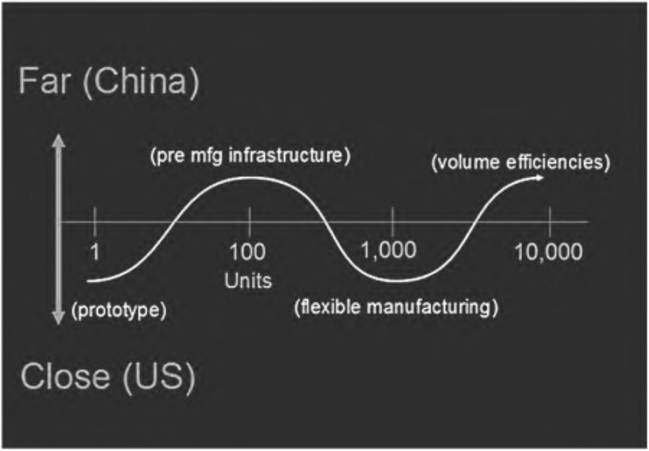
Imagine a new company, WindCo, making its first product, a small backyard wind turbine power generator. They make the first prototype themselves, as well as a handful of others to send to partners. Next, it’s time to go into production. But because they’re small, they don’t have that sort of manufacturing capacity themselves, so they outsource to a Chinese factory do it for them.
That works to get the product into the market. But once sales take off into the hundreds, the limits of that model become clear. First, it’s inflexible: when the product sells out, it takes months for a new supply to arrive, and also the Chinese factory prefers to work in large batches, so WindCo has to take delivery of huge shipments that it can only sell gradually, over time, leaving much of its cash locked up in inventory waiting to be sold.
Simple economics start to argue for local manufacturing. So WindCo sets up its own local factory, where it can make the turbines on demand. It is now much easier to manage the company’s inventory and to make improvements in the product based on customer feedback and demand.
But let’s say sales continue to rise into the tens of thousands. At that point China starts to look more attractive again as a manufacturer. The 30-percent price difference between making it locally and making it in Guangdong,—which was not as critical as time and flexibility at smaller scale—now is impossible to resist. This is even more true if a competitor enters the market at a lower price, and you have to compete on cost. Back production goes to China.
And so it goes. Companies can increasingly move manufacturing to wherever it makes most sense. Because They can do so because the design files are digital, the tooling costs of setting up a new manufacturing operation are minimal, and they all use the same robotic machinery that can be bought anywhere.
This is a world where America can compete. And so can China. And Germany and Mexico and Poland. Digital manufacturing levels the global playing field. Any country can make things. The question is onlywhat can they make better than anyone else.
A very modern factory
Lookhard enough and you’ll see examples of this everywhere. In Silicon Valley, of course, but also in places where you might not expect advanced manufacturing: converted car-repair shops in Brooklyn, industrial parks in suburbs of Las Vegas, farm towns in the middle of Wisconsin. What they all have in common is that they’re located where the entrepreneurs who started these companies wanted to live. They didn’t need to locate near railway tracks or highways, the way factories once did, nor did they need lots of land and cheap labor. Manufacturing can increasingly be done anywhere FedEx and UPS will pick up from.
Take Sparkfun. In 2003, Nathan Siedle was an undergraduate engineering student at the University of Colorado, in Boulder, an upscale college town an hour from Denver. He was finding it difficult to locate electronic components that he needed for his projects, but eventually tracked down some suppliers online. At that point he might have declared victory and simply finished his studies. But like many of the Makers in this book, he decided to share his discoveries instead. He set up a small Web storefront to sell the hard-to-find parts, maxing out his credit cards on inventory in the process. He called it Sparkfun, a winking reference to the frequent experience of touching the wrong parts together and watching them fry in a shower of sparks. On the day he got his official state sales-tax exemption, making him a “real company,” he was so excited he sped home on his motorcycle and got a speeding ticket serious enough that it required a court visit.
By the time Siedle graduated, Sparkfun had grown into a real company. Rather than getting a job elsewhere, Siedle decided to make a go of it. And since he liked Boulder, he just rented some space on the ground floor of a building in a local office park and set up shop.
Today, Sparkfun has more than 120 employees and annual revenues of around $30 million, and is growing by 50 percent a year. A basketball-court-sized ground floor is dominated by robotic electronic production lines, running day and night.Daily blog posts and tutorials have turned its retail website into a high-traffic community, with more than fifty thousand visitors a day.
Remember, this is in high-cost Boulder, Colorado, one of the most expensive real-estate markets in America. And the sector is electronics, a market that many had thought was lost for good to China. How does Sparkfun compete with such low-cost production? With automation (the pick-and-place machines do much of the work, so its prices stay low), close ties to their customers and their needs (its hobbyist roots give it great geek cred), and a community built around its website’s daily tutorials, posts by its employees (now mini-celebrities in the Maker world). Sparkfun is proof that manufacturing success is not just about finding the cheapest labor.
When you ask people about the state of American manufacturing, they often quote the same depressing statistic: despite the U.S. clout in mobile phones, including Apple’s iPhone, Google’s Android phones, Motorola, and others, none of those phones are made in America. We may be technology leaders, but we can only make the bits (the product concept and software), not the atoms (the physical phones themselves). “Designed in California. Made in China” indeed.
But visit the Sparkfun factory and you’ll get a different view. Unlike most of its bigger electronics part supplier competitors, Sparkfun makes most of what it sells—right in Boulder. It has several large pick-and-place robot machines that place chips and other components in precise position on printed circuit boards faster than the eye can see. A conveyor belt takes the “populated” boards into an automatically controlled oven to melt solder paste under the chips, cementing them to the boards. Other computer-controlled machines load components and prepare boards. Three workers watch over the operation, which runs day and night.
In short, electronics can be made in America, as long as they’re specialty electronics, selling in the thousands, not millions.
The Kindle 2 and iPhone need the latest screens and fastest memory chips, which are only made in volume by a few manufacturers in Asia. But most other electronic devices don’t need the very latest, smallest, lightest, and fastest parts. Instead, they get their value from the way they’re put together and the software that runs on them. Think of electronics more like a smart thermostat in your house or the dashboard of your car. They don’t need Apple-Iike
performance. Instead, they get their value from the software that runs on their commodity parts. That’s the sort of thing you can do anywhere.
Such specialty goods usually command higher margins and are less likely to face competition from other commodity suppliers. It’s a classic market niche for a midsized manufacturing business. Big enough to sell globally and have an established brand, but not so big that it falls into the commodity deathtrap of razor-thin margins and scary overexposure to economic swings and the changing taste of fickle consumers.
By contrast, China’s Foxconn, which makes Apple’s iPhone and many of the other mass-market electronics you buy today, has about a million workers, which makes it the second largest non-state company in the world (after Wal-Mart) by employee count.39 It runs entire company towns, and its workplace conditions (including suicides) make headline news. Foxconn doesn’t develop its own product; it does outsourced manufacturing for others. But that means tiny margins. Economists estimate that it gets only $6.50 for the work of assembling a phone that sells for $300.40 Likewise for most of the Asian suppliers that make the components that go into an iPhone. The lion’s share of the profit goes to Apple, the designer. Which business would you rather be in?
Sparkfun, on the other hand, both designs and makes most of its products. And it does so in exactly the model I’ve described above: an open-innovation process built around a community of its customers. Most of Sparkfun’s products are “open-source hardware,” which is to say that their design files are openly shared and can be modified. Many of them were actually designed by customers, and simply reviewed and improved by Sparkfun engineers to make them easier to manufacture.
It’s a classic community-centric company. The front of its website features not products, but its blog, with chatty tutorials and videos from its employees. Its forums are full of customers helping each other. Every year it throws an autonomous vehicle competition, featuring a live band playing robot-themed songs of their own composition, and lots of kids chasing self-driving cars (I’ve been competing in the aerial category every year since it started—no wins yet). At Maker festivals around the country, Sparkfun engineers teach people how to solder, which is actually a lot more fun than it may sound.
Sparkfun’s employees are young, passionate, and appear to totally love their jobs. Dogs and hobbies are indulged at work (although not on the production floor); tattoos and indie punk rock reflect its culture. It’s about as far from the “dark satanic mill” vision of manufacturing as you can image.
This is a twenty-first-century American Maker manufacturing success story. It thrives in the face of Asian competition. It’s growing fast and Creatingjobs. It is very profitable. Equally important, it’s got a great “multiplier effect.” Each conventional manufacturing job is typically credited with creating four other jobs in the community. But Sparkfun, because it sells technology that helps others build their own companies, no doubt has a far higher multiplier.
How high? It’s hard to say, but here is one example: Facebook has about 2,500 employees as of this writing. But its chief operating officer, Sheryl Sandberg, estimates that more than thirty thousand people make their primary living as part of the “Facebook ecosystem,” all the companies and services built on Facebook, from Zynga games like Farmville to all the “social meda experts” hired to help companies navigate Facebook. That’s at least a IOx multiplier.
Pisano and Shih, in their Harvard Business Review article on American Competitiveness, called for a rebuilding of an “industrial commons”—the collective R&D, engineering, and manufacturing ability that can sustain innovation. Notjust the ability to make stuff, but also the ability to invent it, the ability to make the parts that go into it, and the ability to train the generation who will do all that.
Successful technological companies can do this. Their trickle-down effects are not measured in dry cleaners and local pizza franchises serving their workers’ families, but rather in the tools they sell that make other companies around them more powerful. In other words, they are not just creating new jobs, but creating new companies that create more jobs. Sparkfun, a very modern factory, is the hub on one such new industrial commons.The question is only how far this Maker movement commons can spread. But the potential is limitless.