6.1 LIANG AND JHERING
6.1.1 An Appeal to “History”?
Rudolf von Jhering (1818-92) wrote Der Kampf ums Recht (The Struggle for Law) in 1872. He was already regarded as one of Germany’s most important legal philosophers, and Der Kampf helped to ensure a worldwide reputation.
It was translated into Chinese between 1900 and 1901 [Jhering 1900-1]. Jhering’s doctrines stimulated Liang Qichao to publish Lun Quanli Sixiang (On Rights Consciousness) in 1902 as part of his manifesto On the New People. Liang tells us that the “essential points” of his essay, which is among the earliest and most sustained treatments of a concept of rights to appear in Chinese, are mostly taken from Der Kampf [Liang 1989d, p. 32].We will see that there are indeed certain similarities that make Liang’s “quanli” resonate with Jhering’s notion of “Recht,” and these similarities - chief among which is a kind of individual assertiveness - help to explain Liang’s interest in Jhering. My discussion of the two thinkers, in fact, will offer at least the beginnings of an explanation of why German conceptions of law and rights were so attractive to Chinese intellectuals. [148]As is often the case with cross-cultural comparisons, though, we will also see that these similarities mask some less obvious but very important differences. For Jhering, the relation between following the procedures of the law and exercising one’s Recht is crucial; for Liang, in contrast, quanli are deeply related to ethical concerns. This difference, in turn, colors their respective notions of assertiveness, which thus turn out not to resemble one another as closely as first appeared. When we see Recht and quanli as separate concepts emerging from separate discourse contexts, these differences will make sense.
My goal here goes beyond simply interpreting Liang and Jhering: I demonstrate that significant and important conceptual differences can exist even when one person takes himself or herself to be explicating and in fact translating the ideas of another.
To make clear what is at stake, consider the following passage:In ancient times, Lin Xiangru scolded the King of Qin saying: “Smash both my head and the jade disk!”[149] Now given the size of the state of Zhao, how could such love be expressed for a tiny thing like a jade disk? He was saying that Qin could smash the disk, kill him, invade his territory, endanger his state, and still he would not surrender. Ah! This was nothing other than “quanli”! [Liang 1989d, p. 33]
In a later passage, Liang amplifies the idea that ancient China can teach us about quanli. He is impressed by the classical Daoist Yang Zhu’s teaching that “no one [should] give up a hair” on his head, which strikes him as exemplifying the idea that we should not allow even minor invasions of our legitimate benefits. While Liang adds that Yang’s other famous doctrine of “no one benefiting the world” (on which see later) was mistaken, Liang concludes that “Yang Zhu was in fact a philosopher who advocated quanli, and provides a good method with which to save China in its hour of need” [ibid.].
Taken together, the claims we’ve just examined lead to a puzzle. On one hand, Liang clearly identifies his talk of quanli with Jhering’s talk of Recht. On the other hand, Liang asserts that ancient Chinese both theorized about and acted on this same idea of quanli. This leaves us with
at least three possibilities: (1) Liang is right on both counts. Jhering and Yang Zhu were discussing the same concept. (2) Liang is right to see a connection between himself and Jhering, but anachronistically reads quanli into the ancient Chinese figures’ concerns. (3) Liang is right that his concerns are similar to those discussed by Yang and exemplified by Lin, but wrong to think that there is more than a superficial resemblance with Jhering’s ideas.
Joseph Levenson has famously argued that choice (2) is one of the keys to understanding not only Liang, but also “the mind of modern China.” Levenson wrote that “Every man has an emotional commitment to history and an intellectual commitment to value, and he tries to make these two commitments coincide....
[As Liang began his career, he was] straining against his tradition intellectually, seeing value elsewhere, but still emotionally tied to it, held by his history” [Levenson 1967, p. 1]. The attempt to live up to both commitments led him to try to “smuggle Western values into Chinese history” [ibid., p. 4].My focus here is not on Levenson’s argument, which has been amply discussed elsewhere.[150] Levenson does clearly articulate one position against which I will be arguing, though, because I believe that when we take seriously all that Liang says about quanli, we do not find a tension between “value” (that is, Jhering’s ideas) and “history” (face-saving references to the Chinese tradition). Instead, we will uncover a largely consistent and coherent doctrine which builds on orientations found in the Confucian tradition. Liang’s understanding of the abilities and interests that one should legitimately be able to enjoy, which is how I will suggest we gloss his “quanli” has a deep basis in the Confucian idea of an ethical, and not merely legal, ordering of the world. To see this contrast between Jhering and Liang, we will have to look at both Jhering and Liang in their respective contexts, and it is to the first of these tasks that I now turn.
6.1.2 Jhering’s Struggle for Rights and Law
“The life of the law,” writes Jhering, “is a struggle - a struggle of nations, of the state power, of classes, of individuals” [Jhering 1915, p. 1]. Here we find the two terms that are highlighted in the title of Jhering’s Der Kampf umsRecht:“ Kampf ” is “struggle” and “Recht” can be either “law” or “right.” As we will see, it is through struggle for individual rights that Jhering believes we struggle for law. This tight relationship has deep roots in Jhering’s understanding of what Recht is. He says that
The term Recht is, it is well known, used in our language in a twofold sense - in an objective sense and in a subjective sense. This Recht, in the objective sense of the word, embraces all the principles of law enforced by the state; it is the legal ordering of life.
But Recht, in the subjective sense of the word is, so to speak, the precipitate of the abstract rule into the concrete legal right[151] of the person. [1915, p. 6]In his 1877 philosophical treatise Purpose in Law,[152] Jhering explains the relationship between the two senses of “Recht” in a similar fashion.[153] He writes that “without law there is no securing life and property,” and
The form by which law, or right regarded objectively, affords its protection to both interests is, as is well known, by right in the subjective sense. To have a right means there is something for us, and the power of the State recognizes this and protects us. [Jhering 1913, pp. 49-50]
He puts this last thought in even more pithy form when he defines a subjective right as “an interest protected by law (Rechtlich geschutztes Interesse)' [Jhering 1915, p. 58; Jhering 1872, p. 44].
To have a right one must meet two criteria. First, one must have some kind of interest: there must be something for one, something that matters to one. Second, this interest must be recognized and protected by the state. Law, or Recht in the objective sense, is the systematic institutionalization of these protections: the “legal ordering of life.” This latter doctrine has come to be known as “legal positivism”: the insistence that there are neither natural laws nor natural rights, but only those laws that are enforced by some authority.[154]
A crucial move in Jhering’s argument comes when he explains how it is that those of us who are conscious of our rights think about our “interests.” The following passage - which Liang, as we will see, paraphrases in his essay - is revealing:
In those suits at law in which [there is a] disproportion... between the value of the object in controversy and the prospective cost [to the litigant]..., the question is not of the insignificant object in controversy, but of an ideal end: the person’s assertion of himself and of his feeling of right....
It is not a mere money-interest which urges the person whose rights have been infringed to institute legal proceedings, but moral pain at the wrong which has been endured. He is not concerned simply with recovering the object... but with forcing a recognition of his rights. An inner voice tells him he should not retreat, that it is not the worthless object that is at stake but his own personality, his feeling of legal right, his self-respect - in short, the suit at law ceases to appear to him in the guise of a mere question of interest and becomes a question of character. [Jhering 1915, pp. 28-9]In this passage Jhering tells us that disputes over rights can cease to appear “in the guise of a mere question of interest.” This might sound surprising, given that we have just seen that he defines rights as interests protected by law. The problem is that Jhering uses “interests” in two senses. The “interests” mentioned in the passage now under consideration are of a limited type, with “money-interest” as their paradigm. Both in Der Kampf and in Purpose in Law, Jhering also develops a second, broader notion of what it is for something to be in our interest. This does include concrete things, like the “object in controversy” from the foregoing passage, but also encompasses the ways in which other people can be “for us” - as for instance in the reciprocal relationships of the family - and most importantly the ways in which we can be for ourselves
developed by Puchta, Jhering (in his early days), and Laband, among others.Their central premise was that law as a “positive science in which the rules of law and how to apply them were drawn exclusively from the system, concepts, and doctrinal principles: extralegal values or aims, whether religious, social, or scientific, were denied any title to create or alter the law” [Wieacker 1995, p. 341]. As such, pandectism is clearly a species of the broader notion of positivism mentioned in my main text, but one can reject natural law without being a pandectist.
This was Jhering in the latter part of his career (with whom we are now concerned), after he renounced the conceptual method of pandectism: He came to believe that all manner of human purposes were relevant to understanding what laws there were.[Jhering 1913, p. 50]. He says that “the legal expression for [this last kind of interest] is the right of personality” [ibid.]. Note that when he described what was really at stake in the lawsuit, Jhering put it first of all in terms of one’s “personality.” There is a sense, in short, in which the maintenance and development of one’s personality or character is an important interest we each have, and one of the most fundamental roles that rights play is to provide protection for this type of interest. As Jhering puts it, “Man is not concerned only with his physical life but [also] with his moral existence. The condition of this moral existence is right, in the law” [Jhering 1915, p. 31].[155]
The scope of this “moral existence,” extends beyond one’s immediate “personality,” since one’s will and one’s labor can establish a bond between oneself and anything at all. Any object can become
part of my own strength and my own past, or the strength and past of another, which I possess and assert in it. In making it my own, I stamped it with the mark of my own person; whoever attacks it, attacks me; the blow dealt it strikes me, for I am present in it. Property is but the periphery of my person extended to things. This connection of the law with the person invests all rights, no matter what their nature, with that incommensurable value which, in opposition to their purely material value, I call ideal value. [Jhering 1915, p. 59]
Jhering takes the imagery of this passage very seriously. We feel - or at any rate, should feel - pain when our rights are violated. We do so because of our “feeling of right [Rechtsgefuhl].” Jhering says that the “feeling of right” is the key to
the whole secret of the law. The pain which a person experiences when his legal rights are violated is the spontaneous, instinctive admission, wrung from him by force, of what the law is to him as an individual, and then of what it is to human society.... Not the intellect, but the feeling, is able to [say what law is]; and hence language has rightly designated the psychological source of all law as the feeling of right. The consciousness of right (Rechtsbewusstsein), legal conviction, are scientific abstractions with which the people
are not acquainted. The power of the law lies in feeling.... [1915,
p. 61]
Anyone who has not experienced or at least observed the pain that should come when one’s rights are violated has no real knowledge of the law.
I will deal with the connection Jhering mentions between the individual and “human society” in a few moments. First let me take stock. Jhering is concerned to show why rights and law are things for which we should struggle rather than take for granted. The last two paragraphs have articulated a pair of ideas which suggest that we ought to look to Darwin and to Hegel in order to understand Jhering’s ultimate commitment to the struggle for law. One of Jhering’s greatest contributions to German jurisprudence was his insistence that conceptual analysis alone was insufficient: He argued that we also need to pay attention to actual human drives and purposes.[156] The idea that the “psychological source of all law is the feeling of right” aims to give jurisprudence a naturalistic footing: Individuals or groups struggling for legal recognition and protection are analogous to individuals and groups competing in a Darwinian competition for survival. Indeed, the title of Der Kampf was modeled on Haeckel’s Darwinian “Kampf ums Dasein (the struggle for existence).”[157] Struggle directed by the feeling of right, Jhering came to believe, could explain the genealogy of law far better than abstract conceptual analysis.
Whatever we today make of the implication that the “feeling of right” is tantamount to a biological faculty, Jhering’s account of the development of law as a struggle of interests certainly has some pull on us. Be this as it may, however, we will likely see little in the Darwinian side of Jhering’s account to explain the normative aspect of law: In what direction ought law to develop? It is here that Jhering draws on Hegel, when he asserts that a crucial function of rights and law is to protect our developing personalities. In particular, Jhering’s claim that “property is but the periphery of my person extended to things” recalls Hegel’s even stronger claim that property is the concrete “existence of personality” itself [Hegel 1991, p. 81]. Jhering comes close to this idea when he writes that, for an individual in a lawsuit, “it is not the worthless object that is at stake but his own personality.” Taken together, these ideas lay at least the foundation for a less genealogical and more prescriptive account of Recht, according to which we ought to develop laws and rights that protect people’s personalities.11 As we will see later, this stress on the normative import of personality is one of the many features of Jhering’s view that Liang finds attractive.
To sum up, the positivist insight - that there are no laws or rights other than those enforced by some authority - should not lead to passivity, for two reasons. First, as we will see in more detail later, if rights recognized by the state are not actively claimed, the laws on which they are based will lose their concrete reality. The “legal ordering of life” itself, that is, depends on people’s active assertion of their rights. Second, since laws by their very nature defend only those interests already recognized by the state, the only way that new rights can come to be realized is through struggling against the status quo. Jhering’s contention is that the psychological mechanism that stands behind both motives to struggle is the feeling of right, and it is this idea that Liang will discuss in terms of “quanli consciousness.”
We have already seen that Jhering believes our rights, which is to say our subjective Recht, to be dependent on the law, or Recht considered objectively. Only those interests publicly recognized as Recht count as individual, subjective Recht. One of Jhering’s most striking doctrines is his claim that there is also a dependence in the other direction. He writes:
Concrete law not only receives life and strength from abstract law, but gives it back, in turn, the life it has received. It is the nature of the law to be realized in practice. A principle of law never applied in practice, or which has lost its force, no longer deserves the name; it is a worn-out spring in the machinery of the law, which performs no service and which may be removed without changing its action in the least. [Jhering 1915, p. 70]
Although this principle applies to all parts of the law equally, the realization in practice of public and criminal laws is virtually guaranteed, since these are explicit duties imposed on public officials. The realization in practice of private law, in contrast, depends on individuals’ taking action. Jhering is not saying that criminal law is always perfectly carried out, but he does believe that those who violate the criminal laws tend to be prosecuted, since there are officials whose job this is. There is no explicit requirement, though, that individuals claim what is their due. [158] One might have some interest that is protected by law - that is, have a right - and yet not insist on redress when that right is violated. If individuals, therefore, “for any reason neglect to assert their rights, permanently and generally, be it from ignorance, love of ease, or fear, the consequence is that the principles of right lose their vigor” [ibid., p. 71]. It then follows, given the essential role noted in the previous passage that is played by the “force” of Recht, that such neglected rights “no longer deserve the name” of rights. Jhering concludes that the very existence of “the principles of private law” depends on “the power of the motives which induce the person whose rights have been violated to defend them: his interest and his sentiment of legal right” [ibid., p. 72].
Again: According to Jhering, if we fail to exercise our subjective Recht, then the objective Recht on which the former depends will be vitiated to the point of non-existence. This argument depends on a concrete understanding of law (that is, objective Recht) that was quite distinctive of Jhering. Not only are laws not, in Jhering’s eyes, “natural laws” identifiable through reason; neither are they mere abstractions of any kind. Laws are those things that in practice protect people’s interests, and anything that fails to serve this function - even if it is because the people fail to ask for protection - is not a law.
The final move in the argument of Der Kampf follows immediately from this intimate interrelationship between subjective, individual right and objective, inter-personal law. Jhering tells us that
in defending his legal rights [an individual] asserts and defends the whole body of law, within the narrow space which his own legal rights occupy. Hence his interest, and this, his mode of action, extend far beyond his own person. The general good which results therefrom is not only the ideal interest, that the authority and majesty of the law are protected, but this other very real and eminently practical good which every one feels and understands...: that the established order of social relations is defended and assured. [1915, p.74]
Both an individual’s and his group’s interests suffer, that is, when he fails to assert his rights. This imposes on us, says Jhering, duties both to ourselves and to society to defend our rights.[159] In the same way that it is a citizen’s duty to defend his state by opposing a foreign invader, so it is his duty to defend internal threats to the public order by claiming his rights. The struggle for our rights just is the struggle for law: thus the purposeful ambiguity in the book’s title, The Struggle for Recht.
These doctrines found audiences around the world. By 1915 Der Kampf had been translated into nearly thirty languages [Jhering 1915, p. xii]. Jhering’s ideas, especially as interpreted and popularized by Liang’s “On Quanli Consciousness,” exerted a significant influence in China: Numerous essays insisted on the need to resist attempts to deprive one of quanli lest one be guilty of having thrown quanli away, as well as on others of Jhering’s doctrines. Rather than focus on these downstream effects of Jhering in China, though, I will now turn to his immediate interpreter, Liang Qichao, and assess the relation between Liang’s ideas and Jhering’s.
6.1.3 Liang and Quanli
Liang was a central participant in some of the rights-related trends of the 1890s discussed in the previous chapter. In 1896 he briefly discussed the “power (or right) of self-mastery (zizhu zhi quan),” which I treated earlier in the context of Liang’s teacher, Kang Youwei. Liang defined zizhu zhi quan as “each person doing all he ought to do, and receiving all the benefits he ought to receive” [Liang 1989a, p. 99]. We will see similar ideas expressed when he begins to explicate quanli. In 1898, Liang actively promoted “people’s authority (minquan),” expressing views similar to those of the reformers I discussed earlier [Yoon 2000]. 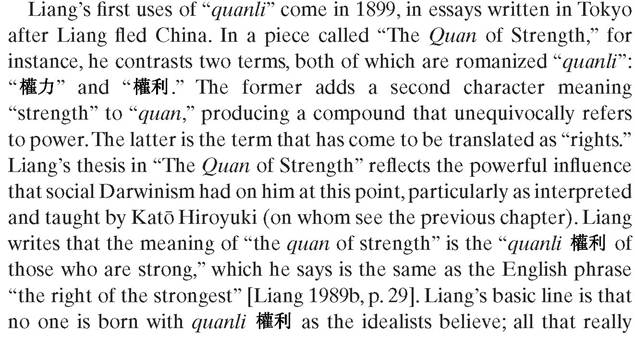
matters is who is stronger. We should focus, therefore, on the quanli ⅛J⅛ that simply and Uncontroversially means “power.”
In addition to finding Kato’s Darwinist ideas attractive, Liang was also influenced while in Japan by Tokutomi Sohb (1863-1957). Among other things, Liang was very taken with Tokutomi’s defense of “human desire as a natural thing and a positive driving force behind one’s success” [Tam 1991, p. 18].As we saw earlier, a revaluation of the importance and validity of desire, growing out of both Confucian and Western sources, played a significant role in nineteenth-century Japanese rights discourse. Some of Liang’s writings make clear that he knew and approved of the related views of Chinese Confucians discussed earlier in Chapter 3 [Liang 1959 (1905)], and we just saw that in 1896 Liang connected zizhu zhi quan with “receiving benefits.” Tokutomi’s views provided Liang with a more immediate stimulus to think in this same direction. Let us now look at how these different ideas came together in Liang’s most sustained treatment of the subject, “On Quanli Consciousness” of 1902.
In an early passage of “On Quanli Consciousness,” Liang sounds very like his social Darwinist “The Quan of Strength” of a few years earlier. He writes that quanli
is born from strength. Lions and tigers always have first-class, absolute q uanli with respect to the myriad animals, as do chieftains and kings with respect to the common people, aristocrats with respect to commoners, men with respect to women, large groups with respect to small, and aggressive states with respect to weak ones. This is not due to the violent evil of the lions, tigers, chieftains, and so on! It is natural that all people desire to extend their own quanli and never are satisfied with what they have attained. Thus it is the nature of quanli that A must first lose it before B can invade and gain it. [Liang 1989d, pp. 31-2]
If we were to go only on the basis of this passage, the obvious conclusion would be that Liang means by “quanli” exactly what Xunzi meant two millennia earlier: power and profit. The idea that it is natural for people to seek to increase their share of power and profit calls to mind Xunzi’s statement, at the beginning of his “Essay on Rites,” that “men are born with desires” [Knoblock 1994, p. 55]. It is true that Liang immediately turns to invoking Jhering, but the passage he alludes to does little to lessen the impression that “quanli” is simply power and profit. Liang tells us that “Jhering writes that the goal of quanli is peace, but the means to this end is none other than war and struggle. When there are mutual invasions, there is mutual resistance, and so long as the invasions do not cease, the resistance will also not end. The essence is simply that quanli is born from competition” [Liang 1989d, p. 32].
As soon as we look further into Liang’s essay, however, we learn that “quanli” cannot simply mean power and profit. For one thing, Liang tells us that “the strength of quanli consciousness truly depends on a person’s character” [ibid.]. Character (pin’ge) is something that “noble warriors” and “pure businessmen” have, and that “slaves” and “thieves” lack. Liang adds that “others have misunderstood the true characteristics of quanli, believing that it involved nothing more than continuous calculation of physical, material benefit. Ah! Is that not despicable?” [ibid., p. 33]. He gives an example, drawn from Jhering’s text [Jhering 1915, pp. 28-9], of a lawsuit:
Suppose that I have an item that I took from another by force. The one whose item was taken will angrily resist [my appropriation] in court, wherein his goal is not [regaining] the thing itself, but [attaining] sovereignty over the thing. Thus it often happens that before a suit begins, people will announce that in previous suits all the benefit that they attained was subsequently used to perform charitable deeds. If the person had been bent on profit, why was this done? This kind of suit can be called an ethical question, not a mathematical one. [Liang 1989d, p. 33]
Liang concludes that “the natures of quanli and benefit are precisely opposed.”
Liang relies on a distinction between “physical (xing er xia)” and “metaphysical (xing er shang)” in order to develop the idea that quanli is concerned with things like character, nobility, and ethics. He writes:
The reason for which humans are greater than the other myriad things is that they not only have a physical existence, but also a metaphysical existence. There are numerous aspects to metaphysical existence, but the most important of them is quanli. Thus animals have no responsibility toward themselves other than preserving their lives, while in order for those who are called “human” to completely fulfill our self-responsibilities, we must preserve both our lives and our quanli, which mutually rely on one another. If we do not do this, then we will immediately lose our qualifications to be human and stand in the same position as animals. Thus the Roman law’s seeing slaves as equivalent to animals was, logically, truly appropriate. [1989d, p. 31]
This passage is a paraphrase of a similar passage in Der Kampf, wherein Jhering contrasts concern with physical existence with concern for “moral existence (moralische Existenz)” [Jhering 1915, p. 31]. Readers not familiar with Jhering’s work may well have thought of another possible source for Liang’s comparison between humans and animals: Mencius’s statement that a man lacking in moral inclinations “is not far removed from an animal.”[160] While the close similarities between Liang’s and Jhering’s texts make me confident that Liang was paraphrasing Jhering, the connection to Mencius was not lost on him. Later in this essay, Liang says that, “Mencius said that ‘[if the people] are allowed to lead idle lives, without education and discipline, they will degenerate back to the level of animals.’ If we consider the legal principles of the Roman law,... isn’t this close to this idea [of Mencius]?” [Liang 1989d, p. 39][161]
When Liang comes to explaining where quanli consciousness comes from, we find an important further tie to Mencius. Liang writes that
In general, that when people are born they are possessed of quanli consciousness is due to innate good knowing and good ability.[162] And why is it that there are great inequalities - some are strong while others are weak, some lie low while others are destroyed? It always follows the history of a nation and the gradual influence of government [in making the nation inferior]. Mencius said it before I: “It is not that there were never sprouts [on the mountainside], but cattle and sheep continuously graze there, so that it becomes barren.” [Mencius 6A:8] If one observes the histories of nations that have been destroyed - whether East or West, ancient or contemporary - one sees that in the beginning, there have always been a few resisting tyrannical rule and seeking quanli. Again and again the government seeks to weed out [those resisting its tyrannical rule], and gradually those resisting get weaker, more despondent, have [their resolve] melt away, until eventually that violent, intoxicating quanli consciousness comes increasingly under control, is ever more diluted and thin, to the point that any possibility of a return to its former strength is forgotten and it is permanently under control. A few decades or centuries of this situation continuing, and quanli consciousness will have completely disappeared. [1989d, p. 38]
The connection Liang draws between quanli and “innate good knowing (liangzhi)” is striking. Unlike many in Liang’s essay, this passage has no correlate in Der Kampf. Liang is telling us that quanli consciousness is an innate characteristic of humans, albeit one that can be gradually diluted and even destroyed by a tyrannical government. Both in this passage and in the previously cited one we have seen that quanli consciousness is connected with our ethical sensibilities far more than with any concern for law. We thus begin to see that “quanli” may have less to do with Jhering’s “Recht” than had originally appeared.
But I am getting ahead of myself. So far we have seen that despite an initial suggestion that the struggle for quanli is tied to unending desires for material improvement, Liang’s view of our motivation and justification for demanding quanli is considerably more complex. Echoing to one degree or another both Jhering and Mencius, Liang explains that human existence has a “metaphysical,” ethical dimension that distinguishes us from animals. Based on what we have seen thus far, let me hypothesize that having quanli represents being able to exercise abilities and enjoy interests crucial to being a whole person, where the understanding of what is necessary for a person to be “whole” rests ultimately on ethical norms. Quanli consciousness is our awareness or feeling of the importance of these abilities and interests; it is this consciousness that should, if appropriately developed, make us feel pain when the abilities and interests are curtailed.
This talk of “whole” persons calls to mind Jhering’s emphasis, echoing Hegel, on the “personality.” In On the New People Liang also puts stress on personality (renge), though the term is mentioned only twice in “On Quanli Consciousness” itself. He argues in “On Civic Virtue,” for instance, that one’s personal virtue can be irreproachable and yet, if one is without civic virtue (i.e., if one does not feel the pull of responsibilities to one’s group), one can fail to have full-fledged renge. For Liang, in other words, “personality” is linked to identification with a group. Like many thinkers who will follow him, Liang views personality as depending both on individual well-being and moral development and on an individual’s constructive contributions to the various groups with which he or she identifies.
Thus far I have concentrated on sections of “On Quanli Consciousness” in which Liang cites, paraphrases, or even quotes Jhering. There are several other important sections in which Liang sets Jhering’s text aside and discusses quanli in contexts that will be more familiar to his readers. One theme that comes out in these sections is the importance of actively struggling for one’s own, ethically legitimate, interests - of looking forward, to the future and to the betterment of one’s lot - rather than relying on others to provide them. Consider, for instance, Liang’s rejection of the central Confucian value of humaneness (ren). He writes that
In general, Chinese excel at talk of humaneness, while the Westerners excel at talk of righteousness (yi). Humaneness is concerned with others. If I benefit others, they will benefit me: the emphasis is always on the other. Righteousness, on the other hand, is concerned with oneself. I don’t harm others, and they are not allowed to harm me: the emphasis is always on me. Of these two ethics, which is, in the end, correct? As for what’s correct in the great utopian world of one or ten thousand years hence, I don’t dare say. As for today’s world, though, I want to say that the world-saving great ethic is truly that of righteousness. [1989d, p. 35]
He goes on to apply this idea as follows:
If we apply this to humane government,[163] we can see that it is not the best form of government. Chinese people simply hope for humane government from their lord. Thus when they run into humaneness, they are treated as infants; when they meet inhumanity, they are treated as meat on a chopping block. In all times humane rulers are few and cruel ones common, and so our people, from the time thousands of years ago when our ancestors taught this doctrine down to the present, have taken being cruelly treated like meat as heavenly scripture and earthly precept. It has been long since the consciousness (shixiang) expressed by the two characters “quanli” was cut off from our brains. [1989d, pp. 35-6]
The upshot seems to be that he connects humaneness with the passive expectation that others will provide for one, while in fact the “best policy is to make people each able to stand on his or her own, not having to rely on others” [ibid.]. One’s sense of righteousness, which he implies comes close to consciousness of quanli, is what informs one’s judgments of what we should stand up for - or in Jhering’s terms, that for which we should struggle.
We have to do more than just defend our own interests, however. I have already mentioned Liang’s endorsement of the ancient philosopher Yang Zhu’s teaching that we should “not give up a hair on our head.” Liang is less enthusiastic about another of Yang’s slogans, though; to Yang’s claim that the world will be well-ordered only if “no one [tries] to benefit the world,” Liang responds:
Yang Zhu did not fully understand the true character of quanli. He knew that quanli should be preserved and never forfeited, but he didn’t know that it is only through aggressiveness that quanli is born. Idleness, play, leaving things to fate, hating worldly affairs - these are all executioners that kill quanli, and yet Yang Zhu promoted them every day. To use such a method to seek quanli - isn’t this like drinking poisoned wine in a search for longevity? [1989d, p. 36]
“Aggressiveness (Jinqu)” is a major topic in On the New People, meriting a chapter all its own, entitled “On the Aggressive and Adventurous Spirit (Lun Jinqu Maoxian).” Now “aggressiveness” might well be thought not to have any close relation to the “ethical legitimacy” of the interests for which we struggle. Close reading of this chapter of On the New People, however, shows this thought to be mistaken.[164] [165] Early in the chapter Liang identifies the “aggressive and adventurous spirit” with Mencius’s “flood-like energy (haoran zhi qi).,,w In the original passage, Mencius begins by discussing two famous exemplars of courage approvingly. Mencius goes on, though, to stress the connection between righteousness and the best sort of courage (namely that exhibited by someone with flood-like energy). Indirectly quoting Confucius, Mencius writes that “If, on looking within, one finds oneself to be in the wrong, then even though one’s adversary be only a common fellow coarsely clad, one is bound to tremble in fear” [Lau 1970, p. 77]. The point of the original passage, in short, is that while raw courage is admirable, it is best if it is combined with ethical purpose. Liang’s analysis in the balance of the chapter suggests that he drew the connection to Mencius in full knowledge of this ethical side to flood-like energy. In his discussion of hope, which Liang identifies as one of the chief features of an aggressive and adventurous spirit, Liang quotes a poem by the famous Ming-dynasty Confucian Wang Yangming (1472-1529) which says in essence that anyone can achieve his ideals if only he keeps looking forward. Liang admires Wang’s poem because of its talk of striving to realize ideals. Most of Liang’s praise in this section, in fact, is aimed at those who are not simply concerned with fulfilling today’s desires, but sacrifice for “tomorrow” [Liang 1989d,p. 24]. It would be twisting the meaning of this passage to suggest that it is ethically neutral. If Liang had wanted to praise someone who had achieved extraordinary things by ignoring ethics, the Chinese tradition offers him many choices: Qin Shi Huang, Ming Taizu, and so on. Instead, Liang chose Wang Yangming, well known as a champion of personal discipline and ethics. The section on zeal, another aspect of the “aggressive and adventurous spirit,” provides still clearer evidence of Liang’s continued concern with ethics. He lists various types of people who are motivated by zeal, and includes “hero (yingxiong),” “filial son (xiaozi),” and “loyal minister (zhongchen).” All three, and especially the last two, are paradigmatic ethical categories. Liang gives a variety of specific examples drawn from both China and the West; the Chinese examples he chooses are all famous ethical exemplars. I believe it is crucial to pay particular attention to Liang’s Chinese examples, who are very familiar to him and his audience, and to be cautious about the conclusions we draw from the Western examples Liang cites. For example, Liang quotes Napoleon’s slogan “The word ‘difficult’ is only found in a fool’s dictionary.” It cannot be denied that this sounds like an instance of the sort of courage that Mencius found to be inferior to full-fledged flood-like energy. From the little context Liang gives us, though, it is hard to tell what he really makes of Napoleon. It is different with Chinese examples. Liang goes on to cite the case of Zeng Guofan, a nineteenth-century general, scholar, and reformer known for his stress on personal ethics. Zeng also, according to Liang, believed that with the proper spirit anything could be accomplished, and is grouped together with Napoleon as “heroes of aggressiveness and adventurousness and models for future generations” [Liang 1989d, p. 29]. Liang could have chosen any one of a wide range of Chinese figures whose courage led them to great achievements, including numerous conquerors of questionable ethics like Napoleon. I think his having chosen Zeng speaks volumes. Returning to “On Quanli Consciousness,” we are now in a position to understand the lesson that Liang draws from Yang Zhu. We have to do more than sit back and defend our integrity. Yang Zhu was convinced that such a policy would allow one to live out one’s allotted span free from the dangers that came with political involvement.[166] The underlying problem with such an attitude is that it ignores the degree to which an individual’s flourishing depends on his group’s doing well; and for the group to do well, we have to act on our ethical responsibilities to the group. This is in fact the master concept of the whole On the New People: the importance of one’s relation with and ethical responsibilities to one’s group, which in the modern world is paradigmatically one’s nation. Jhering’s views on this subject are close enough, at least on the surface, to Liang’s for Liang to carry right on from his criticism of Yang Zhu to a paraphrase of a passage from the chapter of Der Kampf entitled “The Assertion of One’s Recht Is a Duty to Society.” Jhering illustrates the relation between individual and society by considering what will happen to an army under attack if individual soldiers flee in order to protect their lives: If only a few flee, then their lives will indeed be preserved, but only because of the efforts of the rest of the army; if, on the other hand, many flee, then the day will be lost to the enemy and all will be slain. “What difference would it make,” Liang comments, “if the fleeing soldiers were to personally stab the resolute ones with their swords?” [Liang 1989d, pp. 36-7]. 6.1.4 Quanli and Law There is little doubt that both Liang and Jhering believe that individuals have responsibilities to their nations. I have suggested several times that the similarities between Liang and Jhering mask an important difference over the sources and justification of quanli and Recht. The best way to bring this out is to ask about the relation of each to law. For Jhering, as we have seen, this is an intimate relationship: The two are as closely related as “subjective Recht” to “objective Recht.” It is part of the very meaning of Recht that rights are tied to law. In my discussion of Liang to this point, in marked contrast, we have heard virtually no mention of law (falu). There is in fact one passage in “On Quanli Consciousness” that deals with law, which we will examine shortly, but I have not distorted Liang’s text.[167] The relationship between quanli and law is simply not a crucial issue as far as he is concerned. The context in which Liang comes to his discussion of quanli is very different from that in which Jhering writes about Recht. Jhering is working within a positivist tradition of jurisprudence, even if he is striving to stretch the boundaries of that tradition by recognizing ways in which motivations from outside law can prompt our concern for objective and subjective Recht. Liang, in contrast, is pushing at the boundaries of a very different tradition, one which sees ethical concerns as central and definitive of our proper concerns. The strongest argument that Liang bases quanli on ethics, rather than law, comes from looking at what he says about law itself. The only passage in Liang’s essay on quanli that significantly concerns law runs as follows: Being untiring in one’s competition for quanli, and quanli’s [eventual] establishment and protection, all rely on the law. Thus those who have quanli consciousness must take struggling for legislative quan as their most important principle. Whenever a group has law, no matter whether they do good or bad, they all follow that which has been determined by he who has legislative quan in order to protect their quanli. The law of citizenries who are strong in quanli consciousness will be ever improving, each day getting closer to perfection.... As quanli consciousness gets increasingly developed, people’s duties become increasingly strong. Strength meets strength, quan is weighed against quan, and thus an equal, excellent new law is created. In the period when both new and old laws are transmitted there is often the most intense and cruel competition. When a new law appears, those who had previously relied on the old law to enjoy special quanli must necessarily be particularly harmed. Thus those who promulgate a new law are as good as issuing a declaration of war against those people who previously had power. Thus out of the wrangling between progressive power and reactionary power, a great struggle arises! [Liang 1989d, p. 37] In the context of Jhering’s claim that rights are legally protected interests, Liang’s statement that the “establishment and protection” of quanli relies on the law deserves careful scrutiny. Also worth our attention is an important tension between distinguishing laws as good or bad, on the one hand, and as old or new, on the other. Are new laws better? Or are they only better for some, worse for others? We have seen that for Jhering, the idea that the protection of rights relies on the law is true by definition: Rights just are those interests protected by law. If we look at the role of law in the whole of On the New People, I believe we come to a different conclusion. While “law (falu)” appears hardly at all in “On Quanli Consciousness,” it occurs fairly often in other sections of On the New People, a total of 63 times in the complete text. Liang regularly emphasizes the connection between law or rule of law and civilization. Rule by law is that which allows people to join together to determine their own futures. Every bit as important as law, in fact, are the institutions on which it rests. In one passage, for instance, Liang argues that in order to develop a nation’s level of commerce, its commercial quanli must be protected. To do this, commercial law must be established. To accomplish this, the powers and responsibilities of judges and courts must be laid down, which in turn requires that a legislature be empowered, which requires a responsible government, and so on [Liang 1989d,p. 64]. Liang certainly believes that new laws and institutions are needed for the protection of quanli in China. As this passage illustrates, though, he does not believe that quanli are defined by such a relation to law. Suppose, then, that there is nothing in “On Quanli Consciousness” nor in the rest of On the New People that suggests a tighter relation between quanli and law than the latter’s tending, in practice, to reinforce or protect the former. What of the tension I noted between good laws and merely new laws? To put this question slightly differently, what is the distinction that he makes between good laws and bad ones? Do good laws just serve the interests of the strongest parties more efficiently, or are they somehow ethically superior? If I can show that the latter is the case, then my argument that ethics rather than law lies at the heart of quanli will be further strengthened, since the law itself will be seen to depend on ethics. Much of the passage cited earlier suggests that so-called good laws are simply those that serve the stronger party, but “and thus an equal, excellent new law is created” seems to cry out for an ethical interpretation. On balance, I believe that the evidence suggests that Liang understood good laws as not just efficacious, but also ethically praiseworthy. In the section of On the New People entitled “On Self-Rule,” Liang invokes the classical Confucian sage Xunzi’s idea that people need artificial restraints if they are to live ordered and harmonious lives, for if left to themselves, people’s desires will overcome them and inevitably lead to strife [Liang 1989d, p. 51]. While Xunzi believed that codes of ritual propriety could serve this restraining role, Liang looks to law. He goes on to emphasize, however, that while laws are instituted by people, they are not “smelted onto us from the outside. It is not the case that one leader invents them in order to restrain the people. Instead, they come from the innate good knowing (Iiangzhi) common to all people’s hearts” [ibid., pp. 51-2]. All laws, that is - or at least all proper, good laws - express and mandate ways of ordering society that are implicit in our innate feelings for one another. These rules need to be made explicit and taught, for the feelings on which they are based, we can assume, are fragile. We need the “artificial” laws, since human nature alone will not do. But there is an implicit ethical ordering to life. Whether new or old, for laws to be good, they must meet this standard. Quite obviously, talk of ethically good and bad law fits uncomfortably alongside the suggestions we saw earlier that laws come into being simply due to the triumph of one group’s strength over another’s. The best explanation for Liang’s talking in both ways is his commitment to the importance and even inevitability of progress. The imposition of strong, despotic laws onto an earlier, less organized society might be thought to be “good” at least from the perspective of its eventually allowing for further stages of (moral) development.[168] Still, I cannot conclude that Liang is completely unambiguous in his linking of law with ethics. If we had strong evidence that he believed quanli to be derived from law, we might be tempted to conclude that Liang looks a lot more like Jhering than I have been insisting. It is clear, though, that Liang has little to say about the relationship between law and quanli. Thus for all the similarities Liang himself obviously saw between his ideas and Jhering’s, I conclude that quanli and Recht are importantly different. What Liang is applauding is ethical aggressiveness: struggling to exercise those abilities and receive those benefits that properly belong to one. As I hope I have shown, the quanli for which we should struggle may turn out to be protected by laws, but they are not defined by laws. They are defined by ethical norms, by our place in the ethical order of the world. The idea of quanli that Liang develops in “On Quanli Consciousness,” like many of the central concepts of On the New People, shows clear connections to enduring Confucian themes. Insisting on understanding Liang’s quanli as rooted in aspects of the Chinese tradition, rather than simply borrowed from abroad, is not to deny that there are deep and important resonances between Liang’s writings and Jhering’s. Many Chinese thinkers who discuss quanli after Liang continue to see a socially located “personality (renge)” as the subject of quanli. The close tie that Jhering asserts between individuals’ assertion of rights and the maintenance of social - and legal - order is similarly echoed by later authors. Before we look at these later developments, it will be well to consider a second instance of rights discourse from Liang’s decade. As compared with Liang, Liu Shipei draws on different foreign sources and is somewhat more explicit about his working from native starting points. That he ends up conceptualizing quanli in much the same way as Liang can teach us a good deal about the dynamics of the Chinese rights tradition during this period.