Justice and Iconography
The systemic lens is one that reflects a more objective sense of justice, one that is embodied symbolically in the image of the statue of justice that dominated the program brochure for the Symposium and was projected on the screen throughout the day’s proceedings.
It is the image of the Roman goddess of justice, Justitia. She holds the scales of justice in her hand, evenly balanced, and in her other she bears a sword — the ultimate image of authority of the State. This particular statue stands in front of the City Hall in Frankfurt, Germany.[9] It forms part of the Gerechtigkeitsbrunnen (Fountain of Justice) and was built in 1543.[10]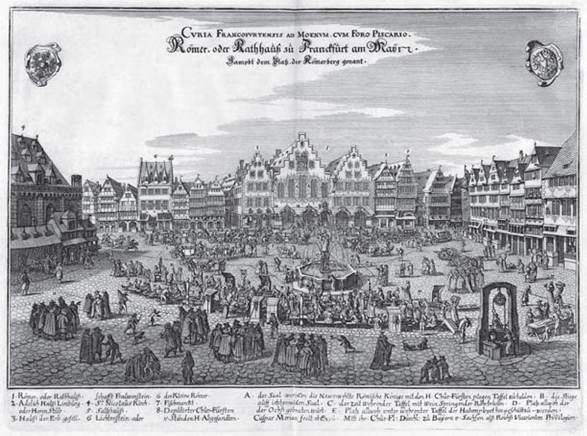
Copper engraving, Caspar Merian (1627-1686) entitled: Curia Francofurtensis ad Moenum. cum Foro Piscario. Romer. or Town Hall of Franckfurt am Mayn. Including the Square. called the Romerberg.[11]
In reflecting upon the idea of justice as fairness as a theme expressed in the three chapters in this section of Justice Connections, and particularly the tensions between the subjective and objective senses of fairness, I found curious resonances in this particular statue and its representation of justice. There are two particular things I found intriguing. First, it is the fact that this statue is not blindfolded, where many images of justice are. The second is the way this particular statue is facing in its physical location.
The blindfolded image of justice is clearly one that signifies objectivity: that justice should be delivered fairly to all, regardless of the standing or wealth of those who come before her. It is the classical embodiment of impartiality. Interestingly, however, Roman depictions of Justitia showed her without a blindfold,[12] and it was only from about the same time as our particular statue of Justitia was born that she appeared with her eyes covered.[13] Many representations of Justitia continue with uncovered eyes: including the statue on top of the Old Bailey courthouse in London and the statute outside the Supreme Court of Queensland, Brisbane, Queensland. While the scales are evenly balanced in all the images — blindfolded or not — I was certainly struck by the particular significance of an open-eyed representation of justice in my musings upon the themes evident in the set of chapters under consideration.
The second intriguing thing about our statue in the context of a discussion of themes is that she faces towards the city hall. And without a blindfold she is staring into the place where justice is meted out — a symbolic expression of the tensions between subjective and objective conceptualisations and practice of fairness. I know it may be seen as drawing a considerably long bow, but as a discussant I am accorded such licence.
More on the topic Justice and Iconography:
- Easteal Patricia (ed.). Justice Connections. Cambridge Scholars Publishing,2014. — 322 p., 2014
- Is There an Iconography of Violence?
- Reflections on Justice as Fairness
- The Baha’i Fait