Kutai Kartanegara in brief
Kutai Kartanegara district was founded in 1999 when Kutai district was broken up into three districts and one municipality. Before, Kutai was an autonomous district (swapraja) together with three other districts and two municipalities (kota praja) through Law 27/1959.
Kutai Kartanegara district is one out of 10 districts in East Kalimantan. The capital city of this district is Tenggarong, which is around 30 km from Samarinda, capital city of East Kalimantan Province. The district comprises of 18 sub-districts and 225 villages. Six sub-districts have a coastline territory, which is located on the coast (Muara Badak, Marangkayu, Anggana, Sanga-Sanga, Samboja, and Muara Jawa). The district is 27,263 km2 in width, of which 4.097 km2 are marine and water areas.1 The district population in 2016 was 717,789. There are 39,986 households that rely for their livelihood on fishery, both cultivated fishing or catch fishing.2
Kutai Kartanegara is known as a rich district. Two years after decentralisation started (2001), the annual budget reached US$150 million and continued to expand to reach its peak with US$610 million in 2015, to subsequently drop to only US$360 million in 2016 and US$300 million in 2017. The huge district budget originates from a significant shared revenue from oil and gas extraction. The importance of the oil and gas sector to the district economy continues up to present.3
The fishery sector's contribution to the District's GDP is less significant. Together with husbandry and forestry, the fishery sector contributes only 10.25%. That also appears from the Kutai's annual revenue (pendapatan asli daerah). In a joint annual report of the Central Bureau of Statistics of Kutai Kartanegara Office and Regional Planning Agency, there is no record of the amount of annual revenue from fishery, but the report says that in the same year (2015) the district fishery yield was 121,932 tons which covers 50.80% of the province's total production.4 That makes the district the largest producer in the province.5
The making of four draft local regulations6
The first fishing regulation in Kutai Kartanegara district dates from 1978 when in an attempt to implement the provincial fishing regulations of 1969 and 1973, the district promulgated District Regulation 18/1978 concerning Fishing within the Administrative Territory of Kutai District.
The main provisions of the provincial regulations stated that the fishing territory would be divided into four fishing zones, and that any activities in this field required a Fishery Business License (FBL), a license for using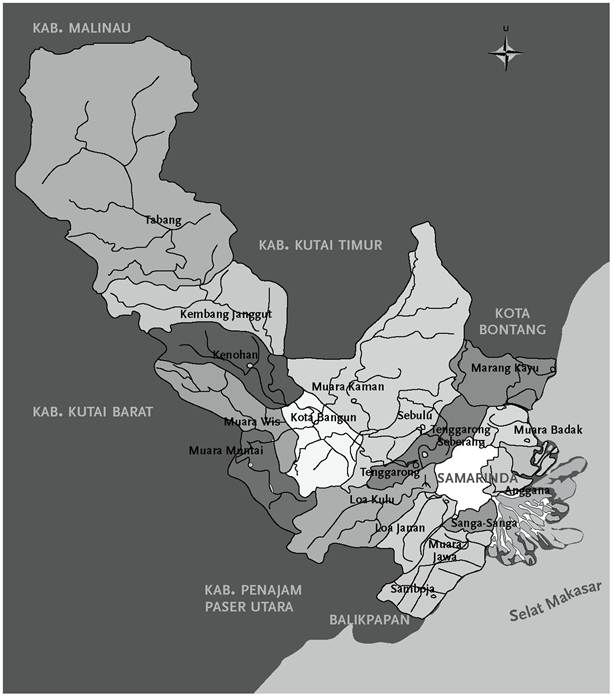
a vessel, and that there was a fishing prohibition in sanctuaries. To follow up on the provision on sanctuaries, the District Head later issued Decree 79/1978, which was later replaced by a Decree of the Head of the Kutai Fisheries Agency (E.1.5234/137A/SP/V/2009 concerning the Sub-District Committee on Fishery Resources Conservation).
As a response to the enactment of a new Fishery Act of 1985, the district government substituted the 1978 regulation with Regulation 3/1999. This Regulation reiterated what had been stated in the Fishery Law of 1985 by prohibiting the use of destructive equipment as well as catching breeding fish and trading fish eggs. Other provisions stipulated that fishing should be in accordance with the rules on a fishing zone division, and any fishery resource use is prohibited in the sanctuaries unless it does not harm or destruct its fishery resources.
The District Regulation of 1999 added another two provisions, which existed neither in the 1978 Regulation nor in the 1985 Fisheries Law. The first provision stipulated that the installation of gear that could possibly endanger a public shipping line (alurpelayaran) would be prohibited. The second stated that any fisherman who wishes to fish outside his village or sub-district should obtain a written letter from the village head and subdistrict head where the fishing grounds are situated. This provision was not only an addition to but was also in contradiction of the 1985 Fisheries Law and its subsequent implementing regulations that did not recognise fishing territory based on administrative boundaries.
After the enactment of Law 22/1999 on Regional Autonomy, the District government promulgated four local regulations in only one year: Regulation 27/2000 on the Authority of Kutai District Government, Regulation 34/2000 concerning Quality Control of Milkfish Fry and Fish Seeds, Regulation 37/2000 on Organoleptic Quality Control, and Regulation 36/2000 on Fishery Business.
Regulation 36/2000 is the most important of the above three regulations. It regulates both capture and aquaculture.Regulation 36/2000 also enacted some new provisions, which the higher national legislation did not stipulate. Firstly, the Kutai Regulation sets almost the same requirements for obtaining a Fishery Business License (FBL) as a Small Scale Fisheries Registration Certificate (Tanda Pencatatan Kegiatan Perikanan or SSFRC).7 Three of the requirements are permit location, business plan, and letter of recommendation from the Kutai Fisheries Agency. Secondly, it restricts the length of validity of an FBL to thirty years with the possibility of another twenty years of extension. Thirdly, it elevated the SSFRC to the same status as an FBL.
The drafting and enactment of Kutai regulations on fishery resource use from 2004 onwards showed a new dynamic and expansion when compared with the previous periods. During 2004-2011, the Kutai District government initiated four Kutai Draft Regulations: the Draft Regulation on Fisheries Levy, the Draft Regulation on Fishing, the Draft Regulation on Fishery Business, and the Draft Regulation of the Kutai District Head on Standardized Ponds.
Agencies involved in the drafting process in this period varied, and so did the subject matters. The Kutai Fisheries Agency is not the only agency that initiated draft regulations on fishery because other agencies took initiatives as well. The reasons for drafting and enacting the Kutai regulations are diverse, ranging from technical and incidental to substantial and future-oriented. The diversity of reasons eventually translates into various subject matters and goals of the enacted and draft regulations. The following section describes the four regional law-making initiatives of fisheries regulations in Kutai District. It pays attention to reasons, input-gathering methods, as well as substance.