Summary
The different forms of liberty and their relationship to the theme discussed in this book may be clarified with the following diagram:
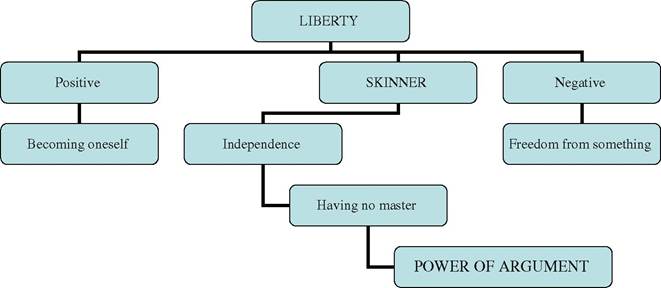
Independence in the diagram is exactly independence from the power of others, which is the key to social activity without masters.
On the negative liberty side, freedom from something may signify the absence of a physical, mental, social or legal constraint. Using force is one example of a factor limiting or prohibiting physical freedom. A mental constraint has often been characterised as being unable to do certain things: for what may be mental reasons, a person does not dare to act in a certain way. The social factor may be a social pressure formed by the environment and guiding human behaviour. The legal constraint is formed by orders and prohibitions, sometimes also by constitutive norms like planning regulations in the field of construction.In an Aristotelian way, Georg Henrik von Wright has connected one important type of constraint to human abilities (and skills). These are not mental in an endogenous manner, but learned, whereas the lack of skills or abilities forms a constituent factor of negative liberty.
In what follows, negative liberty is not essential. As was referred to before, positive liberty and, especially, the Skinnerian third form of liberty is the most significant factor woven into the themes of this book. As a matter of fact, it provides one of the philosophical grounds - from the viewpoint of the classical concept of liberty - to my legal philosophical approach. In this very sense, Skinner's third form of liberty provides a passage to the core of legal thought and DSL.