The Structure of External Justification
Let us now return to the external justification in a more detailed way. The major premise of a syllogism is always open to the question: Why was this premise chosen? The internal justification has no answer to this.
One has to go “outside” the original syllogism and provide reasons for the premises themselves. In the course of this procedure, the syllogism is reformulated, having the contested premise as its conclusion.This step opens a new internal justification, which is on the meta-level - that is, external to the original internal justification. If the meta-level justification is not sufficient, the external justification has to be carried on by formulating a third level syllogism, and so on. The procedure goes on until the chain of syllogisms takes an acceptable form.
The reasoning is not fully deductive, even though the conclusion is deduced from the original premises by a net of (new) syllogisms. However, the logic alone does not determine the meta-level premises used to support the questionable lower premise. As Peczenik said, a “jump” is needed to bridge the move from the net of premises to the final conclusion. The selection of the “next step” arguments results from a practical discourse based on different kinds of materials called the sources of law.
In DSL, the major premise normally refers to the text of a given article, L, such as chapter 23, section 8 of the Inheritance Code. The minor premise gives information about legislative history or precedents, or about some other sources of law. For instance, the minor premise tells us that, according to the legislative history, the meaning content of the major premise is L1. The conclusion is the interpretation:
Ti: The article L has to be given an interpretation L1.
If, for some reason, this conclusion is not satisfactory, the chain of syllogisms branches out into a “syllogism tree”, having as its branches different sources of law which, in order to support the interpretation, point in the same direction.
What is important is that there cannot be any logical relationship between the different branches. The argument x in no way follows logically from y or vice versa. The arguments merely support the original syllogism. They form a kind of puzzle, the entire shape of which decides whether the arguments are adequate or not.The decisive character of the “syllogism tree” is the coherence of the arguments, not solely their internal logic. For example, the reasons can take the form of a scheme, presented below, in which every syllogism (S) supporting the interpretation Ti constitutes one loop:
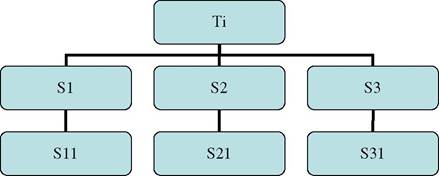
The interpretation Ti can be strengthened with the syllogism chain S1—S11 and/or the chain S2-S21 and/or the chain S3-S31. Chains can be added or carried on but the decisive matter is always that the syllogism closer to the interpretation can be inferred from a syllogism on the next level.
From a procedural point of view, the external justification is a dialogue, in which, for instance, the person A is the interpreter and B the party to whom the interpretation is presented. Chaim Perelman called B the audience. Using this idea, the structure of the interpretative procedure can be specified as follows: When A presents B with the interpretation Ti, and B contests Ti, A needs to provide further reasons S1 and/or S2 and/or S3. Thus a dialogue is born, the starting point being the disagreement between A and B on the content of interpretation.
The disagreement can be either linguistic or factual, or both (Victor 1977, 109). Linguistic disagreement is at hand when A and B use the same linguistic expression as regards different objects or different expressions in reference to the same object. Factual disagreement prevails when the parties - regardless of the terms they use - have adopted a different conception of the facts referred to by the language they use. The disagreement can also be apparent or actual.
In the case of apparent disagreement, there is no need to carry on the argumentation. It is enough to make the use of language “technically” uniform or to reveal the disagreement. In the latter case, the parties may preserve their differing language-games, but this difference is not essential for factual unanimity.Factual disagreement may derive from several different matters. In this chapter I will not analyse in detail the general disagreement with propositions, and the yardsticks needed for the comparison between them. This has been done thoroughly by Svein Eng (Eng 2003, 28). Here, only such a dimension of this problem as is necessary for the understanding of rational (legal) discourse will be analysed. First of all, the disagreement may be either theoretical or atheoretical (Victor 1977, 21). To generalise, theoretical disagreement takes place when there are differences between the cognitive systems adopted by A and B. Atheoretical disagreement, on the other hand, is based on different value-codes. Due to the different value-codes, the parties have different goals as well.
Theoretical disagreement can take two forms as well. First, A and B may have a different conception of the state of affairs prevailing in reality. This could be called factual difference. It occurs, for instance, when A and B disagree on the statistics of societal data. As regards the theoretical disagreement, A and B have adopted a different theoretical conception of the world. They have different theories for how nature and/or society are structured, or give different interpretations for a specific theory. As an example, there could be disagreement on whether a given society is a democracy or not. If A and B share the same information about the societal facts, and they still have different view, their disagreement results from different theories on what democracy is.
The theoretical differences derive from the nature of the so-called theoretical terms and their status in human knowledge.
The problem is probably even more typical in the social sciences than it is in the natural sciences. The difficulties may concern the question of whether our theoretical conceptions of society are “purely” theoretical, or at least partially bound up with evaluations or, in a wider sense, with ideological elements. In this context, these problems will be ignored.If the alternative meaning content of the statute is marked with the symbol Ml and the other possible alternative with M2, the dialogue is a kind of stepped procedure: arguments and counter-arguments alternate, demands for conceptual specification are made, reasons are provided for grounds, etc. The counter-arguments for alternative M2 presented by the addressee may in some cases be pro-arguments for the other interpretation, Ml. In this case, the setting for the interpretation is reversed, as stated above. What supports alternative Ml speaks against alternative M2.
Arguments also have a different role as regards the strength of the reasoning. Some reasons give direct confirmation for Ml, others only indirect support for it. Their purpose is only to strengthen a specific part of the argumentative chain.
The form of a chain can also be different according to the situation. There is no one shared structure for all, that is covered by the term “argumentation”, even though the initial presumptions have been limited certain types of language-games in the problems discussed above. Thus it may be seen that the reasons provided, even in accordance with these boundaries, are a totality of complex and multiform family-resembling language-games.