The Supreme Court Cases (2000-2009)
The parties' court preferences are a relevant issue to this research, as they indicate the preferences of Muslims to have their cases decided either according to adat law or Islamic law.
In Central Java, 21 cases were resolved in the civil court and three in the Islamic court. In East Java, 27 cases were decided by the civil court as compared with six cases in the Islamic court. In South Sulawesi, the numbers were closer, with seven cases settled in the Islamic court and four cases in the civil court.In West Sumatra where the majority of the population is Muslim, all 10 cases of inheritance were settled in the civil court. This is related to the matrilineal kinship system that they follow and their preference for the application of adat law, which is enforced through the civil court (Benda- Beckmann and Benda-Beckmann 2009; 2013). The same is found for Muslims in Aceh4 and South Kalimantan (Bowen 2003). Regarding the choice of court in settling the case, whether it be the civil court or the religious court, can be seen in Figure ι below.
Figure 1 The Choices of Court
| No | Area | R | c |
| 1 | Bali (Central Indonesia), Nusa Tenggara & Moluccas (East Indonesia) | 9 | 2 |
| 2 | DKI Jakarta | 2 | 2 |
| 3 | West Java, including Banten | 8 | 3 |
| 4 | Central Java | 3 | 21 |
| 5 | East Java | 6 | 27 |
| 6 | Kalimantan | 5 | 0 |
| 7 | Nangro Aceh Darussalam | 10 | 0 |
| 8 | Central Sulawesi & North Sulawesi | 1 | 2 |
| 9 | South Sulawesi | 7 | 4 |
| 10 | West Sumatra | 0 | 10 |
| 11 | North Sumatra | 5 | 4 |
| 12 | South Sumatra | 4 | 1 |
| Total | 60 | 76 |
Source: The Supreme Court Register on Inheritance Cases (2000-2009)
The data above is analysed from the data of 136 inheritance cases among Muslims.
The total number of cases was 169, with 33 cases concerning Christians or other religious groups.The First Instance Islamic Court
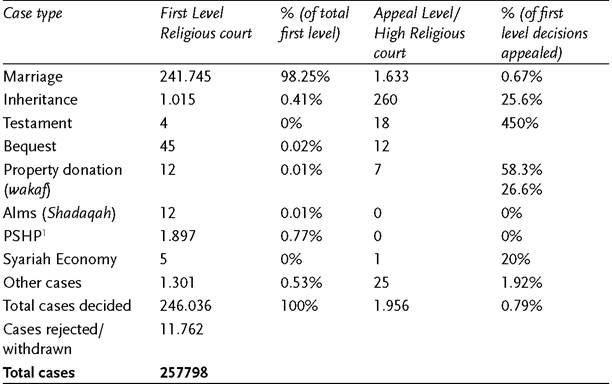
There are 343 first instance Islamic courts5 and 29 Islamic appellate courts across Indonesia6. Figure 2 indicates cases decided by the Islamic courts in 2009 at both first instance and appellate levels.7
Figure 2 Cases Decided by the Religious Courts in 2009
Source: Sumner (2010)
1 P3HP (Permohonan Pertolongan Pembagian Harta Peninggalan - Request for Division of the Estates).
Only 0.41% of inheritance cases were heard in the Islamic court of first instance, compared with divorce cases, which comprised the remaining 98.25%. Of these inheritance cases, 26.5% were appealed. For the civil courts such data are not available.
Depok and Cianjur
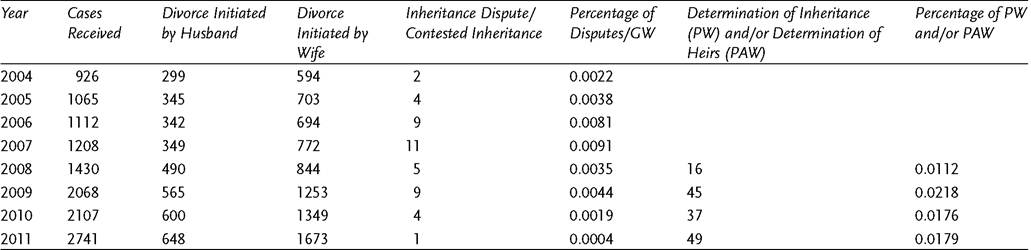
At a more micro level, the above data are supported by the data collected in the Islamic courts in Depok and Cianjur. Generally speaking, inheritance cases were only taken to the court as the last resort. In Depok, only five to ten percent of all cases were brought to the Islamic court between 2004 and 2011 (see Table ι below). Whilst in Cianjur, inheritance cases brought to the Islamic court numbered only four in 2008, consisting of one inheritance dispute and three bequest cases. In 2009, only one inheritance dispute was settled in the Islamic court (Irianto and Bedner 2016).
Field data gathered from women in Kukusan village may explain why only very few cases were filed before the court. They preferred to resolve the matters in family deliberation, usually led by a male. This would usually be the father or a brother. The mother would only be in charge if the father had died. Filing a case before the court means an embarrassment to the family, or the value of inheritance is so small that
Table 1 Number of Cases of Divorce and Inheritance as well as the Percentage of Inheritance Cases in Depok Religious Courtfrom 2004 to 2011
Sources: Monthly and Annual Reports on Cases Received by the Depok Islamic Court between 2004-2011
IRIANTO
it only requires a simple settlement.
According to women we interviewed in Cianjur, the determination and settlement of inheritance cases is mostly done by the local ulama.Although each of the regions is a buffer for a big city—Depok is a buffer for Jakarta and Cianjur is a buffer for Bandung—and the majority of the population is Muslim, inheritance disputes in the two regions are settled in a different manner. Depok is populated by heterogeneous, multi-ethnic residents due to the presence of various universities, which has promoted an urban economy. Whereas in Cianjur, the role of ulama is very prominent, because the residents are relatively homogenous (Sundanese), and the paternalistic characteristic of the society is still very strong.
Both in Depok and Cianjur, a number of judges in the Islamic Court acted beyond all legal references when they discussed inheritance matters outside the court. Some judges favoured an equal inheritance share for their own daughters and sons in the family. As a religious authority in the neighbourhood, a judge may settle inheritance disputes outside the court when asked by relatives or friends to help with the settlement of their cases. Islamic law, including the law concerning inheritance, is practised diversely in different contexts in at least in 12 countries, including Indonesia (Otto 2010).
In resolving disputes in the courtroom, judges would encourage the parties to engage in mediation rather than taking the battle into the trial. They usually persuaded parties by raising the word “embarrassed” (malu), “maintaining the family honour,” or “to allow the deceased to rest in peace.” Apparently, in the practice of law, sociological considerations, such as the social situation of those involved were taken into account by the judges. Although adherence to Shariah is considered normatively required, in practice, they take into consideration local ideas about social justice.