WHEN THE PRESS Council was disbanded in 1990 and succeeded by the Press Complaints Commission, there was a strong plea that the new body should set about establishing a code of future adjudication on privacy;
the plea repeated a recommendation in the report of the Younger Committee1 in 1972 that the Press Council should give rather readier guidance to busy practising journalists, and the interested public, and that this should be kept up-to-date.
Neither the Press Council nor the now defunct Press Complaints Commission responded in any jurisprudential sense (if at all) to the plea for codification on privacy; there was a public need for the latter to garner its own adjudications over the last 20 years, but it failed to present any form of adequately reasoned adjudications. It is vital that the new regulatory body for the newspaper industry, the Independent Press Standards Organisation (IPSO), which is to be the new regulator under the monitoring of the Royal Charter, should heed these recommendations, if only because it is vital that the new defence of ‘public interest’ in section 4 of the Defamation Act 2013 should be replicated as a likely form of defence to a claim for breach of confidentiality, as exemplified in privacy claims. Privacy itself should be expounded by an extension (which the Americans describe as the ‘zone of privacy’) which hopefully will be emulated by IPSO, which began on 15 September 2014 with Sir Alan Moses, an eminent retired Court of Appeal judge, as chairman. The courts have developed their case-law on the law dealing with breaches of confidentiality, but it is that breach of law alongside the common law that safeguards the individual’s right to his private life and family.[235] [236]Two departmental committees, two decades apart, focused on the persistent and unresolved problem of reconciling press freedom with press responsibility, particularly as regards invasion of privacy. Responding to the Fourth Report of the National Heritage Committee on Privacy and Media Intrusion, the Lord Chancellor’s Department and the Scottish Office sent out a consultation paper, Infringement of Privacy, on 30 July 1993, proposing the creation of a civil remedy against whoever infringes an individual’s privacy.
The consultation paper envisaged a Press Ombudsman, established by the press (and hence non- statutory), to deal with complaints from the public about press conduct, as a quicker and less formal remedy than court proceedings in privacy cases involving the press. An Ombudsman scheme, which ‘would probably not be obliged to follow the procedures built up under a new law’ would exist alongside the statutory remedy, as a complement to it. How should the non-statutory remedy develop, having regard to the past experience of the Press Council and its successor body, the Press Complaints Commission?The call by the Younger Committee for codification and a developed body of case law fell on deaf ears, until the scare of legislative intervention in 1989 and the report in June 1990 of Calcutt Mark I propelled the newspaper industry to set up the Press Complaints Commission, equipped with an industry-drafted code - including an article on privacy - which the Commission was charged to interpret and apply. In spite of long-standing concerns about invasion of privacy, neither the Press Council’s uncodified corpus of decisions over the 37 years of its existence (1953-90), nor the attempts of the Press Complaints Commission over the 24 years that followed have adequately addressed the problem. Comprehensive and coherent guidelines about the boundaries of the private arena of individual lives, which the press must not invade, by journalistic investigation or editorial publication, have yet to be established. Since a law of privacy is still not statutorily contemplated, and the recent jurisprudence of the courts is sparse, any non-statutory development of the principles applicable to protection of private lives from press intrusion must be welcome.
It was not until 1976 that the Press Council bowed to pressure and did at least issue a declaration of principle regarding privacy. Even then, the standard articulated was a vague one, and subsequent adjudications have done little or nothing to clarify the line over which the press should not step.
The perceived failings of the Press Council generally, and in the invasion of privacy context specifically, were undoubtedly a factor that discredited it in the eyes of the public and led to its disbandment and replacement by a new body charged with adjudicating complaints under a Code of Practice framed exclusively by the industry. The decisions of the Press Complaints Commission on privacy deserved close attention and evaluation, but only as a pointer to future development. They have done little or nothing to enlighten the reader of adjudications.It may help the reader of this essay to see the relevant article of the Press Industry’s Code of Practice (and any successor code by the new regulator) on privacy as set alongside the suggested article in both Calcutt Mark I and the proposed code of practice in the report of the National Heritage Committee, and the prospective new Code of Conduct that will be annexed next year to IPSO:
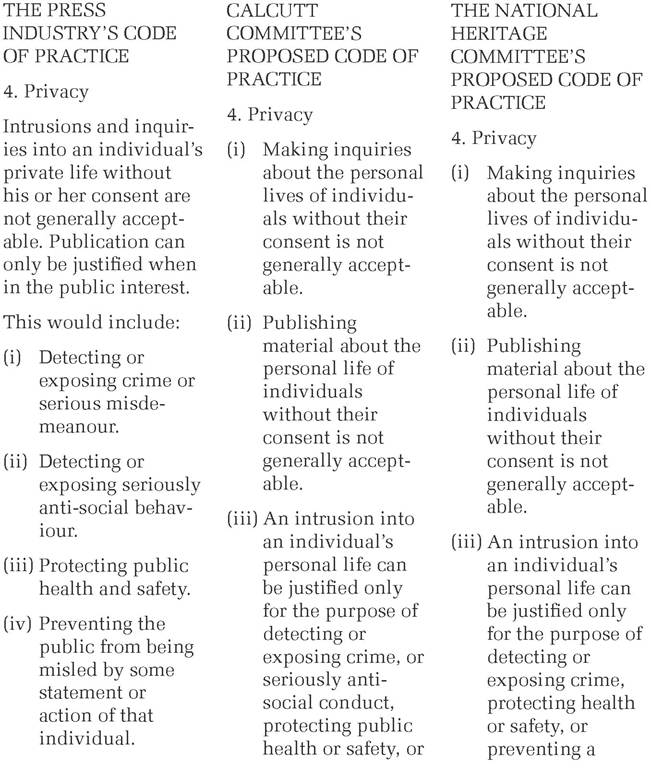
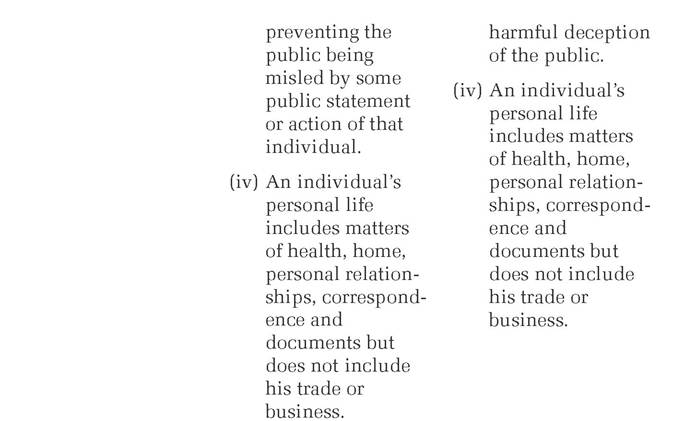
While relatively few complaints have been brought under clause 4 of the PCC’s code, several of the privacy adjudications have been among the highest profile matters considered by the Commission. The relative rarity of invasion of privacy adjudications in the early years makes it difficult to analyse the Commission’s privacy jurisprudence in a systematic way. Difficulty in discerning privacy principles from the adjudications is exacerbated by the Commission’s failure to draft them with any sense of juridical purpose - that is, to identify essential issues arising from a complaint and then to apply the rule of the relevant Code article to determine the proper result. The difficulty was further compounded by the fact that adjudications were not issued separately but were included in a monthly bulletin, while the short statement of the reasoning for decisions presented further difficulty to the jurist or the intelligent reader.
A number of other adjudications could properly be considered as privacy cases, although clause 4 was not cited. The utility of a case law on privacy has been disappointingly sparse, if not almost absent.Consider however this early attempt, the Clare Short matter. Because the complaint dealt with a number of issues that arose in subsequent complaints, it might have set precedents to influence or determine the outcomes of those matters. Nothing since has elucidated the case. And the newspaper’s acceptance that it was miserably misled in its investigations of its hacking activities invalidated the ability of the Press Complaints Commission as a public regulator. (The trial of Rachel Brookes and Colin Coulson in October 2013 reveals that there were other interests than formal adjudications on privacy; indeed its focus was the criminal offence of hacking by the News of the World.)
Ms Short’s allegations of invasion of privacy arose from an investigation by a News of the World reporter and story subsequently published by that newspaper. Her complaint, enumerating a number of incidents arising from the reporter’s activity and the subsequent publication, raised both clause 1 (inaccuracy) and clause 4 (privacy) issues. In brief, the chronology of events leading to Ms Short’s complaint was that, in 1986, she had introduced a Bill in Parliament which would have curtailed publication of ‘page 3 girl’ photos, which she considers pornographic. She alleged she was subsequently the object of a ‘campaign of vilification’ by the Sun and its sister paper, the News of the World. Ms Short complained about two specific incidents where the latter had linked her, in quite a misleading fashion, to pornography. The Commission upheld her complaint in this regard, albeit on unspecified grounds, noting the ‘inescapable suspicion’ that the paper engaged in these objectionable activities with a purpose to embarrass Ms Short in retaliation for her anti-pornography stance. It is unclear whether this reprehensible motive carried over, and was relevant to other activities about which Ms Short complained.
In late 1990, Ms Short had received several reports indicating that she was being investigated by a News of the World reporter. The reporter had first contacted her former husband, asking him for a photo showing Ms Short topless or in a nightgown. The reporter’s knowledge that the former husband was mentally unstable and had previously threatened Ms Short was undisputed. Secondly, the reporter had investigated Ms Short’s friendship, during the early 1970s, with John Daniel, a man who had been convicted of various criminal offences prior to that friendship. Several years after the end of his relationship with Ms Short, Daniel had been the victim of a murder for which no one had ever been charged. Early in 1991, convinced that the News of the World was about to publish a story related to these investigations, Ms Short gave a speech in the House of Commons outlining these investigations into her private life and attacking the publication and its staff. The material about which she had spoken was published by the News of the World a few days later.
Ms Short’s complaint was considered under clauses 1 and 4 of the Code of Practice. The invasion of privacy claims may have related only to the investigation, and the inaccuracy claims may have related only to the publication. This is logical, given the manner in which Ms Short presented her case. After all, any information that was ‘private’ was first published by her House of Commons speech which attacked the investigative tactics used by the News of the World reporter. Accordingly, she would have waived any right to complain of invasion of privacy over its subsequent publication in the newspaper. A complaint that the newspaper report contained inaccuracies and misrepresentations was, however, appropriate.
One issue on which the Commission correctly focused, as a determinative element of the adjudication, was Ms Short’s status as a public figure - at least inasmuch as that brought the matter within the purview of ‘public interest’ (statutorily to be a defence to a defamation action).
As both Ms Short and the News of the World accepted, the paper was justified in inquiring into aspects of a public figure’s private life on the assumption that information discovered might be in the public interest. Still, the Commission held that such inquiries could not justify publication of the information unless the facts discovered in the course of the investigation satisfied the ‘public interest’ test of clause 4 of the editors’ Code. Commenting on the meaning of ‘public interest’, the Commission stated that it is not merely ‘whatever happens to interest the public’. The adjudication expressly recognised that ‘circumstances in the private life of [an MP] may bear on her conduct of that office or fitness for it’, but it never concluded whether the test was satisfied on the known facts. The Commission simply noted that the News of the World had not sought to ‘suggest that information it possessed... would have justified an article about her which was in the public interest’, implying that both parties agreed there was none on the facts revealed by the investigation. At no point was any specific part of clause 4’s four- prong public interest test discussed, leading one to wonder whether the Commission considered the codified test at all.Rather than concluding its inquiry with this finding, that ‘public interest’ could not justify publication of the offending statements, the Commission in its adjudication considered several other matters, stating some informative dicta, but also making several comments that served only to obscure the issues on which the decision turned - or at least should have turned. Among its more positive contributions, the Commission noted that passage of time does not necessarily diminish the relevance of justification for publishing material that otherwise meets the ‘public interest’ test. As with many American courts’ handling of suits for publication of private facts, the Commission was also sensitive to the investigative, newsgathering techniques employed by the News of the World journalist. The Commission considered the reporter’s knowledge of the former husband’s psychiatric condition particularly damning, calling the journalist’s behaviour ‘indefensible’. It upheld Ms Short’s complaint ‘in this respect’, a statement which is somewhat confusing by its implication that an independent basis for complaint arises from the investigative technique of the journalist. If the Commission considered this activity independently to give rise to a privacy complaint, it should have been explicit about that finding. Generally, under the common law of most American states, for example, deceptive or otherwise offensive newsgathering techniques do not independently give rise to a cause of action, unless they rise to the level of ‘intrusion upon seclusion’ - as literally into one’s home. The method of obtaining information is relevant as a potentially aggravating factor, but it is not generally the subject of ultimate inquiry.
The Commission appeared to attribute more import to the investigative process. This is consistent in some ways with the Calcutt Mark I’s recommendation that certain forms of physical intrusion should be criminal offences in England and Wales. Ms Short’s physical privacy, however, was not invaded in any of the ways enumerated in Calcutt Mark I’s recommendation, so it is surprising that the adjudication did not specifically refer to the Calcutt proposal. What the Commission ought to have recognised - and probably sought to in the Clare Short adjudication - is that one’s privacy may be invaded in the investigative phase leading to an anticipated publication, not only by the publication itself. This can mean psychic or emotional privacy, not only physical privacy. Thus, Ms Short’s privacy was invaded by the ‘[i]ntrusions and inquiries into [her] private life’ - to quote the code language. The Commission considered inquiries into her relationship with John Daniel to be justified in the public interest, while inquiries made to her former husband, seeking a salacious photo of the MP, were not. None of the information disclosed as a result of either inquiry, however, achieved the level of public interest that would have justified its publication.
Under the laws of most American state jurisdictions, this is certainly the case. The motive of the publisher/defendant is simply not discussed. The only instance in which it is arguably relevant is when a public official or public figure is the complainant. In those cases, the rule of New York Times[237] and its progeny, which establish different standards of intent for those allegedly defaming different types of defamation plaintiffs, also apply to public official and public figure plaintiffs bringing invasion of privacy actions. The level of culpability which public figure/official defamation plaintiffs must prove is ‘actual malice’, further defined as ‘knowledge of falsity’ or publication ‘with reckless disregard as to truth or falsity’ of the statement.
In the 1967 case of Time, Inc v Hill,[238] the US Supreme Court held that the First Amendment precluded application of a New York privacy statute to redress reports of matters of public interest, even if they depicted the plaintiffs in a ‘false light’, absent proof that the defendant had published the report with ‘knowledge of its falsity or in reckless disregard of the truth’. However, the actual malice standard defined in New York Times does not transfer comfortably or sensibly into any privacy context except the false light one. This is because ‘knowledge of falsity’ or ‘reckless disregard’ as to truth or falsity is irrelevant to ‘private facts’ cases, in which ‘privacy’, not ‘falsity’ is the key inquiry. American courts have exhibited some confusion as to how this standard should be applied in privacy cases. Some have roughly translated actual malice as knowledge that a publication would constitute an invasion of privacy or reckless disregard as to whether it would or not. Most courts have determined that the standard applies only to false light cases.
Thus, a US legal analysis of the Short complaint might have found the publisher’s bad motive relevant, but it is unlikely because her allegations would be considered publication of private facts, rather than a false light type of invasion of privacy, the latter being generally necessary to trigger an ‘actual malice’ analysis.
The adjudication discussed at length the motives of both Ms Short and the News of the World. This may be because each party sought to focus on the reprehensible motive of the other. As previously noted, Ms Short alleged that the News of the World was pursuing a long-standing vendetta against her over her political crusade to ban ‘page 3 girls’ - and who could blame her now, regarding their hacking activities, televisually revealed in the Leveson Inquiry? The Commission gave credence to the relevance of this motive by acknowledging the ‘inescapable suspicion’ that the newspaper had sought to embarrass Ms Short in retaliation for her political stance on pornography. Motive should not necessarily be an issue with regard to invasion of privacy. Either an invasion has occurred, or it has not. The motive of the publishers is of no moment. Generally, a complainant’s behaviour is relevant only insofar as he or she may have waived any right to action, because of previous publication of the sensitive information, or because he or she may otherwise have consented to the disclosure. With the Short complaint, the Commission apparently considered her behaviour relevant because the News of the World claimed that Ms Short’s speech in the House of Commons in January 1991 had provoked it to publish the objectionable story. During her parliamentary speech, Ms Short strongly condemned the behaviour of the paper and its staff, including that of editor Ms Patricia Chapman, who coincidentally was the chairperson of the committee that drafted the industry’s Code of Practice and who, from its inception, was a member of the Press Complaints Commission. Ms Short said she made the speech in the expectation that publication of a News of the World article was imminent. The News of the World editor resisted Ms Short’s complaint, in part by claiming that it had not decided to publish a story based on its investigations until Ms Short made her speech in the House of Commons, after which the editor claimed that an article and editorial were the ‘only effective way’ to answer Ms Short’s allegations and to correct her alleged inaccuracies. The Commission was sympathetic to this justification, but on the whole accorded far too much attention, and therefore implicitly assigned far too much importance to the motive issues.
The Press Complaints Commission appears never to have been quite able to sort through the complexity of Clare Short’s complaint, and it stumbled several times because of its lack of understanding about how a privacy analysis might best proceed. For example, the initial inquiry might logically have been whether any invasion of privacy had occurred. Clause 4 asserts the basic unacceptability of ‘intrusions and inquiries into an individual’s private life’. But what does ‘private life’ mean? Does it include a person’s home or private business address? Information about a person’s sexual practices? About a family member’s drug problem? The Commission did not, in the Short adjudication, and has not in handling any subsequent complaint, dealt with the meaning of ‘privacy’ or ‘private life’ as a term of art representing a concept on which a complaint may be based. Beyond this threshold issue, the Commission should have determined whether there has been an ‘intrusion’ or ‘inquiry’ into, or ‘publication’ relating to, this private sphere. If the answer is ‘yes’ the defences of ‘consent’ and ‘public interest’ become relevant.
The Short adjudication represents an early unsatisfactory adjudication of the Press Complaints Commission. This was not necessarily because it got the result wrong. Rather, it was because it did not proceed with such step-by-step analysis. Accordingly, very few free-standing principles about privacy can be garnered from it. The adjudication, in its construction and language, lacked a sense of juridical purpose. The Commission seemed to focus only on making a decision about a matter at hand; it was seemingly oblivious to any implications it might have for subsequent cases, and so unhappily it has been. It was similarly oblivious to its obligations to interpret in a meaningful way the Code of Practice, and to provide guidelines of acceptable press behaviour for both the media and the public. Its failure to expand the ambit of clause 4 was no doubt in part responsible for its demise. (The fact that until the last years of its existence no lawyer was a member of the Press Complaints Commission indicated the lack of legality of the Code.) Can IPSO do better?