Chapter 11 Appendix III: Comments from the Department of Agriculture
United States Government Accountability Office
Note: GAO comments supplementing those in the report text appear at the end of this appendix.
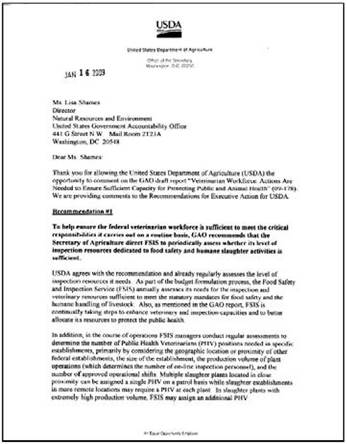
See comment 1.
See comment 2.
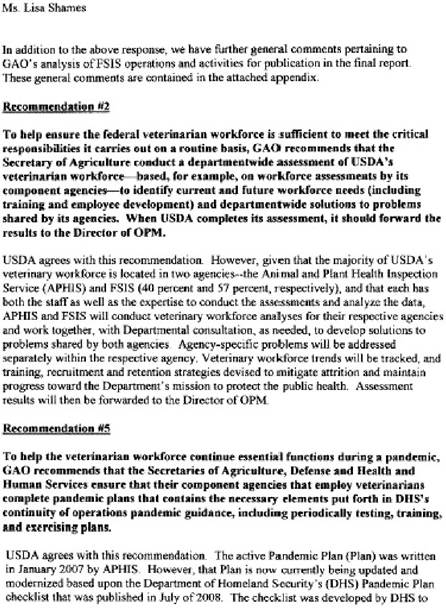
See comment 3.
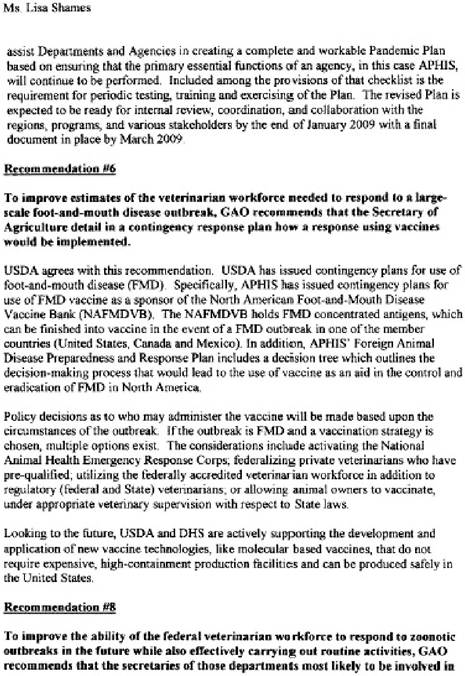
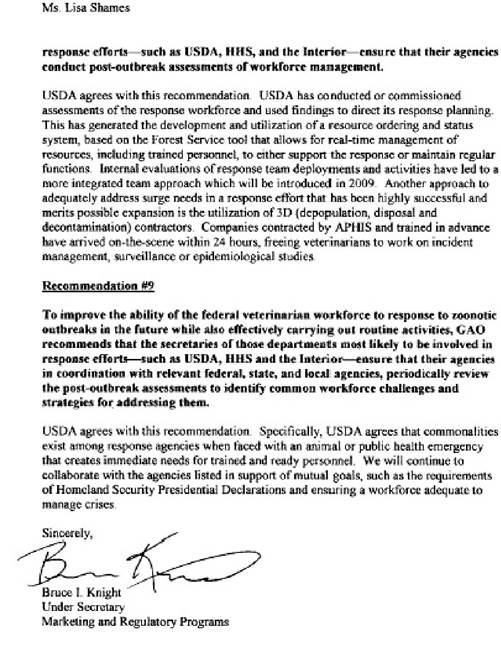
The following are GAO’s comments on the Department of Agriculture’s letter dated January 16, 2009.
GAO Comments
1. USDA commented that FSIS already regularly assesses the level of inspection resources it needs, as we recommended in 2004. However, as our report states, FSIS has yet to demonstrate that they have done so. We regularly follow up to request evidence that agencies have implemented our recommendations, and FSIS has not provided such evidence.
2. USDA reported the majority of its veterinarian workforce is located within two agencies, APHIS and FSIS, and each has the staff and expertise to conduct veterinarian workforce analyses for their respective agencies. Therefore, these two agencies will work together, with departmental consultation, as needed, to develop solutions to problems shared by both agencies.
We continue to believe that a departmental assessment, not a consultation, is necessary, particularly in light of the competition between the two agencies. As we reported, APHIS is attracting veterinarians away from FSIS because the work at APHIS is more appealing, there are more opportunities for advancement, and the salaries are higher. Furthermore, ARS continues to experience difficulties recruiting and retaining highly qualified veterinarians to carry out critical research of national importance, yet there is no mention of ARS in USDA's comments.3. USDA commented that it has contingency plans and a decision tree for use of foot-and-mouth disease vaccine from the North American Foot-and-Mouth Disease Vaccine Bank. We acknowledge that USDA has these plans. In fact, we reviewed a draft plan titled, Response to the Detection of Foot-and-Mouth Disease in the United States, dated October 2007, that USDA officials told us was their new response plan that considered alternative response strategies, including “vaccinate to live.” However, this plan does not detail how a policy of this nature would be implemented. USDA further commented that policy decisions as to who may administer the vaccine will be made based on the circumstances of the outbreak. While we recognize that each outbreak is unique, this should not preclude USDA from identifying a plausible scenario or scenarios and detailing how a vaccinate to live strategy would be carried out in order to enhance preparation, response, and recovery in a time of crises.
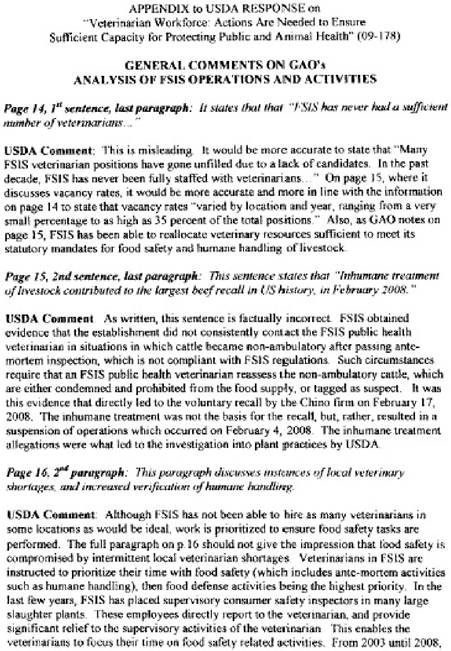
4. We modified our report to reflect that USDA would like to change their statement from FSIS has “never” had a sufficient number of veterinarians to “over the past decade.” USDA also asserts that our report says that FSIS has been able to reallocate veterinary resources sufficient to meet its statutory mandates for food safety and humane handling of livestock. However, our report only presents this as the view of FSIS headquarters officials.
We raise this point to illustrate that FSIS headquarters officials and veterinarians working in slaughter plants differ on the impact of this shortage.5. We modified our report to reflect more clearly the relationship between the events at a Chino, California, plant and the February 2008 beef recall.
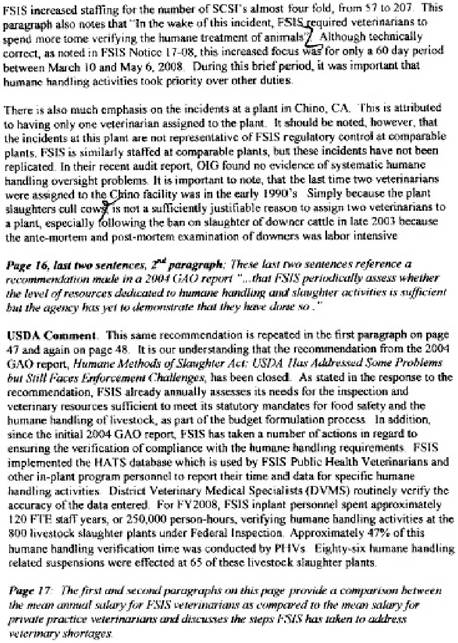
6. USDA commented that that our report emphasizes the incident at a plant in Chino, California. We raise the point because some veterinarians told us they did not have time to ensure the humane treatment of livestock, and this example illustrates inhumane treatment occurred despite the presence of FSIS inspectors. USDA further commented that we attribute this incident to having only one veterinarian. We do not state this in our report. We use this and other statements about resources to illustrate the need for FSIS to periodically assess whether the level of resources dedicated to humane handling and slaughter activities is sufficient. They have yet to do so. In addition, USDA commented that the USDA Inspector General did not find systematic problems associated with oversight of humane handling at slaughter facilities that process cull cows. However, the Inspector General did conclude that there is inherent vulnerability at the other plants in the scope of its audit, and that inhumane handling could occur and not be detected by FSIS inspectors due to lack of continuous surveillance.
7. USDA commented that GAO has closed the 2004 recommendation that FSIS periodically assess whether the level of resources dedicated to humane handling and slaughter activities is sufficient. We recognize that FSIS has taken actions in response to a number of recommendations made in the 2004 report and have documented implementation of these recommendations. However, with regard to periodic assessment, we closed this recommendation because enough time had passed that we considered it unlikely to be implemented. As our report states, FSIS has yet to demonstrate that it has been implemented. Based on our current work, we continue to believe that periodic assessment is needed, and we make a recommendation to that effect.
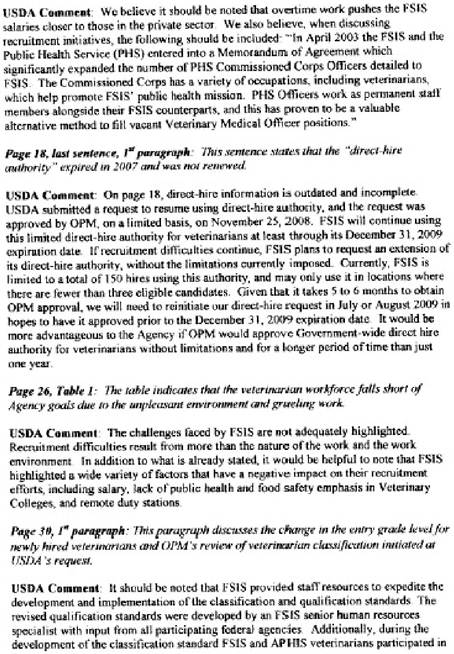
8. We modified our report to include the recent approval of USDA's direct-hire authority and noted that USDA has raised some concerns.
9. We modified our report to include the concern about veterinary schools and enhanced the chart to include the concern for salary.