Dicrocoelium dendriticum (lancet fluke)
CAUSATIVE AGENT (CLASSIFICATION, morphology) Dicrocoelium dendriticum is a medium to small liver fluke, 5 to 15 mm long and about 2 mm wide, of the Family Dicro- coelidae, Order Plagiorchiformes (App.
1: Table 3) (Davis and Libke 1971). Genetic variability among adult flukes can be high, even within a given study site (Manga-Gonzalez and Gonzalez-Lanza 2005). At least two other species, D. hospes (Romig et al. 1980) and D. rileyi (Martin 1976), have been reported.host range and distribution Dicro- coelium dendriticum occurs in the bile ducts of a wide range of domestic and wild mammals, including cattle, sheep, goats, pigs, cats, donkeys, cervids, rodents, lagomorphs, and primates, including humans (Mapes 1951, Huffman et al. 1997, Chowdhury and Aguirre 2001). It has a broad Palearctic occurrence, including Europe, northern Asia, northern Africa, Turkestan, parts of the Far East, including Japan, and less commonly in North America (Davis and Libke 1971, Chowdhury and Aguirre 2001, Shimalov and Shimalov 2003).
Its presence in North America may have resulted from an introduction from the Palearctic region (Mapes 1951), and the population in North America appears to still be expanding. Recent increases in prevalence and intensity were reported among elk (Cer- vus elaphus) of southeastern Alberta, Canada, where it is circulating among other sympatric ungulates, including beef cattle (Groater and Colwell 2007).
life cycles and variations The adult inhabits the bile ducts of the liver, as well as pancreas and gall bladders of its definitive hosts (Pybus 2001). The life cycle requires a terrestrial snail as the first intermediate host and an ant as the second intermediate host (Fig. 4.7); this life cycle is an excellent example of how a parasite has adapted its biology to enhance transmission to intermediate and definitive hosts (Otranto and Traversa 2003), and may reflect a long association between these flukes and their ant intermediate hosts (Carney 1969).
The eggs pass out the feces, but the miracidium does not hatch from the egg until ingested by a snail. In the snail, the miracidium migrates to the snail hepatopancreas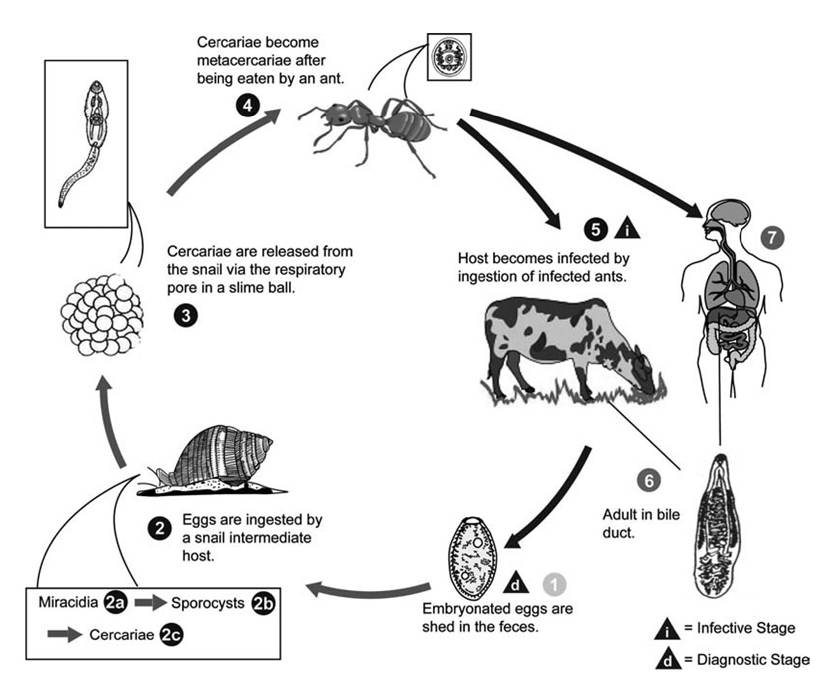
FIGURE 4.7 Life cycle of Dicrocodium dendriticum (Courtesy of Centers for Disease Control and Prevention’s Division of Parasitic Diseases and Malaria, www.dpd.cdc.gov/dpdx).
and gives rise to both mother and daughter sporocysts; no rediae are produced in this life cycle (Otranto and Traversa 2003). The sporocysts produce cercariae, which migrate to the respiratory chambers of the snail and are enveloped in mucilaginous slime balls and extruded from the snail. Ants of the genus Formica ingest these slime balls and the cercariae encyst, and form infective metacercariae in the hemocoel.
Once ingested, the metacercariae excyst in the gut of the definitive host, and the young flukes migrate directly up to the biliary duct system of the liver without penetrating the gut wall, liver capsule, or liver parenchyma; in the bile duct they mature into adult trematodes (Otranto and Traversa 2002). After reproduction by hermaphroditism or cross-fertilization, adults of D. dendriticum release eggs again into the environment through their host feces following a prepatent period of about 2 months (Otranto and Traversa 2003).
RESERVOIRS AND TRANSMISSION Unlike most other flukes, the intermediate hosts of Dicrocoelium do not require an aquatic environment and are widely present in pastures (Manga-Gonzalez et al. 2001). Over 90 mollusc species can serve as the first intermediate hosts of D. dendriticum, and some have a worldwide distribution (Otranto and Traversa 2002).
Several species of ants in the genus Formica can serve as second intermediate hosts (Manga-Gonzalez et al. 2001, Otranto and Traversa 2002). Among these ants, the size and numbers of metacercariae vary with ant species and are correlated to ant size; the larger the ant specimens evaluated, the greater the number of metacercariae found (Schuster 1991). While most metacercariae settle in the ant hemocoel,
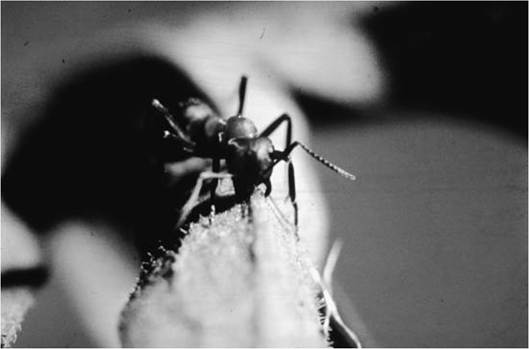
FIGURE 4.8 Ant with paralyzed mandible following D.
dendriticum infection (Courtesy of W. Frank, Universitat Hohenheim, Germany).the first cercariae ingested by the ant usually settle in the ventral part of the subesophageal ganglion (“brain”) of the ant; normally, only one settles there (Romig et al. 1980, Manga-Gonzalez et al. 2001). Metacercariae localized in the ant's subesophageal ganglion can cause a cataleptic cramp (Fig. 4.8) (Frank 1976) when the temperature falls below 24°C (Spindler et al. 1986, Manga-Gonzalez and Gonzalez-Lanza 2005). These cramps can paralyze the ants so that their mandibles remain clamped onto the tips of herbage and grass when the temperatures drop in the evening, and grazing ruminants can easily ingest these ants in cooler temperatures of the evenings or early mornings (Otranto and Traversa 2003).
CLINICAL EFFECTS AND IDENTIFICATION Most clinical information is available for domestic animals. Clinical symptoms often are not manifested, even in heavy infections (Theodoridis et al. 19 91). Affected animals may experience anemia, edema, emaciation, and, in advanced cases, cirrhosis, scarring of the liver surface, and marked distension of bile ducts (Otranto and Traversa 2002). There is a direct relation between parasite intensity and lesion severity among affected animals (Jithendran and Bhat 1996).
Many infections are identified only postmortem in the definitive hosts. Adult worms are small (5-15 mm ? 2 mm) and strongly tapered at each end. Thus they are readily differentiated from other trematodes that may inhabit the liver (Pybus 2001)
Diagnosis of dicrocoeliosis also occurs by finding eggs on fecal examination (Otranto and Traversa 2002). In recent years a number of immunological methods have been developed, including immunofluorescence, passive hemagglutination, complement fixation, and ELISA tests, as well as SDS-PAGE evaluated by Western blot (See App. 2) (Jithendran et al. 1996, Otranto and Traversa 2002, Revilla-Nufn et al. 2005). Specific somatic, excretory, and secretory products of D.
dendriticum also can be detected with ELISA tests (Gonzalez-Lanza et al. 2000).A DNA probe is available for detection of D. dendriticum in ant intermediate hosts (Heussler et al. 1998). Since ants are the infective stage for grazing hosts, such a tool can be useful for epizootiological studies of dicrocoeliosis.
population effects No sites with persistent population problems have been identified for wildlife. Where acute epizootics of dicrocoe- liosis occur among domestic animals, the role of wild species as possible reservoirs should be assessed (Pybus 2001).
special problems This parasite is unusual in its capacity to cause changes in behavior and increased vulnerability of the ant intermediate hosts to predation by their definitive host. While not considered a problem to managers, it presents a fascinating evolutionary insight on the adaptive strategies of some parasites to enhance the likelihood of completing their life cycles.
control and host immunity Bile IgA may inhibit parasite adherence and penetration of the mucosal surface, as well as interfere with parasite growth, feeding, reproduction, and enzyme production (Otranto and Traversa 2002). Also, IgG to excretory-secretory and somatic antigens of D. dendriticum occur 30 days post-infection in lambs, with a peak at 60 days (Manga-Gonzalez and Gonzalez-Lanza 2005).
A variety of chemicals have been used to control this liver fluke in domestic animals (Davis and Libke 1971, Fraser and Mays 1986). Long-term control likely would involve some snail and ant control; birds have been suggested for snail control (Davis and Libke 1971). However, control likely would be difficult because of the widespread abundance of both suitable snail and ant intermediate hosts (Pybus 2001).
More on the topic Dicrocoelium dendriticum (lancet fluke):
- FASCIOLOIDES MACNA (CIANT AMERICAN LIVER FLUKE)
- Concluding Remarks
- Conclusion
- REFERENCES
- Boon Andrew. The Ethics and Conduct of Lawyers in England and Wales. Hart Publishing,1999. — 808 p., 1999
- Griffiths-Baker Janine. Serving Two Masters: Conflicts of Interest in the Modern Law Firm. Hart Publishing,2002. — 227 p., 2002
- Grisso T.. Evaluating Competencies: Forensic Assessments and Instruments. 2nd edition. — Springer,2002. — 564 p., 2002
- Luban David. Legal Ethics and Human Dignity. Cambridge University Press,2007. — 350 p., 2007
- Ayupova Z.K.. Theory of state and law: textbook. - Almaty: Kazakh University,2015. - 192 pages., 2015
- Allen Danielle, Benkler Yochai et al. (eds.). A Political Economy of Justice. The University of Chicago Press,2022. — 416 p., 2022
- Barnes Rudolph C.. Military Legitimacy: Might and Right in the New Millennium.Frank Cass,1996. — 198 p., 1996
- Bedner Adriaan (ed.).. Real Legal Certainty and its Relevance: Essays in Honor of Jan Michiel Otto. Leiden University Press,2018. — 261 p., 2018
- Fridson M., Alvarez F.. Financial Statement Analysis. John Wiley & Sons, Inc.,2002. — 413 p, 2002
- Banking, Finance, and Accounting: Concepts, Methodologies, Tools, and Applications. IGI Global,2014. — 1593 p., 2014
- Hare C., Neo D. (eds.). Trade Finance: Technology, Innovation and Documentary Credit. Oxford University Press,2021. — 417 p., 2021
- Fligstein Neil. The Banks Did It: An Anatomy of the Financial Crisis. Harvard University Press,2021. — 334 p., 2021
- Cline W.. The Right Balance for Banks. Peterson Institute for International Economics,2017. — 281 p., 2017