Flushing and Suctioning the Bulla
Probably the most important technique for treating otitis media is flushing the bulla. Topical otic medications cannot penetrate through the thick exudate that fills the middle ear during otitis media, so this exudate and secretory material must be removed.
In the bulla, many destructive enzymes that are trapped in the mucoid secretions remain in contact with the mucoperiosteum, which prolongs the disease. Hydrating the mucus with the water in flushing solutions makes it less dense and easier to suction.Using fluid under pressure to irrigate the bulla loosens mucus from the tissue. This material does not stick to the mucous membrane as cerumen sticks to the epithelium in the external ear canal.
The fluid the author uses for flushing the bulla is warmed, very dilute povidone- iodine solution in warm tap water. If there is an identifiable bacterial infection, warmed tris-EDTA is also infused into the bulla. Acidic solutions should be avoided in the middle ear to prevent pain and irritation. Using a device that delivers the fluid under high pressure allows the mucus and pus to flush out of the bulla either into the external ear canal, where it can be suctioned out, or through the auditory tube into the throat. The MedRx Earigator (MedRx, Inc., Seminole, Florida) makes flushing and suctioning the tympanic bulla a simple, efficient procedure. A 5-Fr or smaller polypropylene catheter connected to the irrigation/suction unit is placed into the 2-mm working channel built into the Video Vetscope. The entire cleaning process is observed on the video monitor. The veterinarian positions the Video Vetscope in the proper location in the horizontal canal, and the assistant manipulates the catheter under direction from the veterinarian. The catheter is advanced along the floor of the horizontal canal and is directed ventrally into the bulla (Figure 14-13). A less rigid red rubber feeding tube can be used for flushing, but it may collapse when used for suctioning.
Use of a flush/suction instrument allows small pieces of wax, mucus, pus, blood clots, and other material in the bulla to be removed quite easily without the need for an assistant to manipulate a suction syringe. Repeated infusion-suction cycles are done to ensure that the bulla is as clean as possible. Without this equipment, catheter placement and evaluation of the efficiency of cleaning are hard to determine, but that should not deter the attempt to flush the bulla.
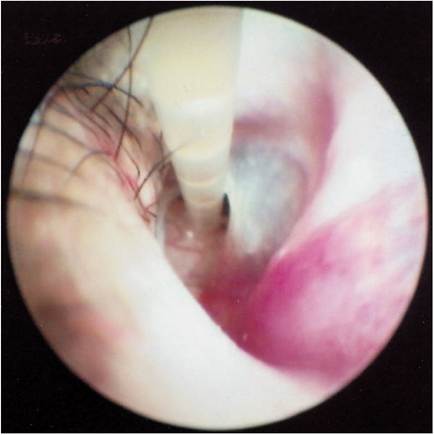
Figure 14-13
A catheter attached to a flush/suction device is used to clean and dry the tympanic bulla before infusing medication into the bulla.
A recent retrospective analysis from a major university looking at the effect of flushing the bulla on the outcome of otitis media showed that high-pressure bulla flushing resulted in an 82% resolution of otitis media.